Nassim Nicholas Taleb on Decentralization
Taleb favors decentralization because small, distributed units keep mistakes local, preserve optionality, and make systems more robust under uncertainty.
- Small, distributed systems contain errors instead of letting one mistake spread everywhere.
- Top-down control suppresses variation and often creates hidden fragility.
- Decentralization works with optionality: many small bets, many exits, no single point of ruin.
- Local scale improves accountability because decision-makers stay close to consequences.
Decentralization is Taleb's way to keep errors small
Taleb's starting point is uncertainty. Since mistakes are unavoidable, the central design question is not how to eliminate error but how to stop it from becoming ruinous. His view of decentralization is to spread mistakes across many small units so that failure stays limited and does not threaten the whole system.123
This follows directly from his definition of fragility. What is fragile is harmed by variability and disorder, especially when shocks become large. A decentralized structure is safer because it turns one big failure into many smaller failures that are easier to absorb.456
Why top-down systems become fragile
Taleb repeatedly links fragility to complexity, optimization, and centralized control. When a system is tightly managed from the top, it tends to remove slack, compress variation, and rely on a narrow plan. That can look efficient in calm periods, but it increases vulnerability to large shocks and Black Swans.789
His political point is less public versus private than large versus small. Large systems are disproportionately weakened by unexpected events, while smaller ones have a better chance of surviving because damage does not cascade as easily.1011
He also warns that trying to suppress volatility can backfire. Organisms and other living systems need stressors and variation; when control becomes excessive, apparent stability can hide deeper weakness.121314
Small units work because they preserve optionality
For Taleb, decentralization is not just about dividing power. It is also about preserving exits, reversibility, and the ability to adapt. He prefers arrangements that limit losses while leaving room for upside, which is exactly what many small experiments can do better than one grand plan.1516
That is why he is suspicious of long, rigid plans with no escape route. A sequence of shorter, adaptable moves is better than a fixed path because it can respond to changing conditions. In practice, decentralization creates more options and reduces dependence on any single forecast.1617
This same logic explains his support for trial and error. If losses are bounded, many attempts can be beneficial because learning comes from variation and adjustment rather than from abstract certainty.21819
Decentralization needs skin in the game
Taleb thinks small-scale systems work better partly because accountability is closer. When people deal with the same people repeatedly, consequences are harder to hide and bluff is harder to sustain. Locality creates pressure to own the results of decisions.2021
This is why decentralization and skin in the game fit together. Decision-makers should bear the downside of the risks they create; otherwise large institutions can privatize gains and socialize losses. Decentralization makes that transfer of harm harder because power is more distributed and effects are more visible.222311
He also rejects political systems driven by abstract narratives from the center. What matters more is whether the legal and institutional arrangement keeps responsibility attached to action.2425
How to apply Taleb's decentralization in real life
At the practical level, Taleb's advice is to build systems that can survive disorder and use it productively. That means avoiding single points of failure, keeping redundancy, and maintaining buffers such as inventory or cash so that shocks do not force bad decisions.262728
Heuristics should also be designed so that being wrong is cheap. A good rule of thumb is not one that predicts perfectly but one that keeps losses small when it fails. Decentralized decisions fit this approach because they allow local revision without systemwide disaster.292
In politics, business, and social organization, the broad lesson is to prefer many semi-independent units over one tightly controlled machine. Systems should fail early and often at a small scale, rather than appear stable until one large collapse arrives.303132
Taleb on decentralization, in his own words
“When you can't avoid having mistakes, you want them to remain small. And typically, top-down things make large mistakes. This is what my idea of decentralization is: you have to decentralize the errors by making sure they remain small and distributed. Okay? But when you're willingly making errors because they're small and because they're not of huge cost, when you're willingly, then you want—you see, then you want to make error; you want to make a lot of errors because they're not as harmful. You see, and the payoff comes from it. But remember one thing: you saw my first graph where I was showing you the…”
“Distributing the power makes make... Allows for things to work better.”
Where to watch
 Nassim Nicholas Taleb on Nation States: Why Small Units Work Better2022 · 68 min · full transcriptBest single discussion of why small political units outperform centralized nation-states on accountability and scale.
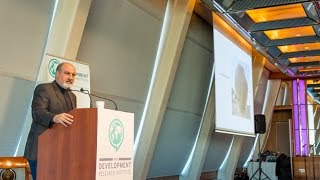 Nassim Nicholas Taleb on Fragility and City-States: Why small systems survive2021 · 62 min · full transcriptConnects decentralization to fragility, disorder, and why cities and other small systems survive.
 Nassim Nicholas Taleb on Antifragility: Stress, Optionality, and Skin in the Game2012 · 79 min · full transcriptShows how optionality, bounded downside, and antifragility support decentralized design.
 Nassim Nicholas Taleb on Uncertainty and Robustness: Why Fragile Systems Break2007 · 52 min · full transcriptExplains why complexity, optimization, and large centralized systems become fragile under uncertainty.
 Nassim Nicholas Taleb on Skin in the Game: Risk, Responsibility, and Power2017 · 85 min · full transcriptAdds the moral logic: decentralization works better when decision-makers have skin in the game.
Questions people ask
- How does Nassim Nicholas Taleb think about leverage and optimization?
- What did Nassim Nicholas Taleb say about small government and localism?
- When does Nassim Nicholas Taleb think military intervention is justified?
- Why did Nassim Nicholas Taleb say mistakes should be small and decentralized?
- Why does Nassim Nicholas Taleb favor optionality over rigid planning?
- Does Nassim Nicholas Taleb think gasoline distribution can be antifragile?
Sources
Every quote above, word for word from the transcripts. Numbers match the text.
“I have only one topic: uncertainty…”
“When you can't avoid having mistakes, you want them to remain small. And typically, top-down things make large mistakes. This is what my idea of decentralization is: you have to decentralize the errors by making sure they remain small and distributed. Okay? But when you're willingly making errors because they're small and because they're not of huge cost, when you're willingly, then you want—you see, then you want to make error; you want to make a lot of errors because they're not as harmful. You see, and the payoff comes from it. But remember one thing: you saw my first graph where I was showing you the…”
“I call it the Bob ruin problem…”
“…what doesn't like variability is fragile…”
“…fragile is what doesn't like disorder.”
“…whatever is fragile doesn't like volatility…”
“…anything that becomes complex becomes a lot more fragile to Black Swans…”
“At the same time, we had a rise of leverage. I'm not just talking about financial leverage. Financial leverage is only five times what it was in 1980, which is very dangerous, but operational leverage. People have no slack in systems. People are over optimized. Companies are very large, so it means more fragile to contingencies, and you get squeezed. Uh, let me discuss two things. Let me discuss first the notion of operational leverage or operational optimization, what I call optimization.”
“Yeah, exactly. So what happened is that there's a gross allergy for variability that grows with, uh, statism, modernity, top-down control. You see, so anything that's top-down control has that allergy for modernity, for, for, uh, for variability. So you think you want to control everything, and you start compressing variation. That sort of happens with the state. To give you an idea where the state, when I look at the area I'm from, to conclude here—uh, I come—and this is the reason I took this, but I'm not yet an expert on cities—is because I made the following discovery in, uh, in 2000, in, in about three years ago Aleppo started getting into war and...”
“A small government works better, not because it's small government, but because it's-- you get the idea. Top down government doesn't work. Now you can have probably a dictatorship in a small village and it may work. So I cannot prove that it's not private versus public. For me, it's large versus small. Small has the ability to survive and a large gets disproportionately weakened by unexpected events. And thanks for linking it to epistemic opacity, because this idea of fragility being measurable solves the problem of opacity. I don't understand the environment, but I can pretty much figure out I'm fragile to it.”
“Distributing the power makes make... Allows for things to work better.”
“The organic communicates with its environment via stressors and only via stressors.”
“But very exacerbated now because we're more capable of controlling our environment. We want to eliminate volatility from life. We make the categorical mistake I call it mistaking the cat for washing machine. I don't know if you own a cat or washing machine; they're very different. The washing machine will never self-heal. An organism needs some amount of variability and disorder; otherwise, it dies. It actually, an organism communicates with the environment via stressors. You see, you, you, you have stressors. You, you, you put, you know, you lift weight, your bones are going to get thicker. If you don't do that, if you're going to space shuttle, you're going to lose bone.”
“…a system that does not convert stressors, problems, variability into fuel is doomed…”
“…limit the losses, don't limit the gains…”
“I'm not quite opposed to planning. I'm opposed to, uh, planning like you're on a highway and with no exits; you suddenly have a problem, you can't exit. That's what I'm against. I'm in favor of planning if you have optionality to exit. See, an option benefits from uncertainty, you need options out. So, and there's something technical. A five-year plan is like a five-year option is not as good as a series of one-year plans, very adaptable. You're not—you can't take advantage of changes in the environment if you're planning.”
“I'd rather be antifragile than smart…”
“…the more you tear it apart, the more you debate it, the more you share it, the more you question it, the stronger it becomes…”
“The, uh, this idea that, uh, knowledge comes from universities is the biggest scam you can think of, designed mostly by real estate agents and university administrators to convince us to give them more money. Because typically, knowledge is generated by tinkering and it's recycled later by university. And you can see it in the numbers, and you can see it in any form of number for the countries that had no education, all right, were poor, okay? What did they get? Education first and then wealth, or wealth first and education? It's, of course, wealth first and education. Why places like England, during the Industrial Revolution, were…”
“You do a lot better I think meeting a person a thousand times than meeting a thousand persons once.”
“It is vastly easier to macro BS and micro BS.”
“…skin in the game is a filter philosophy…”
“If you own it-- very simple. To shorten, it is justified if those who advocate for it are willing to pay the price if they're wrong. If you want you settle in Iraq in case something goes wrong? Be my guest. Go ahead and we're going to listen to your opinion. But you've got a price to pay if things go wrong. You want to settle in Libya? Go ahead. Today Libya has a slave market. Don't tell me that your thing was harmless. It's called iatrogenics. People should always pay for the iatrogenics.”
“A state is a body of laws, basically, that you're accepting.”
“The notion of national narrative, again, I mean, in my work now, the narrative should not be the driver.”
“…anything fragile eventually breaks, and anything robust will survive…”
“Uh, okay, an antifragile system improves from stressors. So visibly, if they improve from stressors they had the structure, they probably have some amount of antifragility. But you need to be robust, so they probably moved towards robustness, and robustness requires, uh, some kind of redundancy, to have inventory. People think it's silly to have cash in a bank. You're more robust if you have cash in a bank, you see. And actually even antifragile because you can capture opportunities that way. So you see the idea of having more... Actually, I know, I wrote in a book. Actually, I wrote in this book about if you have excess inventory,…”
“People think they a cost. Okay, if you have excess humus in your basement, okay, the kind of inventory I have in my basement being Lebanese, you know, people think it's not a cost to have extra stockpile for companies because if there's a crisis, there's a squeeze, and the other people don't have what you need, the price of the commodity shoots up massively, and you can sell it. So having inventory is antifragile. And by, uh, I would have answered if I were you. I was expecting you to give a different answer. Well, what the antifragile antifragile would not be at the level of gasoline distribution. It would be at the level of transportation. I mean, gasoline is for a purpose, and the…”
“On Friday because supermarkets are empty. All right, this is sort of a heuristic. All right? You're not making a big deal out of it. You know, it's something that's a trick that works. The minute it doesn't work a couple of times, all right, this is it. Theistic has a small loss when it's wrong. You see, this is what defines to me convex heuristic: when it's wrong, the loss is small. So if you go to the store a couple of times on Monday or on Tuesday as compared to Friday, you see and see more food, then you revise your heuristic. You see? So you don't have to go through the analysis every time, and it sort of works, and being wrong by definition has a small cost. You see the idea—the—and, and you know, it's wrong. That's the beauty of…”
“It should fail early and frequently to clean up continuously.”
“What has survived time is giving us indication as to its ability to handle disorder.”
“What the FED has been doing: the idea of the government—they don't understand antifragility. They don't understand that when you have a crisis, you should come out a better than you were before. You guys had your crisis in California, remember 2000? You weren't born, many. Okay, so almost all right, so you came out of it better off than before? No. It cleaned up the system. So you should never let the crisis go to waste. Now, what happened in Japan and here and in Europe: they have a crisis, now they shoot to establish the system, to bring it back to what it was before without letting what is fragile break and new things come in its place. You see? So the monetary policy aims at preserving the status quo, and then also…”
How this guide was made: drafted with AI from the full transcripts of the recordings cited, then checked: every quotation must match a transcript word for word and be the speaker's own words, and an independent review gates accuracy. Methodology and corrections.


