Nassim Nicholas Taleb on Forecasting
Taleb’s view of forecasting is that in fat-tailed, highly connected systems, prediction is usually less useful than building robustness to being wrong.
- Forecasts break down in domains shaped by rare, high-impact events.
- The main mistake is treating fat-tailed worlds as if they were stable and measurable.
- Taleb prefers testing fragility and building robustness over trying to predict exact outcomes.
- Simple heuristics can beat optimization when uncertainty is high and model error is large.
- Good systems are designed to survive expert error, leverage, and surprise.

Taleb thinks forecasting fails most where outcomes are dominated by extremes
Taleb’s basic objection to forecasting is not that the future is always unknowable in every domain. It is that many important domains are driven by rare, high-impact events, so ordinary prediction tools miss what matters most. He describes Black Swans as events with low predictability and high consequence, and says history moves by jumps rather than smooth increments.12
That leads to a practical distinction: some processes are tame enough for regular statistical expectations, while others are not. In the second class of models, extreme events play a very large role, so forecasts built on normal variation are structurally misleading.34
This is why Taleb is so blunt about his own limits. His stance is not confident prediction but humility about the future, especially in social, economic, and financial systems.56
Fat tails make standard forecasting tools unreliable
Taleb argues that forecasting goes wrong when people use thin-tail intuitions in fat-tail environments. In these settings, outcomes far from the center are not negligible noise; they can dominate the whole distribution. That changes what counts as evidence, what counts as a sample, and whether summary statistics mean much at all.43
His criticism is technical but practical. He says there is no meaningful standard deviation in Extremistan, and he repeatedly warns that averages can mislead because the function of an average is not the same as the average of a function.78
That is why standard econometric habits can produce false confidence. If variance itself shifts and the tails carry the real consequences, then model fit can look respectable while the forecast is useless at the point where survival matters.910
His alternative is to study fragility, not guess exact outcomes
Taleb’s replacement for forecasting is not passivity. It is to ask how a person, portfolio, institution, or society reacts to shocks. Once you know you are in a fat-tailed domain, he says the focus should shift away from trying to predict exact random events and toward understanding sensitivity to them.11
That is why fragility is central in his work. Complex systems, optimized systems, and highly leveraged systems become more exposed to Black Swans, and anything fragile eventually breaks while the robust survives.1213
So the practical question becomes: if the forecast is wrong, what happens? Taleb’s answer is that under uncertainty the goal is robustness, not optimization, because systems should be able to tolerate error rather than depend on precision.1415
He applies this critique especially hard to finance and policy
Finance is one of Taleb’s clearest examples of bad forecasting because it combines fat tails, leverage, and false precision. Debt and leverage make mistakes intolerable, so even small forecasting errors can turn into ruin. He treats this not as a narrow market problem but as a design flaw in the system.1617
That is why he argues for structures that can survive expert failure. A society should not rely on institutions that are too big to fail, because that means forecast error and hidden risk are being socialized.1819
He also favors changing the structure instead of polishing the model. In banking, for example, his instinct is to reduce fragility directly, including by converting debt into equity rather than preserving brittle promises.20
Under deep uncertainty, simple heuristics can be smarter than optimization
Taleb does not think abandoning ambitious forecasting means abandoning intelligence. He argues that heuristics are often better suited to uncertainty than optimization-heavy methods, because they make fewer brittle assumptions and are easier to keep robust.2122
The logic is not that simple rules are magically accurate. It is that in noisy environments with estimation error, a modest rule with limited downside can outperform a complicated model that is precise on paper and fragile in reality.1423
This also fits his broader interest in convexity and asymmetry. If being wrong is cheap and being right can help a lot, then you do not need a perfect forecast to do well. You need exposure structures that do not blow up when the world surprises you.
Taleb on forecasting, in his own words
“…events of low predictability, high consequence.”
“…history jumps. It doesn't crawl.”
Where to watch
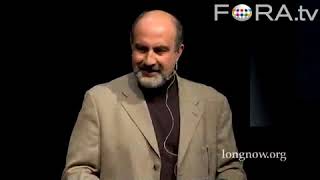 Nassim Nicholas Taleb on Black Swans: Why the Future Breaks Forecasts2007 · 88 min · full transcriptBest starting point for why Taleb thinks the future defeats forecasts through Black Swans, hindsight, and silent evidence.
 Nassim Nicholas Taleb on Fat Tails: Why Extremistan Breaks Forecasting2019 · 123 min · full transcriptBest for understanding why fat tails and Extremistan break standard statistical forecasting.
 Nassim Nicholas Taleb on Extreme Events: How to Live with Them2019 · 64 min · full transcriptShows his practical shift from predicting events to examining fragility and reaction to shocks.
 Nassim Nicholas Taleb on Heuristics and Uncertainty: Less Is More2018 · 89 min · full transcriptExplains why simple heuristics and robustness can outperform optimization under uncertainty.
 Nassim Nicholas Taleb on Uncertainty and Robustness: Why Fragile Systems Break2007 · 52 min · full transcriptConnects failed forecasting to complexity, over-optimization, and systemic fragility.
 Nassim Nicholas Taleb on Financial Fragility: Debt, Leverage, and Tail Risk2018 · 30 min · full transcriptApplies the forecasting critique directly to finance, debt, and institutional design.
Questions people ask
- How does Nassim Nicholas Taleb think about leverage and optimization?
- What did Nassim Nicholas Taleb say about debt and leverage?
- What did Nassim Nicholas Taleb say about fat tails and what to do when you face them?
- What did Nassim Nicholas Taleb say about the precautionary principle and uncertainty?
- What did Nassim Nicholas Taleb say about why tail risks matter more than frequency?
- What did Nassim Nicholas Taleb say about heuristics and dogma?
Sources
Every quote above, word for word from the transcripts. Numbers match the text.
“…events of low predictability, high consequence.”
“…history jumps. It doesn't crawl.”
“You have to assume that you're in the second class of models…”
“Fat tail distributions are one in which extreme events, the ones away from the center of the distribution, play a very large role.”
“I know nothing about the future.”
“I have only one topic: uncertainty…”
“…there is no such thing as a standard deviation in extremistan.”
“…the function of an average is not an average of a function…”
“…you're missing a layer of dimensionality in economics…”
“…the mean return is not the true return.”
“…whatever is fragile, instead of focusing on random events, once you know it's fat tails, you forget about the values, just focusing on how things react to random events.”
“…anything that becomes complex becomes a lot more fragile to Black Swans…”
“…anything fragile eventually breaks, and anything robust will survive…”
“Robustness is a goal under uncertainty, not optimization.”
“…what I think I contributed to mostly is fragility…”
“…public debt is the mother of all fragilities…”
“Known that debt causes instability because with debt you cannot make a mistake. Islam still bans debt; they say to protect you from yourself. Okay, so we need to bring down—if you just brought down the level of debt, I'm sure you'd be satisfied with about a fifth of the level of debt that we have. Well, the high leverage is a sign of our overconfidence, right? Right. Yeah, exactly. How leverage—the problem that we have is too much debt. If you just bring down the level of debt. Now, what's the government doing? They're asking the banks to lend more and asking people to spend more, and they're borrowing money, sorry, and they're borrowing money to prop up the over-leverage institution.”
“You want a society where you don't have too big to fail…”
“…you cannot, you shall not be long an option, hidden option, at anyone else's expense…”
“…you just convert that to equity.”
“…heuristics are not the stupid causes of all human disasters…”
“You need sufficiently simple models to have a robust solution.”
“On Friday because supermarkets are empty. All right, this is sort of a heuristic. All right? You're not making a big deal out of it. You know, it's something that's a trick that works. The minute it doesn't work a couple of times, all right, this is it. Theistic has a small loss when it's wrong. You see, this is what defines to me convex heuristic: when it's wrong, the loss is small. So if you go to the store a couple of times on Monday or on Tuesday as compared to Friday, you see and see more food, then you revise your heuristic. You see? So you don't have to go through the analysis every time, and it sort of works, and being wrong by definition has a small cost. You see the idea—the—and, and you know, it's wrong. That's the beauty of…”
How this guide was made: drafted with AI from the full transcripts of the recordings cited, then checked: every quotation must match a transcript word for word and be the speaker's own words, and an independent review gates accuracy. Methodology and corrections.


