Nassim Nicholas Taleb on Politics & Government
Taleb’s politics centers on decentralization, local accountability, and precaution against top-down decisions that can create large irreversible harms.
- He prefers small, distributed political units over large centralized states because they are more accountable and less fragile.
- His political rule is skin in the game: decision-makers should bear the downside of the risks they impose on others.
- He judges governments by fragility, not ideology: top-down systems make bigger mistakes and hide risk until it is systemic.
- On public policy under tail risk, he favors precaution early, especially when harms can spread, compound, or become irreversible.
- He distrusts narrative-driven politics and prefers durable arrangements that have survived stress over abstract grand designs.

“…they basically deliver the most likely explanation on the web…”CivilNet conversation, 2021 · 5:51
He thinks scale is the central political problem
Taleb’s basic political instinct is not left versus right but small versus large. He argues that government works better when power is closer to the people affected by it, because smaller units are easier to monitor, easier to exit, and less likely to generate catastrophic errors. For him, the key distinction is between distributed arrangements that can survive shocks and oversized structures that become brittle as they scale.123
That is why he speaks favorably about smaller political units such as city-states, cantons, and federated arrangements rather than heavily centralized nation-states. Repeated local interaction creates accountability in a way anonymous mass politics often does not, and a state is best understood as an accepted legal order rather than a single emotional identity.45
He is also skeptical of national storytelling as a basis for rule. Political narrative can become a substitute for practical arrangements that actually work, and he prefers systems whose resilience has been tested over time.67
Government should be designed to keep mistakes small
Taleb treats politics as a problem of fragility under uncertainty. Since mistakes are unavoidable, the right political design is one that prevents them from becoming large, synchronized, and ruinous. Centralized systems tend to do the opposite: they compress variation, suppress local adaptation, and then fail on a bigger scale when reality does not match the plan.8910
This is why he prefers decentralized error over centralized optimization. In his view, many small errors are healthy if they clean up the system continuously, while policies that prevent any short-term disorder often store up hidden fragility. Robust orders survive because they allow stress, feedback, and adjustment rather than trying to eliminate volatility from above.111213
This way of thinking applies beyond economics to institutions and public administration generally. Complexity itself is a warning sign for him, because as systems become more intricate and interdependent, they become more exposed to Black Swan-type failures.314
Skin in the game is his test for legitimate power
Taleb’s moral and political standard is symmetry: the people who make decisions should share the downside if those decisions go badly. He sees skin in the game not merely as an incentive device but as a filter that screens out reckless behavior and empty talk. When elites can keep the upside and transfer losses to others, politics becomes both unjust and dangerously fragile.1516
That principle is especially important in war, intervention, finance, and bureaucracy. He is explicit that people advocating risky actions should be willing to bear real consequences if they are wrong; otherwise they are imposing harms on others without paying for the iatrogenics. This is a direct critique of distant policymakers and experts whose mistakes are socialized.1718
So his political outlook is anti-irresponsibility more than anti-state in the abstract. He does not frame the issue as public versus private so much as whether power is insulated from consequences and allowed to externalize ruin.116
Under systemic risk, he wants precaution, not optimism
Taleb’s politics of public policy is strictest when risks are fat-tailed. In those cases, ordinary cost-benefit habits break down because a few extreme outcomes dominate everything, and uncertainty becomes a reason for caution rather than a reason to wait. The practical rule is to avoid gambles with irreversible downside and make sure the system is still standing tomorrow.1921
That logic drives his views on pandemics and other large-scale threats. When contagion, connectivity, or compounding can create population-wide harm, he favors early action because stopping the process is cheapest before it becomes large. Individual choices matter politically here because each person can create spillovers for many others.22
The same reasoning generalizes to government decision-making more broadly. If a policy error can become systemic, the burden should be on proving that exposure is safe enough, not on assuming things will probably work out.2519
He distrusts technocratic overconfidence and abstract planning
Taleb is deeply suspicious of expert systems that produce polished explanations without real accountability or contact with consequences. He warns that large information systems often give the most standard, most socially repeated answer, which can reinforce prevailing biases rather than discover truth. That fits his broader distrust of centralized expertise in politics and administration.2627
His alternative is not chaos but independence, local knowledge, and institutions that learn through stress. Durable political orders are not those with the neatest models; they are those that have handled disorder without collapsing. In that sense, he values survival properties more than elegant theories or official narratives.7126
Applied politically, this means preferring arrangements that are legible through outcomes: can they absorb shocks, keep errors bounded, and force decision-makers to live with the consequences? If not, Taleb expects hidden fragility no matter how impressive the rhetoric.1315
“…they basically deliver the most likely explanation on the web…”CivilNet conversation, 2021 · full transcript →
Taleb on politics & government, in his own words
“Distributing the power makes make... Allows for things to work better.”
“A small government works better, not because it's small government, but because it's-- you get the idea. Top down government doesn't work. Now you can have probably a dictatorship in a small village and it may work. So I cannot prove that it's not private versus public. For me, it's large versus small. Small has the ability to survive and a large gets disproportionately weakened by unexpected events. And thanks for linking it to epistemic opacity, because this idea of fragility being measurable solves the problem of opacity. I don't understand the environment, but I can pretty much figure out I'm fragile to it.”
“The notion of national narrative, again, I mean, in my work now, the narrative should not be the driver.”
Where to watch
 Nassim Nicholas Taleb on Nation States: Why Small Units Work Better2022 · 68 min · full transcriptBest single overview of his view that small political units outperform centralized nation-states on accountability and resilience.
 Nassim Nicholas Taleb on Skin in the Game: Risk, Responsibility, and Power2017 · 85 min · full transcriptExplains skin in the game as his core political rule for power, responsibility, and fairness.
 Nassim Nicholas Taleb on Uncertainty and Robustness: Why Fragile Systems Break2007 · 52 min · full transcriptShows how his politics grows out of fragility, uncertainty, leverage, and the dangers of optimization.
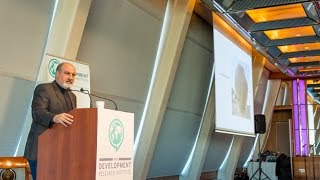 Nassim Nicholas Taleb on Fragility and City-States: Why small systems survive2021 · 62 min · full transcriptConnects decentralization and city-states to antifragility, variation, and the value of small failures.
 Nassim Nicholas Taleb on Pandemic Risk: Why Tail Events Matter2020 · 67 min · full transcriptApplies his political logic of precaution to public policy under tail risk, especially pandemics.
Questions people ask
- What did Nassim Nicholas Taleb say about small government and localism?
- When does Nassim Nicholas Taleb think military intervention is justified?
- Why did Nassim Nicholas Taleb say mistakes should be small and decentralized?
- Does Nassim Nicholas Taleb think modern society is biased against variability?
- What did Nassim Nicholas Taleb say about limited liability and bailouts?
- What did Nassim Nicholas Taleb say about the precautionary principle and uncertainty?
Sources
Every quote above, word for word from the transcripts. Numbers match the text.
“A small government works better, not because it's small government, but because it's-- you get the idea. Top down government doesn't work. Now you can have probably a dictatorship in a small village and it may work. So I cannot prove that it's not private versus public. For me, it's large versus small. Small has the ability to survive and a large gets disproportionately weakened by unexpected events. And thanks for linking it to epistemic opacity, because this idea of fragility being measurable solves the problem of opacity. I don't understand the environment, but I can pretty much figure out I'm fragile to it.”
“Distributing the power makes make... Allows for things to work better.”
“…anything that becomes complex becomes a lot more fragile to Black Swans…”
“You do a lot better I think meeting a person a thousand times than meeting a thousand persons once.”
“A state is a body of laws, basically, that you're accepting.”
“The notion of national narrative, again, I mean, in my work now, the narrative should not be the driver.”
“What has survived time is giving us indication as to its ability to handle disorder.”
“I have only one topic: uncertainty…”
“When you can't avoid having mistakes, you want them to remain small. And typically, top-down things make large mistakes. This is what my idea of decentralization is: you have to decentralize the errors by making sure they remain small and distributed. Okay? But when you're willingly making errors because they're small and because they're not of huge cost, when you're willingly, then you want—you see, then you want to make error; you want to make a lot of errors because they're not as harmful. You see, and the payoff comes from it. But remember one thing: you saw my first graph where I was showing you the…”
“Yeah, exactly. So what happened is that there's a gross allergy for variability that grows with, uh, statism, modernity, top-down control. You see, so anything that's top-down control has that allergy for modernity, for, for, uh, for variability. So you think you want to control everything, and you start compressing variation. That sort of happens with the state. To give you an idea where the state, when I look at the area I'm from, to conclude here—uh, I come—and this is the reason I took this, but I'm not yet an expert on cities—is because I made the following discovery in, uh, in 2000, in, in about three years ago Aleppo started getting into war and...”
“It should fail early and frequently to clean up continuously.”
“The organic communicates with its environment via stressors and only via stressors.”
“…anything fragile eventually breaks, and anything robust will survive…”
“At the same time, we had a rise of leverage. I'm not just talking about financial leverage. Financial leverage is only five times what it was in 1980, which is very dangerous, but operational leverage. People have no slack in systems. People are over optimized. Companies are very large, so it means more fragile to contingencies, and you get squeezed. Uh, let me discuss two things. Let me discuss first the notion of operational leverage or operational optimization, what I call optimization.”
“…skin in the game is a filter philosophy…”
“The, the, the—if it's used, okay, for this trial and error, then it's very good. If limited liability, if limited liability is used to transfer your losses to society so you get the bonus, the upside, and society gets the downside, then it's not good. You see, and what has happened in the capitalistic system is instead of having incentives and disincentives, we have some people who have the incentives, and then when they lose money, take banks—they make bonuses when they have good years, and then when they have a bad year, they transfer it to society, to the taxpayer, and they keep their bonuses, as we saw before. Again, remember the two kinds of payoff: the payoff where you…”
“If you own it-- very simple. To shorten, it is justified if those who advocate for it are willing to pay the price if they're wrong. If you want you settle in Iraq in case something goes wrong? Be my guest. Go ahead and we're going to listen to your opinion. But you've got a price to pay if things go wrong. You want to settle in Libya? Go ahead. Today Libya has a slave market. Don't tell me that your thing was harmless. It's called iatrogenics. People should always pay for the iatrogenics.”
“It is vastly easier to macro BS and micro BS.”
“…fat tailed. Must be fat tailed.”
“Make sure you're in tomorrow.”
“If we don't stop this pandemic, it will affect everyone.”
“You're Tim Ferriss flying to go to Mexico. You go to JFK, and they tell you that you have uncertainty about the skills of the pilot. But we think he's good, but there's uncertainty. What do you do? You're not gonna get on that plane. I'm not gonna get that life is too important for me. You'll take a train, walk, maybe you'll ride a bicycle, know, take a few months, but you're not gonna get on that plane. Okay, you change your plans and say, okay, there are other plans or other countries too, and other planes. So that's Warren Buffett and his investments. And that's my Krupesh Kosher principle, the idea that there's an asymmetry, is that uncertainty about certain things is not good. So the climate, for example, if you have uncertainty about the climate, stop these models. Alright, just don't pollute, you get it or try to use something else, try to mitigate.”
“…they basically deliver the most likely explanation on the web…”
“It's not a contrarian nature. It's independence.”
How this guide was made: drafted with AI from the full transcripts of the recordings cited, then checked: every quotation must match a transcript word for word and be the speaker's own words, and an independent review gates accuracy. Methodology and corrections.


