Nassim Nicholas Taleb on Black Swans
Taleb treats Black Swans as high-impact events that are hard to predict in advance, then falsely made to look explainable afterward, so the real task is reducing fragility rather than trusting forecasts.
- Black Swans are events of low predictability and huge consequence.
- They matter because many real-world domains are fat-tailed, where extremes dominate outcomes.
- Forecasting breaks in Extremistan, so Taleb shifts attention from prediction to fragility.
- Complexity, leverage, and over-optimization make systems more vulnerable to Black Swans.
- His practical rule is survival first: build robust or antifragile systems with slack and without ruin risk.

“You want a society where you don't have too big to fail…”The New Yorker finance conference panel, 2018 · 8:54
Black Swans are rare surprises with outsized effects
Taleb’s basic definition is simple: Black Swans are low-predictability events with very large consequences. He treats them as central to history, markets, and social life because big turning points often come from shocks that were not reliably forecast in advance.12
That is why he is skeptical of confident talk about the future. His position is not that nothing can ever be known, but that decisive events often arrive from outside the range of standard expectations, and people underestimate how little they truly know ahead of time.34
Why we keep missing them: hindsight and the wrong statistical world
Taleb’s deeper claim is that Black Swans fool us because we use the wrong mental model. In many domains, outcomes do not cluster neatly around the average; instead, extremes have an outsized role, which is the logic of fat tails.56
This is the contrast behind his thin-tail versus Extremistan view. In Extremistan, ordinary tools like standard deviation and familiar forecasting habits become unreliable, so what looked like an outlier may actually be part of the structure of the domain.78
After a shock, people then tell neat stories that make it seem as if the event had been understandable all along. Taleb rejects that retrospective confidence because history often moves by jumps rather than smooth trends.23
The real issue is exposure: fragility turns surprise into disaster
Taleb increasingly frames Black Swans through fragility. A surprise is one thing; being built in a way that cannot absorb surprise is the deeper problem. Once a system becomes complex, optimized, and tightly coupled, it becomes more fragile to Black Swans.910
This is why he focuses less on guessing specific shocks and more on how things react when shocks arrive. In fat-tailed settings, he says the key move is to stop obsessing over exact event paths and examine whether the system can survive volatility.1112
Leverage is a prime example of dangerous exposure. Debt removes room for error, and over-optimization strips out the slack that would let people, firms, or institutions absorb a large surprise.15
Forecast less, design for survival more
Taleb’s practical answer to Black Swans is not better point prediction. It is to build in ways that do not require being right about the future. He repeatedly argues for survival first: avoid structures that earn small steady gains while hiding a chance of ruin.3
That logic leads to robust and antifragile design. Fragile things are harmed by volatility, while antifragile things can benefit from it, so the goal is to remove ruin risk, add buffers, and create room for error.1718
In domains with catastrophic asymmetry, he endorses strong precaution. If uncertainty sits on top of irreversible downside, the sensible response is not optimism but refusal to take the gamble.5
How Taleb applies Black Swan thinking to finance, policy, and daily judgment
In finance, Taleb’s Black Swan view leads directly to hostility toward leverage, hidden tail risk, and institutions that can threaten the whole system. He wants arrangements that do not depend on experts getting tail forecasts right and that avoid concentrations large enough to become untouchable when they fail.20
In public policy, the same reasoning supports precaution around systemic risks such as pandemics and other fat-tailed harms. His point is not that every bad outcome is a surprise, but that connected systems can turn local shocks into large cascades.5
At the level of personal judgment, his advice is to separate attractive upside from ruinous downside. If an exposure can wipe you out, the burden of proof becomes much higher, because one Black Swan can erase many small successes.
“You want a society where you don't have too big to fail…”The New Yorker finance conference panel, 2018 · full transcript →
Taleb on black swans, in his own words
“…history jumps. It doesn't crawl.”
Where to watch
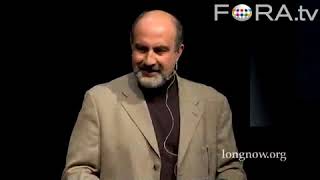 Nassim Nicholas Taleb on Black Swans: Why the Future Breaks Forecasts2007 · 88 min · full transcriptHis clearest direct explanation of what Black Swans are, why hindsight deceives us, and why history is shaped by jumps.
 Nassim Nicholas Taleb on Extreme Events: How to Live with Them2019 · 64 min · full transcriptBest for understanding the statistical logic behind extreme events and why standard tools break in fat-tailed domains.
 Nassim Nicholas Taleb on Uncertainty and Robustness: Why Fragile Systems Break2007 · 52 min · full transcriptShows how Black Swans become destructive through fragility, complexity, and over-optimization.
 Nassim Nicholas Taleb on Antifragility and Uncertainty: Why Disorder Matters2007 · 66 min · full transcriptExtends Black Swan thinking into antifragility: how to benefit from volatility instead of being broken by it.
 Nassim Nicholas Taleb on Precautionary Principle: Fat Tails and Risk2023 · 124 min · full transcriptApplies the logic to precautionary decision-making when uncertainty meets irreversible downside.
 Nassim Nicholas Taleb on Financial Fragility: Debt, Leverage, and Tail Risk2018 · 30 min · full transcriptApplies Black Swan reasoning to debt, leverage, and why finance should be structured to survive tail events.
Questions people ask
- How does Nassim Nicholas Taleb think about leverage and optimization?
- What did Nassim Nicholas Taleb say about debt and leverage?
- What did Nassim Nicholas Taleb say about fat tails and what to do when you face them?
- What did Nassim Nicholas Taleb say about the precautionary principle and uncertainty?
- What did Nassim Nicholas Taleb say about why tail risks matter more than frequency?
- What does Nassim Nicholas Taleb say about how to take risks without blowing up?
Sources
Every quote above, word for word from the transcripts. Numbers match the text.
“…events of low predictability, high consequence.”
“…history jumps. It doesn't crawl.”
“I know nothing about the future.”
“I have only one topic: uncertainty…”
“…fat tailed. Must be fat tailed.”
“Fat tail distributions are one in which extreme events, the ones away from the center of the distribution, play a very large role.”
“You have to assume that you're in the second class of models…”
“…there is no such thing as a standard deviation in extremistan.”
“…anything that becomes complex becomes a lot more fragile to Black Swans…”
“…what I think I contributed to mostly is fragility…”
“…whatever is fragile, instead of focusing on random events, once you know it's fat tails, you forget about the values, just focusing on how things react to random events.”
“…anything fragile eventually breaks, and anything robust will survive…”
“…public debt is the mother of all fragilities…”
“…the opposite of fragile is definitely not robust…”
“…what is fragile doesn't like volatility, what is antifragile loves volatility…”
“You want a society where you don't have too big to fail…”
How this guide was made: drafted with AI from the full transcripts of the recordings cited, then checked: every quotation must match a transcript word for word and be the speaker's own words, and an independent review gates accuracy. Methodology and corrections.

