Nassim Nicholas Taleb on Fragility
Taleb treats fragility as a measurable exposure to harm from volatility and shocks, and argues that the practical task is to reduce ruin, leverage, and oversized dependence before trying to predict events.
- Fragility means disliking volatility and suffering more downside than upside from randomness.
- You detect fragility by nonlinear response: bigger shocks cause disproportionate damage.
- Taleb focuses on avoiding ruin through less debt, more redundancy, and smaller errors rather than forecasting.
- Large, optimized, centralized systems are often more fragile than smaller, distributed ones.
- The real opposite of fragile is antifragile: systems that can gain from stressors and variability.

Fragility is a dislike of disorder
Taleb’s basic definition is simple: something is fragile when it does not like volatility, disorder, or variability. In his framing, fragility is not mainly about looking weak; it is about having more downside than upside when the world becomes noisy, random, or stressful.123
That is why he insists the opposite of fragile is not merely robust. Robust things resist shocks, but antifragile things can actually gain from them, which gives him a three-part map: fragile, robust, and antifragile.4567
“…fragile is what doesn't like disorder.”NYU Marron Institute conference talk, 2021 · full transcript →
You find fragility by looking for disproportionate harm
Taleb’s practical test for fragility is nonlinearity. A fragile thing responds disproportionately to shocks: a larger shock does not just hurt more, it hurts much more. That acceleration of harm is the signature to look for when you cannot fully understand the environment.8
This is why he prefers detecting exposure over making detailed predictions. Under uncertainty, especially when big surprises matter, he argues it is more useful to ask what can break badly than to pretend you know which event is coming.
Debt, optimization, and scale make systems brittle
Taleb repeatedly points to debt as a major source of fragility because debt removes room for error. If outcomes turn against you, you cannot absorb randomness in the same way as someone with slack, cash, or spare capacity.121314
He extends the same logic beyond finance. Over-optimized systems, operational leverage, and lack of slack make companies and institutions more vulnerable to contingencies, while complexity increases exposure to large breaks.1516
Scale matters too. He argues against structures that become too big to fail because when mistakes happen at large scale, the damage becomes harder to contain. Smaller units survive shocks better because failures stay local.17
The cure is slack, optionality, and small failures
Taleb’s response to fragility is to cap downside and preserve upside. That means limiting losses, keeping exits open, and arranging life or institutions so stress does not lead directly to ruin.1819
He favors redundancy because spare capacity is not waste in an uncertain world; it is protection and sometimes an opportunity. Cash, inventory, and biological spare parts all fit his logic that robustness requires extra margin.132021
He also prefers many small errors to a few giant ones. If mistakes are unavoidable, decentralization keeps them distributed and affordable, and repeated small failures can clean up hidden problems before they compound.2223
Organic systems need stressors, but ruin must be avoided
Taleb thinks many living and social systems are damaged when variability is removed completely. Organisms communicate with their environment through stressors, and some strength only comes from exposure, adaptation, and recovery.242526
But this is not a call for reckless stress. His rule is to accept as much variability as you can afford as long as it is not lethal, because the central danger is ruin. Once ruin happens, no later gains matter.2728
That is why his framework is moral as well as technical: people should not impose hidden risks on others, and systems should be built so mistakes do not become someone else’s catastrophe.29
Taleb on fragility, in his own words
“…fragile is what doesn't like disorder.”
“…public debt is the mother of all fragilities…”
Where to watch
 Nassim Nicholas Taleb on Antifragility and Uncertainty: Why Disorder Matters2007 · 66 min · full transcriptBest single overview of fragile, robust, and antifragile, plus why Taleb prefers testing fragility over forecasting rare events.
 Nassim Nicholas Taleb on Uncertainty and Robustness: Why Fragile Systems Break2007 · 52 min · full transcriptShows how optimization, complexity, and leverage make systems break under uncertainty.
 Nassim Nicholas Taleb on Antifragility: Stress, Optionality, and Skin in the Game2012 · 79 min · full transcriptBest for optionality, skin in the game, and the practical rule of limiting losses while keeping upside.
 Nassim Nicholas Taleb on Financial Fragility: Debt, Leverage, and Tail Risk2018 · 30 min · full transcriptMost direct application of fragility to debt, leverage, and too-big-to-fail finance.
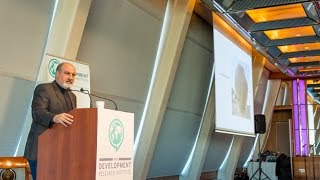 Nassim Nicholas Taleb on Fragility and City-States: Why small systems survive2021 · 62 min · full transcriptStrong on scale, decentralization, and why small systems survive disorder better.
Questions people ask
- How does Nassim Nicholas Taleb think about leverage and optimization?
- What did Nassim Nicholas Taleb say about debt and fragility?
- What did Nassim Nicholas Taleb say about debt and leverage?
- What did Nassim Nicholas Taleb say about small government and localism?
- Why did Nassim Nicholas Taleb say mistakes should be small and decentralized?
- Why does Nassim Nicholas Taleb favor optionality over rigid planning?
Sources
Every quote above, word for word from the transcripts. Numbers match the text.
“…what doesn't like variability is fragile…”
“…fragile is what doesn't like disorder.”
“…whatever is fragile doesn't like volatility…”
“The opposite of fragile cannot possibly be robust.”
“The opposite would be something that gains from disorder.”
“…the opposite of fragile is definitely not robust…”
“Antifragile is a category of object…”
“…everything fragile has to have one property: it must respond disproportionately to shocks…”
“…public debt is the mother of all fragilities…”
“Into finance, but what fragiles a system is debt. Debt, debt. If you're a company or a person and you have debt, you can't face random outcomes in the same way as someone who doesn't have that. And what is the opposite of that? Redundancy. Okay, having extra stuff like, for example—I don't know if it applies to people at AUC, but most people in Curaçao have two kidneys. Okay, come with two. Why do you have two kidneys? All right, because, because of, you know, in case you lose one, and effectively, you could function on one very well. So, you have a spare part. Okay, so that is the inverse of a spare part and things get fragile. So, let me explain one thing.”
“Known that debt causes instability because with debt you cannot make a mistake. Islam still bans debt; they say to protect you from yourself. Okay, so we need to bring down—if you just brought down the level of debt, I'm sure you'd be satisfied with about a fifth of the level of debt that we have. Well, the high leverage is a sign of our overconfidence, right? Right. Yeah, exactly. How leverage—the problem that we have is too much debt. If you just bring down the level of debt. Now, what's the government doing? They're asking the banks to lend more and asking people to spend more, and they're borrowing money, sorry, and they're borrowing money to prop up the over-leverage institution.”
“…anything that becomes complex becomes a lot more fragile to Black Swans…”
“At the same time, we had a rise of leverage. I'm not just talking about financial leverage. Financial leverage is only five times what it was in 1980, which is very dangerous, but operational leverage. People have no slack in systems. People are over optimized. Companies are very large, so it means more fragile to contingencies, and you get squeezed. Uh, let me discuss two things. Let me discuss first the notion of operational leverage or operational optimization, what I call optimization.”
“You want a society where you don't have too big to fail…”
“…limit the losses, don't limit the gains…”
“I'm not quite opposed to planning. I'm opposed to, uh, planning like you're on a highway and with no exits; you suddenly have a problem, you can't exit. That's what I'm against. I'm in favor of planning if you have optionality to exit. See, an option benefits from uncertainty, you need options out. So, and there's something technical. A five-year plan is like a five-year option is not as good as a series of one-year plans, very adaptable. You're not—you can't take advantage of changes in the environment if you're planning.”
“Uh, okay, an antifragile system improves from stressors. So visibly, if they improve from stressors they had the structure, they probably have some amount of antifragility. But you need to be robust, so they probably moved towards robustness, and robustness requires, uh, some kind of redundancy, to have inventory. People think it's silly to have cash in a bank. You're more robust if you have cash in a bank, you see. And actually even antifragile because you can capture opportunities that way. So you see the idea of having more... Actually, I know, I wrote in a book. Actually, I wrote in this book about if you have excess inventory,…”
“People think they a cost. Okay, if you have excess humus in your basement, okay, the kind of inventory I have in my basement being Lebanese, you know, people think it's not a cost to have extra stockpile for companies because if there's a crisis, there's a squeeze, and the other people don't have what you need, the price of the commodity shoots up massively, and you can sell it. So having inventory is antifragile. And by, uh, I would have answered if I were you. I was expecting you to give a different answer. Well, what the antifragile antifragile would not be at the level of gasoline distribution. It would be at the level of transportation. I mean, gasoline is for a purpose, and the…”
“When you can't avoid having mistakes, you want them to remain small. And typically, top-down things make large mistakes. This is what my idea of decentralization is: you have to decentralize the errors by making sure they remain small and distributed. Okay? But when you're willingly making errors because they're small and because they're not of huge cost, when you're willingly, then you want—you see, then you want to make error; you want to make a lot of errors because they're not as harmful. You see, and the payoff comes from it. But remember one thing: you saw my first graph where I was showing you the…”
“It should fail early and frequently to clean up continuously.”
“The only way you know you're alive, you're not a machine, is if you like variability.”
“The organic communicates with its environment via stressors and only via stressors.”
“But very exacerbated now because we're more capable of controlling our environment. We want to eliminate volatility from life. We make the categorical mistake I call it mistaking the cat for washing machine. I don't know if you own a cat or washing machine; they're very different. The washing machine will never self-heal. An organism needs some amount of variability and disorder; otherwise, it dies. It actually, an organism communicates with the environment via stressors. You see, you, you, you have stressors. You, you, you put, you know, you lift weight, your bones are going to get thicker. If you don't do that, if you're going to space shuttle, you're going to lose bone.”
“You should have as much variability as you can afford that's not lethal.”
“I call it the Bob ruin problem…”
“…you cannot, you shall not be long an option, hidden option, at anyone else's expense…”
How this guide was made: drafted with AI from the full transcripts of the recordings cited, then checked: every quotation must match a transcript word for word and be the speaker's own words, and an independent review gates accuracy. Methodology and corrections.


