Nassim Nicholas Taleb on Uncertainty and Robustness: Why Fragile Systems Break

What Taleb talks about
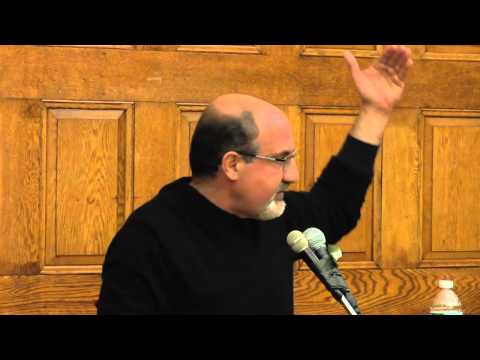
Nassim Nicholas Taleb gave this lecture at Google Talks in 2007 on The Black Swan, uncertainty, and why systems built for efficiency become fragile under rare, high-impact events.
Also known as: The Black Swan: The Impact of the Highly Improbable; Google Talks lecture; GBH Forum Network talk.
Taleb argues that modern systems become fragile when they are optimized, overleveraged, and made too dependent on technology and forecasts. He uses everyday examples—books, Kindles, blackouts, and market crashes—to show how robustness matters more than efficiency under uncertainty.
He extends the idea beyond finance to institutions, economics, and society, warning that bailouts, specialization, and centralized expert culture can amplify risk. His core message is that you should reduce exposure to catastrophic tail events rather than pretend they can be forecast away.
A host introduces Taleb and asks questions during Q&A; Taleb speaks throughout the main talk and responses.
In his words
“Anything that becomes complex becomes a lot more fragile to Black Swans”
“Anything fragile eventually breaks, and anything robust will survive”
“Science is perspective not retrospective”
“I have only one topic: uncertainty”
“Get the [ __ ] out of there”
Key points
- Complexity and optimization often increase fragility rather than resilience.
- Black Swans are not just rare events; they are events with outsized impact in systems exposed to them.
- Large organizations, debt, and leverage make shocks more dangerous.
- Robust systems need slack, redundancy, and the ability to survive stress.
- Forecasting fails badly in domains dominated by uncertainty and fat tails.
- Bailouts and favoritism toward large firms make society less robust.
- Cash, gold, and lower exposure can help individuals move out of the most fragile quadrant.
Full transcript: Nassim Nicholas Taleb, The Black Swan lecture (2007)
Nassim Nicholas Taleb has devoted his life to immersing himself in problems of luck, randomness, human error, probability, and the philosophy of knowledge. Although born in Lebanon and with a rich family history in that country, in a 2008 London Times article, he was described as not believing in national character—those are the reporter's words—but to be comfortable with a regional identity. "My body and soul are Mediterranean," he was quoted as saying. Mr. Professor Taleb, who has his bachelor's and master's in science from the University of Paris, an MBA from the Wharton School, and a PhD in management science from the
University of Paris, also has had three successful careers thus far: as a man of letters, as a businessman, trader and risk manager, and as a university professor. He is currently distinguished professor of risk engineering at New York University's Polytechnic Institute, a distinguished research scholar at Oxford, and a principal and senior scientific advisor at Universa Investments. His books *Fooled by Randomness* and *The Black Swan* have been published in 31 languages. He is widely recognized as the foremost thinker on probability and uncertainty. Please welcome Nassim Nicholas Taleb. And the idea of robustness can be best illustrated
with this example: how many of you own what do you call them, these ugly things that are sold by Amazon, or you can download electronically, a Kindle? How many of you own a Kindle? Okay, all right. So, and how many of you have read, used the book—something commonly known as a book—you could buy it at a bookstore, like their bookstore? Okay, so a lot of you have read books, have seen, touched the book. Okay. Now make a comparison: if you spill coffee on your Kindle, you know what happens, no? Or if you don't have electricity, or if you have whatever, there's a technical problem. Now, what kind of technical problem can you have with a book? All right. So okay, I have a book my
parents had in their collection, a book by Plotinus, *The Comedies* by Plotinus, that my father bought for something like $5 in Moscow when he was visiting 50 years ago. Anyway, the book was 500 years old; it looked no different from a regular book. I don't know how many of you are old enough to have encountered the floppy disk drive? Okay, all right. So I have stuff written on floppy disk drives not long ago, 10 years ago—can't retrieve it, can't read them. I'm glad I can't read them because I'm sure I'd be very disappointed by the literary quality of what I wrote 10 years ago. But so you understand that the difference between the two worlds, one seemingly
is not efficient—a book is heavy, it's so P. All right, the other is hip, it's technology, and guess what? So the problem with technology is that it seemingly optimizes things, but it does cause some fragility. And my idea is—anything that becomes complex becomes a lot more fragile to Black Swans, to these events named, you know, Black Swan after some exception mentioned by Juvenal. And my Black Swan is different because I'm not talking about birds, I'm talking about events with some sets of characteristics. So this, in a nutshell, is
what I've been thinking about. Then I realized that anything fragile eventually breaks, and anything robust will survive. And I looked at nature and discovered that nature had some parameters. No; too big animals are too big: the elephant is the biggest. Why? Because as elephants, anything bigger than an elephant would have to pay up for water per liter a lot more. You see, an elephant pays up—if there's a shortage of water, what do you pay up? A lot more than a mouse per liter, you agree. So seemingly, a larger organization would be a lot more efficient but in fact becomes a lot more
fragile. So the biologists understand why, you know, they have some theories why you can't be bigger than an elephant. It's [expletive]. I mean, the problem is sensitivity to random events. Random events may squeeze you a lot more when you're a larger organism. So modern nature understands that rather well and builds things in a certain way. Humans think they're smart; they will think in a bad way, and these things break. I mean, how many corporations have survived the last 100 years, 50 years, 25 years, 10 years, right? So you realize that there's a high mortality in the species called
businesses, and a much higher mortality than in species, biological species. So based on that, I realized that we have to work on—I'm tired of the idea of the Black Swan—so we have to work on something called robustness. And in this new edition of *The Black Swan*, I made a tableau of where it is that we're fragile to Black Swans. I call that the fourth quadrant and how we can protect ourselves by becoming more robust. In the fourth quadrant, you can either exit the fourth quadrant, or if you're in it, you need to be robust. So I can talk about these things. The idea of fragility
and robustness came to me. As you know, I'm not a Gladwell or a regular journalist who takes a topic and milks it and then moves on; it's like serial monogamy to another topic, right? I have only one topic: uncertainty, but I continue, so I continue. So the transition between my books is seamless, okay? So, I'm transiting into how to live in a world we don't understand. So I added that stub on fragility and robustness as a transition between *The Black Swan* and the next idea. Then I realized that, you know, that stub was rich enough as a document it could be a book on its own in Europe and most countries. What I added to *The Black Swan* we published a
Separate book so that idea came to me before. You know, I finished The Black Swan. I don't know how many of you remember or are old enough to remember the 2003, uh, problem we had in New York City when we had, uh, a sorry, blackout. You remember the blackout? Okay. I don't know if you've seen pictures of Grand Central, but, uh, I don't go to the movies anymore for reasons, and I watched, uh, I remember, it reminds me, I've seen a train station in Chicago, people sleeping on the floor. You don't know if they're dead. You walk over, buddies, you know, in Grand Central, New York. That was 2003, 2002? No.
2003. Grand Central, 200 New York City, so vulnerable to a technological glitch and became an obsession for me. And I remember, you know, my, and you can—I couldn't wash my hands because they had that, uh, fancy technology, no more faucets. It's so much PD, and it works beautifully. You know, you, you, you, you, uh, you wave in front of it. Sometimes it doesn't work, of course, but here you couldn't wash your hands. You couldn't get water because they were 100% reliant on technology. So I understood what the notion of fragility was, and I knew that the idea of Black Swan had to be coupled with what systems are more fragile to Black Swan than others. So I
continued my idea with that stub and I'm continuing now, and, uh, here I have my aphorisms. I even continue now part-time putting aphorisms on Twitter because it's a good discipline to write ideas, uh, you know, in 140 characters. I'm now trying to go to 200 characters and maybe I'll get to 10 characters, maybe one day. So, so this is my, my, my speech. All right, I think I'm done. It was a long minute, and now we can move to Q&A. And don't worry, I always— I sometimes don't listen to questions, so answers will be decorrelated. I can continue my speech. All right, so don't, don't worry. And, but you won't notice. There's one thing I
learned during my book tour of 2007 when The Black Swan became a bestseller. I realized that when a journalist asks you a question and you listen to it, you feel obligated, and usually they're dumb questions about journalists. You have to answer, like CNBC journalist you have to answer. All right, if you listen to it, the best thing is I daydream when they ask me the question. I look at their face, I vaguely have an idea of what they're talking about and I answer randomly, and it works beautifully. Nobody notices, either the viewers. I did that last week with CNBC, perfect, don't listen to what they're talking about except very vaguely. So I realize that when people are focusing on your answers, the question doesn't matter much, and, and better have the illusion of having driven the conversation rather than me.
It's a lot more fun. So I'd rather go to that format where you ask me questions and we have time till they are out of here, and, and we can, I can answer. And plus I have some aphorisms if I don't have enough answers I may read some aphorism to just, uh, you know, impress you guys with my literary, uh, orientation. Okay. So, uh, let's start with, with Q&A. Okay. He's asking me about—I was accused of—it's too cute to say—the Black Swan author had a hand in in the destruction of markets, the flash crash, and perhaps destruction of Western civilization, a lot of things. And I was sipping wine. I was in Saudi Arabia and got to Dubai and I
developed an obsession for Lebanese wine and someone provided me with Lebanese wine. I was sipping Lebanese wine in Dubai and I couldn't care less about what's happening in markets, of course. You get phone calls if you are in the market, if you're involved with a hedge fund, and that's the hedge fund is a baby of my old hedge fund. It's not real hedge fund, it's a firm that just buys out-of-the-money options because I have this idea that the only way you can understand the world is if you have something at risk plus life is very boring if when you wake up in the morning you don't have a screen to go to, right? So, uh, to, to look at what happens, right? So and, and, uh, so it's good to be involved in something but I, I'm, I'm involved. I don't have enough interest in
details of transactions so I'm completely immune from the burdens of details of transaction. I have no idea where they traded but I know that we're in a business of buying puts almost every day. Okay, just like you're in a trucking business so you have trucks, you know, on a road every day. Right now, if one of your trucks is on a bridge, the truck on the bridge before the bridge collapses, you're definitely only the Wall Street Journal would be interested in investigating why that truck was there. Okay, so that's what happened with the flash crash. We were one of the last buyers of puts before the market collapsed, so but we do that for a living. Okay, so you don't look at the buyer as a pus, you look at the structure of the
market capable of collapsing under the weight of, uh, of, uh, selling which means that the market is fragile. That's, that's the idea. So did I answer your question or no? All right, so sorry that, that my metaphor is when you have, uh, when the bridge collapses you, uh, the first phone call should be to the engineer, and you know, of course, angry phone call. You don't call the last, the owner of the last truck that was on it. Okay, that, that was my, that's my idea. So plus, so I deny plus, but it's very nice to portray me as a Professor Moriarty, okay, extremely enigmatic, you know, living an enigmatic life hiding in places, and
Having a hand in the destruction of things, it's very nice to trigger Black Swans. You see, Black Swan author calls Black Swan is, but unfortunately, reality isn't as romantic as that, all right? Vastly more boring than that. That's a good point. Uh, but I disagree with the notion of Tipping Point. Um, he's saying that volcanoes appear to be like a Tipping Point. Uh, I don't believe in that notion of Tipping Point. It's very good in bookstores, but it's not to me. It's an exposed idea because, ahead of time, you never know what’s the Tipping Point. You know, in history books, it’s like saying Sarajevo was a Tipping Point for the first war. Okay, so that thing, it’s sort of butterfly in India concept. There are a lot more butterflies than
events, so you're not going to, you know, study every butterfly ahead of time. And to me, science is perspective not retrospective, because we have hindsight biases. But I agree with you, as some as an illustration it's just like my story of the New York, uh, having someone wants to wash his hands in New York in August 2003 when you have a blackout and realizes how vulnerable we are to technology. We just realize how vulnerable we are with that, with that, uh, volcano, uh, in Iceland. But, but there are many more problems, particularly one coming from land. So let me illustrate in that addition of the
Black Swan, my idea of what has happened over the past, uh, 25 years and why, uh, we're a lot more, uh, uh, I would say lot less fit and the governments, uh, and universities are a lot less fit to understand what's going on than they were 25 years ago. So in other words, the world has gained in complexity while incompetence has risen a lot more. So let me go through that point very quickly and why, uh, I have one of my tweets. All right, but I call them aphorisms because I mean I put things on Twitter. I have no idea what people put there except when they send me messages, so I'm not into the culture of the place, uh. So one of them is every 10 years, there's something called Moore's law.
Every year, computational power, uh, doubles. So my, my, my, uh, my aphorism was every 10 years collective wisdom degrades by half. All right? So I, you see what we're going? No? Okay, let me start 25 years ago. They invented something called the internet. You agree? And we started having experiencing a rise in complexity from the internet. The planet, get start getting smaller. The best insight on the results of that came to me from a gentleman Nathan Mval who explained who gave me—I was discussing it with him and then he sent me that paper who got me into this notion of something called area square
law, some name like that, and it tells you the following: You have a lot more species, uh, per square meter in islands than you do in continents. So in other words, diversity decreases as your space becomes larger and that's an effect of what I discussed in the first Black Swan, the first edition of the Black Swan, as, uh, the result of globalization. You start having more clustering, in other words. Think about the scenery not in terms of species but in terms of languages. Now you have a lot more people on a planet who speak the same language badly, of course, bad English as like I used to call it City Bank English.
But, uh, I don't want to glorify too much by sticking the name of City Bank. By the time, they were not bust. So the whole planet speaks bad English. You see, the whole planet reads Harry Potter, whereas 100 years ago you had more diversity, okay, and you had local poets and local languages. And now the whole, you know, planet studies fraud called, uh, Portfolio Theory or stuff like that. So here you have this clustering that has increased thanks to the internet, the good, you know, if you're lucky and you have a winner take all effect and you're in California and your name is Sergey Brin or something, then you have a company that dominates the world, all right? And anyone would have dominated the world. It's not them.
Uh, but if you're right a bestseller—and I experience that, although in a modest way—that now everybody talks to me about Black Swan, you know, everybody reads Black Swans. I see it in airports and crazy places, all right? I saw it because it sells a lot more overseas by the way than here per capita, strangely. So you can sell—you can have a planetary phenomena like the Harry Potter read by every child on a, you know, almost every child on a planet, some obscenely large number. So we had the rise of that complexity exacerbated by globalization and the internet. Now, things run very smoothly under these conditions, except when there's an accident bad things can
happen. At the same time, we had a rise of leverage. I'm not just talking about financial leverage. Financial leverage is only five times what it was in 1980, which is very dangerous, but operational leverage. People have no slack in systems. People are over optimized. Companies are very large, so it means more fragile to contingencies, and you get squeezed. Uh, let me discuss two things. Let me discuss first the notion of operational leverage or operational optimization, what I call optimization. I was in Istanbul as I was writing the Black Swan and I walked into the room and I wanted to download the hate mail I usually get because the only
interesting thing, the, you know, love letters and stuff are boring old, you know, but hate mail there's some diversity there. So wanted to download my hate mail at the time. So I go in and plug my thing. It doesn't work. I call up receptionist. Okay, technician. All right. Oh, you're in room, uh, 1305. Yes. Yeah. I know. Yeah, no, it should be working. Okay. The guy had an Indian accent before I hung up. I told him, "Do you, um, are there a lot of Indians in Istanbul?" I could understand why they import Indians, all right. He said no, "I'm not in Istanbul." All right? So everybody's in Bangalore, which is a lot cheaper probably, except if you have a problem in Bangalore. All right?
And you don't know the consequences of the things you know percolating through the system. Okay, that's a complex system. So that's operational, uh, that's optimization. It means you don't have redundancies, you go for the thing. But now, let me talk about financial, in the financial sense. Say I have $100 capital, and I have a view of the future that I'm going to, you know, I'm going to be able to earn 8% return from my great idea. I'm going to have some special diet, uh, things that people can eat before the health club and after the health club, some kind of crazy thing. I'm going to earn 8% return, okay, with a high degree of certainty attached to my
Forecast. I have two options: I borrow against, you know, at 5%. Okay, therefore I borrow at 5%, earn 8%, I'm going to leverage myself crazy. Or, if I'm skeptical, I can just not borrow, but I'm going to have a smaller project. So if I'm, you know, if I'm successful, I'm going to make a little bit of money, not a lot. What would, you know, someone—what would we do? When you borrow, it means that the borrowing maps one-to-one with confidence you have about the future. Okay? But it's a lot more efficient to borrow. Anybody who went to business school learned about borrowing. Okay, so
That kind of, it's more, a lot more optimal. But if you're right, if you're wrong, it's a lot worse. So, of course, people are going to be encouraged to borrow. The same thing can be translated into the way you operate with your inventory and all that. Okay, if you have no glitch, everything is right. If you have a glitch, well, you know, you have a shortage, you have to pay up for something, and you get hosed. So, the problem, of course, is that we had a rise of that coupled with the rise of complexity. And, of course, what can happen? The volcano is nothing. It’s what happened in 2007. Things started unraveling, and, of course, the thing needs to...
Collapse. But that's part one. Part two of the story is that nobody in Washington seems to know. That's the problem. Nobody seems to understand the cause of the problem is the rise of complexity, degradation of predictability. Hence, you have to have a system, a system a lot more robust. So in my paper, in my edition, I also—okay, let me tell you one thing. When I came up with The Black Swan, a lot of academics thought I was an idiot, all right? Because it was unrigged and sold a lot of books. When you sell a lot of books, you automatically—it correlates with being an idiot. So I then started publishing things that had been written for 20 years in journals, referee journals, and they started to shut up. Okay, they
Stopped addressing it. I started addressing things on limits of computational probability, things on stuff like that. But among the things I published is one thing on size, why size causes nonlinearities. Okay, the same thing can be extended to specialization. Anybody who learns about specialization doesn't understand anything about risk, because specialization causes you to be a lot more fragile. You know, you have this theory—I don't know how many of you went to economics school, how many of you studied that ugly thing. All right, so he studied about Ricardo, that it's more efficient, comparative advantage, for one country to produce cloths, the other wine. All right, which is great. But that model, if you...
Perturbate. In other words, say they're going to have a fatwa against wine. All right, in America, that, you know, that uh, will have no precedent, and precedent will have a fatwa against wine. What happens to your specialization or the optimality of the specialization? All right, so it makes you less robust to change within an environment. And Mother Nature is vastly smarter than, than you know, economists visibly, and then biologists just like the economy is smarter than economists. So organically, things develop in a way to be robust. They face stressors, and they become robust. And we humans have been messing up this—the thing with Utopias, with a physical Utopia or economic Utopias or anything else, just like...
Economically, we bail companies. We make them less robust and make society less robust. Physically, we take antibiotics, so therefore, we're going to be less robust to the next epidemic. Okay? We're fragilized ourselves. We have air conditioning all the time, so it fragilizes your system because you can't experience thermal variations, for which we made, and stuff like that. So, uh, uh, my concern is, uh, how to increase robustness in society and what these models you study at school do to that robustness. And in fact, almost everything in economics makes you more fragile—whether the tools you study, uh, in, in statistics—because everything is based on a bell curve. But I'm not going to go through that. I'm
Tired of the concept this or the other ones. Now, next, the thing that is shocking to me is an—and that's part of my new work. Part of my new work isn't so much whether something is right or wrong; it's the fact that how come something can be deemed as wrong by individuals, can be, uh, and considered as true by the collective. Okay, if you take a cab driver, a cab driver knows that you can't forecast, okay? That you have to have a buffer. But if you collectively put people together, they start living in a stock market, all kind of, uh...
Lunacies, okay, and all kinds of stuff. This is what shocks me about it. So, so Fat Tony has a saying: it's easier to scam people with billions than scam them with thousands, and it's a lot easier to fool the multitude than fool a single person. And we know from social epistemology, from contagion, from something called informational cascades that this is entirely true. So, you have here, you've had over the past 30 years a clustering of opinion in academia, and everything's dominated by—it's like almost the same economist who's wrong, by the way. So, and you supply them with the truth, it's like your statistical method.
Don't work in the tails. Hence, robustness: you can't compute these risks because they're uncomputable. You supply them with the fact that you can't forecast. Don't let people be suckers by relying on forecast errors. You're supplying them with all these effects and guess what, you get nothing. But this is well known in medicine, and in medicine it bears a name: translational gap. Like, it took 200 years for doctors to stop killing patients because if you have pneumonia, you multiply your chance of death by four if you're bled. You know, bleeding was a standard procedure. They bled you first and then started the conversation. That was, uh, and no doctor wanted to do anything that other doctors didn't do. But they knew they were killing patients individually, you see. But that
was a profession. It's the same thing in economics, same thing in forecasting. The IMF never got anything right. The last time I had a nervous, uh, not nervous, I had an anger fit was number two of the IMF, some schmu called Dr. Kato. I'm on a record here, so, so, uh, now anything I say about public affairs and private is public. That's my, uh, my, uh, ethic. Um, Professor Mr. Kato was in Korea presenting the poor Korean, 2,500 people in a room with the forecast by the IMF for 2010, '12, '13, and '14. Okay, and, and my, uh, my rage came from
the fact that Mr. Kato show him your forecasts for 2007 and '08 and '09, made in 2001, '02, '03, '04, '05, and '06. Had you done that, you'd realize that it's totally unreliable. But guess what, he's made to forecast. That's their business, or he's not going to stop a crisis. It's not going to be, you know, say what's the crisis all right. Just like what's the death of a million patients, right? To stop them from their method. That's the problem: stickiness. It's called institutional stickiness. Mother Nature doesn't do that that way. Mother Nature kills; it doesn't have tenure, so it acts by destroying, not by teaching or preaching. All right, so, and
and what I, when I did my model of a perfect society, it would be something in which people like that would be destroyed naturally, organically. Now, so institutions keep things around. Okay, so the and the problem is, of course, I had these poor 2,500 suckers taking notes on his forecasts, okay, thinking they're real. And now we are suckers because we have Obama with his Office of Management and Budget. Have you heard of that? Okay, all right, how much they forecast? Does someone work for them here? Okay, how much do they forecast deficit for next 10 years? How much? That's their forecast. The forecast will start with 5 and 7 trillion, okay, 10 trillion. Take these guys, the same environment in Washington
was forecasting oil prices 25 years down the road at $25 a barrel in January 2004 and then had to double their forecast 6 months later for $25 and didn't tell anybody. Look, we are not good at forecasting oil prices. All right, the same people ask him what the forecast was for a deficit made in 2007. Okay, so small little change in assumption, say higher interest rate and renewing the debt can make that number go to 40, 50, 60 trillion. You don't realize that, people don't realize that. Okay, so my idea of a society, I have a, and I put it in in the addition to The Black Swan is, I have a perfect society that would be robust. You have to have no
debt, less debt than we did in 1980. You can't function because the environment is less forecastable. But now, how many individuals follow that policy? All right, by having cash in the bank, you shoot for, I, every person I'm sure shoots for positive, uh, balances, others for, uh, surplus, and you end up sometime with a deficit because of unforeseen circumstances. Okay, now why the [ __ ] does it—sorry, I have to be—does the government shoot for deficit? Okay, that's, I don't understand. Okay, the other thing, uh, that, that, that is, uh, shocking here is the irresponsibility of making future generation pay for your
mistakes. Future generations are paying for your mistakes whether you're polluting today, you polluting. We don't understand the climate, by the way. So people pollute, and then later on some schmuck is going to come up with a model, say, "Oh yeah, this product is bad, it's ex ante. We should know that." Mother Nature knows a lot more than climate experts, okay, and just like the human body knows a lot more than doctors and the economy, I mean organically knows more than economists, uh, provided you leave it in its own habitat. So we have a, uh, we have a severe expert problem, and my, my platform for society in which these experts can be frauds all they want because they are. I
mean, I see no difference between Mr. Kato and you're paying, you know, his salary whether you're from Tanzania or Ulator Mongolia or the US. You pay to the International Civil Service, so you pay—I don't know—maybe $2 because he's very rich; he looks rich, or two cents for you go to his salary. All right, okay, so you're paying the salary of someone destroying the planet. You get the idea. So we have, but there's no difference between them and astrologers. So how can experts—so this is my real concern—how can you have pseudo-experts last so long? I thought about it, I said, well, you know what, you cannot stop people from being charlatans. What
you—you can't stop, just like you can't stop markets from having collective, uh, euphoria, whatever they want. Well, you can do—it's very easy—is build a system in which people can make all the mistakes they want without endangering others. And it's so simple, that blueprint is so simple: collapse a debt. No too big to fail. No. No government saving CitiBank. Okay, no stop loss for Goldman Sachs on the part of you guys. If they lose money, who's stuck with the bill? If they make money, then they're arrogant and stuff like that. It has, it has said 10 points for blacks one robust society and it's in a book. So I'm bored with this. Let's move on to more interesting questions.
Right. He, that's a very good question. There’s a gentleman in Boston whom I never had the privilege of meeting but who had the best understanding of this, or Orlov. Is he here or not here? Okay, sorry, Dimitri Orlov. He considers the robustness to social breakdown. He doesn’t phrase it this way, but I realized he did great work too late. You know, I don’t have a mention of his work in my book because I discovered it too late. But Orlov explained the following: The U.S. is built around suburbia. Okay? Your friends are usually friends on Facebook. Russia had turmoil, but Russia — your friends live
in the same building, and three people live through three generations, and even to have an activity that males and females like to do, usually in private, they could find the privacy. So they do it in stairways and stuff like that. So to tell you how — there are two things that helped Russia: an extremely bad housing policy, which means people have been stuck knowing each other for three generations, all right? So you help each other in tons of trouble. There’s a liability thing, you know; it’s not strangers. And the second thing is, what Orlov said, that one call: in Russia, it was Stalin who tried to optimize agriculture and failed. And, you know, he had to kill a lot of millions of farmers. That was his war. I mean, from the
kags, that was a war of the state against farmers. So every — it’s so inefficient that around every city, you have all kinds of products there to support the city. In America, we pay 9 calories of fuel for every calorie consumed. It’s too optimized. So in breakdown, we’re more vulnerable than Russia, for example, places that are less optimal. Okay? The perfect place would be Syria. They don’t even know there was a crisis. They have no debt. Nobody would lend them, you see. So they have good food and nice mountains and stuff. So you have to imagine what would happen. Yes, I, I, I
think, to me, I saw the war in Lebanon and I saw how you can hit chaos rather quickly. But in Lebanon, the breakdown of social order was slowed down by this familiarity — with faces you see every day. So you had that tribal help. So nobody really — I mean, few people starved, if any, during the war, whereas here, your friends on Facebook aren’t going to have the emotional drive to go report you, you know? It just drops you or something or stops checking their mail, you see? It stops checking their thing, so it’s a different structure. Suburbia is not good. So there may be, in case we’re driven to a breakdown in social order, I think that some countries are
more robust than others. So if you have Russian ancestry, I would suggest you, you know — you know where to go. I’m going back to Lebanon, all right? So it’s simple because they’ve had problems before. And some places are more robust than others. Now, second thing is: there’s high risk of breakdown of social order. Let me tell you what people don’t seem to understand. I was, in essence, just by complete coincidence, a year and a half ago — not this time, a year and a half ago — when they started rioting, and they were rioting. It reminded me of my childhood. But I was arrested at the age of 15, throwing a slab of stone at the policeman, okay? And I was rioting. But it looks like I — I found the cause later. I don’t want it to
riot. It was so exciting to riot with your friends, okay? And, and, of course I was arrested and caused some problems with my family, because for a lot of reasons. So I had to be punished more than others because my grandfather was minister of the interior, who sent the troops, okay? So it was simple. So when his grandson’s arrested, you can’t really — you have to spend more time in jail, all right, and stuff. So it was — it was great, but it was exhilarating to riot. Okay? So when I was in Athens a year and a half ago, I saw these people rioting. The kids were rioting to riot, and it was so exhilarating. It was like May ’68, just like California in 1968. But May 1968 in France was prime thing, all right, where they would go burn cars
or whatever. You have this utopian drive from within to just riot, okay? And you feel alive. And it’s so wonderful. And it was arrested. It’s ecstatic to be arrested because my friends will know. You see, you be — I became a local hero, you know, as you know. I was 15, 16, and then suddenly you can get the dates that the 20-year-old can get because you’re arrested. So this, to me, tells us where we’re heading, okay? With generations that have been deprived of any heroism, hero, you know, spirit, suddenly rediscovering it. So now we saw again what happened in Greece. But there is something more vicious. The only way we can pull out of the problem two years ago—
nobody identified the problem. Had one solution: collapse that. Okay? Of course, I was saying it, but I’m tired of they all told you so. All right, so, but let’s move on. But nobody, you know, nobody saw it then, two years ago. Now they’re seeing what needs to be done: belt tightening. Because it looks like people read some thing called Keynes. Keynes was smart, but usually Keynesians are frauds because they don’t quite understand that the whole notion doesn’t work under high uncertainty. So whatever equation you’re using, I’m trained to perturbate stuff, okay? So if you perturbate K in policies under uncertainty, the thing blows up, okay? But visibly, you’re borrowing money.
You don't have now. Everybody's borrowing money they don't have. Okay, now the 10 trillion—who are you going to borrow from? For all the Chinese—the Chinese have two trillion. Okay, two trillion. All right, who are you going to? Now, they're borrowing from you, from people putting money in treasury bills. But these people are dying, all right, or running out of money. So we have a problem with, uh, with what needs to be done. What needs to be done, of course, you're going to ask people to tighten their belts, but look what's going to happen. Take Greece—they're going to riot, and everywhere in Europe is going to riot because the kids are going to say, "Why should I pay the price for mistakes made by those bankers?" So they're going to go burn, uh, I don't know if you own a—
Rolls-Royce, I wouldn't own one, okay? You try to have a non-descript car if you can, that's what I suggest, you see? And things like that. So, I suggest that, uh, to lay low, okay? Have, uh, gold in your basement and stuff like that, and go to Siberia if you have friends over there or something like that. But I mean, you can have easily—I, hopefully, we won't have that problem. If we have a social breakdown today, the world is more fragile. So that volcano is nothing, it's peanuts. What can happen? The internet—we don't understand the internet. Uh, Pakistan shut down YouTube—
One day, YouTube worldwide went down. We don't quite understand with all these interactions what can happen one place or the other. So, um, Greece is a small thing. It's 2% of—two and a half percent of the European Union was nothing. But so I can expect here to have social disorder. It's so simple. The youth would say, "Look, we're paying the price for bankers, it's outrageous," and then go after, hopefully beat up Larry Summers. No, no, no, I didn't say it right, but uh, beat up, uh, Bob Rubin—Bob Rubin, I mean, sorry—or something like that. Stuff that, that, that kids like to do, and from there—
May generate now what is the society that's robust to that. It's a society that very quickly recognizes, all right, and starts punishing. In other words, Obama, instead of favoring Goldman Sachs guys and stuff like that, you go in and start punishing to show that he means business and immediately start tightening, all right, the belts by saying, "We adults—an adult, some idiot lent to another idiot. There's no reason why I should transfer, socialize those losses. Those who made the mistake should pay." But they're too scared of the consequences themselves. The only person who seems to be aware of the problem—
Today is David Cameron in the UK. Yes, we have a question in the back. Is analysis possible to system? Uh, well, I mean, I don't know. I mean, I'm sure there is, but uh, I, I go, R.I., I'm just—I'm not my specialty is not robustness. It's just I came to it. Okay, my specialty is the inverse of robustness, but I came up with seven or eight methods. Not me, seven or eight methods, and I'll give you for portfolio robustness, and I can generalize. Okay, you start playing with the parameters. Okay, take value at risk or a method like that. You start playing with—
The parameters and see, or or the just by perturbating the parameters how much the output changes, and that gives you an indicator how robust you are to value at risk. And this is how I came up with my barbell strategy because if you perturbate, if you have 75% cash and Value at Risk tells you the probabilistically assessed risk of losing more than 15%—no, no method will make you, will show you, will show any difference. So that's ultimate robustness, and this is what I mean: perturbation of parameters and also change of class, change of class of distribution, thin tail, fat tail, and stuff like that.
But there's a general theory top-down? I don't know. I, I don't know. I don't know. There can be one. I'm not spending time on this, I'm spending time on identifying fragility. Now, how do you identify fragility? To me, it's all linked to small probabilities. What I did is I did something called four quadrants. Okay, my specialty is tails of distribution, is rare event and the role of rare event. That's my lifetime specialty. I had no other specialty. A little bit of biography—I was a trader in 1987 with some schmuck MBA, which doesn't teach you anything, and I saw, no, I discovered in 1985 some that tail events could—
Matter. In 1987, I decided to become a scholar of tail events. Okay, so I had to go spend half the time in psychology—why people don't get the point—and the other half in the empiricism of tail events. Okay, and let me, uh, tell you what my discovery reframing my Black Swan is: that there's some domain in which tail events play a larger role than others, type two, type one domains, and the second thing is that some exposures are larger to tail events than others. Okay, so you don't have to answer the, uh, the first, the previous question. So here, for example—
Let me give you an idea, okay? If I'm operating on a patient, okay, either I kill him or I don't kill him, I'm a doctor, okay? But it's not like I'm going to kill him 10 times, right? You kill him once. So the outcome is very binary. It doesn't—it's not impacted by tail events. On the other hand, an epidemic can be impacted by tail events. An epidemic can kill 100 people or a billion people or, or maybe six billion people, you see. So a war can kill a lot of people, and it bet with a friend of a dollar, okay? Regardless of the distribution is limited to, is, in, doesn't, is insensitive.
To fat tails. So, I had my three quadrants: decisions that are sensitive to fat tails, decisions that are not sensitive to fat tails; and then up top I had distributions that have fat tails, distributions that don't have fat tails. Sorry to get technical. But this... and then there's a fourth quadrant of exposure to fat tails and distributions that have fat tails, and my idea is get the [ __ ] out of there. All right? However you can. That was the point. All right? Sorry, for... is it, uh, you had to clip? All right, for... okay. So, we're not allowed to curse on TV. Is it live or not live? It's not live. Okay, so no, that's what they're telling me every time I go to the studio, right? So get out of there. Okay, so simple. So how do you get out of there, my friend?
Terry here runs a portfolio. He just goes into cash. Cash is insensitive to probability distribution; it doesn't vary because you are rare. Cash. All right. I'm from Lebanon, so my rare is gold. All right? So whatever I have in gold is insensitive to distribution, stuff like that. Now, can you hedge everything that way? No. I cannot hedge the risk of epidemics. I can—why? I can hedge risk of epidemics. I can't unless you stop airplanes from flying, okay, because airplanes transport people, venereal diseases, and other stuff like that. Very inconvenient thing. So you can't, you know, you cannot. So epidemics travel now much faster than they did before and, of course, they're...
...fatter tail than before because the whole planet now is connected, stuff. So that, my idea is, have to get out of the fourth quadrant in finance is simple, very, very simple. In economic life, very simple to get out of fourth quadrant. Okay? No too big to fail, no big impact. And the metaphor I say is: look at Mother Nature, the elephant. If I shot an elephant, no impact on ecosystem. If you shoot Goldman Sachs, God forbid—no, actually I hope. Okay, someone shot Goldman Sachs, it'll be a big impact on the ecosystem. You see? So Goldman Sachs is too big. Hedge funds are okay because if you shot a hedge fund, no impact on ecosystem. That's sort of like parameters in finance is very simple outside...
...finance. I don't know, right? I, I, I had a few speculative ideas. Now, do we need to measure with parameters? I don't. But there's a trick I used in the past about sensitivity to parametric or distributional changes that gives you some idea. Yeah. Okay, she's asking about public policy preventing too big to fail. Let me tell you what we'd like to do. The governments are the ones who—well, government regulation is not the policy because regulation tends to make Goldman Sachs rich, the traders. I mean, my colleague got rich because of regulation. All right? You find some expensive lawyer...
...and you go around it. And, of course, it makes lawyers rich. So the, uh, I bet some regulation can work. I'm not against, but don't think it's the policy. Regulation is what got us here. We had regulations. They're regulating, uh, like they say, "Oh, the firms have bank, can use this model to measure tail events." That was plain [ __ ]. I knew that. I spent 12 years saying it was plain [ __ ], and, of course, they were kept using it called value at risk. And, of course, they blew up, and they still use it today, by the way. And regulations allowed people to say, "Oh, you can own AAA paper," so you had some trader put them given garbage and find ways to call it AAA. So, okay. And here, you're asking me your question is, if, uh, government can...
...stop too big to fail, you don't have to. All you have to do is remove the advantage given to the big guy or stop favoring the big guy. In 1982, had you let Citibank go bust, we wouldn't have Lehman Brothers today. You should let him die and go to the funeral. Okay? That's the way to do it. Okay. We bailed out Detroit. I don't know if you remember Chrysler. We bailed them out. We started bailing them out, and they keep getting bigger. We've been bailing there. Just the idea of bailing out a company. And, of course, when we bailed out in 1982 all these schmucks, guess what they said? "It's so un-American, we'll never do it again." When someone says "we'll never do it again," it's a confirmation, the guarantee that they will do it again, right? Like someone saying "never again" in...
...one of my aphorisms: you guarantee repetition. All right. So, and, of course, if you bail out someone, he knows, it's just like a kid, you know? You let them off then they know they can push the envelope a little more. So just not bailing out is already good, good, good enough. But let me tell you another other thing. I've been talking to the CRI administration about why it is that hairdressers, for example, and massage professionals and small grocery store owners are never bailed out. Okay? But it's a system, is very robust. They have a huge disadvantage to the big...
...guy. I was at the public library, with you, arguing with Ferguson from Harvard, and there was that poor lady, the chairperson of PepsiCo, and she didn't know what she was getting into, okay, sitting between the two of us. Her argument she used, she made the mistake, she used the argument, "I employ 300,000 people, so, therefore, I thought you should have a say." You see how dangerous it is, these people? And Ferguson, of course, who knows his history, immediately picked up on the fact that that was in marks and angles. Okay? Whether you're libertarian or a communist, you know you're going to have collusion between state and large companies, and that's Europe. Okay? Collusion and large companies are are...
Just an integral part of the state, okay? And, of course, the state appears to be smaller, but they have all these satellites around them, okay? So I looked at— we looked at her, and then, of course, you know, you realize this, a company that deserves to go bust because they're hijacking the state, employ 3,000 people, okay, whereas individually grocery store owners, hairdressers, prostitutes, massage professionals, uh, all these poor people, okay, they're not bailed out, okay? So you see the restaurant owners, okay? So you— you get the idea of what the state should do. The state should stop giving advantage to the big, and the big, I guarantee, will self-destroy. Don't give someone a monopoly, but at the same time, don't bail.
Put out anyone and look what will happen, because companies, if you look at the history of companies, they love to self-destroy themselves by getting my elephant. You just let them, the minute. So, that's, that's all you have to do. Are we done? Great. Thank you. Thanks a lot for listening.
From YouTube captions, lightly punctuated for readability. Timestamps link to the video above. Errors are possible.
Cite this recording
Nassim Nicholas Taleb, “The Black Swan lecture (2007)”, Google Talks, 2007. Transcript and video: Thinkers Archive, https://thinkersarchive.com/nassim-taleb/uncertainty-robustness-the-black-swan-2007/
Quoting a passage? Link to its exact moment: every timestamp above has its own anchor (for example https://thinkersarchive.com/nassim-taleb/uncertainty-robustness-the-black-swan-2007/#t-141).