Black Swan Foundations
Why the future breaks the stories we tell about it.

“…there is no such thing as a standard deviation in extremistan.”Podcast interview, 2019 · 52:09
The lesson
Taleb starts from a simple constraint: under uncertainty, the future is not something we can know in the way forecasts pretend we can. In this chapter, a Black Swan means an event with low predictability and very large consequences, not merely something unusual1. That matters because history is often moved by discontinuities rather than smooth trends, so looking for neat continuation from the past can mislead us about what actually changes outcomes23.
A key reason we miss Black Swans is hindsight bias. After a large event happens, people build explanations that make it feel as if it should have been seen in advance, but that retrospective clarity is not the same as genuine foresight. Taleb’s stance is that our knowledge of the future is sharply limited, so the honest starting point is less prediction and more respect for surprise4.
He adds a second distortion: silent evidence. When we learn only from what survived, succeeded, or became visible, we miss the hidden failures and near-misses that would change our conclusions. This is one reason stories built from winners alone are dangerous: they make the world look more understandable and controllable than it is, especially in domains where a few outcomes dominate the total picture, as emphasized in the Black Swan talk’s focus on retrospective storytelling and survivor-based learning.
That leads to Taleb’s distinction between ordinary variation and extreme-impact domains. In some bounded settings, deviations stay limited enough that averages and familiar statistical summaries can be useful; in fat-tailed settings, extreme events far from the center can dominate results6. In those domains, you should begin by assuming you are in the harder class of models, because common tools like standard deviation or summary averages can fail to describe the risk you actually face789.
The practical consequence is to focus less on precise prediction and more on exposure and fragility. If a system is fragile, complexity, leverage, and over-optimization make Black Swans more damaging; if it is robust, it can survive shocks even when specific events are unpredictable101112. In fat-tailed environments, Taleb’s advice is to pay attention to payoff asymmetry and to avoid situations where you are exposed to extreme harm, because the right response is often structural rather than predictive131415.
4 principles from Nassim Nicholas Taleb
Treat Black Swans as a structural problem, not just a forecasting error
A Black Swan is defined by low predictability and high consequence, so better forecasting alone is not enough. Examine where a surprise could have outsized effects on your work, finances, or organization, and redesign those exposures before you try to predict the trigger.
“…events of low predictability, high consequence.”
Distrust explanations that appear only after the event
When people explain a shock after it happens, the story often feels cleaner than reality was beforehand. Ask what was actually knowable in advance and what is being reconstructed from hindsight.
“I know nothing about the future.”
Assume fat tails in open-ended domains
In domains where outcomes are not naturally bounded, extreme deviations may dominate the whole distribution. Use caution with averages, volatility measures, and models that assume ordinary variation if the domain is more like markets, crises, or winner-take-all environments.
“You have to assume that you're in the second class of models…”
Manage fragility before chasing precision
If a system is fragile, optimization and leverage can turn uncertainty into ruin. Build slack, reduce dependence on a single forecast, and avoid exposures where one bad shock can wipe you out.
“…anything that becomes complex becomes a lot more fragile to Black Swans…”
Moments to watch
In his own words
The quotes behind the lesson, word for word from the transcripts. Numbers match the lesson above.
“…events of low predictability, high consequence.”
“…history jumps. It doesn't crawl.”
“I have only one topic: uncertainty…”
“I know nothing about the future.”
“Fat tail distributions are one in which extreme events, the ones away from the center of the distribution, play a very large role.”
“You have to assume that you're in the second class of models…”
“…there is no such thing as a standard deviation in extremistan.”
“…the mean return is not the true return.”
“…anything that becomes complex becomes a lot more fragile to Black Swans…”
“…anything fragile eventually breaks, and anything robust will survive…”
“At the same time, we had a rise of leverage. I'm not just talking about financial leverage. Financial leverage is only five times what it was in 1980, which is very dangerous, but operational leverage. People have no slack in systems. People are over optimized. Companies are very large, so it means more fragile to contingencies, and you get squeezed. Uh, let me discuss two things. Let me discuss first the notion of operational leverage or operational optimization, what I call optimization.”
“…whatever is fragile, instead of focusing on random events, once you know it's fat tails, you forget about the values, just focusing on how things react to random events.”
“So, I had my three quadrants: decisions that are sensitive to fat tails, decisions that are not sensitive to fat tails; and then up top I had distributions that have fat tails, distributions that don't have fat tails. Sorry to get technical. But this... and then there's a fourth quadrant of exposure to fat tails and distributions that have fat tails, and my idea is get the [ __ ] out of there. All right? However you can. That was the point. All right? Sorry, for... is it, uh, you had to clip? All right, for... okay. So, we're not allowed to curse on TV. Is it live or not live? It's not live. Okay, so no, that's what they're telling me every time I go to the studio, right? So get out of there. Okay, so simple. So how do you get out of there, my friend?”
“…you don't have to be a genius to figure out if the payoff can be so large…”
Reflect
- Where in your work or life are you treating an open-ended, extreme-impact domain as if it were stable and well-behaved?
- Think of a success story you admire. What silent evidence—failed attempts, invisible losers, or discarded paths—might make the lesson less reliable?
- What is one area where reducing fragility would matter more than improving your forecast?
Check your understanding
Go deeper
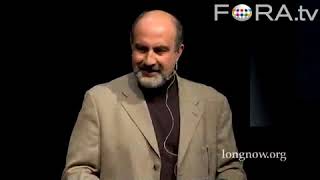 Nassim Nicholas Taleb on Black Swans: Why the Future Breaks Forecasts2007 · 88 min · full transcript
 Nassim Nicholas Taleb on Uncertainty and Robustness: Why Fragile Systems Break2007 · 52 min · full transcript
 Nassim Nicholas Taleb on Fat Tails: Why Extremistan Breaks Forecasting2019 · 123 min · full transcript
 Nassim Nicholas Taleb on Extreme Events: How to Live with Them2019 · 64 min · full transcript