How does Nassim Nicholas Taleb think about leverage and optimization?
Taleb argues that leverage and optimization make people and institutions more fragile because they remove slack. Financial leverage can amplify gains, but it also makes losses much worse when forecasts are wrong. The same logic applies to operations: when systems are over-optimized, even a small glitch can cause a big failure.
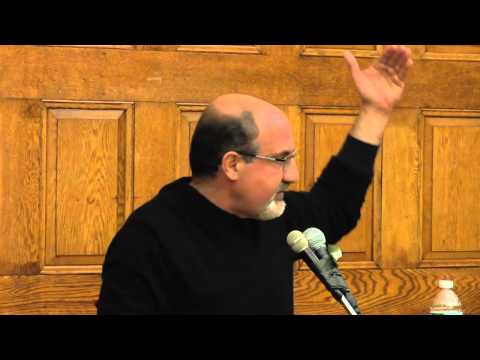
“At the same time, we had a rise of leverage. I'm not just talking about financial leverage. Financial leverage is only five times what it was in 1980, which is very dangerous, but operational leverage. People have no slack in systems. People are over optimized. Companies are very large, so it means more fragile to contingencies, and you get squeezed. Uh, let me discuss two things. Let me discuss first the notion of operational leverage or operational optimization, what I call optimization.”
Key takeaways
- Keep slack in systems.
- Borrowing is dangerous when certainty is overstated.
- Small disruptions can cascade in over-optimized systems.
Context
In the middle of his 2007 talk, Taleb shifts from books and technology to the rise of leverage and thinly buffered systems. The quote above is taken word for word from the recording's transcript.
In the transcript
…overseas by the way than here per capita, strangely. So you can sell—you can have a planetary phenomena like the Harry Potter read by every child on a, you know, almost every child on a planet, some obscenely large number. So we had the rise of that complexity exacerbated by globalization and the internet. Now, things run very smoothly under these conditions, except when there's an accident bad things can
At the same time, we had a rise of leverage. I'm not just talking about financial leverage. Financial leverage is only five times what it was in 1980, which is very dangerous, but operational leverage. People have no slack in systems. People are over optimized. Companies are very large, so it means more fragile to contingencies, and you get squeezed. Uh, let me discuss two things. Let me discuss first the notion of operational leverage or operational optimization, what I call optimization.
interesting thing, the, you know, love letters and stuff are boring old, you know, but hate mail there's some diversity there. So wanted to download my hate mail at the time. So I go in and plug my thing. It doesn't work. I call up receptionist. Okay, technician. All right. Oh, you're in room, uh, 1305. Yes. Yeah. I know. Yeah, no, it should be working. Okay. The guy had…
Topics
What others said about risk
More questions about Nassim Nicholas Taleb
- What did Nassim Nicholas Taleb say about fat tails and what to do when you face them?
- What does Nassim Nicholas Taleb say about how to take risks without blowing up?
- What did Nassim Nicholas Taleb say about the precautionary principle and uncertainty?
- What did Nassim Nicholas Taleb say about debt and leverage?
- What did Nassim Nicholas Taleb say about debt and fragility?
- Does Nassim Nicholas Taleb think gasoline distribution can be antifragile?
All Nassim Nicholas Taleb answers · All Nassim Nicholas Taleb recordings
How this answer was made: the quote is checked word for word against the transcript of the recording and confirmed as the speaker's own words; the summary above it was drafted with AI from that transcript and quality-checked. Methodology and corrections.