Nassim Nicholas Taleb on Uncertainty
Taleb treats uncertainty as a permanent feature of life, so the smart response is to avoid ruin, distrust fragile predictions, and build options that gain from volatility.
- Uncertainty is not just missing information; in many domains, rare extremes dominate outcomes.
- Because prediction fails in fat-tailed worlds, Taleb prefers testing fragility over forecasting.
- The first rule is survival: never take risks that can wipe you out.
- Optionality beats certainty: keep downside small and upside open.
- Under uncertainty, robustness matters more than optimization, and simple heuristics often beat overfit models.

Uncertainty means living with outcomes that cannot be forecast well
Taleb’s starting point is that many important parts of life are shaped by events that are both hard to predict and massively consequential. History, markets, and social systems do not move in a smooth, average-driven way; they jump, and a few outliers can dominate everything that came before.123
That is why he is skeptical of confidence about the future. In domains with Black Swan dynamics or fat tails, not knowing the future is not a temporary inconvenience that better models will remove; it is a structural condition.453
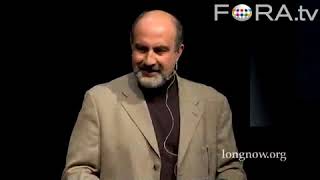
“…events of low predictability, high consequence.”Long Now Foundation talk, 2007 · full transcript →
Fat tails make standard reasoning about risk break down
Taleb argues that uncertainty becomes especially dangerous when distributions are fat-tailed. In those settings, extreme events are not minor exceptions around a stable center; they can dominate total outcomes, which means averages, regression-style intuitions, and ordinary comparisons can mislead.36
He repeatedly warns that the usual statistical shortcut of relying on mean outcomes is unsafe in these domains. Aggregate averages can hide what actually happens along a single path, and the return you expect from a distribution may not resemble the return you personally live through over time.789
This is also why he says many fields miss an extra layer of uncertainty: not just random outcomes, but randomness in the parameters themselves. When volatility varies, neat models become far less trustworthy than they appear.10
Don’t predict the shock; find what is fragile to the shock
Taleb’s practical move is to shift attention away from forecasting specific events and toward identifying fragility. If a person, institution, or strategy is damaged more than proportionally by volatility, then uncertainty is a threat regardless of whether you can name the next trigger in advance.111213
This leads to his famous three-part distinction. Fragile things are harmed by volatility, robust things resist it, and antifragile things benefit from it. For Taleb, the real opposite of fragile is not mere sturdiness but a structure that improves through stressors and variation.141516
He thinks many modern systems become dangerous precisely because they suppress small disturbances. When a system cannot use stress, adapt through error, or cleanse itself through small failures, it accumulates hidden risk and becomes vulnerable to large breaks.

“…whatever is fragile, instead of focusing on random events, once you know it's fat tails, you forget about the values, just focusing on how things react to random events.”Darwin College lecture, Cambridge, 2019 · full transcript →
The right response to uncertainty is survival first, optionality second
Taleb insists that uncertainty should be handled dynamically, not as a one-shot gamble. The first requirement is staying alive in the game, because no upside matters if a single loss can end your path.192021
From there, he favors optionality: arrange life so that losses are limited but gains remain open-ended. That means many small experiments, many exits, and no dependence on one irreversible plan.222324
This is why he praises trial and error and small distributed mistakes. If errors are affordable, you can learn from them and sometimes capture outsized upside; if errors are centralized and large, uncertainty becomes catastrophic.232526
He also connects optionality to precaution. When the downside is systemic, irreversible, or lethal, uncertainty is not a reason to gamble more boldly but a reason to refuse the bet.5

“…limit the losses, don't limit the gains…”New York Public Library conversation with Daniel Kahneman, 2012 · full transcript →
Under uncertainty, simplicity and redundancy beat over-optimization
Taleb argues that uncertainty punishes systems that are tightly optimized for a forecasted world. Optimization often assumes more knowledge than we really have, while robustness accepts ignorance and builds margins of safety.2829
That is why he is unusually friendly to heuristics. In messy environments, a simple rule with bounded downside can outperform complicated model-heavy approaches that look precise but are vulnerable to estimation error and hidden assumptions.3031
He extends this logic to redundancy as well. Spare capacity, cash, inventory, and decentralized structures can look inefficient in calm times, but they make systems more robust and sometimes antifragile when conditions change.3233

“Robustness is a goal under uncertainty, not optimization.”RiskMindsTV panel discussion, 2018 · full transcript →
Uncertainty also raises an ethical question: who bears the downside
For Taleb, uncertainty is not just a technical problem; it is also a moral one. A system becomes reckless when people keep the upside from risky behavior while passing losses to others.3435
That is why he cares so much about skin in the game. If someone creates uncertainty for others without sharing the downside, the system hides fragility and encourages ruinous behavior.3435
This is also why he is so critical of institutions that preserve failed structures instead of letting fragile parts break. In his view, suppressing consequences today often stores up larger risks for tomorrow.36

“…you cannot, you shall not be long an option, hidden option, at anyone else's expense…”Google Talks, 2007 · full transcript →
Taleb on uncertainty, in his own words
“…events of low predictability, high consequence.”
“I know nothing about the future.”
“…limit the losses, don't limit the gains…”
“Robustness is a goal under uncertainty, not optimization.”
Where to watch
 Nassim Nicholas Taleb on Antifragility and Uncertainty: Why Disorder Matters2007 · 66 min · full transcriptBest single overview of why Taleb treats prediction as weak and fragility-testing as the real response to uncertainty.
 Nassim Nicholas Taleb on Heuristics and Uncertainty: Less Is More2018 · 89 min · full transcriptBest for his distinction between risk and uncertainty, and why robustness and heuristics beat optimization.
 Nassim Nicholas Taleb on Risk, Fat Tails: Why Survival Comes First2023 · 44 min · full transcriptBest for the survival-first logic: non-ergodicity, ruin, and why averages can fail a real person over time.
 Nassim Nicholas Taleb on Extreme Events: How to Live with Them2019 · 64 min · full transcriptBest explanation of fat tails and why extreme events change how uncertainty must be understood.
 Nassim Nicholas Taleb on Optionality and Antifragility2012 · 59 min · full transcriptBest for optionality and trial-and-error as practical tools for acting under uncertainty.
 Nassim Nicholas Taleb on Precautionary Principle: Fat Tails and Risk2023 · 124 min · full transcriptBest for when uncertainty should trigger precaution instead of experimentation.
Questions people ask
- What did Nassim Nicholas Taleb say about calling out fraud?
- What did Nassim Nicholas Taleb say about how governments handle crises?
- What did Nassim Nicholas Taleb say about limited liability and bailouts?
- What did Nassim Nicholas Taleb say about the precautionary principle and uncertainty?
- Why did Nassim Nicholas Taleb say mistakes should be small and decentralized?
- Why does Nassim Nicholas Taleb favor optionality over rigid planning?
Sources
Every quote above, word for word from the transcripts. Numbers match the text.
“…events of low predictability, high consequence.”
“…history jumps. It doesn't crawl.”
“Fat tail distributions are one in which extreme events, the ones away from the center of the distribution, play a very large role.”
“I know nothing about the future.”
“…fat tailed. Must be fat tailed.”
“…you should never, never ever compare the means of fat tail distributions with thin tail distributions…”
“…the mean return is not the true return.”
“Things will never average out for you…”
“…the function of an average is not an average of a function…”
“…you're missing a layer of dimensionality in economics…”
“…what doesn't like variability is fragile…”
“…what is fragile doesn't like volatility, what is antifragile loves volatility…”
“…whatever is fragile, instead of focusing on random events, once you know it's fat tails, you forget about the values, just focusing on how things react to random events.”
“…the opposite of fragile is definitely not robust…”
“Antifragile is a category of object…”
“…a system that does not convert stressors, problems, variability into fuel is doomed…”
“…every single surviving trader or surviving risk-taking person knows that in order to succeed, you must first survive…”
“…first survive, because it's a condition…”
“I call it the Bob ruin problem…”
“…limit the losses, don't limit the gains…”
“Trial and error is an option.”
“I'm not quite opposed to planning. I'm opposed to, uh, planning like you're on a highway and with no exits; you suddenly have a problem, you can't exit. That's what I'm against. I'm in favor of planning if you have optionality to exit. See, an option benefits from uncertainty, you need options out. So, and there's something technical. A five-year plan is like a five-year option is not as good as a series of one-year plans, very adaptable. You're not—you can't take advantage of changes in the environment if you're planning.”
“When you can't avoid having mistakes, you want them to remain small. And typically, top-down things make large mistakes. This is what my idea of decentralization is: you have to decentralize the errors by making sure they remain small and distributed. Okay? But when you're willingly making errors because they're small and because they're not of huge cost, when you're willingly, then you want—you see, then you want to make error; you want to make a lot of errors because they're not as harmful. You see, and the payoff comes from it. But remember one thing: you saw my first graph where I was showing you the…”
“…convexity matters a lot more than knowledge.”
“Robustness is a goal under uncertainty, not optimization.”
“You need sufficiently simple models to have a robust solution.”
“…heuristics are not the stupid causes of all human disasters…”
“On Friday because supermarkets are empty. All right, this is sort of a heuristic. All right? You're not making a big deal out of it. You know, it's something that's a trick that works. The minute it doesn't work a couple of times, all right, this is it. Theistic has a small loss when it's wrong. You see, this is what defines to me convex heuristic: when it's wrong, the loss is small. So if you go to the store a couple of times on Monday or on Tuesday as compared to Friday, you see and see more food, then you revise your heuristic. You see? So you don't have to go through the analysis every time, and it sort of works, and being wrong by definition has a small cost. You see the idea—the—and, and you know, it's wrong. That's the beauty of…”
“Uh, okay, an antifragile system improves from stressors. So visibly, if they improve from stressors they had the structure, they probably have some amount of antifragility. But you need to be robust, so they probably moved towards robustness, and robustness requires, uh, some kind of redundancy, to have inventory. People think it's silly to have cash in a bank. You're more robust if you have cash in a bank, you see. And actually even antifragile because you can capture opportunities that way. So you see the idea of having more... Actually, I know, I wrote in a book. Actually, I wrote in this book about if you have excess inventory,…”
“People think they a cost. Okay, if you have excess humus in your basement, okay, the kind of inventory I have in my basement being Lebanese, you know, people think it's not a cost to have extra stockpile for companies because if there's a crisis, there's a squeeze, and the other people don't have what you need, the price of the commodity shoots up massively, and you can sell it. So having inventory is antifragile. And by, uh, I would have answered if I were you. I was expecting you to give a different answer. Well, what the antifragile antifragile would not be at the level of gasoline distribution. It would be at the level of transportation. I mean, gasoline is for a purpose, and the…”
“…you cannot, you shall not be long an option, hidden option, at anyone else's expense…”
“The, the, the—if it's used, okay, for this trial and error, then it's very good. If limited liability, if limited liability is used to transfer your losses to society so you get the bonus, the upside, and society gets the downside, then it's not good. You see, and what has happened in the capitalistic system is instead of having incentives and disincentives, we have some people who have the incentives, and then when they lose money, take banks—they make bonuses when they have good years, and then when they have a bad year, they transfer it to society, to the taxpayer, and they keep their bonuses, as we saw before. Again, remember the two kinds of payoff: the payoff where you…”
“…public debt is the mother of all fragilities…”
How this guide was made: drafted with AI from the full transcripts of the recordings cited, then checked: every quotation must match a transcript word for word and be the speaker's own words, and an independent review gates accuracy. Methodology and corrections.