Nassim Nicholas Taleb on Thinking & Rationality
Taleb treats rationality as behavior that survives contact with reality: use simple rules, respect fat tails, and align decisions with consequences.
- Rationality is what works under real uncertainty, not what looks elegant on paper.
- In complex domains, simple heuristics often beat optimization because estimation error and hidden fragility dominate.
- Good thinking starts by respecting fat tails and admitting that extreme events can dominate outcomes.
- The right aim is survival and robustness first, then upside through optionality and convex payoffs.
- A view deserves more trust when the person giving it bears the downside of being wrong.

“…the more uncertainty there is, the more certainty there is in what to do…”Talks at Google, 2017 · 13:03
For Taleb, rationality means surviving reality
Taleb’s basic standard for rational thought is not elegance, consistency with a formal model, or approval from experts. It is whether a way of acting survives contact with the real world, especially when the world is uncertain and hard to predict. That is why he emphasizes robustness over optimization and practical judgment over detached theorizing.123
He treats uncertainty as a reason to become more disciplined about action, not less. When the future is opaque, the task is to avoid ruin, reduce fragility, and choose actions that remain defensible under many possible futures. In that sense, uncertainty narrows what a rational person should do.45
This also explains his hostility to institutions insulated from consequences. A style of thinking that never gets corrected by reality can keep sounding sophisticated while drifting further from what is actually true or safe.1
“…the more uncertainty there is, the more certainty there is in what to do…”Talks at Google, 2017 · full transcript →
Simple heuristics are often more rational than complex models
Taleb rejects the idea that rationality always means more calculation. In many real situations, probabilities are not known well enough for optimization to work, and heavy modeling creates false confidence. Under uncertainty, the rational target is a robust solution, not a mathematically optimal one built on fragile assumptions.23
That is why he defends heuristics. A good heuristic is not a random shortcut; it is a simple rule that works tolerably well, is easy to revise, and does not produce catastrophic errors when wrong. He gives special weight to rules with small downside and open-ended upside, because they let you learn without blowing up.67
This fits his broader picture of knowledge. He is skeptical of the claim that formal institutions generate most useful knowledge, and instead gives priority to tinkering, trial and error, and practices shaped by repeated real-world use. Rationality, on this view, is often embedded in tested habits before it is captured in theory.9
Thinking goes wrong when you ignore fat tails and Black Swans
A central Taleb claim is that many important domains are not well described by ordinary bell-curve thinking. In markets, pandemics, and other open-ended systems, extreme events can dominate outcomes, so treating them as negligible outliers is a deep error in reasoning.1011
This is why he warns against standard forecasting habits. If major changes come from novel events, prediction by extrapolating the past is structurally limited. History does not unfold smoothly; it is punctuated by discontinuities and disproportionate shocks.121314
He also argues that many formal tools hide crucial layers of uncertainty. If volatility itself varies, if outcomes are nonlinear, and if averages conceal tail exposure, then familiar statistical intuitions become unreliable. A rational thinker must ask what kind of world he is in before trusting the output of a model.151617
The rational response to uncertainty is antifragility and optionality
Taleb does not stop at criticizing prediction. He proposes a positive style of reasoning: examine fragility instead of pretending to know the future. If something has much more downside than upside from volatility, it is fragile; if it can gain from disorder, it is antifragile. This makes rationality less about forecasting specific events and more about shaping exposures.181920
From there, the practical rule is to seek variability you can survive and avoid exposures that can end you. He favors arrangements where mistakes are informative but nonlethal, because those arrangements let learning accumulate while ruin stays off the table. Survival comes first; gains matter only if you are still around to collect them.215
Optionality matters for the same reason. Flexible plans with exits are more rational than rigid plans that assume the world will cooperate. If uncertainty is unavoidable, it is better to structure life and decisions so that favorable surprises help you more than unfavorable surprises hurt you.222324
Skin in the game is a test of whether reasoning is real
For Taleb, rationality is inseparable from moral symmetry. A judgment carries more weight when the person making it also bears the consequences of being wrong. This is not just an ethical preference; it is an epistemic filter that helps separate serious thought from cheap talk.26
That is why he distrusts experts, policymakers, and professionals who can impose downside on others while keeping upside for themselves. Without shared exposure, bad ideas can persist because their authors are evaluated by peers, status, or rhetoric instead of results. Skin in the game forces reality to do the judging.128
This principle scales from everyday conduct to public life. His negative golden rule and examples like the cook eating his own cooking express the same standard: do not ask others to bear risks you would not absorb yourself. Rationality, in practice, requires symmetry between advice and consequence.29
Taleb on thinking & rationality, in his own words
“…the more uncertainty there is, the more certainty there is in what to do…”
“You need sufficiently simple models to have a robust solution.”
Where to watch
 Nassim Nicholas Taleb on Heuristics and Uncertainty: Less Is More2018 · 89 min · full transcriptBest single entry on why simple heuristics can outperform optimization under uncertainty.
 Nassim Nicholas Taleb on Skin in the Game: Risk, Symmetry, and Reality2017 · 61 min · full transcriptShows how skin in the game turns rationality from abstract theory into consequence-bearing action.
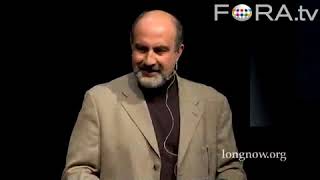 Nassim Nicholas Taleb on Black Swans: Why the Future Breaks Forecasts2007 · 88 min · full transcriptExplains why forecasting fails in Black Swan domains and why hindsight misleads thinking.
 Nassim Nicholas Taleb on Fat Tails: Why Extremistan Breaks Forecasting2019 · 123 min · full transcriptBest for understanding fat tails, Extremistan, and why standard statistical intuition breaks.
 Nassim Nicholas Taleb on Antifragility and Uncertainty: Why Disorder Matters2007 · 66 min · full transcriptDevelops the shift from prediction to fragility testing and antifragile design.
 Nassim Nicholas Taleb on Uncertainty And Fat Tails: Economics Needs Stochasticity2021 · 211 min · full transcriptMost technical treatment of nonlinear effects, unstable averages, and hidden stochasticity.
Questions people ask
- What did Nassim Nicholas Taleb say Hammurabi’s code means in Skin in the Game?
- What did Nassim Nicholas Taleb say about calling out fraud?
- What did Nassim Nicholas Taleb say about why tail risks matter more than frequency?
- What does Nassim Nicholas Taleb say about how to take risks without blowing up?
- When does Nassim Nicholas Taleb think military intervention is justified?
- What did Nassim Nicholas Taleb say about deadlifting and skin in the game?
Sources
Every quote above, word for word from the transcripts. Numbers match the text.
“Anything, like academia doesn't have contact with reality, collapses.”
“Robustness is a goal under uncertainty, not optimization.”
“You need sufficiently simple models to have a robust solution.”
“…the more uncertainty there is, the more certainty there is in what to do…”
“To make sure that survival comes first and everything else later. Take all the risks you want but make sure you're there tomorrow. It's a different class of risk taking than the one that takes risks for small return but can blow you up completely. It's [INAUDIBLE]. So last chapter of the book, The Logic of Risk Taking, it's actually should be a book on its own.”
“…heuristics are not the stupid causes of all human disasters…”
“On Friday because supermarkets are empty. All right, this is sort of a heuristic. All right? You're not making a big deal out of it. You know, it's something that's a trick that works. The minute it doesn't work a couple of times, all right, this is it. Theistic has a small loss when it's wrong. You see, this is what defines to me convex heuristic: when it's wrong, the loss is small. So if you go to the store a couple of times on Monday or on Tuesday as compared to Friday, you see and see more food, then you revise your heuristic. You see? So you don't have to go through the analysis every time, and it sort of works, and being wrong by definition has a small cost. You see the idea—the—and, and you know, it's wrong. That's the beauty of…”
“…the more you tear it apart, the more you debate it, the more you share it, the more you question it, the stronger it becomes…”
“…there is no such thing as a standard deviation in extremistan.”
“…events of low predictability, high consequence.”
“If you want to predict the future, you can't predict what new will happen.”
“…history jumps. It doesn't crawl.”
“I know nothing about the future.”
“You have to assume that you're in the second class of models…”
“…the function of an average is not an average of a function…”
“…you're missing a layer of dimensionality in economics…”
“…what doesn't like variability is fragile…”
“…the opposite of fragile is definitely not robust…”
“…what is fragile doesn't like volatility, what is antifragile loves volatility…”
“You should have as much variability as you can afford that's not lethal.”
“I'm not quite opposed to planning. I'm opposed to, uh, planning like you're on a highway and with no exits; you suddenly have a problem, you can't exit. That's what I'm against. I'm in favor of planning if you have optionality to exit. See, an option benefits from uncertainty, you need options out. So, and there's something technical. A five-year plan is like a five-year option is not as good as a series of one-year plans, very adaptable. You're not—you can't take advantage of changes in the environment if you're planning.”
“I realized, and I had, uh, you know, uh, an unintentional reward from having a tail exposure. So I realized that, I said, okay, you don't have to be a genius to figure out if the payoff can be so large, right, as to swamp the frequency. So I think that I was pretty convinced by, uh, September 1985 after the Plaza Accord had a 10 Sigma move.”
“…you don't have to be a genius to figure out if the payoff can be so large…”
“If you own it-- very simple. To shorten, it is justified if those who advocate for it are willing to pay the price if they're wrong. If you want you settle in Iraq in case something goes wrong? Be my guest. Go ahead and we're going to listen to your opinion. But you've got a price to pay if things go wrong. You want to settle in Libya? Go ahead. Today Libya has a slave market. Don't tell me that your thing was harmless. It's called iatrogenics. People should always pay for the iatrogenics.”
“…you cannot, you shall not be long an option, hidden option, at anyone else's expense…”
“But basically the most robust is the silver rule. You want as a business and anything, to treat others as a way-- you don't want to harm them, you want to treat them-- not treat them the way you wouldn't like them to treat you. It's called the negative golden rule. And of course, it has a lot of-- we can talk in the small and large. This is called hidden symmetries in daily life. And something quite obvious, as obvious as the cook should eat his or her cooking. It needs to apply everywhere. And these rules did prevail until recently. And we're going to see where they stopped prevailing. But they prevailed for a long time, until say, maybe a generation and a half ago, two generations ago.”
How this guide was made: drafted with AI from the full transcripts of the recordings cited, then checked: every quotation must match a transcript word for word and be the speaker's own words, and an independent review gates accuracy. Methodology and corrections.


