Jack Ma on Technology & the Future
Jack Ma sees technology as a tool that should expand human wisdom, creativity, health, and opportunity rather than replace human purpose.
- AI should support people, not define them
- Humans stay ahead through wisdom, heart, creativity, and dreams
- Education must change fastest because machines will do more routine cognitive work
- The future economy should be more inclusive, letting small businesses go global through digital infrastructure
- Technology matters most when it helps people live healthier, happier, and more meaningful lives

“It's not technology that changes the world; it's the dreams behind the technology that change the world.”Shanghai panel with Elon Musk, 2019 · 44:48
Technology should serve human beings, not become the point
Ma’s starting point is that technology is valuable only when it improves human life and helps solve real problems. He consistently argues that AI should support people, and that the real driver of change is human purpose rather than the tools themselves12.
That is why he ties the future of technology to health, sustainability, and the condition of life on Earth. He wants innovation aimed at cleaner, healthier, better living, not admiration for technology for its own sake.
He also warns against placing faith in machines while neglecting human aspiration. In his view, the future goes wrong when people attach their hopes to technology itself instead of to values, vision, and dreams6.
“It's not technology that changes the world; it's the dreams behind the technology that change the world.”Shanghai panel with Elon Musk, 2019 · full transcript →
Humans win through wisdom, heart, and imagination
Ma draws a sharp distinction between what machines do well and what people do well. Machines can accumulate knowledge and process information, but humans retain an advantage in wisdom and the human heart78.
For him, this is the central reason not to panic about AI. He does expect machines to become more capable than people in many tasks, but he does not believe that means human beings become obsolete, because wisdom is different from intelligence and cannot simply be engineered in the same way910.
This belief shapes his larger view of the future. The world should produce not just more smart people but wiser people, able to judge, restrain themselves, and act with values rather than merely optimize for efficiency1112.
Education is the main battleground of the future
Ma repeatedly says education is the area that must change fastest because the economy and workplace are changing faster than schools. If AI can handle more memory, calculation, and standard tasks, then education cannot keep training children to compete with machines at exactly those things1314.
His answer is to shift education toward creativity, constructive thinking, and independent judgment. He wants children to become more creative, because those are capacities that remain distinctly human in an AI age1516.
He also argues against one-size-fits-all industrial schooling. In the AI era, he wants differentiation instead of standardization, and he places unusual importance on early education rather than concentrating resources only at the university level1718.
AI will disrupt jobs, so societies must adapt instead of resist
Ma does not romanticize the transition ahead. He expects technological change to eliminate many jobs and create social strain, but he treats this as a reason to adapt faster, not to try to stop progress1920.
He imagines a future in which people may work less, live longer, and devote more time to life beyond employment. That view reflects his belief that the purpose of productivity gains is not endless labor, but more space for health, family, and fuller living21.
This is why he keeps returning to practical readiness. The future belongs to people and institutions that change themselves early rather than defend old models too long22.
“What I think is the next or 20–30 years, human being will live much longer. The life science technology is gonna make people live probably a hundred, a hundred twenty years. That may not be a good thing because you get a grandfather's grandfather still working hard. But the challenge is my question, why should we have a lot of jobs? I think people should work three days a week, four hours a day. When we have electricity, the power of electricity is that we make people more time so you can go to the kala. Okay, in the evening, you…”Shanghai panel with Elon Musk, 2019 · full transcript →
The next wave of technology should widen opportunity, especially for small business
Ma’s future is not only about AI inside firms; it is also about digital infrastructure across the economy. He argues that e-commerce, payments, logistics, broadband, and mobile connectivity together form the foundation that lets more people participate in growth2324.
He thinks globalization is not ending, but its next version must include the groups that benefited least from the last one. Small businesses, young people, and developing countries should be able to enter global trade directly through digital tools252627.
That is why he talks less about building one giant company and more about making the system itself more accessible. His future vision is structural: lower the friction so many more ordinary businesses can sell, pay, deliver, and grow across borders2428.
The practical mindset for the future is courage, focus, and long-term thinking
Ma’s advice on the future is not just institutional; it is personal. He thinks opportunity often appears where consensus is missing, so criticism and disagreement can be useful signals rather than reasons to retreat2922.
He also believes leaders waste energy when they obsess over investors or competitors instead of customers and teams. In a fast-changing world, durable progress comes from solving real problems for people and building with committed colleagues30.
Underneath this is a deeper point: the future should be approached with imagination rather than fear. People need dreams so they use technology as a tool for building something better instead of becoming passive extensions of machines62.
Ma on technology & the future, in his own words
“It's not technology that changes the world; it's the dreams behind the technology that change the world.”
Where to watch
 Jack Ma on AI and Human Futures: Focus on Earth2019 · 47 min · full transcriptBest overview of how Ma connects AI to human purpose, health, happiness, work, and the planet.
 Jack Ma on Education and Innovation: Teach Creativity, Not Machines2019 · 66 min · full transcriptBest for his argument that education must teach what machines cannot do.
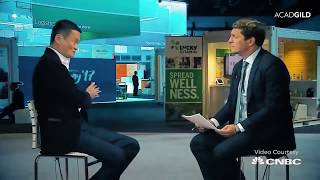 Jack Ma on Artificial Intelligence: Humans Win Through Wisdom2018 · 11 min · full transcriptConcise statement of his core distinction between machine knowledge and human wisdom.
 Jack Ma on Digital Trade For Small Businesses: Globalization 4.02019 · 32 min · full transcriptBest for seeing how his future outlook extends from AI to trade, SMEs, and global opportunity.
 Jack Ma on Education Reform: Teachers, Kids, and the Future2019 · 152 min · full transcriptBest for his fuller case that schools were built for the wrong era and must change quickly.
Questions people ask
- What did Jack Ma say AI should help humans do?
- What did Jack Ma say about artificial intelligence and human wisdom?
- What did Jack Ma say about helping the Earth instead of going to space?
- What did Jack Ma say about artificial intelligence and jobs?
- What did Jack Ma say about technology, dreams, and happiness?
- What did Jack Ma say about the future of jobs?
Sources
Every quote above, word for word from the transcripts. Numbers match the text.
“Artificial intelligence should support human beings.”
“It's not technology that changes the world; it's the dreams behind the technology that change the world.”
“If you don't have dreams, you are another wing of machines in the future.”
“Machine is good in knowledge, but human beings are good at the wisdom.”
“You can always make a machine to learn knowledge, but it is difficult for machines to have a human heart.”
“Artificial intelligence will never have wisdom.”
“Machine is good knowledge, but human beings are good at the wisdom. So that is why I'm encouraging a lot of governments, and talking to a lot of government offices, pay special attention to the education system. If you want, the machine is going to be smart, the human being. This is for sure. All right, I'm a guarantee, because the day when we design the machine, we know the machine is powerful, stronger than us. When we design the trains and buses, we know machines are going to run faster than us. When we have the computers, we have to know that machines are going to be smarter than us. But the human beings, they are not only smart, they have the wisdom. And so artificial intelligence will never have wisdom. No, no, no. It's about a valley. It's about wisdom. It's about experience.”
“Last century we made so many smart and clever people. This century we should create a lot of wise people.”
“Smart people know what they want. Wise people know what they don’t want.”
“…the thing that we need to change the fastest is the education system…”
“What education we should give our kids that they will be able to do the things better than machine?”
“Creative, constructive, I think very important: innovative, independent thinking.”
“We should make our kids to be more creative.”
“In the AI period, we want differentiation…”
“I call myself CEO, Chief Education Officer…”
“Finally, let's talk to our young people. The artificial intelligence is coming, as robots is going to replace a lot of jobs. But I'm building of a belief that 30 years later this new technology is going to create more jobs than today. Every technology overcomes the kill jobs, and then 30 years later those people who understand technology, who change themselves, they start to make more jobs. So pay attention to the kids…”
“Water is coming, let’s swim.”
“What I think is the next or 20–30 years, human being will live much longer. The life science technology is gonna make people live probably a hundred, a hundred twenty years. That may not be a good thing because you get a grandfather's grandfather still working hard. But the challenge is my question, why should we have a lot of jobs? I think people should work three days a week, four hours a day. When we have electricity, the power of electricity is that we make people more time so you can go to the kala. Okay, in the evening, you…”
“When people criticize you, now you have to think.”
“…e-commerce is the solution for sustainable growth.”
“We do not want to globalize Alibaba; we want to globalize e-commerce infrastructure.”
“The next generation of globalization should be inclusive…”
“Globalization actually, in the past 30, 40 years, helped a lot of countries to grow…”
“If they have a phone, they can go global by global sell, global deliver, global pay, and global travel.”
“WTO needs to be upgraded to the second version…”
“If everybody agrees, then there is no opportunity.”
“Spend time on your customers, spend time on your people, on your own team.”
How this guide was made: drafted with AI from the full transcripts of the recordings cited, then checked: every quotation must match a transcript word for word and be the speaker's own words, and an independent review gates accuracy. Methodology and corrections.


