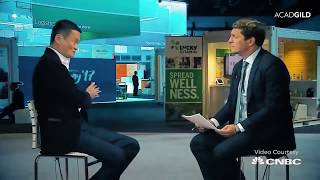
Jack Ma on Small Businesses
Jack Ma sees small businesses as the real winners of the internet era—if they get the right infrastructure, trust, and access to global markets.
- Small businesses are his core focus, not large incumbents.
- They win when platforms provide infrastructure: payments, logistics, data, and credit.
- The internet can let even tiny firms sell globally.
- Globalization should be redesigned to include SMEs, young people, and developing countries.
- Founders must adapt, learn from failure, and build teams instead of waiting for perfect conditions.

Small businesses are the mission, not a side effect
Ma does not describe Alibaba mainly as a retailer or a company trying to dominate transactions. He frames it as a system built to help small businesses grow, and he repeatedly puts entrepreneurs, young people, and underserved groups at the center of that mission.123
That leads to a very different definition of success. Instead of asking how big one company can become, he asks how many smaller firms can become capable, competitive, and durable. He even argues that a company at scale should focus less on short-term expansion and more on solving real social problems so it can last.5
“Alibaba is an ecosystem that helps small businesses to grow.”WSJD Live interview, 2015 · full transcript →
What small businesses really need is infrastructure
Ma’s central practical idea is that small businesses usually do not fail because they lack ambition. They fail because the surrounding systems are weak: trust is low, payments are hard, logistics are fragmented, and finance is inaccessible. His answer is to build infrastructure that lowers those barriers.167
That is why he insists Alibaba should be understood as business infrastructure rather than a company that simply buys and sells goods. In his view, marketplaces matter, but they only work at scale when paired with payments, delivery networks, data, and other services that let small firms operate like much bigger ones.189
He extends the same logic beyond one company or one country. The goal is not to spread a single brand everywhere, but to spread the capabilities that allow people and businesses to trade online.7
The internet lets small firms go global
Ma believes technology has changed globalization’s basic unit from the giant corporation to the small business. A phone, internet access, digital payments, and delivery systems can give tiny firms access to customers that used to be reachable only by multinationals.119
That is why he talks so often about helping local sellers reach foreign buyers. He presents cross-border e-commerce as a concrete path for small firms, farmers, and entrepreneurs to sell distinctive products to the world instead of depending only on domestic demand.1213
He also treats this as a broad economic shift, not a narrow Alibaba story. In his view, the next phase of globalization should help small businesses go globally, because the internet now makes that possible in a way older trade systems did not.1415
Inclusive globalization matters because the old model favored the big
Ma is not anti-globalization. He argues that globalization created enormous growth, but he also says its gains were distributed unevenly, with large companies and richer economies benefiting more than small firms and developing countries.1614
So his position is reform, not retreat. Trade should continue, but the rules and infrastructure should be upgraded so ordinary entrepreneurs can participate, not just large exporters with political influence and deep capital.1517
This is also why he emphasizes public investment in people and systems. If governments want small businesses to thrive, they should spend on infrastructure, education, and the people being left behind by economic change.17

“…you're supposed to spend money on your own people…”World Economic Forum interview, Davos, 2018 · full transcript →
For founders, the job is to adapt, persist, and build trust
Ma’s advice to small business owners is demanding but simple: do not wait for ideal circumstances. Start, adapt, and keep going through rejection and mistakes. He treats resilience as a basic operating requirement for entrepreneurs.192021
He also pushes founders to look inward before blaming markets or competitors. When conditions change, the first move is to change yourself, your model, your team, and your skills.2223
Finally, he sees trust and teamwork as decisive. Digital business works only when customers trust the system, and no founder can solve technology, operations, and scale alone. Small businesses need reliable teams and transparent systems as much as they need a good product.6
“It's trust, right? It's the trust, its ability to trust others, and it's about transparency.”WSJD Live interview, 2015 · full transcript →
Ma on small businesses, in his own words
“Alibaba is an ecosystem that helps small businesses to grow.”
“We do not want to globalize Alibaba; we want to globalize e-commerce infrastructure.”
“I want to help you to sell your great stuff to the world using internet.”
“…we love small business, we love young people, we love women.”
Where to watch
 Jack Ma on Entrepreneurial Infrastructure: Building for Small Businesses2015 · 68 min · full transcriptBest single explanation of Ma’s idea that small businesses need infrastructure, not just a marketplace.
 Jack Ma on Digital Trade For Small Businesses: Globalization 4.02019 · 32 min · full transcriptBest overview of how Ma thinks digital trade can let SMEs participate in globalization.
 Jack Ma on Inclusive E-Commerce: Globalize the Infrastructure2018 · 64 min · full transcriptShows why he wants to globalize e-commerce infrastructure rather than simply expand one company.
 Jack Ma on the China Opportunity: Small Businesses Can Go Global2017 · 57 min · full transcriptUseful if you want the practical case for how small businesses can use the China opportunity and go global.
 Jack Ma on Alibaba Strategy: Ecosystem for Small Businesses2015 · 36 min · full transcriptGood concise interview on Alibaba as an ecosystem built to help small businesses grow.
Questions people ask
- What did Jack Ma say about Alibaba’s goal in Russia?
- What did Jack Ma say about globalization and small businesses?
- What did Jack Ma say entrepreneurs should take away from his talk?
- Why did Jack Ma say Alibaba must think long term?
- Why does Jack Ma think small businesses are the future of globalization?
- What did Jack Ma say about changing the world and self-improvement?
Sources
Every quote above, word for word from the transcripts. Numbers match the text.
“…we are infrastructure of business in China.”
“…we love small business, we love young people, we love women.”
“Alibaba is an ecosystem that helps small businesses to grow.”
“To me, I think, you know, I don't worry about today Alibaba business. I don't worry about next three years because whatever we have done today, we've been working for 15 years for today and next three years. But what I'm worried about is ten years later what we should do. Company like us, it's so difficult to catch one or two opportunities to make our business sustained. So company like us, we have to solve social problems. We only solved the social problems we can last long. That's a pretty big mission as well. You know, small companies catch one or two opportunities, but company like our size you have to think about the future, right? So I think in 10 years China has two problems which…”
“It's trust, right? It's the trust, its ability to trust others, and it's about transparency.”
“We do not want to globalize Alibaba; we want to globalize e-commerce infrastructure.”
“We do not buy and sell.”
“…e-commerce is the solution for sustainable growth.”
“If they have a phone, they can go global by global sell, global deliver, global pay, and global travel.”
“I want to help you to sell your great stuff to the world using internet.”
“…when trade stops, the world stops…”
“In the past 20 years, globalization is more like Americanization. Helping big companies going, oh, does not mean bad. Contribute the world a lot, the past globalization, helping big companies going global. But I think because of the internet, next 30 years globalization should help small business going globally. For China, because of us, last year, we created at least 14 million jobs for China by helping small business, by enabling small business with the technology we have, with the resources we gather together. So if we can help more small business in the world, we can help millions and millions of people create jobs innovations.”
“WTO needs to be upgraded to the second version…”
“Globalization actually, in the past 30, 40 years, helped a lot of countries to grow…”
“…you're supposed to spend money on your own people…”
“The only thing, we never give up.”
“If you don't do it, nothing's possible.”
“Failure never stopped me and trained me.”
“Don't change the rabbit, change yourself.”
“Now I think if you want to change the world, change yourself. Change yourself is more important and easier than change the world. And second is that I want to improve the world, because to change the world maybe Obama's job, because my job is to make sure that my team are happy. Because my team are happy, they can make my customers happy. If my customers, they are all small business owners; when they're happy, we are happy.”
How this guide was made: drafted with AI from the full transcripts of the recordings cited, then checked: every quotation must match a transcript word for word and be the speaker's own words, and an independent review gates accuracy. Methodology and corrections.