Jack Ma on Long-Term Thinking
Jack Ma treats long-term thinking as building for the next decade: solve real social problems, strengthen people and culture, and design organizations that can outlast the founder.
- Think beyond the next quarter or even the next three years; ask what matters in 10 years.
- A big company lasts by solving social problems, not just chasing business opportunities.
- Build infrastructure that helps others grow, especially small businesses.
- Long-term leadership requires culture, trust, teamwork, and successors who can carry the mission forward.
- Treat worry, criticism, and change as signals about the future, not reasons to freeze.
Start with the next 10 years, not just the next few
Ma draws a sharp line between running for today and building for durability. He says he is less worried about the present or even the next three years because those results come from work already done; the real question is what the company should do 10 years later. That is his basic standard for long-term thinking: move attention from immediate performance to future relevance.
He also sees large companies differently from small ones. A small company may survive by catching one or two opportunities, but a company at scale has to think about the future in a broader way. For Ma, size creates a responsibility to look farther ahead.
Endurance comes from solving social problems
Ma's most practical test for long-term strategy is whether a company solves problems society will keep having. He argues that large companies last only if they address real social needs, not if they simply exploit short-lived openings. That is why he links durability to mission rather than to product categories.
He points to areas like health, education, mental health, environment, and the quality of life as the kinds of needs that matter over time. On climate in particular, he is blunt: if the planet's environment is damaged, wealth and business success will not protect anyone from the consequences. Long-term thinking therefore includes acting on problems that are bigger than the company itself.
This also shapes how he sees opportunity. He repeatedly says that worry and criticism often point to what matters next. For him, the places where people are anxious are often exactly where long-term builders should focus.
Build infrastructure, not just a business hit
Ma does not frame enduring success as winning a single market battle. He describes Alibaba as infrastructure for business and as an ecosystem that helps small businesses grow. That reflects a long-term mindset: create systems other people can rely on, rather than depending on one product or one transaction stream.
His focus on small businesses is part of the same logic. If globalization and technology help only large firms, the gains stay narrow; if they help small firms participate, the system becomes broader and more resilient. Long-term thinking, in his view, means enabling millions of others to create value, jobs, and innovation.
He applies this infrastructure idea beyond commerce. He talks about building talent and policy support for philanthropy, showing that durable change needs institutions, trained people, and rules that let good work continue. The pattern is consistent: think in platforms, capabilities, and ecosystems.
Put people, trust, and culture at the center
Ma does not think long-term leadership is mainly about tighter control or better prediction. He argues that nobody is an expert on tomorrow, which means organizations need adaptability more than certainty. In that world, human judgment, values, and creativity matter more, not less.
That is why he emphasizes trust and transparency. A company that wants to last cannot rely only on rules or hierarchy; it needs people who can work through uncertainty together. For Ma, trust is not a soft extra but one of the foundations of an enduring organization.
He also says founders should spend less time obsessing over investors and competitors and more time on customers and their own people. Long-term thinking is therefore relational: strengthen the team, stay close to users, and build a culture that can absorb change.
Think beyond yourself: succession is part of strategy
Ma treats succession as a long-term leadership duty, not a personal drama. He says stepping back was planned over years, and he warns that often the problem is not that a company cannot function without the founder, but that the founder cannot leave. That is a direct challenge to leaders who confuse their own presence with the organization's future.
He also distinguishes between having a team and having teamwork. Long-term organizations need more than talented individuals; they need a way of working together that survives transitions. That makes succession less about naming one heroic replacement and more about building an institution that can keep learning.
This fits his broader view that leadership should prepare the next generation rather than trying to control everything forever. If a company depends completely on its founder, it may look strong in the short term but weak over the long term.
Use criticism and uncertainty as future signals
Ma often links long-term thinking with a willingness to see what others dismiss. He says that if everybody agrees, there is no opportunity, and that criticism should make you think rather than retreat. For him, consensus often points to the present, while disagreement can reveal the future.
He applies the same logic to worry. When people start to worry, he sees that as opportunity, not because fear is good in itself, but because it reveals unmet needs and coming changes. Long-term thinkers pay attention to discomfort early.
At the same time, he pairs this with responsibility. Long-term vision is not fantasy or blind optimism; it requires action, learning, and respect for realities beyond your own bubble. That is why he stresses seeing the world firsthand and staying open to different people and cultures when making decisions about the future.
Where to watch
 Jack Ma on Alibaba Strategy: Ecosystem for Small Businesses2015 · 36 min · full transcriptBest single overview of Ma's view that big companies must think 10 years ahead and solve social problems.
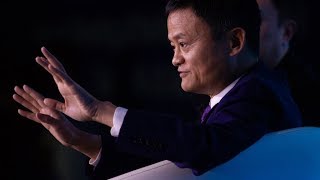 Jack Ma on Retirement and Succession: Why He Stepped Back2017 · 48 min · full transcriptShows how long-term thinking changes leadership: succession, letting go, and building teamwork beyond the founder.
 Jack Ma on Entrepreneurial Infrastructure: Building for Small Businesses2015 · 68 min · full transcriptExplains Ma's infrastructure mindset: build systems that help small businesses grow over time.
 Jack Ma on Climate Change: Business Must Act Now2017 · 25 min · full transcriptConnects long-term strategy to climate, survival, and acting on problems that outlast business cycles.
 Jack Ma on Leadership For The Future: Build Human, Not Machine2019 · 56 min · full transcriptUseful for understanding why Ma ties the future to human values, adaptability, and culture rather than control.
 Jack Ma on Entrepreneurship and Future Thinking: Embrace Change2017 · 50 min · full transcriptBest for his view that criticism, disagreement, and change are clues about future opportunity.
Questions people ask
- What did Jack Ma say about globalization and small businesses?
- Why did Jack Ma say Alibaba must think long term?
- What did Jack Ma say about philanthropy in China?
- What did Jack Ma say about understanding other cultures?
- What did Jack Ma say about what people should focus on for the future?
- What did Jack Ma say about technology, dreams, and happiness?
How this guide was made: drafted with AI from the full transcripts of the recordings cited, then checked: every quotation must match a transcript word for word and be the speaker's own words, and an independent review gates accuracy. Methodology and corrections.