Jack Ma on Artificial Intelligence
Jack Ma sees AI as powerful and disruptive, but believes humans keep the advantage through wisdom, heart, creativity, and values.
- AI will outperform humans in knowledge and many tasks, but not in wisdom or heart.
- He does not think people should fear AI; it should support human beings and solve real problems.
- The biggest response to AI is education reform toward creativity, independence, and differentiation.
- AI will disrupt jobs and cause pain, so societies must help people adapt rather than try to stop change.
- Technology matters less than the human dreams, values, and mission guiding it.

“Machine is good in knowledge, but human beings are good at the wisdom.”World Economic Forum interview, Davos, 2018 · 0:00
AI is strong at knowledge, but humans win through wisdom
Ma draws a clear line between what machines do best and what people do best. In his view, AI can become superior at knowledge, calculation, and many forms of trained intelligence, but that does not make it superior in the most important human capacities. He repeatedly says the human edge is wisdom rather than raw intelligence.123
He also ties that human advantage to heart, not just cognition. Machines may have chips and powerful learning systems, but he argues they do not have the human heart, which is why he does not see AI as the final winner over humanity.456
“Machine is good in knowledge, but human beings are good at the wisdom.”World Economic Forum interview, Davos, 2018 · full transcript →
He thinks AI should support people, not replace human purpose
Ma is not anti-technology. He argues that AI should be directed toward helping human beings and tackling hard real-world problems, including making life healthier and improving the planet people actually live on.78
That is why he keeps bringing the conversation back to human purpose. Technology alone does not change the world in the right direction; what matters is the dream, mission, and values behind it. Without that, people risk becoming extensions of machines instead of using machines to serve human goals.91011

“Artificial intelligence should support human beings.”World Economic Forum interview, Davos, 2018 · full transcript →
The real AI challenge is education
For Ma, the most urgent response to AI is not panic but education reform. If machines will remember more, calculate faster, and perform many standard tasks better than people, then schools must stop training children for machine-like competition.612
He argues that children need creativity, constructive thinking, innovation, and independent judgment. In the AI era, education should produce wise people, not just smart test-takers, and it should emphasize differentiation rather than industrial-age standardization.1314151617
This is also why he places so much weight on early education. The goal is to develop capacities machines cannot easily copy, rather than doubling down on the exact skills software and robots are steadily absorbing.1216

“What education we should give our kids that they will be able to do the things better than machine?”KIEF 2019 dialogue in Kyiv · full transcript →
AI will disrupt jobs, but fear is the wrong response
Ma does not minimize the disruption ahead. He expects AI and related technologies to replace many jobs and create significant social pain over the next decades, which means governments, businesses, and workers need to prepare seriously.318
But he still resists the idea that the right answer is to fear technology or try to freeze the world in place. His instinct is that change creates opportunity, and that people who understand technology and change themselves will eventually create new forms of work and value.191820
His broader message is confidence in human adaptability. He urges people to trust human beings and especially young people, rather than assume AI means inevitable human defeat.216

“But don't worry about it. Machines can never win human beings. Machines can do only things machines can do better. Human beings have hearts; machines don't. Only machines only have chips. So what worried me about is the way the things, the cat, that all the things would teach our kids today how to remember more things, calculate faster; all these things machines would do better. Next 30 years, what are the things we should teach our kids that they will be different? They can do better. They can do the things machines cannot do.”Tel Aviv University inspirational dialogue, 2018 · full transcript →
A better AI future depends on inclusive progress and human-centered leadership
Ma does not treat AI as a purely technical issue. He links it to globalization, opportunity, and whether ordinary people and small businesses can benefit from technological change instead of being left behind.22
He also argues that tomorrow cannot be led with yesterday's expertise alone. In a fast-changing AI era, leaders need optimism, values, and cultures that develop people rather than controlling them rigidly.235
That is consistent with his larger belief that human beings are the most important resource. If societies want AI to improve life rather than deepen instability, they need to invest in people, especially their ability to learn, adapt, and act with wisdom.242322

“The machine in the future, they have chips, but human beings have the heart.”World Economic Forum Meet the Leader, Davos 2019 · full transcript →
Ma on artificial intelligence, in his own words
“Machine is good in knowledge, but human beings are good at the wisdom.”
“Artificial intelligence will never have wisdom.”
“You can always make a machine to learn knowledge, but it is difficult for machines to have a human heart.”
“Artificial intelligence should support human beings.”
“What education we should give our kids that they will be able to do the things better than machine?”
“The machine in the future, they have chips, but human beings have the heart.”
Where to watch
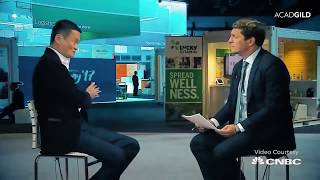 Jack Ma on Artificial Intelligence: Humans Win Through Wisdom2018 · 11 min · full transcriptBest short overview of Ma’s core AI argument: machines take knowledge, humans keep wisdom.
 Jack Ma on AI and Human Futures: Focus on Earth2019 · 47 min · full transcriptShows how he connects AI to human purpose, health, the planet, and confidence in humanity.
 Jack Ma on Education and Innovation: Teach Creativity, Not Machines2019 · 66 min · full transcriptBest on what education must change if AI will do many current school-trained tasks better.
 Jack Ma on Education Reform: Teachers, Kids, and the Future2019 · 152 min · full transcriptExpands the education argument into a full case for reform in the AI era.
 Jack Ma on Globalization and Technology: Make Trade Inclusive2018 · 58 min · full transcriptConnects AI to inclusive globalization and the need to make technological progress benefit more people.
Questions people ask
- What did Jack Ma say AI should help humans do?
- What did Jack Ma say about artificial intelligence and human wisdom?
- What did Jack Ma say about helping the Earth instead of going to space?
- What did Jack Ma say about artificial intelligence and jobs?
- What did Jack Ma say about technology, dreams, and happiness?
- What did Jack Ma say schools should teach instead of memorization?
Sources
Every quote above, word for word from the transcripts. Numbers match the text.
“Machine is good in knowledge, but human beings are good at the wisdom.”
“Artificial intelligence will never have wisdom.”
“Machine is good knowledge, but human beings are good at the wisdom. So that is why I'm encouraging a lot of governments, and talking to a lot of government offices, pay special attention to the education system. If you want, the machine is going to be smart, the human being. This is for sure. All right, I'm a guarantee, because the day when we design the machine, we know the machine is powerful, stronger than us. When we design the trains and buses, we know machines are going to run faster than us. When we have the computers, we have to know that machines are going to be smarter than us. But the human beings, they are not only smart, they have the wisdom. And so artificial intelligence will never have wisdom. No, no, no. It's about a valley. It's about wisdom. It's about experience.”
“You can always make a machine to learn knowledge, but it is difficult for machines to have a human heart.”
“The machine in the future, they have chips, but human beings have the heart.”
“But don't worry about it. Machines can never win human beings. Machines can do only things machines can do better. Human beings have hearts; machines don't. Only machines only have chips. So what worried me about is the way the things, the cat, that all the things would teach our kids today how to remember more things, calculate faster; all these things machines would do better. Next 30 years, what are the things we should teach our kids that they will be different? They can do better. They can do the things machines cannot do.”
“Artificial intelligence should support human beings.”
“I want to stay on this Earth. I want to work on this Earth. I want to do anything I can to help this Earth to be better because even if we go to space, it's great, but if we can spend those resources just to focus on helping pick up the garbage from the oceans, that thing is more difficult than to go to Mars. But artificial intelligence can help us achieve that and solve the problems. And secondly, human beings can live better, can live longer, but what we need is not only to live longer, we want to live healthier.”
“It's not technology that changes the world; it's the dreams behind the technology that change the world.”
“Think I'm 100% sure people will live longer, people will live healthier, but may not necessarily live happier. If you want to be happier, human beings, you focus on a value, the vision, and the mission, and always have the dreams. And I don't want people to love technology and put their dreams on the technology. I think that technology should be with dreams. It's not technology that changes the world; it's the dreams behind the technology that change the world. So, my hope is that anything we can do to improve this road to helping 7.5—…”
“If you don't have dreams, you are another wing of machines in the future.”
“What education we should give our kids that they will be able to do the things better than machine?”
“Creative, constructive, I think very important: innovative, independent thinking.”
“We should make our kids to be more creative.”
“Last century we made so many smart and clever people. This century we should create a lot of wise people.”
“…the thing that we need to change the fastest is the education system…”
“In the AI period, we want differentiation…”
“Finally, let's talk to our young people. The artificial intelligence is coming, as robots is going to replace a lot of jobs. But I'm building of a belief that 30 years later this new technology is going to create more jobs than today. Every technology overcomes the kill jobs, and then 30 years later those people who understand technology, who change themselves, they start to make more jobs. So pay attention to the kids…”
“When people start to worry, you think this is opportunity.”
“When people criticize you, now you have to think.”
“Billion people live better and live healthier, and this is all about our world. And I think we will be working very happily because I love your product Tesla, you know, making the world cleaner and no noise and such great technology. I'm happy you have a Tesla factory in China, and I think we need to do more things to improve this Earth, improve this world, and make sure that people are happier and people care about the family, people care about the house. That's all we should do and trust us, trust human beings, and trust young people. Let's take responsibility for today, but let's not take away all the solutions—…”
“The next generation of globalization should be inclusive…”
“There is no expert of tomorrow; there's only expert of yesterday.”
“The best resource on the earth, and not the coal, not the oil, not the electricity, is the human brains.”
How this guide was made: drafted with AI from the full transcripts of the recordings cited, then checked: every quotation must match a transcript word for word and be the speaker's own words, and an independent review gates accuracy. Methodology and corrections.

