Jack Ma on Life Lessons
Jack Ma treats life as a long game of self-change: keep your dreams, learn from rejection, focus on people, and adapt to each new stage with optimism.
- Do not expect an easy life; expect setbacks and keep going
- When the world is hard to change, start by changing yourself
- Dreams, values, and people matter more than technology alone
- Criticism, rejection, and complaints often point to opportunity
- A good life changes by stage: do meaningful work, build teams, and know when to let go

Resilience is the starting point of Ma's life philosophy
Ma returns again and again to a simple lesson: life will reject you, and that is not the end. His basic rule is persistence, not self-pity. What matters is continuing to act even when the odds look bad, because possibility only opens after action123.
He also treats failure as training rather than humiliation. In his view, mistakes do not permanently define you; what changes their meaning is whether you keep building. That is why he links success less to smooth performance than to endurance over time43.
Change yourself before trying to change the world
One of Ma's clearest life lessons is that self-correction is more useful than blaming circumstances. He argues that when reality does not match what you want, the first move is not to demand a different world but to become more capable, flexible, and clear yourself56.
This is connected to how he sees opportunity. Complaints, criticism, and disagreement are not just annoyances; they are signals that something important is being missed. Instead of resisting bad news, he thinks you should use it to think harder and adjust faster789.
Dreams and values matter more than status or technology
Ma's life advice is strongly anti-cynical. He believes people need dreams, vision, and mission, especially in a world shaped by powerful technology. Tools matter, but they do not supply meaning; without dreams, people become passive and machine-like101112.
That is why he is so focused on the distinctly human side of life. He emphasizes wisdom, creativity, and the inner life over memorization or mechanical skill. Machines may become smarter at narrow tasks, but he insists humans must develop the capacities that give life direction and depth13141516.
A good life is built around people, not ego
Ma's practical advice is to spend less energy on image, rivals, or outside approval and more on the people you serve and the people you build with. He repeatedly points back to customers, teammates, and shared effort as the center of meaningful work171819.
This also explains why he describes leadership in teaching terms. He sees the job of a leader as developing others, not just commanding them. Teamwork is a discipline of listening, trust, and shared growth, which is different from merely gathering talented people in one place202119.
Live in stages and know when to let go
Ma does not frame success as clinging forever to one role. He sees life as having stages, each with different responsibilities and limits. Part of maturity is recognizing what you can do, what others can do better, and when continuing to hold on becomes a form of attachment rather than purpose.
This broader perspective includes how to handle noise and uncertainty. He advises emotional steadiness in the face of gossip, misunderstanding, and turbulent conditions, because public opinion is always unstable. A grounded life depends more on long-term purpose, health, and contribution than on constant control242526.
He also widens the lesson beyond career. For Ma, a worthwhile life should improve the world people actually live in, help others live better and healthier, and stay connected to family, young people, and the future of society2627.
Ma on life lessons, in his own words
“The only thing, we never give up.”
“Don't change the rabbit, change yourself.”
Where to watch
 Jack Ma on Rejection and Resilience: "Never Give Up"2015 · 45 min · full transcriptBest for Ma's core lesson on rejection, persistence, and acting instead of complaining.
 Jack Ma on Failure & Opportunity: Build the Future by Helping Others2018 · 64 min · full transcriptBest for how he turns failure, long-term thinking, and teamwork into practical life advice.
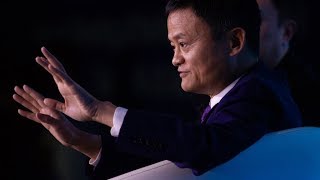 Jack Ma on Retirement and Succession: Why He Stepped Back2017 · 48 min · full transcriptBest for his mature view of life stages, letting go, gossip, and what leadership means over time.
 Jack Ma on Education And Entrepreneurship: Build for the Future2018 · 49 min · full transcriptBest for his advice on staying human through creativity, education, and self-expression.
 Jack Ma on AI and Human Futures: Focus on Earth2019 · 47 min · full transcriptBest for his big-picture life view on dreams, happiness, health, and technology's place.
Questions people ask
- What did Jack Ma say AI should help humans do?
- What did Jack Ma say about helping the Earth instead of going to space?
- What did Jack Ma say about changing the world and self-improvement?
- What did Jack Ma say about technology, dreams, and happiness?
- What did Jack Ma say about understanding other cultures?
- What did Jack Ma say schools should teach instead of memorization?
Sources
Every quote above, word for word from the transcripts. Numbers match the text.
“The only thing, we never give up.”
“If you don't do it, nothing's possible.”
“Failure never stopped me and trained me.”
“I think if you succeed, every mistake becomes legendary.”
“Don't change the rabbit, change yourself.”
“Now I think if you want to change the world, change yourself. Change yourself is more important and easier than change the world. And second is that I want to improve the world, because to change the world maybe Obama's job, because my job is to make sure that my team are happy. Because my team are happy, they can make my customers happy. If my customers, they are all small business owners; when they're happy, we are happy.”
“Opportunity always exists in the place where people complain.”
“If everybody agrees, then there is no opportunity.”
“When people criticize you, now you have to think.”
“It's not technology that changes the world; it's the dreams behind the technology that change the world.”
“If you don't have dreams, you are another wing of machines in the future.”
“Think I'm 100% sure people will live longer, people will live healthier, but may not necessarily live happier. If you want to be happier, human beings, you focus on a value, the vision, and the mission, and always have the dreams. And I don't want people to love technology and put their dreams on the technology. I think that technology should be with dreams. It's not technology that changes the world; it's the dreams behind the technology that change the world. So, my hope is that anything we can do to improve this road to helping 7.5—…”
“Machines can never win human beings.”
“We should teach our kids how to be more innovative, how to be more creative, and how to be more constructive.”
“Machines are going to be smarter, but human beings are always wiser.”
“But don't worry about it. Machines can never win human beings. Machines can do only things machines can do better. Human beings have hearts; machines don't. Only machines only have chips. So what worried me about is the way the things, the cat, that all the things would teach our kids today how to remember more things, calculate faster; all these things machines would do better. Next 30 years, what are the things we should teach our kids that they will be different? They can do better. They can do the things machines cannot do.”
“Spend time on your customers, spend time on your people, on your own team.”
“Customer number one, employee number two, shareholder number three.”
“But I know if we want to realize our dream, we must have the technology. But if I don't know the technology, we should invite the best engineers and scientists. I work with them. I listen to them. Nobody can do anything alone. What you should do is always form a team. I think it is very difficult to make an exact company like Alibaba. Again,…”
“I call myself CEO, Chief Education Officer of the company.”
“The team is different from teamwork.”
“We need to learn to swim in the ocean of gossips.”
“Being an entrepreneur, in my experience, the economic outlook is always problematic for us.”
“I want to stay on this Earth. I want to work on this Earth. I want to do anything I can to help this Earth to be better because even if we go to space, it's great, but if we can spend those resources just to focus on helping pick up the garbage from the oceans, that thing is more difficult than to go to Mars. But artificial intelligence can help us achieve that and solve the problems. And secondly, human beings can live better, can live longer, but what we need is not only to live longer, we want to live healthier.”
“Billion people live better and live healthier, and this is all about our world. And I think we will be working very happily because I love your product Tesla, you know, making the world cleaner and no noise and such great technology. I'm happy you have a Tesla factory in China, and I think we need to do more things to improve this Earth, improve this world, and make sure that people are happier and people care about the family, people care about the house. That's all we should do and trust us, trust human beings, and trust young people. Let's take responsibility for today, but let's not take away all the solutions—…”
How this guide was made: drafted with AI from the full transcripts of the recordings cited, then checked: every quotation must match a transcript word for word and be the speaker's own words, and an independent review gates accuracy. Methodology and corrections.


