Jack Ma on China
Jack Ma sees China as a huge consumer and entrepreneurial opportunity that must shift from scale to quality, invest in people, and open global trade to small businesses.
- China’s biggest strength is people, not natural resources.
- He views China’s next stage as higher-quality growth built on small business, trust, and domestic consumption.
- He thinks China is a major opportunity for entrepreneurs worldwide, especially through the internet and cross-border trade.
- He argues China should invest more in its people through education, philanthropy, health, and social problem-solving.

“The best resource on the earth, and not the coal, not the oil, not the electricity, is the human brains.”Shanghai panel with Elon Musk, 2019 · 28:20
China’s real advantage is its people
Ma’s starting point is that China’s future does not rest on raw materials or cheap scale. He says the most important resource is human intelligence, and he ties China’s progress to whether people become more creative, wiser, and more capable of shaping technology rather than merely following it.12
That is why he is consistently optimistic about China even during periods of technological anxiety. He argues machines will outperform people in narrow tasks, but not in judgment, heart, or wisdom, so China’s long-term strength depends on developing human capabilities that machines cannot replace.345
“The best resource on the earth, and not the coal, not the oil, not the electricity, is the human brains.”Shanghai panel with Elon Musk, 2019 · full transcript →
He sees China moving from quantity growth to quality growth
Ma describes Alibaba not as a merchant but as business infrastructure inside China. His point is that the country’s next phase is not mainly about one company buying and selling more goods; it is about building systems that let millions of others operate better through commerce, payments, logistics, data, and trust.678
That view explains why he places so much weight on small businesses. He repeatedly says Alibaba exists to help them grow, and he links that mission to a broader shift in China’s economy toward entrepreneurship, better services, and broader participation instead of growth driven only by large-scale production.9810
Trust is a central part of this transition. Ma argues that an economy at China’s scale needs transparency and the ability to trust others, which is why he talks about systems and behavior change, not only transactions.11
China is a huge market, but the opening is for small businesses
When Ma talks about China as an opportunity, he does not frame it as a prize reserved for giant corporations. He urges entrepreneurs not to miss China and the internet, presenting them together as the big opening of the next decades.12
His broader argument is that globalization should no longer belong mainly to large firms. He wants many more small businesses to be able to buy and sell across borders, and he treats that as good for China and for the world because it spreads job creation and innovation more widely.1013
This is also why he opposes breakdowns in trade. In his view, trade is not just about moving products; it is one of the basic ways countries stay connected and economies keep moving.14

“Yeah, don't miss the opportunity. I think the next 30 years is the opportunity for people like us. The big companies, they have to look for a way to survive, but we have to look for a way to expand our business, to find more partners, and I think China is the best opportunity. Internet is the best opportunity. Don't miss it. This is what I want to say. Just try to learn, just like when I opened the Internet.”Gateway '17 Detroit talk, 2017 · full transcript →
China’s next challenge is education, not memorization
Ma thinks China cannot succeed in the next era by training children to do what machines already do better. He argues that schools should teach innovation, creativity, and constructive thinking, because those are the capacities that matter in an AI-heavy economy.155
His confidence about China’s future rests partly on this educational shift. He believes new technology will change jobs dramatically, but that people who understand technology and change themselves can create new work and new value.163
This is not a side issue in his view. It is part of national competitiveness: if China teaches memory and calculation while machines take those tasks over, it wastes human potential; if it teaches creativity and wisdom, it turns technological disruption into strength.52
He wants China to solve social problems with wealth and scale
Ma says large companies in China should think beyond the next few years and focus on social problems if they want to last. He specifically points toward future needs in areas such as health, education, and related social strains, arguing that endurance comes from solving real problems, not just capturing opportunities.17
That same logic shapes his view of public priorities. He says countries are supposed to spend money on their own people, which fits his repeated emphasis on education, infrastructure, and those left behind by economic change.18
He applies this to philanthropy as well. Rather than treating giving as informal charity, he talks about building Chinese philanthropy with trained talent, better management, and supportive policy, including work with Beijing University on formal training.19
Even his technology comments circle back to quality of life in China: healthier lives, a cleaner world, and a society that keeps dreams and human values ahead of technical tools.202122
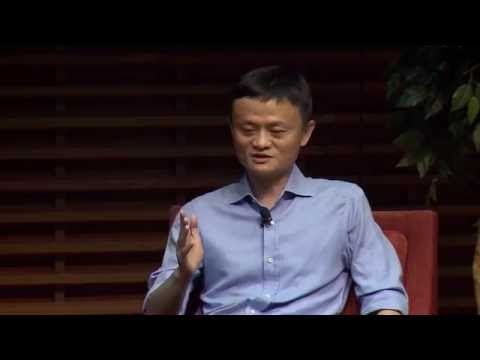
“I think what we will doing is to train a people who can do philanthropy properly, so that's why we will work with the Beijing University. Have the first master degree for philanthropy. Training people, develop people, how to manage the money, how to manage the project, how to do things better. I think we also have to work with the government to make a good policy program, so when we build up this infrastructure, talents and the policy, and I think they're coming. China philanthropy is coming but the key is; we need good infrastructure.”Stanford GSB Entrepreneurial Company of the Year interview, 2015 · full transcript →
Ma on china, in his own words
“The best resource on the earth, and not the coal, not the oil, not the electricity, is the human brains.”
Where to watch
 Jack Ma on the China Opportunity: Small Businesses Can Go Global2017 · 57 min · full transcriptBest for Ma’s direct case that China is a major opportunity for entrepreneurs and cross-border small business.
 Jack Ma on Entrepreneurial Infrastructure: Building for Small Businesses2015 · 68 min · full transcriptBest for how he interprets China’s economic transition through infrastructure, entrepreneurship, and small business.
 Jack Ma on Inclusive Globalization: Spend on Your People2018 · 32 min · full transcriptBest for his view of China inside a more inclusive form of globalization and trade.
 Jack Ma on Alibaba Strategy: Ecosystem for Small Businesses2015 · 36 min · full transcriptBest for his argument that China’s future depends on trust, ecosystems, and solving social problems.
 Jack Ma on Education And Entrepreneurship: Build for the Future2018 · 49 min · full transcriptBest for understanding why he thinks China must change education for the next era.
Questions people ask
- What did Jack Ma say about globalization and small businesses?
- What did Jack Ma say entrepreneurs should take away from his talk?
- Why did Jack Ma say Alibaba must think long term?
- Why does Jack Ma think small businesses are the future of globalization?
- What did Jack Ma say about artificial intelligence and jobs?
- What did Jack Ma say about philanthropy in China?
Sources
Every quote above, word for word from the transcripts. Numbers match the text.
“The best resource on the earth, and not the coal, not the oil, not the electricity, is the human brains.”
“It's not technology that changes the world; it's the dreams behind the technology that change the world.”
“Machines can never win human beings.”
“Machines are going to be smarter, but human beings are always wiser.”
“But don't worry about it. Machines can never win human beings. Machines can do only things machines can do better. Human beings have hearts; machines don't. Only machines only have chips. So what worried me about is the way the things, the cat, that all the things would teach our kids today how to remember more things, calculate faster; all these things machines would do better. Next 30 years, what are the things we should teach our kids that they will be different? They can do better. They can do the things machines cannot do.”
“…we are infrastructure of business in China.”
“We do not buy and sell.”
“Alibaba is an ecosystem that helps small businesses to grow.”
“…we love small business, we love young people, we love women.”
“In the past 20 years, globalization is more like Americanization. Helping big companies going, oh, does not mean bad. Contribute the world a lot, the past globalization, helping big companies going global. But I think because of the internet, next 30 years globalization should help small business going globally. For China, because of us, last year, we created at least 14 million jobs for China by helping small business, by enabling small business with the technology we have, with the resources we gather together. So if we can help more small business in the world, we can help millions and millions of people create jobs innovations.”
“It's trust, right? It's the trust, its ability to trust others, and it's about transparency.”
“Yeah, don't miss the opportunity. I think the next 30 years is the opportunity for people like us. The big companies, they have to look for a way to survive, but we have to look for a way to expand our business, to find more partners, and I think China is the best opportunity. Internet is the best opportunity. Don't miss it. This is what I want to say. Just try to learn, just like when I opened the Internet.”
“What if we can support 6 million, 60 million small businesses, they can go global, they can buy and sell? That thing will change very, very fast. So I think when the king is changing so fast, everybody here, every entrepreneur, you have to think about this: What does this change mean to me, to my kids? What should I change myself to meet the changes? What kind of things should I do about it? So I recommend to many government offices and I also would love to share this idea with many entrepreneurs here.”
“…when trade stops, the world stops…”
“We should teach our kids how to be more innovative, how to be more creative, and how to be more constructive.”
“Finally, let's talk to our young people. The artificial intelligence is coming, as robots is going to replace a lot of jobs. But I'm building of a belief that 30 years later this new technology is going to create more jobs than today. Every technology overcomes the kill jobs, and then 30 years later those people who understand technology, who change themselves, they start to make more jobs. So pay attention to the kids…”
“To me, I think, you know, I don't worry about today Alibaba business. I don't worry about next three years because whatever we have done today, we've been working for 15 years for today and next three years. But what I'm worried about is ten years later what we should do. Company like us, it's so difficult to catch one or two opportunities to make our business sustained. So company like us, we have to solve social problems. We only solved the social problems we can last long. That's a pretty big mission as well. You know, small companies catch one or two opportunities, but company like our size you have to think about the future, right? So I think in 10 years China has two problems which…”
“…you're supposed to spend money on your own people…”
“I think what we will doing is to train a people who can do philanthropy properly, so that's why we will work with the Beijing University. Have the first master degree for philanthropy. Training people, develop people, how to manage the money, how to manage the project, how to do things better. I think we also have to work with the government to make a good policy program, so when we build up this infrastructure, talents and the policy, and I think they're coming. China philanthropy is coming but the key is; we need good infrastructure.”
“I want to stay on this Earth. I want to work on this Earth. I want to do anything I can to help this Earth to be better because even if we go to space, it's great, but if we can spend those resources just to focus on helping pick up the garbage from the oceans, that thing is more difficult than to go to Mars. But artificial intelligence can help us achieve that and solve the problems. And secondly, human beings can live better, can live longer, but what we need is not only to live longer, we want to live healthier.”
“Think I'm 100% sure people will live longer, people will live healthier, but may not necessarily live happier. If you want to be happier, human beings, you focus on a value, the vision, and the mission, and always have the dreams. And I don't want people to love technology and put their dreams on the technology. I think that technology should be with dreams. It's not technology that changes the world; it's the dreams behind the technology that change the world. So, my hope is that anything we can do to improve this road to helping 7.5—…”
“Billion people live better and live healthier, and this is all about our world. And I think we will be working very happily because I love your product Tesla, you know, making the world cleaner and no noise and such great technology. I'm happy you have a Tesla factory in China, and I think we need to do more things to improve this Earth, improve this world, and make sure that people are happier and people care about the family, people care about the house. That's all we should do and trust us, trust human beings, and trust young people. Let's take responsibility for today, but let's not take away all the solutions—…”
How this guide was made: drafted with AI from the full transcripts of the recordings cited, then checked: every quotation must match a transcript word for word and be the speaker's own words, and an independent review gates accuracy. Methodology and corrections.

