Jack Ma on Leadership
Jack Ma sees leadership as teaching, building culture, and helping others grow so the organization can thrive beyond the founder.
- Leadership is about developing people, not controlling everything.
- Great leaders build culture and teamwork so smart people can manage themselves.
- Leaders stay optimistic in uncertainty and look for opportunity when others panic.
- A leader should serve customers and employees before personal status or shareholder pressure.
- Succession matters: leadership includes knowing when to leave space for the next generation.

“I call myself CEO, Chief Education Officer of the company.”University of Nairobi public lecture, 2018 · 5:07
Leadership means teaching people to become better
Ma repeatedly describes the leader as a teacher. His idea is not that a leader has all the answers, but that a leader helps other people grow, learn, and eventually do more than the founder can do alone.12
That fits his broader view that people are developed, not simply found ready-made. In practice, this means hiring for attitude and potential, then training, encouraging, and trusting people over time instead of expecting perfect talent on day one.
This also explains why he connects leadership to education so often. If the future rewards creativity, differentiation, and human judgment, then leaders must build those qualities in others rather than just enforce compliance.345
“I call myself CEO, Chief Education Officer of the company.”University of Nairobi public lecture, 2018 · full transcript →
The leader's job is to build teamwork, not be the hero
Ma's leadership model is deeply anti-solo. He says nobody can do anything alone, and he emphasizes forming teams, listening to experts, and working with people who know what you do not know.6
He also draws a distinction between having a team and creating teamwork. That matters because leadership, in his view, is not just assembling talented individuals. It is creating the values, habits, and trust that let capable people work well together.7
This is why rigid expertise can become a weakness in changing times. If there is no fixed expert for tomorrow, then leaders need organizations that can learn, adapt, and self-correct instead of depending on one all-knowing boss.8

“But I know if we want to realize our dream, we must have the technology. But if I don't know the technology, we should invite the best engineers and scientists. I work with them. I listen to them. Nobody can do anything alone. What you should do is always form a team. I think it is very difficult to make an exact company like Alibaba. Again,…”Lomonosov Moscow State University talk, 2018 · full transcript →
Leaders face uncertainty by staying calm and spotting opportunity
Ma does not present leadership as certainty. He treats worry, difficulty, and complaint as normal conditions of business and life, especially in periods of change.910
What separates a leader is the response. Instead of freezing or complaining, the leader looks for openings where others see only threat, and keeps moving when conditions shift.1112
His optimism is practical rather than naive. He argues that mistakes and failures become useful if you learn from them, and that resilience is part of what qualifies someone to lead others through turbulence.1314

“When people start to worry, you think this is opportunity.”World Economic Forum Meet the Leader, Davos 2019 · full transcript →
Good leadership serves people and solves real problems
Ma ties leadership to service. His ordering is clear: customers first, employees second, shareholders third. That reflects a belief that durable organizations are built by making the people closest to the mission stronger, not by chasing status or short-term financial approval.15
This service mindset extends beyond the company. He often frames strong organizations as ones that solve social problems and help small businesses, young people, and local entrepreneurs succeed.16
Seen this way, leadership is not domination. It is creating infrastructure, opportunity, and conditions in which other people can win. That is why he prefers enabling ecosystems over building an empire around one company.19
A real leader knows when to step back
For Ma, leadership includes succession. Stepping back is not abandonment; it is part of building an organization that can continue without depending on the founder's permanent presence.2021
This requires self-knowledge. A leader has to understand what stage the company is in, what the next generation is better suited to do, and when holding on becomes a liability rather than a contribution.21
His broader point is that leadership should outlast the individual. If the culture, mission, and teamwork are real, then the organization can keep growing after the founder leaves the top role.7
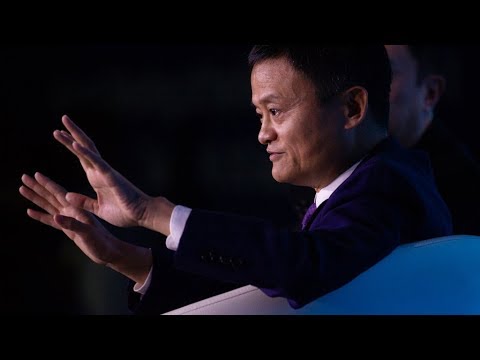
“It's not the company. It's you who cannot leave the company.”World Economic Forum, Davos 2017 conversation · full transcript →
Ma on leadership, in his own words
“I call myself CEO, Chief Education Officer of the company.”
“It's not the company. It's you who cannot leave the company.”
“There is no expert of tomorrow; there's only expert of yesterday.”
“When people start to worry, you think this is opportunity.”
Where to watch
 Jack Ma on Leadership For The Future: Build Human, Not Machine2019 · 56 min · full transcriptBest single explanation of Ma's future-facing leadership: values, culture, human judgment, and developing people.
 Jack Ma on Retirement and Succession: Why He Stepped Back2017 · 48 min · full transcriptBest for understanding succession, stepping back, and why leadership should not depend on one founder forever.
 Jack Ma on E-Commerce Opportunity: Africa Can Sell to the World2018 · 39 min · full transcriptShows Ma's teacher-style view of CEO leadership and his emphasis on customers, employees, and learning from failure.
 Jack Ma on Education Reform: Teachers, Kids, and the Future2019 · 152 min · full transcriptBest on why leadership is tied to education, creativity, trust, and preparing people for an AI era.
 Jack Ma on Failure & Opportunity: Build the Future by Helping Others2018 · 64 min · full transcriptUseful for Ma's emphasis on resilience, teamwork, and helping others build rather than trying to dominate.
Questions people ask
Sources
Every quote above, word for word from the transcripts. Numbers match the text.
“I call myself CEO, Chief Education Officer of the company.”
“I call myself CEO, Chief Education Officer…”
“…the thing that we need to change the fastest is the education system…”
“In the AI period, we want differentiation…”
“The machine in the future, they have chips, but human beings have the heart.”
“But I know if we want to realize our dream, we must have the technology. But if I don't know the technology, we should invite the best engineers and scientists. I work with them. I listen to them. Nobody can do anything alone. What you should do is always form a team. I think it is very difficult to make an exact company like Alibaba. Again,…”
“The team is different from teamwork.”
“There is no expert of tomorrow; there's only expert of yesterday.”
“When people start to worry, you think this is opportunity.”
“Being an entrepreneur, in my experience, the economic outlook is always problematic for us.”
“Opportunity always exists in the place where people complain.”
“Water is coming, let’s swim.”
“I think if you succeed, every mistake becomes legendary.”
“Failure never stopped me and trained me.”
“Customer number one, employee number two, shareholder number three.”
“To me, I think, you know, I don't worry about today Alibaba business. I don't worry about next three years because whatever we have done today, we've been working for 15 years for today and next three years. But what I'm worried about is ten years later what we should do. Company like us, it's so difficult to catch one or two opportunities to make our business sustained. So company like us, we have to solve social problems. We only solved the social problems we can last long. That's a pretty big mission as well. You know, small companies catch one or two opportunities, but company like our size you have to think about the future, right? So I think in 10 years China has two problems which…”
“I want to help you to sell your great stuff to the world using internet.”
“I don't want to die in my office.”
“It's not the company. It's you who cannot leave the company.”
How this guide was made: drafted with AI from the full transcripts of the recordings cited, then checked: every quotation must match a transcript word for word and be the speaker's own words, and an independent review gates accuracy. Methodology and corrections.


