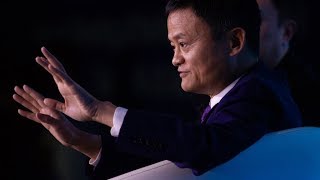
Jack Ma on Entrepreneurship
Jack Ma sees entrepreneurship as persistent problem-solving for others: learn from rejection, build strong teams, and create infrastructure that helps small businesses grow.
- Expect rejection and use it to improve, not to quit
- Look for opportunity where others complain or disagree
- Serve customers and your team before chasing status, investors, or rivals
- Build with great people; no founder succeeds alone
- The biggest opportunities come from helping small businesses go global

Entrepreneurship starts with persistence through rejection
Ma treats rejection as normal, not exceptional. In his view, founders should assume things will go wrong, accept that failure is part of the path, and keep moving instead of waiting for perfect conditions123.
He also pushes founders to respond to setbacks by changing themselves rather than blaming the market, competitors, or circumstances. That makes entrepreneurship a discipline of self-correction as much as ambition4.
A practical takeaway from Ma is simple: when something fails, do not turn the failure into an excuse. Use it as training, look for what you need to improve, and keep trying31.
“The only thing, we never give up.”Davos Annual Meeting, Bloomberg Television, 2015 · full transcript →
The entrepreneur's job is to find opportunity in doubt and complaint
Ma believes opportunity often appears where consensus is weak. If everyone already agrees, the opening is usually gone, so criticism and skepticism can be useful signals that a founder is seeing something others do not yet see67.
He links this to a concrete way of spotting ideas: pay attention to what people complain about. Complaints reveal unmet needs, friction, and broken systems, which are exactly where a useful company can begin8.
This makes entrepreneurship less about copying obvious success and more about noticing neglected problems. For Ma, disagreement is not a reason to retreat; it is often the starting point for a real business68.

“Opportunity always exists in the place where people complain.”University of Nairobi public lecture, 2018 · full transcript →
Build for customers and teams, not for ego
Ma is unusually clear about priorities. He says customers come first, employees second, and shareholders third, and he urges founders to spend time on customers and their own people rather than obsessing over competitors or external approval910.
That priority shapes how he thinks about leadership. A founder should act less like a heroic solo genius and more like a teacher who develops others, listens to capable people, and helps the team do better work1112.
In practice, this means entrepreneurship is service before status. If your team is strong and your customers are better served, the company has a chance to endure; if not, image and valuation do not matter much910.

“Spend time on your customers, spend time on your people, on your own team.”VivaTech interview, 2017 · full transcript →
Great companies solve infrastructure problems for others
Ma does not frame entrepreneurship mainly as buying and selling products. His view is broader: the most important companies often build the infrastructure that lets other businesses operate, grow, and reach customers1314.
That is why he emphasizes payments, logistics, data, and trust. In his account of Alibaba, the key work was not just listing goods online but solving the bottlenecks that stopped commerce from happening in the first place1314.
This is a useful lens for founders. Instead of asking only what you can sell, ask what friction you can remove for other people. Businesses become powerful when they enable many others to succeed13.
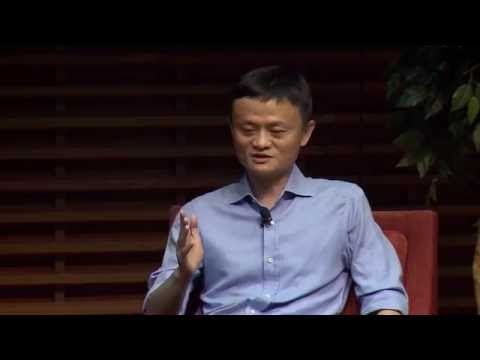
“…we are infrastructure of business in China.”Stanford GSB Entrepreneurial Company of the Year interview, 2015 · full transcript →
Entrepreneurship matters most when it expands opportunity for small businesses
Ma's entrepreneurship is not centered on elite founders building for other elites. He consistently returns to small businesses, young people, and women as the groups he most wants companies to serve and empower16.
He thinks technology now makes global business possible for far more people than before. With digital tools, even a small firm can sell, get paid, and deliver across borders, which changes what entrepreneurship can do for entire economies1718.
So the ambition is bigger than building one successful company. It is to create systems that let many entrepreneurs participate, especially those who were previously excluded from global trade and growth1820.

“If they have a phone, they can go global by global sell, global deliver, global pay, and global travel.”World Economic Forum Annual Meeting, Davos 2019 · full transcript →
Founders must prepare for a future shaped by technology but led by human judgment
Ma sees entrepreneurship as future-facing. Founders should embrace technological change rather than fear it, because change creates new openings for people willing to learn and adapt.
At the same time, he does not think technology replaces the need for human strengths. He repeatedly argues that machines may become smarter at narrow tasks, but people retain the advantages of creativity, wisdom, heart, and imagination.
For entrepreneurs, that means building with technology while investing in distinctly human capabilities. The future belongs to those who can combine tools with creativity, judgment, and the ability to inspire others2627.
Ma on entrepreneurship, in his own words
“The only thing, we never give up.”
“Opportunity always exists in the place where people complain.”
“If everybody agrees, then there is no opportunity.”
“Spend time on your customers, spend time on your people, on your own team.”
“Customer number one, employee number two, shareholder number three.”
“…we are infrastructure of business in China.”
Where to watch
 Jack Ma on Entrepreneurship and Future Thinking: Embrace Change2017 · 50 min · full transcriptBest short statement of Ma's founder mindset: criticism, opportunity, customers, team, and future thinking.
 Jack Ma on Entrepreneurial Infrastructure: Building for Small Businesses2015 · 68 min · full transcriptShows how Ma defines entrepreneurship as building business infrastructure for small firms, not just selling online.
 Jack Ma on E-Commerce Opportunity: Africa Can Sell to the World2018 · 39 min · full transcriptStrong overview of his priorities: learning from failure, serving customers, teaching teams, and helping small businesses reach the world.
 Jack Ma on Rejection and Resilience: "Never Give Up"2015 · 45 min · full transcriptBest for understanding how rejection and persistence shaped his entrepreneurial philosophy.
 Jack Ma on Digital Trade For Small Businesses: Globalization 4.02019 · 32 min · full transcriptExplains why Ma thinks digital trade can let small businesses everywhere become global entrepreneurs.
Questions people ask
- What did Jack Ma say about Alibaba’s goal in Russia?
- What did Jack Ma say about building a company and working with others?
- What did Jack Ma say about globalization and small businesses?
- What did Jack Ma say entrepreneurs should take away from his talk?
- Why does Jack Ma think small businesses are the future of globalization?
- What did Jack Ma say about artificial intelligence and jobs?
Sources
Every quote above, word for word from the transcripts. Numbers match the text.
“The only thing, we never give up.”
“If you don't do it, nothing's possible.”
“Failure never stopped me and trained me.”
“Don't change the rabbit, change yourself.”
“If everybody agrees, then there is no opportunity.”
“When people criticize you, now you have to think.”
“Opportunity always exists in the place where people complain.”
“Customer number one, employee number two, shareholder number three.”
“Spend time on your customers, spend time on your people, on your own team.”
“I call myself CEO, Chief Education Officer of the company.”
“But I know if we want to realize our dream, we must have the technology. But if I don't know the technology, we should invite the best engineers and scientists. I work with them. I listen to them. Nobody can do anything alone. What you should do is always form a team. I think it is very difficult to make an exact company like Alibaba. Again,…”
“…we are infrastructure of business in China.”
“We do not buy and sell.”
“…we love small business, we love young people, we love women.”
“If they have a phone, they can go global by global sell, global deliver, global pay, and global travel.”
“In the past 20 years, globalization is more like Americanization. Helping big companies going, oh, does not mean bad. Contribute the world a lot, the past globalization, helping big companies going global. But I think because of the internet, next 30 years globalization should help small business going globally. For China, because of us, last year, we created at least 14 million jobs for China by helping small business, by enabling small business with the technology we have, with the resources we gather together. So if we can help more small business in the world, we can help millions and millions of people create jobs innovations.”
“I want to help you to sell your great stuff to the world using internet.”
“We should teach our kids how to be more innovative, how to be more creative, and how to be more constructive.”
“If you don't have dreams, you are another wing of machines in the future.”
How this guide was made: drafted with AI from the full transcripts of the recordings cited, then checked: every quotation must match a transcript word for word and be the speaker's own words, and an independent review gates accuracy. Methodology and corrections.