Jack Ma on Artificial Intelligence: Humans Win Through Wisdom

What Ma talks about
Jack Ma gave this interview at the World Economic Forum in Davos in January 2018, discussing artificial intelligence, globalization, education, and how technology policy should help people adapt to economic change.
Also known as: Interview with Alibaba Group founder Jack Ma; Davos interview.
Jack Ma says artificial intelligence and machine learning will reshape work, create pain in the next 30 years, and eliminate many jobs. But he argues this is not a reason to stop globalization; instead, the world should make globalization more inclusive and use technology to help people adapt.
He draws a sharp line between machine intelligence and human wisdom. Machines can learn knowledge and do things people cannot, but they cannot replace the human heart, experience, or wisdom—so governments should focus on education and on jobs that machines should not try to do.
Ma also emphasizes data as the foundation of the next era of innovation, comparing it to water and soil. He says the future belongs to small businesses, personalized commerce, and technology that improves human life rather than replacing it.
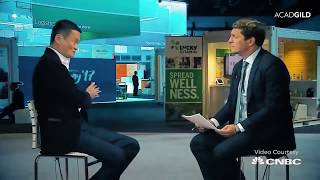
Jack Ma speaks with an interviewer at Davos.
In his words
“Machine is good in knowledge, but human beings are good at the wisdom.”
“You can always make a machine to learn knowledge, but it is difficult for machines to have a human heart.”
“Data is our water and our soil.”
“No, humans will win.”
“Artificial intelligence will never have wisdom.”
Key points
- AI will be powerful, but humans will still win because of wisdom, not raw intelligence.
- The next 30 years will bring social pain as technology kills many jobs.
- Globalization should not stop; it should become more inclusive.
- Small businesses should be empowered to sell local products across borders.
- Data is the essential resource of the future, like water and soil.
- Governments should pay special attention to education and creativity.
- Machines should do things humans cannot do, not replace human judgment.
Full transcript: Jack Ma, World Economic Forum interview (2018)
Do you think the machines will win? It's impossible because the day when we design the machine, we know the machine is powerful, stronger than us. The next 30 years is going to be painful. What is that? So stop globalization? It's impossible. People are already unhappy because a lot of machine learning, artificial intelligence is killing a lot of jobs. Machine is good in knowledge, but human beings are good at the wisdom. That doesn't sound good to me. Artificial intelligence is going to be very smart. We think it was a big data company today that was compared to yesterday. Compared to tomorrow, we are nothing. We think data is going to be so important in human life in the future. There's plenty of people who don't believe you who
think that eventually artificial intelligence will exceed our own and the machines will take over, and we won't even know when that point is reached. Machine can do things that human beings cannot do. One of the best ways is to help small businesses to sell their local products across the board. You can always make a machine to learn knowledge, but it is difficult for machines to have a human heart. I noted some quotes from you recently when it comes to the future of work. In the next 30 years, the world will see much more pain than happiness. This is one thing that you said, and that was involving the idea of how work is going to change and how conceivably the
social fabric will change. That doesn't sound good to me. Well, every technology revolution, we call social instability. The first technology revolution caused World War I. The second technology revolution caused the threat warning of World War II. This is the third technology revolution. People are already unhappy because a lot of machine learning, artificial intelligence is killing a lot of jobs. People start to worry those with the background—the education background—if you cannot, if you're not innovative enough, if you're not creative enough, your job will be taken away by a lot of machines. So this is the challenge. So it's a third technology revolution. We
may cause the third world war. What's the third world war? It should be the wall if human beings do not have the same tag, the one target, like poverty, disease, environment. Human beings are going to be problems. So I think the good thing is that technology is going to improve people's life. The bad thing is technology is killing a lot of jobs. People may live in a different way. So this is something that I worry about. An extra 30 years, as you said, this would seem to be a huge challenge. I could think, for example, of social stability in your own country, where tens of millions of people are employed in industries where eventually a robot might be able to do
it. What's going to happen to those jobs? That's why we should have zero globalization. In the last 20 years or last 200 years, I would say it's like industry period—large scale standardization is the model. Next 100 years, personalized, customer-made is the future. So I think the challenge of this technology is to a lot of big companies. So how we can empower small business? Normally, small businesses can only sell things to their village or their own country or even their city. With the power of the internet, we can help them sell across the board. The way to figure out the job creation. One of the best ways is to help small
businesses to sell their local products across the board. And we have to prepare now because the next 30 years is going to be painful. It's going to be painful. They're painful because of the changes that are going to change, the technology change of a lot of people with a lot of time on their hands too. Well, you know, the other thing people would be interested, they might want to spend it on Alibaba, watching movies and buying things. But, well, believe it or not, I think in the next 30 years people only work four hours a day and maybe four days a week. People say, "Wow! When? Then what are they gonna do?" My grandfather worked 16 hours a day in the farmland to dig him. He thinks he's very busy.
We work eight hours, five days a week. We think we are very busy. By the next 30 years, people only work four hours, and normally in your life, you only, normal people visit like 30 places. 30 years later, they will probably visit 300 places, so there will be... There will be more by population. So stop globalization? It's impossible. The only thing is that how can we make globalization more inclusive, to trade more reserves knowledge, more inclusive. This is how we can deal with the instability of the world. These are all very important issues. Do you think the machines will win? No, humans will win. They will. Oh yeah, absolutely.
Machine is good knowledge, but human beings are good at the wisdom. So that is why I'm encouraging a lot of governments, and talking to a lot of government offices, pay special attention to the education system. If you want, the machine is going to be smart, the human being. This is for sure. All right, I'm a guarantee, because the day when we design the machine, we know the machine is powerful, stronger than us. When we design the trains and buses, we know machines are going to run faster than us. When we have the computers, we have to know that machines are going to be smarter than us. But the human beings, they are not only smart, they have the wisdom. And so artificial intelligence will never have wisdom. No, no, no. It's about a valley. It's about wisdom. It's about experience.
It's about user experience. It's about your life experience. So, I don't think the machine, the artificial intelligence, is going to replace the wisdom. Artificial intelligence is going to be very smart. So, the smart between the smart and with the wisdom: smart people know what you want; wise people, wise people know what they don't want. I just continue to wonder what that world will look like over the next 30 years. What's changeful? What does that mean? Well, you will see that some people, because the knowledge is not enough, the wisdom is not enough, so the new wave coming, the job is being taken away some people who...
...could catch up, the way will be rich, will be more successful. Some people will be more painful. The government, you know, if the world is going to be data-driven, the people we know have more data than the bosses, right? You have said we're talking about data? Yeah, data. You said machines had drunk—had drank electricity. Now, they will drink data. Data is our water and our soil. Yeah. What does that mean? Well, in the future, in the office, there is electricity, their water, and the pipe of the status. If you want to make machines smart, the machine must drink data.
So, data is—without the data, innovation society is impossible. And the other thing, in the past 200 years, because of science, people's eyes look outside. We go to the moon, we want to go to Mars, we'll see the outside world, but we never see the old inside of human beings. Data—you will know human beings better. You have a lot of data at Alibaba, don't you? Yeah, we do. And how are you focused on creating and obtaining more of it? No, I think it's just the beginning of the data period. We think data is going to be so important in human life in the future. So now, we just said we are the earth's...
...first runner compared to tomorrow. Our data is nothing tomorrow. IoT, Internet of Things—everything connected, everything would be billions upon billions of devices connected. That's kind of connected, right? So, we think it was a big data company today; that was compared to yesterday. Compared to tomorrow, we have nothing. What will it let you do? Having access to that data as it accumulates more and more, what would allow you to do? Improve people's life, improve the machines, to make sure the machine can do better jobs to support human beings instead of machines doing better jobs to cure human jobs. So, I think that they—we don't know how data really can make money...
...today, but we know we have to protect the security of the data, the privacy of the data, and when we know one day the data will empower human beings. Today's data is like a hundred years ago people think about electricity as light, you know, but they never thought a hundred years later we have refridges and washing machines, everything using electricity. So data, you know, we have to believe our kids will be much smarter than us using the data. But you don't believe all that data when used with artificial intelligence will create wisdom? You don't. No, wisdom is from the heart.
The machine intelligence is about the brain. Brain is about the male knowledge. You can always make a machine to learn the knowledge, but it is difficult to fully make a machine have a human heart. I like the sound of it. I'm not sure. There's plenty of people who don't believe you, who think that eventually artificial intelligence will exceed our own and the machines will take over and we won't even know when that point is reached. Yeah, we were seeing 30 years, 30 years later we were still surviving, we would check out. You talked to Elon Musk about this at all? Ever? Oh, good. I—you know, I think the machine intelligence and human intelligence we have to be careful. If you're using artificial—I don't think we should make...
...like human. This is something we should do. We should make sure the machine can do things that human beings cannot do. This is the focus that we are doing. Thanks for checking out this video. Sign up with a CAD Guild to kickstart your career, and don't forget to subscribe to our YouTube channel to get more updates on our latest courses.
From YouTube captions, lightly punctuated for readability. Timestamps link to the video above. Errors are possible.
Cite this recording
Jack Ma, “World Economic Forum interview (2018)”, World Economic Forum, Davos, January 2018. Transcript and video: Thinkers Archive, https://thinkersarchive.com/jack-ma/artificial-intelligence-davos-2018/
Quoting a passage? Link to its exact moment: every timestamp above has its own anchor (for example https://thinkersarchive.com/jack-ma/artificial-intelligence-davos-2018/#t-131).