Jack Ma on Globalization
Jack Ma sees globalization as inevitable and valuable, but says its next phase must be redesigned so small businesses, young people, and developing countries can participate directly.
- Globalization should continue, but its next version must be more inclusive.
- The problem is not global trade itself; it is that old globalization favored big companies more than small ones.
- Digital infrastructure, payments, logistics, and broadband can let even very small firms sell across borders.
- Countries should invest in people, education, and adaptation so technology and trade create broad opportunity.
- Trade should connect and cooperate across countries, not be replaced by conflict or isolation.

“The next generation of globalization should be inclusive…”World Economic Forum interview, Davos, 2018 · 15:12
Globalization is good, but the old model was too narrow
Ma’s starting point is not anti-globalization. He argues that global trade helped many countries grow and should not be reversed just because its benefits were unevenly distributed. His position is reformist: keep globalization, but fix who it serves and how it works.12
His main criticism is that the last era of globalization worked better for large companies than for small businesses, young people, and poorer countries. He describes the old pattern as one in which big firms were the main vehicles of global expansion, while the next era should open cross-border opportunity much more widely.32
“The next generation of globalization should be inclusive…”World Economic Forum interview, Davos, 2018 · full transcript →
The next stage should let small businesses go global
For Ma, the core change is who gets to participate. He wants globalization to move from a system dominated by large corporations to one where millions of small businesses can buy and sell internationally. That is why he treats small firms not as a side issue, but as the main unit of a healthier global economy.34
He sees technology as the reason this shift is finally possible. A mobile phone, internet access, and the right trade tools can give very small companies abilities that once belonged only to multinationals. In his view, digital trade can make global commerce more open, practical, and everyday.56
Globalization depends on infrastructure, not just trade deals
Ma does not treat globalization as a slogan or a treaty problem alone. He argues that real participation in world trade requires e-commerce infrastructure: broadband, mobile access, logistics, payments, and systems that let people buy, sell, pay, and deliver across borders. Without that base, inclusion remains rhetorical.67
This is why he says the goal is not to spread one company everywhere, but to build the enabling systems that allow others to operate globally. His emphasis is ecosystem over empire: create the rails, and small businesses can move on them.78
Technology should widen opportunity, not deepen exclusion
Ma links globalization directly to technological change. He expects artificial intelligence and automation to disrupt jobs, but he does not think that means countries should retreat from trade. Instead, he argues that technology should be used to make globalization more inclusive and to help people adapt.29
That leads to a broader human point: machines may outperform people in knowledge, but people retain strengths in wisdom, judgment, values, and care. So the right response to technological disruption is not panic, but education and redesign—especially for the young and for workers exposed to change.10111213
If societies want globalization to work, they must invest in people
Ma thinks backlash against globalization becomes dangerous when societies ignore those left behind. His answer is straightforward: spend on people. Countries should put more into education, infrastructure, and the ordinary workers and communities that rapid change can bypass.14
He also sees trade as a form of connection, not just competition. When trade breaks down, cooperation breaks down with it, so preserving open exchange matters economically and politically. In his view, globalization works best when it creates jobs, spreads opportunity, and keeps countries engaged with one another.151
This also requires a wider worldview. Ma repeatedly pushes people to learn directly from other countries and cultures rather than rely on distance, stereotype, or fear. A more inclusive globalization depends not only on better systems, but on more respect across borders.16

“…when trade stops, the world stops…”World Economic Forum interview, Davos, 2018 · full transcript →
Ma on globalization, in his own words
“The next generation of globalization should be inclusive…”
“Globalization actually, in the past 30, 40 years, helped a lot of countries to grow…”
“…when trade stops, the world stops…”
Where to watch
 Jack Ma on Globalization and Technology: Make Trade Inclusive2018 · 58 min · full transcriptBest single overview of Ma’s core claim that globalization is inevitable but must be rebuilt to include small businesses and young people.
 Jack Ma on Digital Trade For Small Businesses: Globalization 4.02019 · 32 min · full transcriptShows his most concrete vision of digital trade, mobile tools, and a new global system designed for SMEs.
 Jack Ma on Inclusive E-Commerce: Globalize the Infrastructure2018 · 64 min · full transcriptExplains why globalization needs infrastructure like payments, logistics, broadband, and e-commerce systems.
 Jack Ma on Inclusive Globalization: Spend on Your People2018 · 32 min · full transcriptFocuses on the social side: why countries must invest in workers and communities if they want open trade to remain legitimate.
 Jack Ma on the China Opportunity: Small Businesses Can Go Global2017 · 57 min · full transcriptApplies his globalization ideas directly to entrepreneurs and small businesses looking for cross-border opportunity.
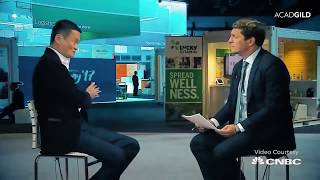 Jack Ma on Artificial Intelligence: Humans Win Through Wisdom2018 · 11 min · full transcriptConnects globalization to AI and explains why technological disruption is a reason to improve globalization, not stop it.
Questions people ask
- What did Jack Ma say about artificial intelligence and human wisdom?
- What did Jack Ma say about globalization and small businesses?
- What did Jack Ma say entrepreneurs should take away from his talk?
- Why does Jack Ma think small businesses are the future of globalization?
- What did Jack Ma say about artificial intelligence and jobs?
- What did Jack Ma say about understanding other cultures?
Sources
Every quote above, word for word from the transcripts. Numbers match the text.
“Globalization actually, in the past 30, 40 years, helped a lot of countries to grow…”
“The next generation of globalization should be inclusive…”
“In the past 20 years, globalization is more like Americanization. Helping big companies going, oh, does not mean bad. Contribute the world a lot, the past globalization, helping big companies going global. But I think because of the internet, next 30 years globalization should help small business going globally. For China, because of us, last year, we created at least 14 million jobs for China by helping small business, by enabling small business with the technology we have, with the resources we gather together. So if we can help more small business in the world, we can help millions and millions of people create jobs innovations.”
“What if we can support 6 million, 60 million small businesses, they can go global, they can buy and sell? That thing will change very, very fast. So I think when the king is changing so fast, everybody here, every entrepreneur, you have to think about this: What does this change mean to me, to my kids? What should I change myself to meet the changes? What kind of things should I do about it? So I recommend to many government offices and I also would love to share this idea with many entrepreneurs here.”
“If they have a phone, they can go global by global sell, global deliver, global pay, and global travel.”
“…e-commerce is the solution for sustainable growth.”
“We do not want to globalize Alibaba; we want to globalize e-commerce infrastructure.”
“WTO needs to be upgraded to the second version…”
“Artificial intelligence should support human beings.”
“Machine is good in knowledge, but human beings are good at the wisdom.”
“You can always make a machine to learn knowledge, but it is difficult for machines to have a human heart.”
“Machine is good knowledge, but human beings are good at the wisdom. So that is why I'm encouraging a lot of governments, and talking to a lot of government offices, pay special attention to the education system. If you want, the machine is going to be smart, the human being. This is for sure. All right, I'm a guarantee, because the day when we design the machine, we know the machine is powerful, stronger than us. When we design the trains and buses, we know machines are going to run faster than us. When we have the computers, we have to know that machines are going to be smarter than us. But the human beings, they are not only smart, they have the wisdom. And so artificial intelligence will never have wisdom. No, no, no. It's about a valley. It's about wisdom. It's about experience.”
“Finally, let's talk to our young people. The artificial intelligence is coming, as robots is going to replace a lot of jobs. But I'm building of a belief that 30 years later this new technology is going to create more jobs than today. Every technology overcomes the kill jobs, and then 30 years later those people who understand technology, who change themselves, they start to make more jobs. So pay attention to the kids…”
“…you're supposed to spend money on your own people…”
“…when trade stops, the world stops…”
“So, I'm sitting in my home looking at the world. You know, it's not possible to have a very right outlook on the world. Before I went to Africa, I believed Africa is a, um, a less developed place with poverty. But when I was there, I felt a lot. It's kind of imagination before you were there. You read about it from the media, from the news. If there is a bias of the media, you know that your decision is not right. I believe that going out, you need to look at the world. Only by showing respect to the ethnic groups and the cultures will your life become more interesting.”
How this guide was made: drafted with AI from the full transcripts of the recordings cited, then checked: every quotation must match a transcript word for word and be the speaker's own words, and an independent review gates accuracy. Methodology and corrections.