Make Trade Inclusive
Globalization should work for more than big companies.

“Globalization actually, in the past 30, 40 years, helped a lot of countries to grow…”World Economic Forum Annual Meeting, Davos 2019 · 2:11
The lesson
Ma’s starting point is that globalization should not be reversed; it should be redesigned. He argues that global trade has helped many countries grow, but the old model benefited large companies more than smaller firms and ordinary people12. His answer is not to shut trade down, but to build a next version of globalization that includes small businesses, young people, and developing countries more directly34.
In this view, inclusion is practical, not just moral. Ma argues that digital tools now make it possible for very small firms to participate across borders in ways that used to be reserved for large corporations, especially through phones, payments, delivery, and connected services5. That is why he keeps focusing on enabling millions of smaller businesses rather than concentrating power in a few giant platforms or companies6.
But inclusion does not happen automatically just because technology exists. Ma’s argument is that countries and institutions need to invest in the basics that let people participate: infrastructure, education, and support for their own workers and communities78. He ties this to the rise of AI as well: machines will take over many routine jobs, so societies must prepare people for a world where human value comes more from wisdom, judgment, and heart than from repeating knowledge910.
Ma also frames trade as a form of cooperation, not just competition. He warns that stopping trade harms everyone because trade is how people communicate, connect, and create shared prosperity across borders11. That is why he prefers models that help local entrepreneurs, logistics, and payments grow in each market instead of simply trying to make one company dominant everywhere12.
For learners, the core idea is to judge globalization by who can actually use it. If a system works mainly for big firms, it is incomplete; if it helps small businesses sell, deliver, get paid, and learn across borders, it is moving in the right direction52. Ma’s redesign asks leaders to combine openness with support: keep trade flowing, upgrade the rules and infrastructure, and make sure technology expands participation instead of narrowing it347.
5 principles from Jack Ma
Redesign globalization, don’t retreat from it
Ma’s position is that globalization has created real gains, so trying to stop it is the wrong response. The better move is to improve the system so more people and more kinds of businesses can benefit from it.
“Globalization actually, in the past 30, 40 years, helped a lot of countries to grow…”
Build trade around small business participation
Instead of treating cross-border trade as something only large corporations can do, design systems that let smaller firms buy, sell, and grow internationally. Ask whether your policies, products, or platforms reduce friction for ordinary entrepreneurs.
“In the past 20 years, globalization is more like Americanization. Helping big companies going, oh, does not mean bad. Contribute the world a lot, the past globalization, helping big companies going global. But I think because of the internet, next 30 years globalization should help small business going globally. For China, because of us, last year, we created at least 14 million jobs for China by helping small business, by enabling small business with the technology we have, with the resources we gather together. So if we can help more small business in the world, we can help millions and millions of people create jobs innovations.”
Invest in infrastructure and people
Inclusion requires more than slogans: people need education, logistics, payments, and other basic systems to join the modern economy. If you want broad participation, spend on the capabilities that help workers and firms adapt.
“…you're supposed to spend money on your own people…”
Use technology to support humans, not sideline them
Ma sees AI as powerful but incomplete. The practical implication is to automate routine work while developing the human strengths machines do not replace well, such as judgment, empathy, and wisdom.
“Artificial intelligence should support human beings.”
Treat trade as cooperation
Trade is not only about winning market share; it is also a way for societies to stay connected and productive together. Apply this by building partnerships that strengthen local ecosystems instead of aiming only for control and dominance.
“…when trade stops, the world stops…”
In his own words
The quotes behind the lesson, word for word from the transcripts. Numbers match the lesson above.
“Globalization actually, in the past 30, 40 years, helped a lot of countries to grow…”
“In the past 20 years, globalization is more like Americanization. Helping big companies going, oh, does not mean bad. Contribute the world a lot, the past globalization, helping big companies going global. But I think because of the internet, next 30 years globalization should help small business going globally. For China, because of us, last year, we created at least 14 million jobs for China by helping small business, by enabling small business with the technology we have, with the resources we gather together. So if we can help more small business in the world, we can help millions and millions of people create jobs innovations.”
“The next generation of globalization should be inclusive…”
“WTO needs to be upgraded to the second version…”
“If they have a phone, they can go global by global sell, global deliver, global pay, and global travel.”
“What if we can support 6 million, 60 million small businesses, they can go global, they can buy and sell? That thing will change very, very fast. So I think when the king is changing so fast, everybody here, every entrepreneur, you have to think about this: What does this change mean to me, to my kids? What should I change myself to meet the changes? What kind of things should I do about it? So I recommend to many government offices and I also would love to share this idea with many entrepreneurs here.”
“…you're supposed to spend money on your own people…”
“Machine is good knowledge, but human beings are good at the wisdom. So that is why I'm encouraging a lot of governments, and talking to a lot of government offices, pay special attention to the education system. If you want, the machine is going to be smart, the human being. This is for sure. All right, I'm a guarantee, because the day when we design the machine, we know the machine is powerful, stronger than us. When we design the trains and buses, we know machines are going to run faster than us. When we have the computers, we have to know that machines are going to be smarter than us. But the human beings, they are not only smart, they have the wisdom. And so artificial intelligence will never have wisdom. No, no, no. It's about a valley. It's about wisdom. It's about experience.”
“Machine is good in knowledge, but human beings are good at the wisdom.”
“You can always make a machine to learn knowledge, but it is difficult for machines to have a human heart.”
“…when trade stops, the world stops…”
“I think Tmall Russia is something that we are testing. Personally, my wish is that Tmall Russia can inspire as many young people, as many entrepreneurs as possible. They can do the same thing. We do not necessarily want to make Tmall Russia big. I hope you understand my saying, because we don't want Alibaba one day to become the largest e-commerce company in Russia. This is not—this is not my dream. This is not our dream. We want…”
Reflect
- In your industry, who benefits most from the current system: large organizations or smaller players? What would have to change for small businesses or individuals to participate more easily?
- What forms of infrastructure or support do people around you need most right now: education, logistics, payments, access to customers, or something else?
- How could you use technology in a way that expands human opportunity instead of only cutting labor costs?
Check your understanding
Go deeper
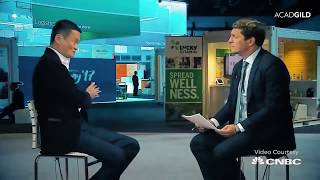 Jack Ma on Artificial Intelligence: Humans Win Through Wisdom2018 · 11 min · full transcript
 Jack Ma on Globalization and Technology: Make Trade Inclusive2018 · 58 min · full transcript
 Jack Ma on Digital Trade For Small Businesses: Globalization 4.02019 · 32 min · full transcript
 Jack Ma on Inclusive Globalization: Spend on Your People2018 · 32 min · full transcript
 Jack Ma on Failure & Opportunity: Build the Future by Helping Others2018 · 64 min · full transcript