Wisdom Over Intelligence
How Ma thinks humans should live with AI.

“Think I'm 100% sure people will live longer, people will live healthier, but may not necessarily live happier. If you want to be happier, human beings, you focus on a value, the vision, and the mission, and always have the dreams. And I don't want people to love technology and put their dreams on the technology. I think that technology should be with dreams. It's not technology that changes the world; it's the dreams behind the technology that change the world. So, my hope is that anything we can do to improve this road to helping 7.5—…”Shanghai panel with Elon Musk, 2019 · 44:48
The lesson
Ma draws a sharp line between what machines do well and what humans must protect. In his view, machines can surpass people in knowledge, memory, and calculation, but that does not settle the question of human value; the human advantage is wisdom, judgment, and heart1234. That is why he treats AI as a tool that should support people rather than replace the human role in deciding what matters5.
Because of that distinction, Ma argues that the right response to AI is not panic but confidence. He does expect disruption and social pain as technology changes work, yet he repeatedly says people should trust human adaptability and keep responsibility for shaping the future instead of fearing that technology will automatically control life6. His broader point is that technology follows human aims, so the deeper question is whether people bring dreams, values, and mission to it789.
This leads directly to education. If machines will do more of what schools have traditionally rewarded, then education should spend less energy on rote knowledge and more on creativity, constructive thinking, and independent judgment1011. Ma is explicit that the goal is not just to produce more clever people, but wiser people who can do what machines cannot and who know how to choose, refuse, and create1213.
Ma also thinks wisdom shows up in care, not only in thinking. He ties the future of AI to healthier lives, a better planet, stronger families, and more human-centered priorities, arguing that progress should help people live better rather than simply make systems more efficient146. In that frame, wisdom means asking what technology is for and whether it is making people happier, healthier, and more responsible to one another8.
Finally, Ma treats adaptability as a practical expression of wisdom. Since the future is hard to predict, people and institutions should prepare for change by learning, rethinking assumptions, and responding well to criticism and disagreement rather than clinging to the past151617. His case is not that humans win by out-computing machines, but by staying creative, values-driven, and able to change.
4 principles from Jack Ma
Compete on wisdom, not machine-style intelligence
Do not measure human worth by memory, speed, or calculation, because machines will keep getting better there. Focus your work on judgment, meaning, ethics, and the ability to understand what should be done, not just what can be done.
“Artificial intelligence will never have wisdom.”
Make technology serve human aims
Use AI as a support tool, not as the source of purpose. Before adopting a new system, ask what human problem it helps solve and whether it advances your values, mission, or long-term vision.
“It's not technology that changes the world; it's the dreams behind the technology that change the world.”
Educate for creativity and independent judgment
Train yourself and others in the abilities machines struggle to copy: creating, questioning, combining ideas, and deciding well under uncertainty. In practice, this means valuing projects, discussion, arts, teamwork, and original thinking more than memorization alone.
“Creative, constructive, I think very important: innovative, independent thinking.”
Judge progress by health, happiness, and care
Efficiency is not enough; the real test is whether technology improves human life and responsibility. When evaluating a new tool or strategy, include effects on well-being, relationships, and the broader world, not just output.
“I want to stay on this Earth. I want to work on this Earth. I want to do anything I can to help this Earth to be better because even if we go to space, it's great, but if we can spend those resources just to focus on helping pick up the garbage from the oceans, that thing is more difficult than to go to Mars. But artificial intelligence can help us achieve that and solve the problems. And secondly, human beings can live better, can live longer, but what we need is not only to live longer, we want to live healthier.”
Moments to watch
In his own words
The quotes behind the lesson, word for word from the transcripts. Numbers match the lesson above.
“Machine is good in knowledge, but human beings are good at the wisdom.”
“You can always make a machine to learn knowledge, but it is difficult for machines to have a human heart.”
“Artificial intelligence will never have wisdom.”
“Machine is good knowledge, but human beings are good at the wisdom. So that is why I'm encouraging a lot of governments, and talking to a lot of government offices, pay special attention to the education system. If you want, the machine is going to be smart, the human being. This is for sure. All right, I'm a guarantee, because the day when we design the machine, we know the machine is powerful, stronger than us. When we design the trains and buses, we know machines are going to run faster than us. When we have the computers, we have to know that machines are going to be smarter than us. But the human beings, they are not only smart, they have the wisdom. And so artificial intelligence will never have wisdom. No, no, no. It's about a valley. It's about wisdom. It's about experience.”
“Artificial intelligence should support human beings.”
“Billion people live better and live healthier, and this is all about our world. And I think we will be working very happily because I love your product Tesla, you know, making the world cleaner and no noise and such great technology. I'm happy you have a Tesla factory in China, and I think we need to do more things to improve this Earth, improve this world, and make sure that people are happier and people care about the family, people care about the house. That's all we should do and trust us, trust human beings, and trust young people. Let's take responsibility for today, but let's not take away all the solutions—…”
“It's not technology that changes the world; it's the dreams behind the technology that change the world.”
“Think I'm 100% sure people will live longer, people will live healthier, but may not necessarily live happier. If you want to be happier, human beings, you focus on a value, the vision, and the mission, and always have the dreams. And I don't want people to love technology and put their dreams on the technology. I think that technology should be with dreams. It's not technology that changes the world; it's the dreams behind the technology that change the world. So, my hope is that anything we can do to improve this road to helping 7.5—…”
“If you don't have dreams, you are another wing of machines in the future.”
“Creative, constructive, I think very important: innovative, independent thinking.”
“What education we should give our kids that they will be able to do the things better than machine?”
“Last century we made so many smart and clever people. This century we should create a lot of wise people.”
“Smart people know what they want. Wise people know what they don’t want.”
“I want to stay on this Earth. I want to work on this Earth. I want to do anything I can to help this Earth to be better because even if we go to space, it's great, but if we can spend those resources just to focus on helping pick up the garbage from the oceans, that thing is more difficult than to go to Mars. But artificial intelligence can help us achieve that and solve the problems. And secondly, human beings can live better, can live longer, but what we need is not only to live longer, we want to live healthier.”
“I think AI is going to open a new chapter of the society, of the world, that people try to understand ourselves better rather than the outside world. And it's so difficult to predict the future. Ninety-nine point nine nine percent of the predictions human beings have made in history about the future…”
“When people criticize you, now you have to think.”
“If everybody agrees, then there is no opportunity.”
Reflect
- Where in your work are you still competing like a machine—on speed, memory, or routine output—instead of building judgment, creativity, or care?
- If a powerful AI tool entered your team tomorrow, what decisions or responsibilities should remain distinctly human, and why?
- What is one change you could make to your learning or teaching style so it develops independent thinking rather than memorization?
Check your understanding
Go deeper
 Jack Ma on AI and Human Futures: Focus on Earth2019 · 47 min · full transcript
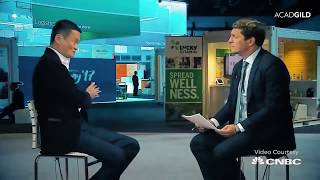 Jack Ma on Artificial Intelligence: Humans Win Through Wisdom2018 · 11 min · full transcript
 Jack Ma on Globalization and Technology: Make Trade Inclusive2018 · 58 min · full transcript
 Jack Ma on Education and Innovation: Teach Creativity, Not Machines2019 · 66 min · full transcript
 Jack Ma on Entrepreneurship and Future Thinking: Embrace Change2017 · 50 min · full transcript