Build Trust Infrastructure
Alibaba as marketplaces, payments, logistics, data, and credit.
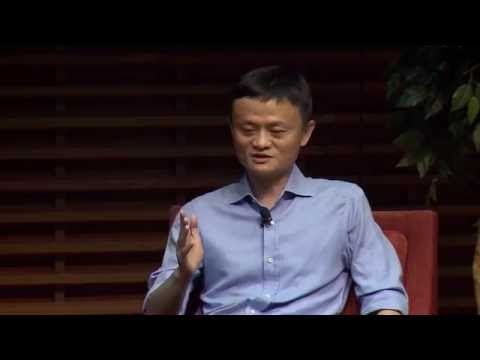
“…we are infrastructure of business in China.”Stanford GSB Entrepreneurial Company of the Year interview, 2015 · 37:08
The lesson
Ma’s basic claim is that Alibaba should be understood as infrastructure, not as a conventional retailer. He describes the company as a system that helps other businesses operate online rather than a business that mainly buys and sells goods itself12. That framing matters because it shifts attention from one transaction to the conditions that make many transactions possible for small businesses over time34.
In Ma’s view, trust is one of those core conditions. Online commerce stalls when buyers and sellers do not know each other, so the real bottleneck is not just product discovery but confidence, transparency, and willingness to transact5. This is why he says lasting companies solve social problems: if distrust is blocking commerce, building mechanisms that reduce that distrust becomes strategic, not secondary.
Payments were central because trust needs practical tools. In the recordings, Ma explains that Alibaba grew by addressing the payment problem that existing institutions would not solve, which fits his broader habit of looking for opportunity where people are complaining. The point is not to become a bank for its own sake, but to remove a barrier that prevents small businesses and consumers from participating in online trade6.
From there, Ma expands the idea into a full ecosystem: marketplaces, payments, logistics, data, and credit work together. E-commerce succeeds best when it is paired with the surrounding infrastructure that lets people buy, pay, deliver, and build a record of reliable behavior across the network. That is why he talks about globalizing e-commerce infrastructure rather than simply expanding Alibaba as a brand or empire7.
The chapter’s practical takeaway is to think beyond the app or storefront and ask what missing layer prevents trust at scale. Ma’s focus stays on small businesses, young people, and broader access, because infrastructure creates the biggest leverage when it enables many others to grow48. His logic is that durable growth comes from building the rails that let other people do business better, especially where the current system leaves them out93.
4 principles from Jack Ma
Think infrastructure, not just transactions
Do not define your business only by the product you sell today. Look for the underlying capabilities others need to operate, because building those capabilities can create more lasting value than handling each transaction yourself.
“…we are infrastructure of business in China.”
Treat trust as a core product
If people hesitate to transact, your job is not finished when the listing is online. Build transparency and mechanisms that reduce fear between participants, because trust is what unlocks activity in a marketplace.
“It's trust, right? It's the trust, its ability to trust others, and it's about transparency.”
Solve the complaint behind the market
Pay attention to the repeated frustration users face, especially when incumbents ignore it. Those complaints often point to the infrastructure gap that matters most, as payments did for early e-commerce.
Build ecosystems that help small businesses grow
A marketplace becomes more useful when it connects with payments, logistics, data, and credit. Design your system so smaller firms can access capabilities they could not build alone.
“Alibaba is an ecosystem that helps small businesses to grow.”
In his own words
The quotes behind the lesson, word for word from the transcripts. Numbers match the lesson above.
“…we are infrastructure of business in China.”
“We do not buy and sell.”
“Alibaba is an ecosystem that helps small businesses to grow.”
“…we love small business, we love young people, we love women.”
“It's trust, right? It's the trust, its ability to trust others, and it's about transparency.”
“We are not trying to build up a financial system.”
“We do not want to globalize Alibaba; we want to globalize e-commerce infrastructure.”
“In the past 20 years, globalization is more like Americanization. Helping big companies going, oh, does not mean bad. Contribute the world a lot, the past globalization, helping big companies going global. But I think because of the internet, next 30 years globalization should help small business going globally. For China, because of us, last year, we created at least 14 million jobs for China by helping small business, by enabling small business with the technology we have, with the resources we gather together. So if we can help more small business in the world, we can help millions and millions of people create jobs innovations.”
“…e-commerce is the solution for sustainable growth.”
Reflect
- Where in your work do people still hesitate because they do not trust the process, the counterparty, or the outcome?
- What is one complaint in your industry that most firms treat as unavoidable, but that could actually point to an infrastructure opportunity?
- If you stopped thinking about your product as a standalone offering, what surrounding layer—payments, logistics, data, verification, or support—would help your users succeed more often?
Check your understanding
Go deeper
 Jack Ma on Rejection and Resilience: "Never Give Up"2015 · 45 min · full transcript
 Jack Ma on Entrepreneurial Infrastructure: Building for Small Businesses2015 · 68 min · full transcript
 Jack Ma on Alibaba Strategy: Ecosystem for Small Businesses2015 · 36 min · full transcript
 Jack Ma on Inclusive E-Commerce: Globalize the Infrastructure2018 · 64 min · full transcript