Brian Chesky on Regulation And Cities
Brian Chesky argues that cities need rules for home sharing that protect neighborhoods while recognizing ordinary people as a new kind of micro-business and treating Airbnb as a community marketplace, not just real estate.
- He sees Airbnb as a new category: ordinary people using their homes, not a traditional hotel model.
- He prefers working city by city with governments, even accepting restrictions, rather than fighting every rule.
- He says the goal should be balance: hosts, neighborhoods, and cities all need to benefit.
- He believes cities and platforms should design win-win arrangements, not assume one side must lose.
- His broader view is that empowered individuals and physical community are central to the future of cities and travel.

“…our business is ordinary people renting their homes…”Code Conference interview/session, 2015 · 5:09
He thinks home sharing is a new category cities must recognize
Chesky’s basic argument is that Airbnb should not be understood as a standard hotel business or just a pool of short-term real estate. He describes the core of Airbnb as ordinary people renting the homes they live in, which is why he says old categories do not fit cleanly.12
That view starts with the origin of the company itself: people opening up their own homes to travelers, creating a different way to stay. From his perspective, this created a new kind of travel and hospitality category rather than a simple extension of existing lodging models.34
He also connects this to a larger economic shift in which more people are empowered to participate directly in the economy. In that frame, regulation has to catch up to individuals acting like small businesses without becoming traditional companies.51
“…our business is ordinary people renting their homes…”Code Conference interview/session, 2015 · full transcript →
His instinct is partnership with cities, not permanent war with them
Chesky presents regulation as something to engage carefully rather than dismiss. He says the company should take time, understand government, and treat it seriously, which suggests a strategy of negotiation and adaptation rather than pure confrontation.
In practice, he says Airbnb works city by city because different places want different things. Some cities want more Airbnb activity, others want stronger restrictions, and he says the company often accepts that local balance rather than insisting on one universal rule.7
He gives examples of siding with cities when necessary, such as removing multiple-listing operators in New York and working with registration systems in San Francisco. That reveals a key part of his regulatory philosophy: legitimacy comes from fitting into civic rules and neighborhood realities, not just asserting growth.7
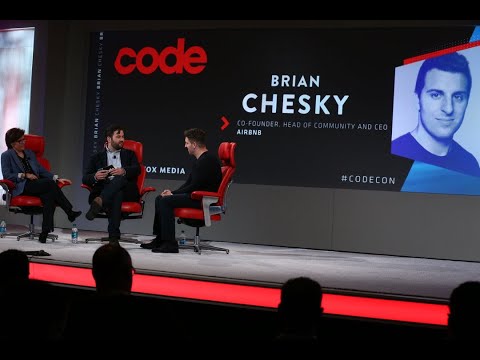
“What we've done is we've partnered with cities. And, as some cities really want a lot of Airbnb's, and some cities want to have more restrictions, when we go city by city—I mean, at the end of the day, we want to be—we want to be good for neighborhoods; we don't want to be bad for neighborhoods. There's sometimes a trade-off between what a neighborhood wants and what hosts want and what business wants, and you have to find that balance. Oftentimes, we end up going on the side of the city. Like in the city of New York, we removed all people that had multiple listings. In the city of San Francisco, we are—you know, we are smaller than—we work free registration in San Francisco. That was definitely a trade-off.”Code Conference interview, 2019 · full transcript →
Neighborhood impact matters, and he frames regulation as a balancing problem
Chesky does not describe city regulation as only a fight over company interests. He says there can be real trade-offs between what neighborhoods want, what hosts want, and what the business wants, and the job is to find a workable balance among them.7
That is why he emphasizes that Airbnb should be good for neighborhoods and should enrich the cities where it operates. His case is not simply that cities should get out of the way, but that home sharing should prove its value to local communities.78
This same logic appears in his later comments about city policy more broadly: he rejects zero-sum thinking and argues that one side does not need to lose for another to win. In his ideal version, regulation should be designed so customers, workers, companies, and society can all benefit.9

“…for me to win, you don't have to lose.”Skift Global Forum interview, 2023 · full transcript →
He believes cities should build new frameworks for empowered individuals
A recurring idea in Chesky’s thinking is that the economy is shifting toward individuals having more agency. When people use their own homes to host, they do not fit neatly into the old box of private consumer or large corporation, so he believes cities need frameworks that reflect that change.51
This helps explain why he keeps stressing that Airbnb is a community marketplace. If policymakers see only real estate inventory, they will regulate it as property alone; if they see a network of people, trust, and local participation, they may build more tailored rules.2
For Chesky, the long-term opportunity is not just more listings but a travel ecosystem rooted in community. That means regulation should make space for participation while still drawing lines around behavior that harms neighborhoods.27
His city view is tied to a larger belief in community and rebuilding
Chesky’s comments on cities are not only about compliance or lobbying. He talks about cities as places that can be rebuilt through partnership between government and private actors, and he argues against being trapped by old assumptions.
He also connects urban life to human connection, saying physical communities matter deeply. That helps explain why he talks about Airbnb as more than lodging: his broader aspiration is to strengthen belonging and local connection, not just transact nights.
Seen this way, his regulation argument is part of a wider philosophy. Cities should not treat platforms only as problems to contain; they should ask how to shape them so they expand opportunity, preserve neighborhoods, and reinforce community.8
Chesky on regulation and cities, in his own words
“…our business is ordinary people renting their homes…”
“…for me to win, you don't have to lose.”
“What we've done is we've partnered with cities. And, as some cities really want a lot of Airbnb's, and some cities want to have more restrictions, when we go city by city—I mean, at the end of the day, we want to be—we want to be good for neighborhoods; we don't want to be bad for neighborhoods. There's sometimes a trade-off between what a neighborhood wants and what hosts want and what business wants, and you have to find that balance. Oftentimes, we end up going on the side of the city. Like in the city of New York, we removed all people that had multiple listings. In the city of San Francisco, we are—you know, we are smaller than—we work free registration in San Francisco. That was definitely a trade-off.”
Where to watch
 Brian Chesky on Regulation and Expansion: Airbnb's Next Phase2015 · 32 min · full transcriptBest single overview of how he thinks cities should regulate home sharing and why Airbnb sees itself as a new category.
 Brian Chesky on Travel, Pricing, and AI: Airbnb's Next Chapter2023 · 34 min · full transcriptShows his later argument that cities and Airbnb can reach win-win outcomes on housing, taxes, and neighborhood concerns.
 Brian Chesky on Rebuilding Cities: New York After COVID2021 · 41 min · full transcriptBroadens the topic from compliance to public-private partnership and what stronger cities should look like after disruption.
 Brian Chesky on Product Philosophy: Trips, Belonging, and Trust2014 · 26 min · full transcriptExplains the deeper worldview behind his city stance: empowered individuals, belonging, and Airbnb as a community marketplace.
 Brian Chesky on Airbnb Origin Story: From Airbeds to a New Category2016 · 21 min · full transcriptUseful for seeing why he thinks Airbnb began as something fundamentally different from traditional lodging.
 Brian Chesky on Corporate Maturity: Building Airbnb for the Long Run2019 · 34 min · full transcriptAdds his mature, later framing of Airbnb as community rather than just real estate and includes examples of city-by-city compromise.
Questions people ask
Sources
Every quote above, word for word from the transcripts. Numbers match the text.
“…our business is ordinary people renting their homes…”
“It was really about building this end-to-end travel app where you can be this global travel community. And I think the key that makes Airbnb so different is the fact that we're a community, not just a series of commodities. And so, the people who misunderstand Airbnb, they tend to just see a bunch of real estate and they're like, "This is real estate." It's, you know, you know, people have a bunch of opinions about real estate being rented on a short-term basis. But of course, when you look a little deeper, what you're going to see, or three million people are hooked in is what you're really buying. And so, I think, yep, only a community marketplace is kind of the big idea here.”
“What if we just turned our house into a bed and breakfast for a design conference?”
“We've created a whole new category of how to stay.”
“The future, the economy is going to increasingly become empowered by people.”
“What we've done is we've partnered with cities. And, as some cities really want a lot of Airbnb's, and some cities want to have more restrictions, when we go city by city—I mean, at the end of the day, we want to be—we want to be good for neighborhoods; we don't want to be bad for neighborhoods. There's sometimes a trade-off between what a neighborhood wants and what hosts want and what business wants, and you have to find that balance. Oftentimes, we end up going on the side of the city. Like in the city of New York, we removed all people that had multiple listings. In the city of San Francisco, we are—you know, we are smaller than—we work free registration in San Francisco. That was definitely a trade-off.”
“…we want to enrich the cities we serve…”
“…for me to win, you don't have to lose.”
How this guide was made: drafted with AI from the full transcripts of the recordings cited, then checked: every quotation must match a transcript word for word and be the speaker's own words, and an independent review gates accuracy. Methodology and corrections.