Brian Chesky on Airbnb Origin Story
Brian Chesky sees Airbnb’s origin story as proof that great companies often start as strange-looking solutions to a real personal problem, then survive through relentless focus on a small group of delighted customers.
- Airbnb started as a practical fix for rent pressure and sold-out hotels, not a grand master plan.
- Chesky thinks the idea looked ridiculous at first, which is part of why others dismissed it.
- The breakthrough lesson was to serve a small group of users so well that they truly love the product.
- Early rejection did not disprove the idea; customer response mattered more than investor opinion.
- Scrappy execution, speed, and design thinking helped turn a quirky weekend experiment into a new category.

“What if we just turned our house into a bed and breakfast for a design conference?”Fortune interview, 2016 · 3:41
It began as a simple answer to an immediate problem
Chesky tells the start of Airbnb as a practical move, not a polished startup thesis. He and Joe Gebbia needed rent money, saw a design conference had filled the hotels, and asked whether they could turn their apartment into a temporary place to stay.12
That matters because his core lesson is that startups often begin by solving something concrete in your own life. The original concept was narrow and specific: offer airbeds during a sold-out event, learn from real guests, and see whether the experience worked for both sides.12
“What if we just turned our house into a bed and breakfast for a design conference?”Fortune interview, 2016 · full transcript →
The idea sounded bad to almost everyone else
Chesky repeatedly frames Airbnb as the kind of idea that looked absurd before it worked. His shorthand for this is that it was the worst idea that ever worked, which captures how unconventional and easy to dismiss it seemed at the start.45
The skepticism was not abstract. Investors rejected the company, many ignored them, and one response he still repeats is that they liked everything except him and the idea. In Chesky’s telling, this is a reminder that consensus is often a poor test for originality.6
Part of the resistance came from a basic social doubt: would strangers really stay in other people’s homes? Chesky’s answer was that the behavior was less unnatural than critics assumed, and once he saw it happen in real life, his conviction deepened.8
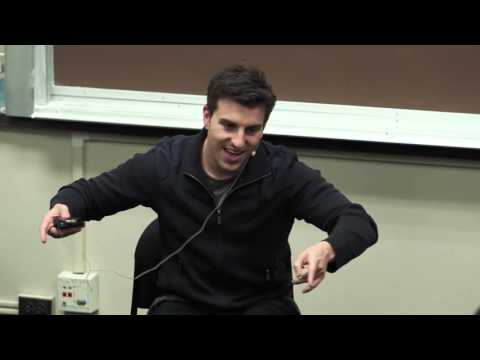
“It's the worst idea that ever worked.”Greylock lecture, 2016 · full transcript →
What kept Airbnb alive was scrappiness, not prestige
In Chesky’s version of the origin story, survival depended on doing whatever honest, creative thing could buy more time. The cereal boxes became the symbol of that phase: when fundraising was failing, the founders found another way to generate cash and prove resourcefulness.9
He also emphasizes speed over polish. The team launched quickly, kept iterating, and learned from actual behavior instead of waiting for the perfect plan. That is why the early story is full of messy launches, experiments, and unconventional tactics rather than a clean roadmap.1011
This is one of his clearest founder lessons: early on, you do not need the full machine of a large company. You need enough belief and ingenuity to keep going until the product finds the people who really want it.91213

“I guess if you can convince people to pay $40 for a $4 box of cereal, then maybe you can convince at least some people to stay in each other's homes.”This Week in Startups interview, 2023 · full transcript →
The real breakthrough was getting a few people to love it
The most important lesson Chesky draws from Airbnb’s early years is not about fundraising, PR, or scale. It is that it is better to have 100 people who love the product than a huge number who only sort of like it.14151617
This became a governing principle for how he thinks companies should start. In his view, deep love from a small set of users creates word of mouth, sharper learning, and a stronger product foundation than broad but shallow adoption.1418
That is also why he says all that matters is the customers. Investor skepticism did not decide Airbnb’s fate; the decisive question was whether guests and hosts found enough value in the experience to come back and tell others.1920
Design thinking shaped the company from day one
Chesky does not treat design as surface decoration. He argues that design is how something fundamentally works, and that mindset shaped Airbnb from the beginning.2122
Applied to the origin story, that meant paying attention to the full experience, not just the transaction. The founders were not only posting space online; they were trying to make staying in a stranger’s home feel understandable, trustworthy, and memorable enough that people would do it again.218
This helps explain why Chesky connects Airbnb’s origin to a broader category shift. What began with airbeds eventually became, in his words, a whole new category of how to stay, because the company redesigned the experience around people rather than the old hotel model.13
Chesky on airbnb origin story, in his own words
“It's the worst idea that ever worked.”
“What if we just turned our house into a bed and breakfast for a design conference?”
“We love everything but you and your idea.”
“I guess if you can convince people to pay $40 for a $4 box of cereal, then maybe you can convince at least some people to stay in each other's homes.”
“We've created a whole new category of how to stay.”
Where to watch
 Brian Chesky on Airbnb Origin Story: From cereal boxes to IPO2022 · 24 min · full transcriptBest compact retelling of the full arc: rent pressure, rejection, cereal boxes, Y Combinator, and the early growth logic.
 Brian Chesky on Launching Airbnb: The Challenges of Scale2016 · 98 min · full transcriptBest for Chesky’s main founder lesson from the story: unusual ideas, conviction, and why 100 loving users matter most.
 Brian Chesky on Designing Experiences: The 10-Star Airbnb Story2023 · 55 min · full transcriptBest for understanding how design thinking shaped the original idea and why Chesky sees love, not scale, as the early goal.
 Brian Chesky on Customer Focus & AI: Rebuilding Airbnb2023 · 69 min · full transcriptBest for the rejection and survival side of the story, including investors, cereal boxes, and customer-first thinking.
 Brian Chesky on Airbnb’s Early Growth: From Air Beds to Press2012 · 12 min · full transcriptBest for the earliest tactical phase: launching fast, iterating, and solving the marketplace chicken-and-egg problem.
 Brian Chesky on Airbnb Origin Story: From Airbeds to a New Category2016 · 21 min · full transcriptBest short interview on the original insight that strangers could stay in strangers’ homes and create a new category.
Questions people ask
- What did Brian Chesky say about becoming an entrepreneur?
- What did Brian Chesky say about launching quickly and not worrying about the first version?
- What did Brian Chesky say about making customers love you before scaling Airbnb?
- What did Brian Chesky say about raising Airbnb's first money when investors rejected the company?
- What does Brian Chesky mean when he says design is how something fundamentally works?
- Why did Brian Chesky keep going on Airbnb during the hard times?
Sources
Every quote above, word for word from the transcripts. Numbers match the text.
“What if we just created a bed and breakfast for the design conference?”
“What if we just turned our house into a bed and breakfast for a design conference?”
“It's the worst idea that ever worked.”
“The worst idea that ever worked.”
“We love everything but you and your idea.”
“It's actually not weird for strangers to stay there — strangers.”
“I guess if you can convince people to pay $40 for a $4 box of cereal, then maybe you can convince at least some people to stay in each other's homes.”
“We had a lot of time on our hands…”
“And literally, 30 minutes, we built this as we were talking. And I don't know, I'm not here to give lessons except to say have an idea, just put something out there in 20, 30 minutes, don't matter, don't worry how bad it looks. And our first launch, our first of many, was this. And this is a site that two designers had built. Um, looks pretty modest today. We ended up hosting three people from around the world. A mole actually came from India, Catherine was a 35-year-old woman from Boston, and Michael, that's not Michael—I just got a 45-year-old guy from Google News. I couldn't actually find a photo…”
“…it's not impossible to be on stage two years from now…”
“We've created a whole new category of how to stay.”
“It's better to have 100 people that love you, 100 customers that love you, than a million customers that just sort of like you.”
“It's better to have 100 people that deeply love you.”
“…it's better to have 100 people love your service than have a million people that are kind of like your service…”
“Probably the most important single piece of advice I got, which is probably advice that is probably the most important advice I can give you, or one of the most important advice, is he basically drew out this chart and he basically said, it's better to have 100 people that love you, 100 customers that love you, than a million customers that just sort of like you. In other words, if you have 100 people that absolutely love your product, they'll tell 100 people, and then they'll tell 100 people, or even 10 people, and this thing will grow. We call it growing virally. In fact, almost all movements in history have grown this way as well. There's like deeply passionate followers and they grow it. And they're customer advocates. And the problem is, in Silicon Valley, the general wisdom is, I need to build some app, this thing it needs to have this viral coefficient. I need to get millions of people to use it. And they gotta like it enough to share it. That's totally the wrong way to think about it, especially if you're in a service business like ours.”
“And then he does another section of what would look like a well, and he said, these are the same volumes. But he said it's better to have 100 people that deeply love you. If this axis is number of people and this axis is love, focus on 100 people that love you, rather than getting a million people that kind of like you. And I think that was a profound piece of advice, and may have been the best piece of advice I've ever gotten. And it actually runs counterintuitive to almost everything that everyone says, everyone focuses on scale. But scale requires people to have a deep passion because if you focus on 100 people who love you, there's two things that happen. The first thing is, how do you know how to make something for a million people? I don't know where to start. But if I pick one person in the audience and I study you, and I take you a journey and say, how do we improve this part of the journey?”
“All that matters is the customers.”
“The best marketing is investing in the user experience, and then your users will market it for you.”
“Design is how something fundamentally works.”
“And to me, design is a much deeper idea, design is how something fundamentally works. I think design makes the complex simple and it focuses on every single detail. Design is really about understand the essence, I think it was Steve Jobs that said design is a fundamental soul of a man-made creation that reveals itself through subsequent layers. And so I think of design as not just how something looks, it's a way to think about the world, and a way to simplify. And engineers, I think, tend to want to narrow in, reduce, like my co-founder, Nate, likes to narrow in and get very focused on a problem you can contain because you gotta build it. And designers, we tend to want to zoom out, to the frustration of the engineers, and be very, very holistic. But I do think that that holistic thinking affected everything.”
How this guide was made: drafted with AI from the full transcripts of the recordings cited, then checked: every quotation must match a transcript word for word and be the speaker's own words, and an independent review gates accuracy. Methodology and corrections.
