Brian Chesky on Long-Term Thinking
Brian Chesky treats long-term thinking as building a company that earns trust, survives shocks, works for all stakeholders, and keeps adapting without losing its core.
- Build the company, not just the product, for decades of endurance.
- Trust is the speed limit on growth, so safety and verification are long-term investments.
- Short-term tradeoffs should be judged by their effect on all stakeholders, not only shareholders.
- Durability requires adapting early to major shifts like remote work, changing travel patterns, and new technology.
- Leaders create long-term value by staying close to details instead of managing from a distance.
Long-term thinking means building an enduring company, not chasing the next bump
Chesky’s idea of long-term thinking starts with a shift in the CEO’s job. In the early years, the focus is proving a product. Later, the harder task is building a company that can keep innovating for many years through stronger leadership, structure, and culture. He frames this as moving from a single successful product toward a platform and team that can last a long time.123
That is also why he did not treat milestones like going public as goals in themselves. He wanted the business to be more legitimate, more prepared, and less exposed to existential risks before stepping onto a bigger stage. His standard was not speed for its own sake, but readiness for durability.
Even small governance choices fit this same pattern. He has said he wants directors and executives with a long horizon and relationships that can last, because institutional longevity depends on people who think beyond the quarter.
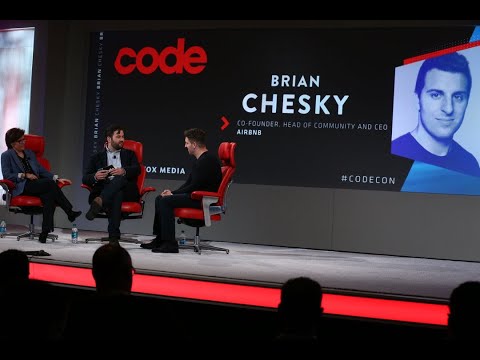
“Over the last couple years, it's been very, very clear that part of what I need to now be doing is building an incredibly strong management team and spending a lot more time building the team and building the platform for all future innovation. So, we had this very successful single product, homes, and we thought to ourselves, "Well, we want to be a company that's gonna be around for a long, long time." And so, to be able to do that, I want to be able to have an executive team that's gonna be with me for, you know, a dozen years or longer, the way Steve did or Jeff did at Amazon. And so, that's kind of probably the biggest thing that I've been doing.”Code Conference interview, 2019 · full transcript →
Trust is a long-term asset, so it deserves heavy investment
For Chesky, long-term growth is impossible without trust. Airbnb only works if strangers can reliably trust one another, which means trust is not a soft value layered on top of the business; it is the business. When trust weakens, the platform slows down.45
That is why he moved Airbnb toward more responsibility after safety failures. Instead of staying mostly hands-off, he argued the company had to review listings more deeply, verify more of what happens on the platform, and take more direct accountability. This is a classic long-term tradeoff: accept more cost, complexity, and friction now to make the system stronger later.78
He also links trust to city relationships and legitimacy. If Airbnb wants to last, it cannot behave like a business that extracts value and moves on. It has to be good for neighborhoods, work with local governments, and aim to enrich the cities it serves.91011
Thinking long term means serving stakeholders together, not treating value as zero-sum
Chesky rejects the idea that companies must choose between doing right by stakeholders and creating value. His view is that durable companies work for multiple groups at once: shareholders, employees, customers, hosts, communities, and society. In his framing, this is not charity and not a distraction from performance; it is how performance compounds over time.12
That approach matters most in moments of conflict. He emphasizes getting close enough to people to understand their needs, because distance makes tradeoffs abstract and easy to mishandle. The point is not to eliminate tensions but to work through them with a broader time horizon.1310
This also explains his optimism. Long-term thinking is not passive patience. It is the belief that if you respond constructively to hard problems, the company can emerge stronger rather than simply preserving itself.14
Durability requires adapting early when the world changes
Chesky’s long-term thinking is not conservative in the sense of defending the old model. He is willing to start from the premise that major shifts are permanent. On travel, he argues that older patterns are not simply returning, and that flexibility, remote work, longer stays, and more distributed travel will reshape demand for years.161718
That leads to product choices aimed at the next era, not the last one. He wants Airbnb to move beyond a narrow destination search tool toward inspiration, discovery, and travel redistribution across more places and times. Long-term thinking here means redesigning around where behavior is heading, not where it used to be.1920
He applies the same lens to technology. He expects AI to have much bigger effects than most people realize, which suggests that leaders should prepare early for second-order change rather than waiting for certainty.21
The leader’s role is to stay deep in the details while building for the future
Chesky does not think long-term leadership means detachment. His version is almost the opposite: the CEO should stay extremely close to the product and the important decisions because quality compounds from details. He explicitly ties this to founder mode and to the belief that great leaders stay in the details.222324
That mindset helps him avoid two common long-term failures. One is letting bureaucracy replace judgment as a company grows. The other is assuming that scale means the leader’s learning can be outsourced. He has said he asks for help aggressively because he does not want thousands of people paying for his learning curve, which is another way of saying that better decisions now protect the future.253
His background as a designer also matters here. He sees intuition, imagination, curiosity, and care for the user experience as strategic assets, especially when building for a future that does not yet fully exist.26
Chesky on long-term thinking, in his own words
“Over the last couple years, it's been very, very clear that part of what I need to now be doing is building an incredibly strong management team and spending a lot more time building the team and building the platform for all future innovation. So, we had this very successful single product, homes, and we thought to ourselves, "Well, we want to be a company that's gonna be around for a long, long time." And so, to be able to do that, I want to be able to have an executive team that's gonna be with me for, you know, a dozen years or longer, the way Steve did or Jeff did at Amazon. And so, that's kind of probably the biggest thing that I've been doing.”
Where to watch
 Brian Chesky on People-First Capitalism: Stakeholders Over Shareholders2021 · 53 min · full transcriptBest single explanation of why long-term value comes from serving stakeholders together rather than treating tradeoffs as zero-sum.
 Brian Chesky on Trust and Verification: Airbnb's Post-Crisis Reset2019 · 30 min · full transcriptShows how Chesky thinks about trust, responsibility, and making costly investments now to strengthen the business for years.
 Brian Chesky on Corporate Maturity: Building Airbnb for the Long Run2019 · 34 min · full transcriptBest for understanding his shift from building a product to building a company designed to endure.
 Brian Chesky on Travel Revolution: Flexibility Is Changing Everything2021 · 29 min · full transcriptExplains how long-term thinking leads him to redesign Airbnb around permanent changes in travel behavior.
 Brian Chesky on Founder Mode: The CEO as Chief Product Officer2024 · 42 min · full transcriptBest window into his belief that leaders create long-term advantage by staying in the details.
 Brian Chesky on Regulation and Expansion: Airbnb's Next Phase2015 · 32 min · full transcriptUseful for seeing how patient, city-by-city regulation work fits his durability mindset.
Questions people ask
- How does Brian Chesky balance Airbnb and neighborhood concerns?
- How has Brian Chesky changed as CEO over time?
- What did Brian Chesky say about asking for help and finding mentors?
- What does Brian Chesky say makes Airbnb different from other big companies?
- What is Brian Chesky focused on now that Airbnb is scaling?
Sources
Every quote above, word for word from the transcripts. Numbers match the text.
“…part of what I need to now be doing is building an incredibly strong management team…”
“Over the last couple years, it's been very, very clear that part of what I need to now be doing is building an incredibly strong management team and spending a lot more time building the team and building the platform for all future innovation. So, we had this very successful single product, homes, and we thought to ourselves, "Well, we want to be a company that's gonna be around for a long, long time." And so, to be able to do that, I want to be able to have an executive team that's gonna be with me for, you know, a dozen years or longer, the way Steve did or Jeff did at Amazon. And so, that's kind of probably the biggest thing that I've been doing.”
“The company, more so than the product needs day to day management, but the company, the product's fine. So, there's a couple things. The first, probably the two biggest things I'm focusing on, the first one is scaling the culture for the new size. A lot of the cultural norms and kind of things we institutionalize was for a company that was 500 people. We're now over 2,000 people and I wanna make sure that this still feels like a fast growing start up. It's still product oriented. It's still everyone is mission driven. So that means a lot of the methods and behaviors in the day to day has to change. The other thing though, probably even bigger, is, most companies that are really, really big have more than one product.”
“…what we invented was a way for strangers to trust one another to stay in homes…”
“…things move at the speed of trust…”
“We will make sure that a hundred percent of hosts and a hundred percent of listings will be reviewed by the end of next year…”
“…we have to take more responsibility for the stuff on our platform…”
“…we want to enrich the cities we serve…”
“What we've done is we've partnered with cities. And, as some cities really want a lot of Airbnb's, and some cities want to have more restrictions, when we go city by city—I mean, at the end of the day, we want to be—we want to be good for neighborhoods; we don't want to be bad for neighborhoods. There's sometimes a trade-off between what a neighborhood wants and what hosts want and what business wants, and you have to find that balance. Oftentimes, we end up going on the side of the city. Like in the city of New York, we removed all people that had multiple listings. In the city of San Francisco, we are—you know, we are smaller than—we work free registration in San Francisco. That was definitely a trade-off.”
“…we need to make sure that we take our time, understand that government is a place of last recourse…”
“I don't think it's zero sum.”
“It's hard to hate up close.”
“I think optimism is massively underrated.”
“…travel as we know it is never coming back…”
“…the more we live remotely and live flexibly, the more we're home all day…”
“I think that we're about to experience a golden age of travel…”
“…the holy grail of over-tourism is travel redistribution…”
“…we want to be more in the inspiration business…”
“AI is going to change the world much more than anybody realizes.”
“…great leaders are in the details.”
“The point is this: great leaders are in the details. That's what founder mode is.”
“I think that the CEO of the company should always be the chief product officer…”
“And every step along the way I've been shameless. And I say "shameless" because I think people are really proud to ask for help. And I think, like, my point of view is, I don't want thousands of people paying for my learning curve. That's like ridiculous. So I should fast track that.”
“So my fun fact was I was an artist and designer before Airbnb. Really an artist, at least how I thought about it. And I think that's maybe one of the things that makes Airbnb different. Because there's not a lot of designers or artists running Fortune 500 or S&P 500 companies. And I think that intuition, imagination, design, curiosity, I think we need more of that. By the way, I think the people listening, I think everyone on this, listen, you have these qualities. But I think that a lot of companies, it's like we're a body and the companies are cut off at the head and they're disembodied from their heart, and they're often really biased towards one side of their head.”
How this guide was made: drafted with AI from the full transcripts of the recordings cited, then checked: every quotation must match a transcript word for word and be the speaker's own words, and an independent review gates accuracy. Methodology and corrections.