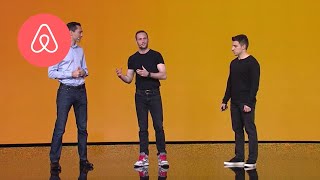
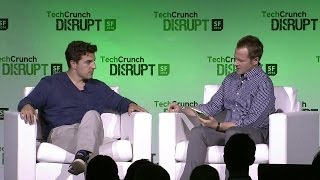
Brian Chesky on Product Development
Brian Chesky sees product leadership as the CEO’s job: stay close to the details, unite design, engineering, product, and marketing, and build something a small group of customers truly loves before scaling.
- The CEO of a product company should act as chief product officer, not sit far above the work.
- Product leadership means being in the details without letting the company fragment into silos and sub-roadmaps.
- Design is not decoration; it is how a product fundamentally works and how complexity becomes simple.
- Start small, win deep love from a small group of customers, then scale through a one-to-10-to-many process.
- Product and marketing should be tightly linked because a product no one understands is not really winning.

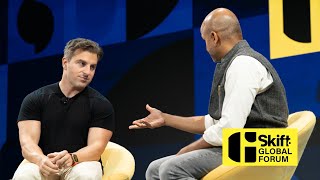
“I think that the CEO of the company should always be the chief product officer…”Skift Global Forum 2024 interview/session · 6:36
The CEO should lead the product directly
Chesky’s clearest view is that in a product or tech company, product leadership cannot be delegated away from the CEO. He argues that the CEO should function as the chief product officer and should understand the product more deeply than anyone else, rather than managing only through layers of people and reports.123
This is why he rejects the idea that senior leadership should stay abstract while others make the real product calls. For him, the strongest leaders stay close to the work, make the key tradeoffs, and create shared direction through active involvement.456
“I think that the CEO of the company should always be the chief product officer…”Skift Global Forum 2024 interview/session · full transcript →
Great product leadership lives in the details, not in org charts
Chesky’s version of product leadership is intensely hands-on. He argues that leaders need to be in the details, not because they want to control every move forever, but because product quality and strategic coherence break down when the leader loses contact with the actual work.347
That belief shaped how he rebuilt Airbnb after the pandemic shock. He pulled decision-making closer, created a shared conversation among top leaders, and moved away from fragmented ownership where every team had its own roadmap and priorities.810
His test for execution is simple: one roadmap, visible priorities, and clear decisions. In his model, product leadership means reducing ambiguity, removing conflicting agendas, and making sure teams work from the same plan.11510
“…great leaders are in the details.”Skift Global Forum 2024 interview/session · full transcript →
Design is the operating system for product leadership
Chesky treats design as a way of running a company, not a finishing layer added after strategy and engineering. His core idea is that design concerns how something fundamentally works, which makes it central to product leadership rather than adjacent to it.121314
That view changes how leaders should make decisions. Product leadership is not just choosing features; it is simplifying complexity, focusing on the essence of the experience, and using judgment to make uncertainty manageable.1516
This is also why he believes design should sit at the center of collaboration across functions. In his model, design, engineering, product, and marketing are not separate kingdoms; they are different lenses on the same customer experience.14117

“What if design just ran the boardroom?”Config 2023 closing keynote conversation · full transcript →
Start with a few customers who love you, then scale carefully
Chesky does not define product leadership by broad early scale. He defines it by whether a small number of customers deeply love what you made, because that is the signal that the product is solving something real and creating genuine advocacy.181920
That is why he urges teams to make the problem small before trying to make the company big. His approach is to get to product-market fit in a narrow setting, prove it in one market, expand to ten, and only then industrialize.21
He ties this to product quality, not just launch sequencing. The goal is to create an experience strong enough that people do more than tolerate it; they actively want to tell others about it.221920
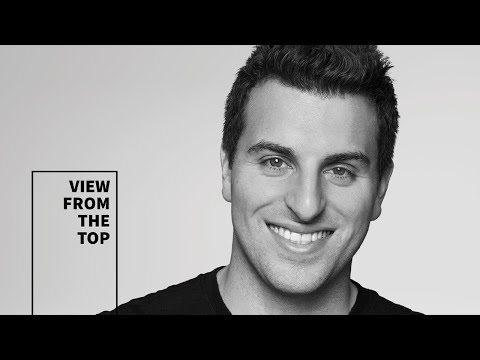
“It's better to have 100 people that deeply love you.”Stanford GSB lecture, 2023 · full transcript →
Product leadership requires customer obsession and product-marketing unity
Chesky’s standard for product leadership is not internal process but customer value. He says what matters is the customer, and he organizes his own time around product, marketing, and hiring because those functions determine whether the company is building something people want and communicating it clearly.2324
He is especially explicit that product and marketing should not be far apart. If a company builds something strong but fails to make it understood, adopted, or desired, then the product effort is incomplete.2524
This helps explain his preference for integrated, functional teams over divisional silos. Product leadership, in his view, is strongest when the people shaping the experience and the people shaping the story work in lockstep on one roadmap.25108

“I spend almost all my time on product, marketing, and hiring.”This Week in Startups interview, 2023 · full transcript →
In the AI era, product leaders will need fewer layers and more direct judgment
Chesky believes the demands of product leadership are rising, not falling. He argues that AI will push companies toward fewer management layers, more direct contact with the work, and more technical and product fluency from leaders.2627
He also thinks the CEO role is learned rather than natural, which means product leaders have to deliberately build judgment instead of assuming they can delegate their way into effectiveness. In his framing, distance from the work is especially dangerous in fast-changing environments.287
The practical implication is that product leaders should get closer to decisions, speed up feedback loops, and preserve authenticity and clarity as technology makes both products and organizations more fluid.2729
Chesky on product development, in his own words
“…great leaders are in the details.”
“Design is how something fundamentally works.”
“It's better to have 100 people that deeply love you.”
Where to watch
 Brian Chesky on Founder Mode: The CEO as Chief Product Officer2024 · 42 min · full transcriptBest short statement of Chesky’s view that the CEO of a product company should act as chief product officer and stay in the details.
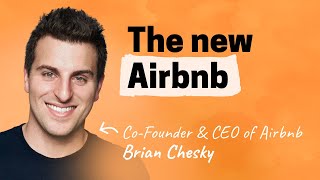 Brian Chesky on Founder Mode: Run the Company in the Details2023 · 73 min · full transcriptBest deep dive on founder mode, clarity, integrated functions, and why product leadership should not be split across silos.
 Brian Chesky on Design Leadership: Running the Boardroom2023 · 29 min · full transcriptBest explanation of how design can run the company through one roadmap, fewer priorities, and cross-functional focus.
 Brian Chesky on Designing Experiences: The 10-Star Airbnb Story2023 · 55 min · full transcriptBest source for his design philosophy and the idea of building something a small number of people truly love first.
 Brian Chesky on Customer Focus & AI: Rebuilding Airbnb2023 · 69 min · full transcriptBest practical view of how he spends his time on product and marketing and why customer focus drives the operating model.
 Brian Chesky on Founder Mode: Building in the AI Era2025 · 83 min · full transcriptBest forward-looking take on how AI will make hands-on, detail-oriented product leadership even more necessary.
Questions people ask
- How does Brian Chesky think startups should go from one city to scale?
- What changes did Brian Chesky make to Airbnb after taking back control?
- What did Brian Chesky say about how Airbnb rebuilt its company during COVID?
- What does Brian Chesky mean by founder mode?
- What does Brian Chesky think the CEO should be in a product company?
- What is Brian Chesky focused on now that Airbnb is scaling?
Sources
Every quote above, word for word from the transcripts. Numbers match the text.
“I think the CEO should be basically the chief product officer of a product or tech company.”
“I think that the CEO of the company should always be the chief product officer…”
“…great leaders are in the details.”
“The point is this: great leaders are in the details. That's what founder mode is.”
“What everyone really wants is clarity.”
“I wouldn't have a chief product officer. I think the CEO should be basically the chief product officer of a product or tech company. If the CEO is not the chief product officer then I don't know if they're a product or tech led company. Maybe that's okay if they're an ops company or if they're a marketing company or if they're not a tech company at all. But ultimately I think the founder or CEO should be that person. So when we were starting Airbnb, it was probably the three of us. As you know, I think Airbnb was a unique situation where it was three of us. I don't think any of us was that dominant. I probably played the closest thing to the role of the people listening, the closest thing to the role of the product manager. But again, I did marketing, I did design, I did ops, I did a little bit of everything. So I was basically everything but engineering.”
“Over time, basically, what I did is I reviewed every single thing for two, three years. I worked like a hundred hours a week, reviewed every little detail of the company. My vision wasn't do this forever. My vision wasn't to micromanage forever. My vision was before I empower people, I need to know what's going on. This notion that great leadership is hiring great people and trust them to know what to do. Well, how do you know they're great if you're not auditing what they're doing? And you actually want to start hands on under control and give ground grudgingly. Everyone does the opposite. They let go, they hire someone, they go in the wrong direction. And by the way, that's bad for the leader. You're not training them. So to bring it back to your question, that's founder mode. We need AI founder mode. AI founder mode is gonna be even more intense than founder mode.”
“I stopped pushing decision-making down. I pulled it in. I created one shared consciousness and I said, the top 30, 40 people in the company are going to have one continuous conversation. Metrics are going to be subordinate to the calendar. So we're going to have a roadmap. It's going to be a two-year roadmap. We'll update the roadmap literally every month. People may wonder, well, what if the world changes? Yeah, it changes every day. So the roadmap's something where the next month doesn't change, but two years out it changes. It's a rolling roadmap. And by the way, if Ukraine gets invaded and you want to provide housing for refugees, you can still pivot people and adapt very quickly. We house 120,000 refugees. So you still keep a reserve of resources to be able to pivot and do things because there's always unexpected events. I created this new function called product marketing. We basically described what that is. I made the group much smaller. I took a lot of product managers, I reassigned them as program managers.”
“So what do we do? We rebuilt the company from the ground up. We went from business unit organization to a functional organization, so we had a design department, a marketing department, engineering department, the way every startup is run. We took all the projects in the company. First of all, I asked every leader, "Show me your roadmap." They couldn't even figure out their roadmaps because everyone had a sub-roadmap on sub-teams, and those teams had roadmaps, and those teams had roadmaps. And so I said, there's a simpler rule: if it's not in the roadmap, it can't ship, and it must be on one roadmap. So with this giant exercise, we put every single thing on one roadmap. Then I said, "We can only do 10 of the things on the roadmap." That was a wet reckoning. So I said, "We're only going to do a few really big things.”
“…if it's not in the roadmap, it can't ship, and it must be on one roadmap.”
“Design is how something fundamentally works.”
“Design is not just how something looks, it's how it fundamentally works.”
“What if design just ran the boardroom?”
“And to me, design is a much deeper idea, design is how something fundamentally works. I think design makes the complex simple and it focuses on every single detail. Design is really about understand the essence, I think it was Steve Jobs that said design is a fundamental soul of a man-made creation that reveals itself through subsequent layers. And so I think of design as not just how something looks, it's a way to think about the world, and a way to simplify. And engineers, I think, tend to want to narrow in, reduce, like my co-founder, Nate, likes to narrow in and get very focused on a problem you can contain because you gotta build it. And designers, we tend to want to zoom out, to the frustration of the engineers, and be very, very holistic. But I do think that that holistic thinking affected everything.”
“Design is kind of a solution to uncertainty, ultimately.”
“So my fun fact was I was an artist and designer before Airbnb. Really an artist, at least how I thought about it. And I think that's maybe one of the things that makes Airbnb different. Because there's not a lot of designers or artists running Fortune 500 or S&P 500 companies. And I think that intuition, imagination, design, curiosity, I think we need more of that. By the way, I think the people listening, I think everyone on this, listen, you have these qualities. But I think that a lot of companies, it's like we're a body and the companies are cut off at the head and they're disembodied from their heart, and they're often really biased towards one side of their head.”
“It's better to have 100 people that deeply love you.”
“Probably the most important single piece of advice I got, which is probably advice that is probably the most important advice I can give you, or one of the most important advice, is he basically drew out this chart and he basically said, it's better to have 100 people that love you, 100 customers that love you, than a million customers that just sort of like you. In other words, if you have 100 people that absolutely love your product, they'll tell 100 people, and then they'll tell 100 people, or even 10 people, and this thing will grow. We call it growing virally. In fact, almost all movements in history have grown this way as well. There's like deeply passionate followers and they grow it. And they're customer advocates. And the problem is, in Silicon Valley, the general wisdom is, I need to build some app, this thing it needs to have this viral coefficient. I need to get millions of people to use it. And they gotta like it enough to share it. That's totally the wrong way to think about it, especially if you're in a service business like ours.”
“And then he does another section of what would look like a well, and he said, these are the same volumes. But he said it's better to have 100 people that deeply love you. If this axis is number of people and this axis is love, focus on 100 people that love you, rather than getting a million people that kind of like you. And I think that was a profound piece of advice, and may have been the best piece of advice I've ever gotten. And it actually runs counterintuitive to almost everything that everyone says, everyone focuses on scale. But scale requires people to have a deep passion because if you focus on 100 people who love you, there's two things that happen. The first thing is, how do you know how to make something for a million people? I don't know where to start. But if I pick one person in the audience and I study you, and I take you a journey and say, how do we improve this part of the journey?”
“The basic philosophy is make the problem as small as possible. Get to product market fit, then scale. So we launched service experiences last year, and it didn't work right away. And I'm like, oh, shit. We launched service experiences in a 100 cities. And I went back and I thought to myself, wait a second, Airbnb launched in New York, Uber launched in San Francisco, DoorDash launched in Palo Alto. Let's make the problem small and just perfect a city. And so we started doing this with new businesses. We basically had any new business, we're gonna do one to 10 to many. We'll pilot in one market, any idea. If we get the market to work, we'll go to 10. If get a 10 at works, we'll industrialize.”
“The way to get to product market fit is to just create a six or seven star experience.”
“All that matters is the customers.”
“I spend almost all my time on product, marketing, and hiring.”
“If you build a great product and no one knows about it, did you even build a product?”
“I think founder mode is gonna be the only way to operate in the age of AI.”
“A lot of companies you have to get your boss to approve it and your boss's boss to approve it and your boss's boss's boss to approve it. I'd have the full chain of command in the room, and anyone can give their opinion. I would make all the final decisions. I would not speak first, I'd usually speak last, And I'd usually agree with the team, but 10% of time I disagree, but I'd ratify every decision. It was a very clear chain of command. But this is a meeting based culture. I think in AI, I think we're gonna move away from meeting based to asynchronous. And we're fairly remote, and so I think that will benefit us. I think you're gonna have a lot fewer layers of management.”
“No one is born a good CEO, and the job of CEO is completely counterintuitive.”
“AI is going to change the world much more than anybody realizes.”
How this guide was made: drafted with AI from the full transcripts of the recordings cited, then checked: every quotation must match a transcript word for word and be the speaker's own words, and an independent review gates accuracy. Methodology and corrections.