Brian Chesky on Marketing & Sales
Brian Chesky treats brand as the outward expression of mission, product, culture, and storytelling working together to make something people feel and remember.
- Brand starts with mission and culture, not ad campaigns.
- Marketing is inseparable from product; if no one knows it exists, the product is incomplete.
- The CEO should stay close to product and story so the company presents one clear idea to the world.
- Great brands create emotion, trust, and inspiration, not just utility.
- Early marketing can be scrappy: launch fast, learn from customers, and use creativity to break through.

“They are two sides of the same coin. So cultural like the principles and the beliefs you have inside the company that you want people to be aligned with long term. And whatever happens inside the company eventually comes out. You can't hold it in. And brand is really the promise outside the company that everyone identifies with. And so I think, having a clear mission, and making sure that you know that mission, and making sure that mission comes through the company is probably the most important thing you can do for both culture and values. And then, the second thing you need to know is that your brand, the way people think about you as a company, is often decided by your, you know, your brand evangelists are your employees.”Stanford CS183B lecture on culture, 2014 · 32:59
Brand is the external promise of an internal mission
Chesky sees brand and culture as deeply linked. Culture is what people inside the company believe and do every day, while brand is the promise people outside the company come to associate with you. If the mission is clear and real inside the company, it eventually shows up outside as a coherent brand.123
That is why he puts so much weight on mission. He wants people to join and stay for the part of the company that does not change, because that creates consistency in decisions, behavior, and how customers experience the company over time. A brand is strongest when it reflects something durable rather than a temporary campaign or trend.243
He also believes you cannot fake this from the outside in. What happens inside the company comes out, so brand is not a layer of polish placed on top of operations; it is a visible expression of what the company actually is.3
“They are two sides of the same coin. So cultural like the principles and the beliefs you have inside the company that you want people to be aligned with long term. And whatever happens inside the company eventually comes out. You can't hold it in. And brand is really the promise outside the company that everyone identifies with. And so I think, having a clear mission, and making sure that you know that mission, and making sure that mission comes through the company is probably the most important thing you can do for both culture and values. And then, the second thing you need to know is that your brand, the way people think about you as a company, is often decided by your, you know, your brand evangelists are your employees.”Stanford CS183B lecture on culture, 2014 · full transcript →
Marketing and product should operate as one system
Chesky rejects the idea that marketing is separate from building the product. He explicitly ties the two together, arguing that a great product without awareness is not enough. In his view, making something useful and making sure people understand it are both part of the job.67
This is one reason Airbnb combined product management with product marketing and kept product, design, engineering, and marketing closely integrated. He wants fewer silos, more shared context, and a company that tells one story through what it builds and how it presents it.8
He also believes the CEO should stay close to this work. If the chief executive is effectively the chief product officer, then the company can keep a tighter connection between strategy, product decisions, and the story told to customers. That reduces drift between what a company says and what it actually ships.9107

“If you build a great product and no one knows about it, did you even build a product?”Lenny's Podcast interview, 2023 · full transcript →
Clarity is a branding advantage
A recurring Chesky theme is clarity. He argues that people mainly want clear direction, and that applies externally as much as internally. A brand gets stronger when the company has one shared consciousness, one roadmap, and a simple idea that everyone can repeat.118
This matters because fragmented organizations produce fragmented messaging. When divisions, leaders, or teams all tell different stories, customers feel the inconsistency. Chesky's answer is to reduce layers, keep senior people in a continuous conversation, and align the company around a common direction.8
For marketing, the implication is practical: do not try to say ten things at once. Build one clear narrative around what the company is for, what problem it solves, and why that matters now. Chesky's own framing of Airbnb around trips and belonging shows this preference for a simple, expansive idea.1314
The best brands stand for a bigger human idea
Chesky does not define Airbnb narrowly as a place to book a room. He frames it around trips and belonging, which turns the brand from a transactional service into a more meaningful part of travel. That kind of positioning gives marketing more emotional range and gives product teams a larger north star.1314
He extends that thinking into discovery. Rather than only serving demand that already exists, he wants Airbnb to move into inspiration. That means the brand should help people imagine possibilities, not just complete a search.15
He also believes technology alone is insufficient. Great companies need creativity, soul, intuition, and emotion, which is another way of saying that brand value comes from how something feels as much as how it functions. In a world shaped by AI and commoditized tools, this human dimension becomes even more important.161718
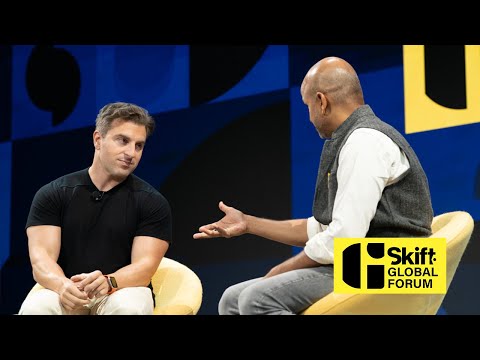
“…we want to be more in the inspiration business…”Skift Global Forum interview/session, 2022 · full transcript →
Scrappy storytelling beats waiting for perfect marketing
Chesky's early growth stories show a hands-on, experimental view of marketing. The team launched quickly without overpolishing, learned from users, and kept putting things into the world. That approach treats marketing as a live feedback loop rather than a finished master plan.19
He also used unconventional tactics to get attention when traditional channels were closed. The cereal-box story captures his belief that creative storytelling can open doors and prove demand before the company looks obviously credible.20
Underneath all of this is a simple rule: customers matter most. Early adopters, not mainstream doubters, are the people who validate a brand in its earliest stage. So Chesky's version of marketing starts with finding people who truly care, serving them well, and letting their response shape both the product and the story.21
Authenticity and trust are becoming central brand assets
Chesky thinks authenticity grows more valuable as technology makes imitation easier. If AI can create convincing images, voices, and identities, then people will place more value on what feels real and verified. That makes trust not just a product feature, but a brand position.23
This fits Airbnb's broader identity. Chesky points toward authenticity as part of what the company can uniquely offer, rather than trying to win by being the most artificial or optimized version of travel. The brand becomes stronger when it is grounded in real people, real places, and real experiences.
For leaders, the lesson is that brand trust is cumulative. It comes from consistent mission, honest storytelling, and products that feel human. In Chesky's framework, love, soul, and authenticity are not soft extras; they are strategic differentiators.161718
Chesky on marketing & sales, in his own words
“If you build a great product and no one knows about it, did you even build a product?”
“…we want to be more in the inspiration business…”
“They are two sides of the same coin. So cultural like the principles and the beliefs you have inside the company that you want people to be aligned with long term. And whatever happens inside the company eventually comes out. You can't hold it in. And brand is really the promise outside the company that everyone identifies with. And so I think, having a clear mission, and making sure that you know that mission, and making sure that mission comes through the company is probably the most important thing you can do for both culture and values. And then, the second thing you need to know is that your brand, the way people think about you as a company, is often decided by your, you know, your brand evangelists are your employees.”
Where to watch
 Brian Chesky on Founder Mode: Run the Company in the Details2023 · 73 min · full transcriptBest for understanding why Chesky merges product, product marketing, leadership clarity, and brand execution.
 Brian Chesky on Company Culture: Values That Scale2014 · 50 min · full transcriptBest for seeing how mission and culture create the conditions for a durable brand.
 Brian Chesky on Customer Focus & AI: Rebuilding Airbnb2023 · 69 min · full transcriptBest for Chesky's practical view of customer-led marketing, authenticity, and where he spends his time.
 Brian Chesky on Product Philosophy: Trips, Belonging, and Trust2014 · 26 min · full transcriptBest for Airbnb's higher-level brand framing around trips, belonging, and purpose.
 Brian Chesky on the Future of Travel: Living and traveling in a blur2022 · 34 min · full transcriptBest for how Chesky wants the brand to move from search and booking into inspiration.
 Brian Chesky on Design and AI: Building Companies With Soul2023 · 58 min · full transcriptBest for his view that great brands need soul, emotion, and creativity beyond pure technology.
Questions people ask
- How does Brian Chesky hire people at Airbnb?
- What are Brian Chesky's core values at Airbnb?
- What changes did Brian Chesky make to Airbnb after taking back control?
- What does Brian Chesky say about the relationship between culture and brand?
- What does Brian Chesky think the CEO should be in a product company?
- Why does Brian Chesky think authenticity matters in the age of AI?
Sources
Every quote above, word for word from the transcripts. Numbers match the text.
“Culture is the thing that's gonna be very, very important for you to be able to scale the business.”
“We want people to be here for the one thing that will never change, and that's our mission.”
“They are two sides of the same coin. So cultural like the principles and the beliefs you have inside the company that you want people to be aligned with long term. And whatever happens inside the company eventually comes out. You can't hold it in. And brand is really the promise outside the company that everyone identifies with. And so I think, having a clear mission, and making sure that you know that mission, and making sure that mission comes through the company is probably the most important thing you can do for both culture and values. And then, the second thing you need to know is that your brand, the way people think about you as a company, is often decided by your, you know, your brand evangelists are your employees.”
“So our first core value that we talk about is champion the mission. And what it really means is that we want to hire people that are here for a mission. We don't want people here because they think we've got a great valuation, they like our office design. They need a job or they think it's hot. We want people to be here for the one thing that will never change, and that's our mission. And just to tell you a quick story about our mission.”
“If you build a great product and no one knows about it, did you even build a product?”
“I spend almost all my time on product, marketing, and hiring.”
“I stopped pushing decision-making down. I pulled it in. I created one shared consciousness and I said, the top 30, 40 people in the company are going to have one continuous conversation. Metrics are going to be subordinate to the calendar. So we're going to have a roadmap. It's going to be a two-year roadmap. We'll update the roadmap literally every month. People may wonder, well, what if the world changes? Yeah, it changes every day. So the roadmap's something where the next month doesn't change, but two years out it changes. It's a rolling roadmap. And by the way, if Ukraine gets invaded and you want to provide housing for refugees, you can still pivot people and adapt very quickly. We house 120,000 refugees. So you still keep a reserve of resources to be able to pivot and do things because there's always unexpected events. I created this new function called product marketing. We basically described what that is. I made the group much smaller. I took a lot of product managers, I reassigned them as program managers.”
“I think the CEO should be basically the chief product officer of a product or tech company.”
“I wouldn't have a chief product officer. I think the CEO should be basically the chief product officer of a product or tech company. If the CEO is not the chief product officer then I don't know if they're a product or tech led company. Maybe that's okay if they're an ops company or if they're a marketing company or if they're not a tech company at all. But ultimately I think the founder or CEO should be that person. So when we were starting Airbnb, it was probably the three of us. As you know, I think Airbnb was a unique situation where it was three of us. I don't think any of us was that dominant. I probably played the closest thing to the role of the people listening, the closest thing to the role of the product manager. But again, I did marketing, I did design, I did ops, I did a little bit of everything. So I was basically everything but engineering.”
“What everyone really wants is clarity.”
“…we're in the business of trips.”
“…our brand to become a universal symbol for something that's very important to us…”
“…we want to be more in the inspiration business…”
“Technology alone is not enough; it's the creativity, it's the soul.”
“I cannot think of a better return on investment than love.”
“The word love is so important.”
“And literally, 30 minutes, we built this as we were talking. And I don't know, I'm not here to give lessons except to say have an idea, just put something out there in 20, 30 minutes, don't matter, don't worry how bad it looks. And our first launch, our first of many, was this. And this is a site that two designers had built. Um, looks pretty modest today. We ended up hosting three people from around the world. A mole actually came from India, Catherine was a 35-year-old woman from Boston, and Michael, that's not Michael—I just got a 45-year-old guy from Google News. I couldn't actually find a photo…”
“I guess if you can convince people to pay $40 for a $4 box of cereal, then maybe you can convince at least some people to stay in each other's homes.”
“All that matters is the customers.”
“AI, I think, we should think of as the most powerful tool that we've ever put in our hands.”
How this guide was made: drafted with AI from the full transcripts of the recordings cited, then checked: every quotation must match a transcript word for word and be the speaker's own words, and an independent review gates accuracy. Methodology and corrections.
