Brian Chesky on Business Strategy
Brian Chesky treats business strategy as founder-led focus: perfect the core, align the whole company behind one roadmap, and expand from a strong product and community foundation.
- Start with clarity: one shared direction beats internal compromise and silos.
- The CEO should drive product strategy directly and stay close to the details.
- Perfect the core before pushing into new businesses.
- Expand from Airbnb’s real advantage: community, unique supply, and changing travel behavior.
- Play a long game with cities and stakeholders; strategy is not zero-sum.

“I stopped pushing decision-making down. I pulled it in. I created one shared consciousness and I said, the top 30, 40 people in the company are going to have one continuous conversation. Metrics are going to be subordinate to the calendar. So we're going to have a roadmap. It's going to be a two-year roadmap. We'll update the roadmap literally every month. People may wonder, well, what if the world changes? Yeah, it changes every day. So the roadmap's something where the next month doesn't change, but two years out it changes. It's a rolling roadmap. And by the way, if Ukraine gets invaded and you want to provide housing for refugees, you can still pivot people and adapt very quickly. We house 120,000 refugees. So you still keep a reserve of resources to be able to pivot and do things because there's always unexpected events. I created this new function called product marketing. We basically described what that is. I made the group much smaller. I took a lot of product managers, I reassigned them as program managers.”Lenny's Podcast interview, 2023 · 27:12
Strategy starts with clarity and one shared roadmap
Chesky’s first principle is that strategy is not a compromise between competing internal preferences. He believes people mainly want clear direction, and he is skeptical of leaders who blur their intent to satisfy everyone. That is why he argues founders should be explicit about how they want to run the company rather than apologizing for it.12
In practice, that means replacing fragmented decision-making with a single company conversation. He describes pulling decisions inward, creating shared consciousness among senior leaders, and running the company against a rolling roadmap that is updated regularly. The point is not rigidity; it is coordinated adaptation, where everyone understands the same priorities at the same time.3
“I stopped pushing decision-making down. I pulled it in. I created one shared consciousness and I said, the top 30, 40 people in the company are going to have one continuous conversation. Metrics are going to be subordinate to the calendar. So we're going to have a roadmap. It's going to be a two-year roadmap. We'll update the roadmap literally every month. People may wonder, well, what if the world changes? Yeah, it changes every day. So the roadmap's something where the next month doesn't change, but two years out it changes. It's a rolling roadmap. And by the way, if Ukraine gets invaded and you want to provide housing for refugees, you can still pivot people and adapt very quickly. We house 120,000 refugees. So you still keep a reserve of resources to be able to pivot and do things because there's always unexpected events. I created this new function called product marketing. We basically described what that is. I made the group much smaller. I took a lot of product managers, I reassigned them as program managers.”Lenny's Podcast interview, 2023 · full transcript →
The CEO should be the chief product officer
For Chesky, strategy in a product company cannot be delegated too far away from the CEO. He repeatedly says the CEO should function as the chief product officer and that great leaders stay in the details. His argument is that the person setting direction must deeply understand the product, not just review dashboards from a distance.4567
This is not a call for random micromanagement. His model is hands-on leadership that sharpens decisions, keeps standards high, and helps teams make better trade-offs. He moved more deeply into this style after the pandemic shock, when speed and clarity became existential rather than optional.68
Perfect the core before expanding
Chesky’s expansion logic is disciplined: first strengthen the main business, then open new chapters from that base. He describes 2023 as a period of perfecting the core, showing that he does not view strategy as endless adjacent bets layered on top of unresolved basics. The core has to become simpler, more trustworthy, and more compelling before expansion can really compound.9
That mindset also explains why he focuses on affordability, transparency, and reducing surprise fees. If strategy is about earning the right to grow, then improving the main product experience is not tactical housekeeping; it is the foundation for everything else. From there, he sees room to add new categories and relaunch businesses like Experiences more effectively.910
Build from Airbnb’s real advantage: community, not commodities
Chesky does not define Airbnb as a standard lodging or real estate business. He says the company’s edge comes from being a community marketplace, which changes what kind of strategy makes sense. If your advantage is community and differentiated supply, then you should not copy incumbents too literally; you should deepen what makes your network unique.1213
That is also why he frames the company as broader than homes alone. He has long aimed at an end-to-end travel platform, and later describes moving from search toward inspiration. The strategic throughline is that Airbnb should help people discover new ways to travel, not just transact on a fixed destination.1214
This fits his reading of how travel itself is changing. He argues that pre-pandemic travel patterns are not simply returning, and that flexibility, longer stays, and more distributed demand are structural shifts. Strategy therefore means building for the world that is emerging, not optimizing for the one that already passed.151617
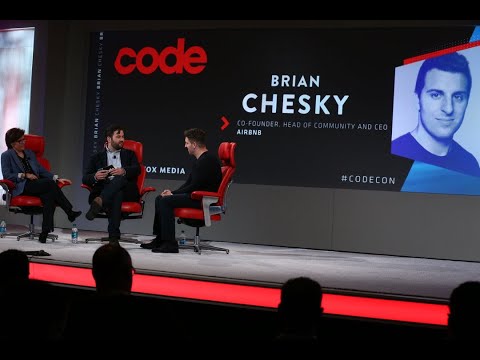
“It was really about building this end-to-end travel app where you can be this global travel community. And I think the key that makes Airbnb so different is the fact that we're a community, not just a series of commodities. And so, the people who misunderstand Airbnb, they tend to just see a bunch of real estate and they're like, "This is real estate." It's, you know, you know, people have a bunch of opinions about real estate being rented on a short-term basis. But of course, when you look a little deeper, what you're going to see, or three million people are hooked in is what you're really buying. And so, I think, yep, only a community marketplace is kind of the big idea here.”Code Conference interview, 2019 · full transcript →
Expansion works when it is capital-light and regulation-aware
Chesky’s approach to growth is expansive but not infrastructure-heavy. He sees large future demand for travel, while believing Airbnb can grow alongside hotels rather than only by taking share from them. That reflects a strategic preference for platform expansion: broaden access, serve more use cases, and increase total travel rather than assuming every market is winner-take-all.1018
He applies the same non-zero-sum logic to regulation. Instead of treating cities as enemies, he argues for working city by city, listening, and helping build rules that recognize home sharing while protecting neighborhoods. His claim is that durable growth comes from legitimacy and local fit, not just speed.192021
This long-game orientation also shows up in how he describes Airbnb’s core supply. The business, in his view, is grounded in ordinary people renting the homes they live in. That framing matters because it shapes both the company’s regulatory posture and its strategic identity.13

“…we want to enrich the cities we serve…”Code Conference interview/session, 2015 · full transcript →
Long-term strategy is organizational, not just market-facing
Chesky does not treat strategy as only choosing markets or products. He says that as Airbnb matured, his job increasingly became building a strong management team and a platform for future innovation. In other words, the company’s internal architecture is itself a strategic asset.2223
He also thinks culture quality affects strategic endurance. He has chosen not to make moves that would weaken the company’s beliefs, and he emphasizes long-horizon relationships with leaders and directors. The practical lesson is that strategy is not merely where you compete; it is the system of people, norms, and decision-making that lets you keep competing well for a long time.24
“…part of what I need to now be doing is building an incredibly strong management team…”Code Conference interview, 2019 · full transcript →
Chesky on business strategy, in his own words
“…travel as we know it is never coming back…”
“…the holy grail of over-tourism is travel redistribution…”
Where to watch
 Brian Chesky on Founder Mode: Run the Company in the Details2023 · 73 min · full transcriptBest for understanding Chesky’s operating strategy: clarity, one roadmap, and founder-led decision-making.
 Brian Chesky on Founder Mode: The CEO as Chief Product Officer2024 · 42 min · full transcriptBest for his current view that the CEO should drive product strategy and expansion beyond the core.
 Brian Chesky on Travel, Pricing, and AI: Airbnb's Next Chapter2023 · 34 min · full transcriptBest for why perfecting the core comes before broader growth and how pricing transparency fits strategy.
 Brian Chesky on Corporate Maturity: Building Airbnb for the Long Run2019 · 34 min · full transcriptBest for the long-run company-building view: management team, platform thinking, and community advantage.
 Brian Chesky on Travel Revolution: Flexibility Is Changing Everything2021 · 29 min · full transcriptBest for the market thesis behind Airbnb’s strategy: flexible travel, longer stays, and redistribution.
 Brian Chesky on Regulation and Expansion: Airbnb's Next Phase2015 · 32 min · full transcriptBest for how Chesky thinks about regulation, cities, and scaling a platform without fighting every battle.
Questions people ask
- How does Brian Chesky balance Airbnb and neighborhood concerns?
- How has Brian Chesky changed as CEO over time?
- What changes did Brian Chesky make to Airbnb after taking back control?
- What did Brian Chesky say Airbnb's mission really is?
- What does Brian Chesky think the CEO should be in a product company?
- What did Brian Chesky say about asking for help and finding mentors?
Sources
Every quote above, word for word from the transcripts. Numbers match the text.
“Way too many founders apologize for how they want to run the company.”
“What everyone really wants is clarity.”
“I stopped pushing decision-making down. I pulled it in. I created one shared consciousness and I said, the top 30, 40 people in the company are going to have one continuous conversation. Metrics are going to be subordinate to the calendar. So we're going to have a roadmap. It's going to be a two-year roadmap. We'll update the roadmap literally every month. People may wonder, well, what if the world changes? Yeah, it changes every day. So the roadmap's something where the next month doesn't change, but two years out it changes. It's a rolling roadmap. And by the way, if Ukraine gets invaded and you want to provide housing for refugees, you can still pivot people and adapt very quickly. We house 120,000 refugees. So you still keep a reserve of resources to be able to pivot and do things because there's always unexpected events. I created this new function called product marketing. We basically described what that is. I made the group much smaller. I took a lot of product managers, I reassigned them as program managers.”
“I think the CEO should be basically the chief product officer of a product or tech company.”
“…great leaders are in the details.”
“The point is this: great leaders are in the details. That's what founder mode is.”
“I think that the CEO of the company should always be the chief product officer…”
“And then the pandemic occurred and we lost 80% of our business in eight weeks. And then suddenly we're like, oh my God. I remember basically staring into the abyss. And luckily I've never had a near-death experience, but the way it's been described to me is it's like your life flashes before your eyes and you have clarity. And that's what happened to our business. We had a near-death business experience and our business flashed before our eyes. And so suddenly I basically got into action and I said, I'm going to run it this other way where I'm going to get back involved in the details. And by the way, Lenny, here's the funny thing. Before the crisis, a lot of people felt like I was too involved in different areas. Once the crisis happened, guess what happened? People were like, what do we do? We need you more involved. And so I got more involved. And when I got involved, I made the following changes. The first thing I did is I said, everything we're doing has to be written down and put into a Google sheet. It turns out people couldn't even write down everything they were doing.”
“This is the year of perfecting the core.”
“…for me to win, you don't have to lose.”
“It was really about building this end-to-end travel app where you can be this global travel community. And I think the key that makes Airbnb so different is the fact that we're a community, not just a series of commodities. And so, the people who misunderstand Airbnb, they tend to just see a bunch of real estate and they're like, "This is real estate." It's, you know, you know, people have a bunch of opinions about real estate being rented on a short-term basis. But of course, when you look a little deeper, what you're going to see, or three million people are hooked in is what you're really buying. And so, I think, yep, only a community marketplace is kind of the big idea here.”
“…our business is ordinary people renting their homes…”
“…we want to be more in the inspiration business…”
“…travel as we know it is never coming back…”
“…the holy grail of over-tourism is travel redistribution…”
“…the more we live remotely and live flexibly, the more we're home all day…”
“I think we're going to live in a world where two, three, four billion international tourism arrivals will one day happen…”
“…we need to make sure that we take our time, understand that government is a place of last recourse…”
“…we want to enrich the cities we serve…”
“What we've done is we've partnered with cities. And, as some cities really want a lot of Airbnb's, and some cities want to have more restrictions, when we go city by city—I mean, at the end of the day, we want to be—we want to be good for neighborhoods; we don't want to be bad for neighborhoods. There's sometimes a trade-off between what a neighborhood wants and what hosts want and what business wants, and you have to find that balance. Oftentimes, we end up going on the side of the city. Like in the city of New York, we removed all people that had multiple listings. In the city of San Francisco, we are—you know, we are smaller than—we work free registration in San Francisco. That was definitely a trade-off.”
“…part of what I need to now be doing is building an incredibly strong management team…”
“Over the last couple years, it's been very, very clear that part of what I need to now be doing is building an incredibly strong management team and spending a lot more time building the team and building the platform for all future innovation. So, we had this very successful single product, homes, and we thought to ourselves, "Well, we want to be a company that's gonna be around for a long, long time." And so, to be able to do that, I want to be able to have an executive team that's gonna be with me for, you know, a dozen years or longer, the way Steve did or Jeff did at Amazon. And so, that's kind of probably the biggest thing that I've been doing.”
“So we were kind of in trouble. And we had this conversation and there was the pragmatic decision of should we acquire them and then there was the values decision. The pragmatic one should've probably have said buy them because you can't risk losing international. So just guarantee you're gonna get international. But we ended up not buying them. And the reason we ended up not buying them is I just didn't like the culture. I didn't wanna bring in this 400 people. I felt like we were missionaries and they were mercenaries. I didn't think they were doing it for the beliefs. I thought they were doing it to make a lot of money very quickly. And I believe in a war on missionaries would outlast and out-endure mercenaries. And I also felt like the best revenge against an Internet startup, Internet clone was just to make them run the company long term. It's like you have the baby, now you gotta raise it.”
How this guide was made: drafted with AI from the full transcripts of the recordings cited, then checked: every quotation must match a transcript word for word and be the speaker's own words, and an independent review gates accuracy. Methodology and corrections.