Barack Obama on Race in America
Obama sees race in America as an unfinished democratic test: the country must face the living legacy of slavery and discrimination, reject division, and build a fairer union through shared responsibility and civic action.
- America’s racial history still shapes present inequality and cannot be wished away.
- Obama treats Black anger and white resentment as real forces, but says both can be manipulated and must not block progress.
- He believes the nation is bound by equality and shared obligation, not race or tribe.
- Racial progress requires citizenship: truth-telling, participation, reform, and responsibility to one another.
- He pairs justice with grace, arguing that moral change and structural change have to work together.

“The past isn't dead and buried. In fact, it isn't even past.”National Constitution Center speech, Philadelphia, March 2008 · 16:08
Race begins with an honest account of history
Obama’s core claim is that race in America cannot be understood as a closed chapter. He argues that slavery, segregation, and discrimination are not just background facts in the national story; they continue to shape present life in schools, housing, wealth, and opportunity. That is why he insists the country cannot talk seriously about race unless it admits that the past is still active in the present.1
At the same time, he places this history inside a larger American promise. He returns again and again to the country’s founding creed of equality, not to say the promise has been fulfilled, but to say it creates a standard by which America must judge itself and improve. Race, in this view, is one of the clearest tests of whether the nation will actually make its own principles real.23
“The past isn't dead and buried. In fact, it isn't even past.”National Constitution Center speech, Philadelphia, March 2008 · full transcript →
He rejects simple villains-and-innocents stories
Obama’s most distinctive move on race is to refuse caricature. He does not deny Black anger; he explains it as connected to real exclusion and accumulated injustice. But he also says white resentment is politically potent and cannot just be mocked away, because many people experience their own insecurity and feel unseen. His point is not that these grievances are identical, but that a politics built on inflaming either side will keep the country stuck.4
That is why he speaks of national choice. Americans can let inherited suspicion, fear, and grievance harden into camps, or they can decide to build a broader sense of common fate. His language of unity is not color-blind denial; it is an argument that racial honesty must lead to democratic cooperation rather than permanent tribalism.45
“We have a choice in this country.”National Constitution Center speech, Philadelphia, March 2008 · full transcript →
Equality is real only when it reaches ordinary life
Obama does not treat race as only a matter of attitudes or private prejudice. He connects racial justice to concrete conditions: whether children have decent schools, whether families can build security, whether neighborhoods are treated fairly, and whether opportunity is genuinely shared. In that sense, equality is not just a moral slogan but a practical standard for public life.62
He often frames this through shared obligation. If the country is truly one nation, then other people’s children are not somebody else’s problem, and freedom is not fully secured when it belongs unevenly. He argues that citizenship means accepting responsibility for one another’s life chances, not retreating into racial, ideological, or regional silos.678
“The children of America are not those kids. They are our kids.”National Constitution Center speech, Philadelphia, March 2008 · full transcript →
The Black church shows both the wound and the strength of America
In Charleston, Obama uses the Black church to explain race in America at its deepest level. He describes it as a center of African-American life, meaning a place of worship, memory, education, organizing, endurance, and freedom struggle. The attack on that church therefore represented more than an isolated act of violence; it touched a long history of racial terror aimed at community, dignity, and belonging.9
But he also draws a second lesson from Charleston: racial justice needs more than outrage. He points to forgiveness, grace, and moral courage as forces that can interrupt the cycle of hatred without excusing injustice. For Obama, grace does not replace reform; it helps make reform possible by enlarging what citizens can imagine for one another.108

“The church is and always has been the center of African-American life.”Charleston memorial service remarks, 2015 · full transcript →
Progress on race depends on democratic action, not sentiment
Obama consistently argues that hope on race is not passive optimism. Change requires organized citizens who vote, tell the truth, listen across difference, and push institutions to live up to democratic ideals. That is why he emphasizes that citizens have the power to set the country’s course and that making things better is a responsibility, not a wish.111213
He especially puts weight on younger generations. When racism, inequality, and dysfunction are exposed, he sees an opening to create a fairer normal instead of restoring old habits. His view of race in America is therefore demanding but not despairing: the nation can change, but only if people choose solidarity over cynicism and action over spectacle.141516

“You can create a new normal.”Dear Class of 2020 commencement speech, virtual, 2020 · full transcript →
Obama on race in america, in his own words
“The past isn't dead and buried. In fact, it isn't even past.”
“That my liberty depends on you being free, too.”
“What we know, what we have seen is that America can change.”
Where to watch
 Barack Obama on Race and Unity: The Road to a More Perfect Union2008 · 38 min · full transcriptHis fullest statement on race: slavery’s legacy, Black anger, white resentment, and the work of building a more perfect union.
 Barack Obama on Grace and Racial Justice: Charleston Memorial Remarks2015 · 38 min · full transcriptShows how he links racial violence, the Black church, forgiveness, and the need for justice.
 Barack Obama on Equality and Climate: Second Inaugural Address2013 · 224 min · full transcriptExplains the civic creed behind his racial politics: equality must be made real by citizens and government.
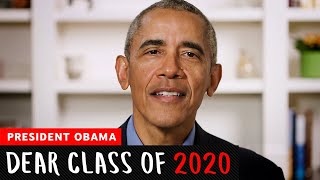 Barack Obama on Democracy and Hope: Dear Class of 20202020 · 15 min · full transcriptApplies his racial thinking to a newer generation, urging them to build a fairer and more truthful normal.
 Barack Obama on Politics of Hope: Audacity in Boston2004 · 22 min · full transcriptEarly statement of his unity argument: America is one nation bound by shared obligations.
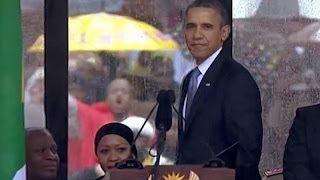 Barack Obama on Nelson Mandela's Legacy: Ubuntu, justice, and courage2013 · 19 min · full transcriptAdds the moral framework of solidarity and shared humanity that shapes his approach to justice.
Questions people ask
- What did Barack Obama say about equality in his second inaugural address?
- What did Barack Obama say about polarization and how to persuade people in politics?
- What did Barack Obama say makes America great?
- What did Barack Obama say young people can do to create a new normal?
- What did Barack Obama say about values and happiness?
Sources
Every quote above, word for word from the transcripts. Numbers match the text.
“The past isn't dead and buried. In fact, it isn't even past.”
“We hold these truths to be self-evident, that all men are created equal…”
“This union may never be perfect, but generation after generation has shown that it can always be perfected.”
“We have a choice in this country.”
“There is not a liberal America and a conservative America. There is the United States of America.”
“The children of America are not those kids. They are our kids.”
“I am my brother's keeper, I am my sister's keeper.”
“That my liberty depends on you being free, too.”
“The church is and always has been the center of African-American life.”
“If we can find that grace, anything is possible.”
“You and I, as citizens, have the power to set this country's course…”
“We have to work to make things better.”
“Hope is not a lottery ticket, it's a hammer for us to use in a national emergency.”
“You can create a new normal.”
“You can make it into the world as it should be and could be.”
“What we know, what we have seen is that America can change.”
How this guide was made: drafted with AI from the full transcripts of the recordings cited, then checked: every quotation must match a transcript word for word and be the speaker's own words, and an independent review gates accuracy. Methodology and corrections.
