Barack Obama on Public Service
Obama treats public service as the work of citizenship: joining with others, accepting responsibility beyond yourself, and helping democracy deliver for ordinary people.
- Public service starts with citizenship, not status or ego.
- Democracy only works when people participate, organize, and keep showing up.
- Freedom includes responsibility to other people, not just personal rights.
- Change is slow and difficult, so service requires persistence, compromise, and hard work.
- Young people and ordinary citizens are the ones who build renewal from the ground up.
Public service is what citizenship asks of you
Obama presents public service as a basic duty of citizenship, not as something reserved for elected officials. In his inaugural address, he ties national renewal to responsibility, sacrifice, and a commitment to the common good, arguing that rights come with obligations and that citizenship carries both a cost and a promise.12
He returns to the same idea in his victory speech by saying politics is worthwhile only when it serves people larger than ourselves. For him, public life is justified when it helps families, communities, and future generations, not when it becomes a vehicle for self-importance.45
Service means building change together, from the ground up
Obama consistently describes change as something ordinary people build together. He credits volunteers, donors, and organizers for creating political victories step by step, and he emphasizes that progress belongs to a collective we rather than to a single leader.6789
That view makes organizing a form of public service. Real change is built locally, patiently, and relationally, through people who give time, effort, and trust to common work rather than waiting for rescue from above.610

“Block by block. Brick by brick. Calloused hand by calloused hand.”Election Night Chicago Remarks, Grant Park, 2008 · full transcript →
Democracy depends on participation, not spectators
Obama's clearest claim is that democracy requires active citizens. He warns against passive politics and insists that people have to vote, engage, persuade, and stay involved if they want self-government to work.1112
He also argues that participation is more than election-season enthusiasm. Trust is built by showing up, listening, and sustaining relationships in places that are often ignored, which means public service includes presence and attention as much as rhetoric.1013
Because democracy is contested, service also includes compromise and mutual respect. Obama praises leaders who understand that most public problems are not simple and that progress requires working with people you do not fully agree with.1415
Responsibility to others is part of freedom
Obama rejects a narrow idea of freedom as only individual independence. He argues for a broader freedom in which our lives are bound together and in which liberty becomes real when people recognize duties to one another.16175
That is why service matters so much in his moral vocabulary. He says a decent society rests on the belief that we are responsible for brothers, sisters, neighbors, and future generations, and he links justice to the insight that one person's freedom depends on the freedom of others.18195
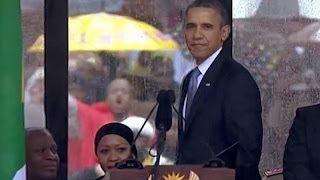
This is also why he honors institutions and leaders rooted in community care. In Charleston and in his tribute to Mandela, he praises forms of leadership that combine moral conviction, humility, and solidarity with practical action.202122
Public service requires endurance, honesty, and hope
Obama is not sentimental about service. He says change is hard, slow, and unfinished, so serving the public means accepting frustration without giving in to cynicism.232
His answer to that difficulty is a disciplined form of hope. Hope, in his telling, is not wishful thinking but a tool for action, a reason to keep working when the outcome is uncertain.2526
That message is especially strong when he speaks to young people. He tells them they can create a fairer new normal if they ground themselves in responsibility, fairness, generosity, respect, truth, and practical effort.28293031
Obama on public service, in his own words
“Block by block. Brick by brick. Calloused hand by calloused hand.”
Where to watch
 Barack Obama on Inaugural Address: Hope, Unity, and Renewal2009 · 99 min · full transcriptBest single statement of service as citizenship, sacrifice, and commitment to the common good.
 Barack Obama on Hope & Democracy: Democratic convention farewell2008 · 49 min · full transcriptBest for his argument that democracy needs participation, compromise, and persistence.
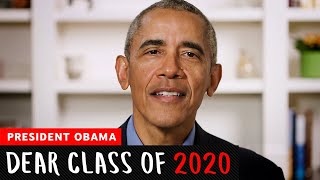 Barack Obama on Democracy and Hope: Dear Class of 20202020 · 15 min · full transcriptShows how he translates public service into practical guidance for young citizens.
 Barack Obama on Election Victory: Yes We Can2008 · 17 min · full transcriptBest example of his belief that ordinary people build change from the ground up.
 Barack Obama on Democracy and Hope: Fight for the Future2020 · 49 min · full transcriptExplains why service today includes proving that democracy can still deliver for ordinary people.
 Barack Obama on Media and Democracy: Lessons from the 2016 Election2016 · 61 min · full transcriptAdds his practical lesson that service means showing up, listening, and organizing locally.
Questions people ask
- What did Barack Obama say about compromise in democracy?
- What did Barack Obama say about polarization and how to persuade people in politics?
- What did Barack Obama say about who his election victory belonged to?
- What did Barack Obama say makes America great?
- What did Barack Obama say young people can do to create a new normal?
- What did Barack Obama say about values and happiness?
Sources
Every quote above, word for word from the transcripts. Numbers match the text.
“This is the price and the promise of citizenship.”
“Greatness is never a given; it must be earned.”
“That's why we do this. That's what politics can be.”
“The belief that our destiny is shared, that this country only works when we accept certain obligations to one another and the future generations; so that the freedom which so many Americans have fought for and died for comes with responsibilities as well as rights. And among those are love and charity and duty and patriotism. That's what makes America great.”
“Block by block. Brick by brick. Calloused hand by calloused hand.”
“I will never forget who this victory truly belongs to. It belongs to you. It belongs to you. I was never the likeliest candidate for this office. We didn't start with much money or many endorsements. Our campaign was not hatched in the halls of Washington. It began in the backyards of Des Moines, in the living rooms of Concord, in the front porches of Charleston. It was built by working men and women who dug into what little savings they had to give $5, $10, and $20 to the cause. It drew strength from the young people…”
“Yes, we can. Not yes, she can. Not yes, I can. Yes, we.”
“It's been you who fueled my dogged faith in our future…”
“So I think we have a scrambled political landscape right now.”
“Democracy isn't a spectator sport.”
“Our job is to convince people democracy can deliver.”
“THAT SENSE OF MUTUAL RESPECT HAS TO BE PART OF OUR MESSAGE. OUR POLITICS HAVE BECOME SO POLARIZED THESE DAYS. ALL OF US ACROSS THE SPECTRUM SEEM SO QUICK TO ASSUME THE WORST IN OTHERS, UNLESS THEY AGREE WITH US ON EVERY SINGLE ISSUE. WE START THINKING THE ONLY WAY TO WIN IS TO SCOLD AND SHAME AND OUT YELL THE OTHER SIDE. AFTER A WILD, REGULAR FOLKS TUNE IT OUT. OR THEY DON'T BOTHER TO VOTE. THAT APPROACH MAY WORK FOR THE POLITICIANS WHO WANT ATTENTION AND THRIVE ON DIVISION.”
“And that's what Hillary Clinton understands. She knows that this is a big, diverse country. She has seen it, she's traveled, she's talked to folks, and she understands that most issues are rarely black and white. She understands that even when you're 100% right, getting things done requires compromise. That democracy doesn't work if we constantly demonize each other. She knows that for progress to…”
“…we are not enemies, but friends.”
“We have a broader idea of freedom.”
“…there is a oneness to humanity…”
“I am my brother's keeper, I am my sister's keeper.”
“That my liberty depends on you being free, too.”
“The church is and always has been the center of African-American life.”
“If we can find that grace, anything is possible.”
“Mandela taught us the power of action, but he also taught us the power of ideas…”
“…change is never easy and never quick…”
“Hope is not a lottery ticket, it's a hammer for us to use in a national emergency.”
“We don't fear the future; we shape it.”
“You can make it into the world as it should be and could be.”
“You can create a new normal.”
“We have to work to make things better.”
“I hope that, instead, you decide to moor yourself in values that last, like responsibility, fairness, generosity, and respect for others. That will make you part of the solution, instead of part of the problem. And if experience is any guide, it actually makes for a happier life. Second, listen to each other. Respect each other. And use all that critical thinking you've developed from your education to help promote the truth. You are the Internet generation and the social media generation. It's not just how you shop or listen to music or watch videos. It's part of your social lives. It's the new town square, where you all come together and meet.”
How this guide was made: drafted with AI from the full transcripts of the recordings cited, then checked: every quotation must match a transcript word for word and be the speaker's own words, and an independent review gates accuracy. Methodology and corrections.