Barack Obama on Faith & Grace
Obama treats faith and grace as sources of hope, humility, mutual obligation, and moral courage that must be turned into repair, justice, and common action.
- Faith means believing in moral possibility even when change is hard.
- Grace is not passive comfort; it opens people to forgiveness, truth, and renewal.
- Religious language points to shared obligation, not tribal division.
- The Black church matters because it has carried dignity, community, and freedom struggles through suffering.
- Hope only counts if it becomes sacrifice, citizenship, and concrete work.

“In the end, that is God's greatest gift to us, the bedrock of this nation: a belief in things not seen…”Democratic National Convention keynote address, Boston, 2004 · 17:07
Faith is belief in possibility, not denial of reality
Obama uses faith to name a disciplined belief that change is possible even when the facts are harsh. He does not present faith as escape from history or suffering. He presents it as the refusal to let fear, cynicism, or despair have the last word.123
That is why his language of hope is usually paired with work and unfinished tasks. In his view, faith does not mean assuming the nation is already righteous; it means trusting that people can still move it closer to justice.456
“In the end, that is God's greatest gift to us, the bedrock of this nation: a belief in things not seen…”Democratic National Convention keynote address, Boston, 2004 · full transcript →
Grace appears when people choose forgiveness, truth, and renewal
Obama’s fullest treatment of grace comes in Charleston, where he responds to racist violence with a moral vocabulary larger than vengeance. Grace, for him, is not sentimentality. It is the power that allows grieving people and a wounded community to answer hatred with a deeper sense of freedom, dignity, and possibility.78
But grace does not erase the crime or soften the truth about it. Obama ties grace to honesty about racial terror, to the role of the Black church, and to the need for public change. In that sense, grace is transforming because it makes repentance and repair imaginable.7

“If we can find that grace, anything is possible.”Charleston memorial service remarks, 2015 · full transcript →
Faith creates obligation to other people
Obama’s religious language almost always leads to solidarity. He links faith to responsibility for neighbors, strangers, and future generations, rejecting a politics that sorts people into hostile camps.1011
This is why he often frames freedom as shared rather than private. A person’s liberty is bound up with the liberty of others, and citizenship asks sacrifice for a common good larger than self-interest.81213
He makes the same point through a broader moral vision of human interdependence. Whether speaking about America, race, or Mandela’s legacy, he returns to the idea that people rise or fall together.1415
The Black church shows how faith sustains dignity under oppression
Obama treats the Black church as more than a place of worship. He presents it as a center of African American life: a shelter, a school of leadership, and a vessel for memory, endurance, and freedom struggle.
That helps explain why he resists shallow readings of Black religious life or Black anger. In his view, you cannot understand American democracy, race, or hope without understanding the institutions that helped Black communities survive exclusion while still believing in the country’s unrealized promise.165
Humility matters because moral progress is real but never automatic
Obama’s view of faith and grace is morally demanding because he rejects triumphalism. Nations, movements, and leaders are imperfect, and progress has to be earned rather than presumed.17
That humility is paired with agency. People must choose maturity over childishness, action over resignation, and new beginnings over endless cycles of grievance. Faith gives the courage to begin; grace helps make reconciliation possible; but neither removes the burden of responsibility.192021
Obama on faith & grace, in his own words
“In the end, that is God's greatest gift to us, the bedrock of this nation: a belief in things not seen…”
“If we can find that grace, anything is possible.”
Where to watch
 Barack Obama on Grace and Racial Justice: Charleston Memorial Remarks2015 · 38 min · full transcriptBest single statement of how grace, forgiveness, racial truth, and the Black church fit together.
 Barack Obama on Race and Unity: The Road to a More Perfect Union2008 · 38 min · full transcriptShows how faith in change coexists with honesty about history, race, and national imperfection.
 Barack Obama on Politics of Hope: Audacity in Boston2004 · 22 min · full transcriptIntroduces Obama’s core idea of hope as a moral and almost theological commitment to unseen possibility.
 Barack Obama on Inaugural Address: Hope, Unity, and Renewal2009 · 99 min · full transcriptConnects faith to citizenship, sacrifice, and the discipline needed for national renewal.
 Barack Obama on War and Peace: The Nobel Lecture2009 · 37 min · full transcriptApplies his moral framework to tragedy, conflict, and the refusal of despair.
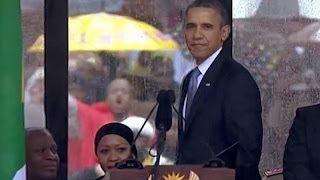 Barack Obama on Nelson Mandela's Legacy: Ubuntu, justice, and courage2013 · 19 min · full transcriptExpands the theme into humility and human interdependence through Mandela and ubuntu.
Questions people ask
Sources
Every quote above, word for word from the transcripts. Numbers match the text.
“In the end, that is God's greatest gift to us, the bedrock of this nation: a belief in things not seen…”
“What we know, what we have seen is that America can change.”
“I refuse to accept despair as the final response to the ambiguities of history.”
“We have more work to do.”
“This union may never be perfect, but generation after generation has shown that it can always be perfected.”
“Our actions matter and can bend history in the direction of justice.”
“If we can find that grace, anything is possible.”
“That my liberty depends on you being free, too.”
“There is not a liberal America and a conservative America. There is the United States of America.”
“I am my brother's keeper, I am my sister's keeper.”
“This is the price and the promise of citizenship.”
“Peace requires responsibility; peace entails sacrifice.”
“…there is a oneness to humanity…”
“The children of America are not those kids. They are our kids.”
“The past isn't dead and buried. In fact, it isn't even past.”
“Greatness is never a given; it must be earned.”
“The time has come to set aside childish things.”
“This cycle of suspicion and discord must end.”
“We have the power to make the world we seek, but only if we have the courage to make a new beginning.”
How this guide was made: drafted with AI from the full transcripts of the recordings cited, then checked: every quotation must match a transcript word for word and be the speaker's own words, and an independent review gates accuracy. Methodology and corrections.
