Warren Buffett on Investing
Buffett’s investing view is to buy understandable, durable businesses at sensible prices, ignore market forecasts, and let long-term compounding do the work.
- Think like an owner, not a trader; a stock is part of a business.
- Ignore market and macro predictions; focus on value within your circle of competence.
- Buy at a sensible price with a margin of safety.
- Prefer great businesses that can compound for years over cheap, weak ones.
- Patience matters: wait for the right pitch and don’t use borrowed money to speculate.
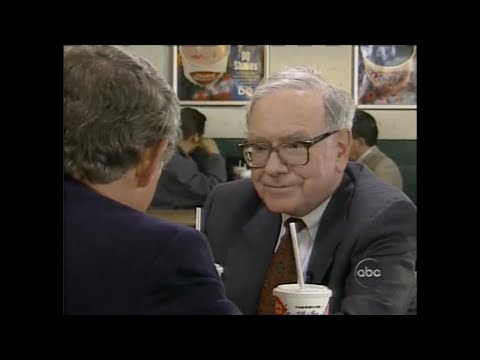
“All I'm trying to do is buy a piece of a business at an attractive price…”Nightline interview, 1999 · 12:12
Start by seeing stocks as businesses
Buffett’s foundation is simple: investing is not about guessing where a ticker goes next week. It is about assessing a real business and deciding whether its future earning power justifies the price you pay. He repeatedly says he approaches a stock purchase as if he were buying the entire company, which shifts attention from price movement to business value123.
That owner’s mindset changes how you react to markets. If you are buying part of a business, daily quotations become less important than whether the company will be stronger over the next 10, 20, or 30 years. Buffett’s test is not whether a stock wiggles around, but whether the business is understandable and worth more than the price asked456.
“All I'm trying to do is buy a piece of a business at an attractive price…”Nightline interview, 1999 · full transcript →
Let the market serve you, not instruct you
Buffett does not build an investing approach around predicting the market, the economy, or interest rates. He says plainly that he does not know what the market will do, has never been able to predict interest rates, and does not pass on good opportunities because of a macro view789.
That leads to one of his central disciplines: use market prices as offers, not commands. When prices fall, a long-term buyer may benefit because future purchases can be made more cheaply. The market is useful when it gives you bargains, but dangerous when you let it tell you what to think101112.
This is also why panic does not automatically change his long-term outlook. Markets can react instantly to fear, but the productive capacity of businesses and the broader economy changes more gradually. Buffett’s posture in turmoil is not prediction but steady focus on what remains true about the business and the long-run progress behind it131415.

“The stock market is there to serve you, not to instruct you.”Charlie Rose interview, 2006 · full transcript →
Stay inside your circle of competence
Buffett’s edge does not come from knowing everything. It comes from knowing what he can evaluate and refusing to pretend expertise elsewhere. He emphasizes understandable businesses and says he does not worry about things he does not understand, which protects him from being pulled into stories, fads, or technically impressive but unknowable situations1617.
In practice, that means asking whether you can explain why you are buying a business and what makes it attractive. If the reason is price action, chatter, or excitement, that is not enough. Buffett wants decisions grounded in business logic, not in social proof or momentum192021.
This discipline also explains why he has often avoided fast-changing areas when he could not confidently estimate long-term economics. He prefers businesses with durable characteristics and fewer moving parts, because change can make valuation far less reliable22.

“We want things that we can understand.”Berkshire Hathaway annual meeting, 1998 · full transcript →
Good investing is value plus a margin of safety
For Buffett, value investing is not just buying cheap things. It is buying future earning power for less than it is worth. Price matters because a good business can still be a bad investment if paid for unwisely, while a sensible price can protect the future by leaving room for error252627.
That is where margin of safety comes in. Since no investor knows everything, Buffett insists on extra room in the purchase price. This is not a small technical preference but a core habit: know what a business is worth, compare that to the market price, and act only when the gap is favorable enough272811.
He also stresses patience. You do not need to swing at every opportunity. Waiting for the right pitch is part of the strategy, because forcing action in an overpriced or uncertain market usually lowers standards293031.
“…always have a margin of safety…”Charlie Rose interview, 2006 · full transcript →
Prefer great businesses that compound over time
Buffett learned that time rewards quality. A weak business may look statistically cheap, but if it earns poor returns on capital for years, time works against you. By contrast, a strong business with durable economics can keep compounding value, making long holding periods an advantage rather than a risk323334.
This is why he moved away from buying merely cheap, troubled companies and toward better businesses bought at reasonable prices. He wants companies that will still be good or better businesses many years from now, because the real engine of investment success is the business’s ability to produce and reinvest earnings over time33355.
That same logic shapes his broad preference for stocks over long bonds, especially when rates are low. Businesses can retain earnings and grow, while a fixed bond payment does not compound in the same way. For Buffett, long-term investing works best when the asset itself has room to build value internally351432.
“The real thing to do with a great business is just hang on for dear life.”Berkshire Hathaway annual meeting, 1998 · full transcript →
Temperament matters as much as analysis
Buffett’s approach only works if your behavior matches it. You must be able to sit still, ignore headlines, and avoid leverage-driven mistakes. He warns specifically against using borrowed money to speculate, because even a sound idea can become disastrous when leverage removes your staying power3622.
Temperament also means accepting that uncertainty never disappears. Buffett does not wait for perfect clarity about the economy or markets. He reads widely, studies businesses, and acts when he understands the business, likes the economics, and can buy at a sensible price373839.
For most people, he suggests humility about stock-picking skill. If you are not in position to judge individual businesses well, a simple index fund is a better route than pretending to have an edge. That fits his broader philosophy: invest in ways that match your actual competence, not your hopes about it40.
“The one piece of advice I'd give them is don't do it on borrowed money.”Nightline interview, 1999 · full transcript →
Buffett on investing, in his own words
“The stock market is there to serve you, not to instruct you.”
“…always have a margin of safety…”
“All I'm trying to do is buy a piece of a business at an attractive price…”
“The real thing to do with a great business is just hang on for dear life.”
“…if I'm a net buyer, I will do better if prices are lower.”
“The one piece of advice I'd give them is don't do it on borrowed money.”
Where to watch
 Warren Buffett on Value Investing: Wait for the Right Pitch2006 · 52 min · full transcriptBest single overview of Buffett’s value investing basics: business value, market psychology, margin of safety, and patience.
 Warren Buffett on Value Investing: Buy Businesses, Not Stocks1999 · 27 min · full transcriptA concise statement of his owner’s mindset, long holding periods, and warning against borrowing to speculate.
 Warren Buffett on Macro Forecasting: Focus on Value, Not Predictions2005 · 260 min · full transcriptShows why Buffett ignores macro forecasting and sees lower prices as opportunity for long-term buyers.
 Warren Buffett on Value Investing: Keep It Simple1998 · 332 min · full transcriptExplains why he prefers understandable, high-quality businesses that compound over time.
 Warren Buffett on Value Investing: Lessons from the Financial Crisis2009 · 43 min · full transcriptConnects Buffett’s early education to his enduring habit of analyzing stocks as whole businesses.
Questions people ask
- What did Warren Buffett say about betting against America?
- What did Warren Buffett say about buying good businesses at a reasonable price?
- What did Warren Buffett say about forecasting the stock market?
- What did Warren Buffett say about having a reason to buy a stock?
- What did Warren Buffett say about his circle of competence?
- What does Warren Buffett recommend for the average investor?
Sources
Every quote above, word for word from the transcripts. Numbers match the text.
“I look at it as buying the whole company.”
“The real question is whether the company's worth more or less than $100 billion.”
“All I'm trying to do is buy a piece of a business at an attractive price…”
“…look at a stock not as some thing that wiggles around…”
“If you get your money's worth in terms of future earning power over the next 10 or 20 or 30 years, you're going to have made a good investment. And you can't pick them from day to day. If you can do that, you can. Well, I haven't met anybody yet that knows how to do it.”
“Well, when I buy 100 shares of XYZ company, I look at it as buying the whole company. And so I've always looked at buying stocks as buying businesses. So it really wasn't a different situation. Now, I couldn't resell it, and I couldn't, if I own the stock, I couldn't change management, which I could if I own the whole company, but it was basically the same approach.”
“I don't think anybody knows what the market's going to do.”
“I have never been able to predict interest rates, and I've never tried…”
“We've never decided not to buy a business we like because of a macro view.”
“…if I'm a net buyer, I will do better if prices are lower.”
“The stock market is there to serve you, not to instruct you.”
“…you use it to serve you and not to instruct you;…”
“…we'll come out better on the other end…”
“I bought a business today, not a stock today.”
“It does not make sense to bet against America.”
“We want things that we can understand.”
“I don't worry about things I don't understand.”
“I mean, you really want your decision making to be by looking in the mirror and saying yourself, I'm buying a 100 shares of General Motors at 55 because... And, I mean, it's your responsibility if you're buying it, and there's gotta be a reason. And if you can't state the reason, you shouldn't buy it. If it's because somebody told you about it at cocktail party, not good enough. You know? Mean, there's just... It's got to be something, you know, can't be because of the volume. You know, the chart looks good on it or anything like that. So there's got to be a reason you'd buy the business.”
“We don't think of stocks as as little items that wiggle around in the paper and that have charts attached to them.”
“Well, you look at everything and relate one to another. I mean, that's the nature of market. So you're always trying to think about, a, what's in my circle of confidence, and then what makes the most sense that's within that circle. But the important thing is know where the perimeter of the circle is. I mean, that's way more important than how big the circle is or a whole bunch of other factors. So I think Apple is within my circle of commerce. I think it's an incredible business run by a fellow who's one of the great managers of all time, and he was underrated for a while, but now he's being seen for what he really is. It's it's an assound... You you could almost... You know, if we had…”
“We view change as more of a threat into the investment process than an opportunity.”
“Price takes care of the future.”
“The surest way to buy, make money, is to buy your own dollar bills for 80 cents or 90 cents.”
“…always have a margin of safety…”
“…the idea of a margin of safety, of always leaving some extra room in things.”
“…we keep waiting for the right pitch…”
“We do not find bargains in this market among the larger companies that are that are our universe.”
“I'm looking for one good idea a year.”
“Those are the companies that have low returns on equity. And if you have a business that's earning five or 6% on equity and you hold it for a long time, you are not going to do well in investing even if you buy it cheap to start with. Time is the enemy of the of the poor business and it's the it's the friend of the great business. I mean, if you have a business that's earning 20 or 25% on equity and it does that for a long time, time is your friend. But time is your enemy if you if you have your money in a low return business. And you may be lucky enough to pick the exact moment when it gets taken over by someone else, but we like to think when we buy a stock, we're gonna own it for a very long time and therefore we have to stay away from businesses that have low returns on equity.”
“You know, we we always look at what a business does in terms of what it earns on capital. We wanna be in good businesses. What what we really wanna be is in businesses that are gonna be good businesses and better businesses ten years from now. And we wanna buy them at a reasonable price. But many years ago, we gave up what I've labeled the cigar butt approach to investing, which is where you try and find a a really kind of pathetic company, but it sells so cheap that you think there's one good free puff left in it. And and we used to pick up a lot of soggy cigar butts, you know.”
“The real thing to do with a great business is just hang on for dear life.”
“Stocks are way better than 30-year bonds.”
“The one piece of advice I'd give them is don't do it on borrowed money.”
“I believe in reading everything in sight.”
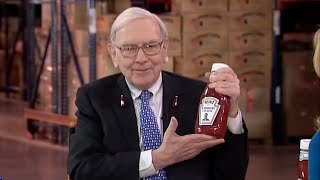
“Heinz makes sense because we've got a business we like, and we've got a partner we like, and we've got a price that I barely like.”
“Charlie and I will talk about the business. We will not get into discussions about the Fed or government or whatever.”
“Well, playing the stock market—playing is not a word I would choose. I—I would recommend that they put a similar sum that maybe they'd be earning more as they went along, but save something every month and just—and basically put it in an index fund. They are not in a position to make judgments on stocks themselves; they're not in the game any more than I'm, you know, I can—I can prescribe in medicine or something of the sort. They will get a good result. The American economy has done wonderfully. I mean, if you take the 20th century, the Dow started at 66 and ended at 11,400. Now, think of that. How could anybody get a bad result in investing starting at 66 to 11,400? But a lot of people do because they jump in at the wrong time or they think they know this stock versus that…”
How this guide was made: drafted with AI from the full transcripts of the recordings cited, then checked: every quotation must match a transcript word for word and be the speaker's own words, and an independent review gates accuracy. Methodology and corrections.