Sundar Pichai on Privacy And Data
Sundar Pichai argues that technology should expand access and usefulness while giving people real control over their data and building privacy, safety, and accountability into AI.
- Privacy should be available to everyone, not just people who can pay for it.
- Google should give users transparency, choice, and control over data collection.
- He treats companies as stewards of user data, not owners of it.
- AI raises privacy risks, so progress has to come with safeguards, accountability, and responsible deployment.
- He sees trust as aligned with Google’s long-term business interests, not opposed to them.
Privacy, in Pichai’s view, is a basic expectation
Pichai’s clearest principle is that privacy should not be reserved for a premium tier of users. He presents it as something technology companies should protect broadly, not as a feature only some people can afford or access.1
That fits his larger view that technology should expand access for more people. When he talks about computing and information, he repeatedly frames progress as widening availability rather than creating advantages for a narrow group.21
User control matters more than passive data collection
When pressed on Google’s data practices, Pichai’s main defense is not that data collection is unimportant, but that users should be able to understand and manage it. He says Google should provide transparency, choice, and control, and he points to settings and product decisions as the mechanism for that control.3
He also argues that data flows depend on context and the relationship between the user and the service they are using. In discussing apps on Android, he distinguishes between information gathered by an app developer and information that goes to Google, suggesting that not every action on a Google-powered device automatically becomes Google’s data.4
Trust is not separate from Google’s incentives
Pichai argues that serving users well over the long run is in Google’s own interest. His case is that durable products depend on user satisfaction and trust, so protecting those things is not charity or public relations but part of how the business sustains itself.5
This is why he often links product decisions to long-term usefulness rather than short-term engagement. He describes Google’s work as oriented around helping users with knowledge, success, health, and happiness, which implies that data use should support outcomes users value rather than simply maximize extraction.7
AI makes privacy and data governance more urgent
Pichai sees AI as unusually powerful, which is exactly why privacy and data questions become more important, not less, as AI improves. He describes AI as one of the most profound technologies humanity is working on and warns that its benefits and harms can both be large.8910
His answer is responsible progress rather than stopping progress. He emphasizes safeguards, proactive responsibility, and human accountability, especially as AI reaches product scale and public attention intensifies.111213
He is especially alert to misuse that crosses lines of identity and surveillance. In one case he says AI should not be used in an impersonation way, and in another he notes that technologies such as facial recognition can help people but also enable mass surveillance.1410
Data stewardship requires rules, not just company promises
Pichai’s position is not that companies should simply be trusted to figure privacy out on their own. He supports broader governance frameworks for advanced technology, especially around safety, fairness, accountability, and privacy.
He also frames the underlying moral idea in terms of stewardship: user data belongs to users, while companies have obligations in how they handle it. That outlook helps explain why he talks about regulation and shared rules as compatible with innovation rather than hostile to it.
Pichai on privacy and data, in his own words
“It's in our natural incentive to do so.”
Where to watch
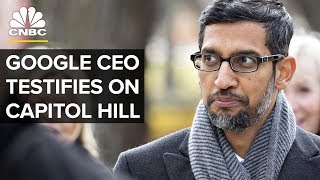 Sundar Pichai on Data Collection: Transparency, Privacy, and Bias2018 · 222 min · full transcriptBest for his direct defense of Google’s data practices, especially transparency, choice, control, and long-term user trust.
 Sundar Pichai on AI, Privacy, and the Internet2020 · 29 min · full transcriptBest for his broad privacy principle that privacy should be universal and for how he connects privacy to AI governance.
 Sundar Pichai on Responsible AI: Ethics, Regulation, and Education2019 · 53 min · full transcriptBest for his framework linking AI progress to privacy, fairness, accountability, and regulation.
 Sundar Pichai on AI in Products: Search, Gmail, and Safety2023 · 10 min · full transcriptBest for understanding how he thinks privacy and safeguards should work when AI is shipped inside widely used products.
 Sundar Pichai on Artificial Intelligence Policy: responsibility, trust, and global rules2017 · 30 min · full transcriptBest for his stewardship view that user data belongs to users and companies need ethical and global rules.
Questions people ask
- Does Google get data from apps that are preloaded on Android?
- What did Sundar Pichai say about political bias at Google?
- What did Sundar Pichai say about engagement versus long-term user trust?
- What does Sundar Pichai think AI should be used for?
- What did Sundar Pichai say about regulating technology and working with governments?
- How does Sundar Pichai use AI in his own life?
Sources
Every quote above, word for word from the transcripts. Numbers match the text.
“…privacy cannot be a luxury good…”
“…enabling radically more access to both information and computing to more people…”
“We give them transparency, choice, and control.”
“Right. Unless there may be specific cases where the user has given us diagnostic information. So the answer would depend on the context, but in general no. I mean, the relationship is between the user and the app developer. If you get an app that gathers information on a specific thing, that's not also coming to Google as well as to the developer of the app. In a general sense, no.”
“It's in our natural incentive to do so.”
“…we have four attributes we focus on: knowledge, success, health, and happiness…”
“AI is one of the most profound things we are working on…”
“AI is one of the most profound things we will ever work on as humanity.”
“You know, I've said this before: AI is one of the most profound things we are working on — humanity as humanity. It's more profound than fire or electricity or any of the other bigger things we have worked on. It has tremendous positive sides to it, but you know, it has real negative consequences. You know anything about technologies like facial recognition; it can be used to benefit, it can be used to find missing people, but it can be used for mass surveillance. And as democratic countries with a shared set of values, we need to, you know, build on those values and make sure when we…”
“I think the world's attention is tuned into AI…”
“…it's at an inflection point to some extent…”
“We are trying to be proactively responsible where we can…”
“AI is not ever used in an impersonation way…”
How this guide was made: drafted with AI from the full transcripts of the recordings cited, then checked: every quotation must match a transcript word for word and be the speaker's own words, and an independent review gates accuracy. Methodology and corrections.
