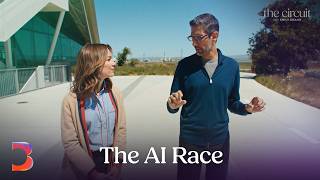
Sundar Pichai on Business Strategy
Sundar Pichai’s business strategy is to treat AI as a long-term, horizontal platform shift and use Google’s full stack to improve every major product at once rather than chase a single new business line.
- Think from the technology shift outward, not from the next standalone business backward.
- Build across the full stack—research, chips, infrastructure, models, and products—to create durable advantage.
- Use one core AI capability across many businesses at once, including Search, YouTube, Cloud, Android, and Waymo.
- Treat AI as expansionary, not zero-sum: strengthen core products while creating new usage, subscriptions, and enterprise demand.
- Move fast organizationally, but keep a high bar on quality, trust, and responsible deployment.

“I, uh, the last decade, you know, uh, set the company to be deeply AI first, right? This is for us. AI is not the LLM. It's one moment in time, right? We are working on so many things in such a deep fundamental way pretty much. It's, it's the same piece of technology which improves search, which improves YouTube, which improves Cloud. You know, Cloud and YouTube are over $100 billion in revenue, and 10 years ago these were in businesses for us, right? It's what, PureView. Uh, we have many, many other bets too. So I, I still think of us as an AI-first company, and I think if you're at the forefront of making progress with this technology, bringing it in a bold and responsible way, I think we'll do very well as a company.”New York Times DealBook Summit interview, 2024 · 40:01
Start with the platform shift, not the org chart
Pichai’s strategy begins with a view about the magnitude of AI. He sees it as a foundational platform shift, larger than a normal product cycle, which means strategy should be anchored in long-term technological change rather than short-term category battles. That is why he describes this period as the beginning of a long innovation wave, not a one-off disruption.13
From that perspective, the key strategic mistake is to ask first what the next big business will be. Pichai instead starts with the underlying innovation, then asks whether Google can build products people genuinely love and use, letting new businesses emerge from that adoption. This is a product-led theory of strategy, but it is grounded in a very broad view of AI’s impact.45
He has applied that lens for years. His AI-first shift was meant to orient the company around the next computing transition, much as earlier eras required adapting to the internet and mobile. In his framing, strategy is not selecting one bet; it is aligning the company early around the deepest technological change.678
Use AI as a horizontal capability across the whole company
Pichai does not treat AI as a separate product line. He treats it as a horizontal capability that should improve nearly every important part of Google at once. In his view, the same core technology can make Search better, strengthen YouTube and Cloud, extend Android and XR, and support newer bets like Waymo and Isomorphic.4910
That matters because it changes how you think about growth. Instead of searching for one replacement business, Google can compound value across multiple large surfaces simultaneously. Pichai points to Cloud and YouTube as examples of major businesses that became significant over time while the company continued building other bets.9
This also explains why he rejects a zero-sum framing around AI and Google’s core businesses. He sees the opportunity space expanding as AI makes engineers more productive, creates new products, and increases what the company can build. Strategy, in that sense, is expansionary: use one technological wave to widen the set of things the company can do.11
“I, uh, the last decade, you know, uh, set the company to be deeply AI first, right? This is for us. AI is not the LLM. It's one moment in time, right? We are working on so many things in such a deep fundamental way pretty much. It's, it's the same piece of technology which improves search, which improves YouTube, which improves Cloud. You know, Cloud and YouTube are over $100 billion in revenue, and 10 years ago these were in businesses for us, right? It's what, PureView. Uh, we have many, many other bets too. So I, I still think of us as an AI-first company, and I think if you're at the forefront of making progress with this technology, bringing it in a bold and responsible way, I think we'll do very well as a company.”New York Times DealBook Summit interview, 2024 · full transcript →
Build full-stack advantages that competitors cannot easily copy
A central part of Pichai’s strategy is depth across the stack. He argues that Google’s edge comes from combining frontier research, custom chips, infrastructure, models, products, and distribution. Rather than relying on a single model or interface, he wants the company to control enough layers that progress in one layer improves the others.1314
This is also his answer to commoditization. He explicitly says that everyone will get more compute, which means lasting differentiation cannot come from access alone. Advantage has to come from algorithmic progress, engineering, infrastructure efficiency, and the ability to translate breakthroughs into products used at scale.15
He applies that logic to economics as well. Cost matters, but he emphasizes that Google has been driving down serving costs through rapid infrastructure and chip innovation. The strategic point is not merely cheaper inference; it is the ability to deliver high-quality AI experiences at Google scale across many products.1714
Protect and expand the core instead of abandoning it
Pichai’s strategy for Search is not defensive retreat. He argues that AI makes Search more useful by enabling new query types, more conversational interactions, and deeper assistance, while preserving the features that made Search valuable in the first place. He expects Search to change profoundly, but not to lose its core identity.18619
That is why he keeps returning to links, sources, and exploration. He believes users sometimes want direct answers, but often want to go further, compare, learn, and navigate the web. So the product strategy is not answer-only; it is answer-plus-discovery, with strong anchoring in sources.2021
He extends this logic beyond Search. In his framing, AI strengthens existing products rather than replacing them from the outside. That is why he describes the moment as far from zero-sum and says user choice is good. A winning strategy, for him, improves the core franchise while opening adjacent behavior and revenue pools.1122
Restructure for speed, but keep trust and responsibility high
Pichai’s strategy is not only about where to compete; it is also about how to operate. He says most decisions are not truly consequential, so leaders should make them quickly to preserve organizational velocity. For a company facing a fast platform shift, speed of decision-making is itself a strategic capability.2324
At the same time, he does not treat speed as license for recklessness. He emphasizes responsible progress toward advanced AI, high quality bars in Search, and the need for user control and transparency in agentic products. The pattern is consistent: move quickly on execution, but keep trust as a design constraint.252126
This combination of speed and restraint also shapes how he thinks about emerging areas like agents and cybersecurity. He expects agents to become a core way people use the web, but only if users feel in control. And where capabilities change the frontier in sensitive domains, he favors a more careful, case-by-case approach.272829
Aim the company with a few clear bets and let innovation spread
Pichai’s leadership philosophy is to make a small number of consequential choices clear, then align the company behind them. He believes large organizations make fewer truly important decisions, but those decisions must point everyone in the same direction. In Google’s case, AI-first is that directional choice.3031
Once that direction is set, he wants innovation to spread broadly through talent, empowered teams, and cross-pollination. He talks about the company as a place where people can innovate at all levels, and he values an environment that keeps ideas moving across teams. This complements the top-level strategy: centralize the deepest shared capabilities, while keeping product creation wide.3233
The practical implication is simple. Set a long-term technological thesis, back it with investment, organize around shared platforms, and let many products absorb the capability. That is how Pichai thinks a company navigates a major transition without narrowing itself to a single bet.34935
Pichai on business strategy, in his own words
“We are definitely investing for the long run…”
Where to watch
 Sundar Pichai on AI and Search: Building Google’s Next Act2024 · 41 min · full transcriptBest overview of his full-stack strategy and why Google sees AI as transforming Search rather than replacing it.
 Sundar Pichai on the AI Platform Shift: Search, Agents, and Glasses2025 · 41 min · full transcriptBest for understanding his product-led view that AI is a horizontal platform shift bigger than prior computing waves.
 Sundar Pichai on AI, Search, and Policy: Google’s Expansionary Moment2025 · 30 min · full transcriptBest concise statement of the expansionary strategy across Search, YouTube, Cloud, subscriptions, and long-term investment.
 Sundar Pichai on Google AI Strategy: Search, Agents, and AGI2026 · 46 min · full transcriptBest for how he is reorganizing Google to move faster with shared models, infrastructure, and cross-product execution.
 Sundar Pichai on AI Search: Google’s Big Transition2025 · 62 min · full transcriptBest for the operating economics behind the strategy, including Search usage, AI mode, infrastructure, and serving costs.
 Sundar Pichai on Artificial Intelligence: Google’s AI-First Shift2021 · 52 min · full transcriptBest for the original AI-first framing and why he sees AI as a broad technological foundation across businesses.
Questions people ask
- How does Sundar Pichai make big decisions at Google?
- What did Sundar Pichai say AI will do to engineering jobs at Google?
- What did Sundar Pichai say about AI and Google Search?
- What did Sundar Pichai say about whether AI will create new businesses at Google?
- What does Sundar Pichai think Google will be in the AI era?
- How does Sundar Pichai describe his leadership style at Google?
Sources
Every quote above, word for word from the transcripts. Numbers match the text.
“To me, we are just getting started in the beginning of what I think will be a extraordinary decade of innovation…”
“AI is gonna be bigger than the internet…”
“And so I think one of the mistakes people make often in a period of rapid innovation is think about what is that next big business versus looking at the underlying innovation and say, can you build something and put out something which people love and use, right? And out of which you, you do the next thing and, you know, create value out of it. So when I look at it, AI is such a horizontal piece of technology across our entire business. It's why, you know, I mean, it impacts not just Google search, YouTube, Cloud, all of Android XR, etcetera, Google Play, things like Waymo, Isomorphic, which is based on AlphaFold.”
“AI is not the LLM. It's one moment in time…”
“It's a good frame, a good question to talk about. You know, I've definitely, you know, for almost a decade, you know, one of the first things I did was to think of the company as AI first. It was very clear to us. We had Google Brain underway in 2012. We acquired DeepMind in 2014. 2015, when I became the CEO, I said, look, the technology is really evolving. The reason we were excited to approach our work as AI first is because we really felt that AI is what will drive the biggest progress in search. And so, you know, I think, even the last couple of years, I viewed this as an extraordinary opportunity for search. I think if you look at how much information means to people, I think they're going to, each person is going to have access to information in a way they've never had before.”
“Around that time, you know, when I became CEO, I kind of pivoted the company to what we call this AI-first approach. I just feel like no difference from when the internet came or desktop to mobile. It's an even bigger transition. When I fast forward to now, AI is kind of built into all our products. You know, even if you take search, the quality improvements we've gotten by now being able to understand voice, video, images, text, both from an input standpoint and also looking at the information standpoint and putting it all together, it's pretty profound. Conversational AI, I don't think is fully transformed yet. By AI, we are still in the handcrafted stage of…”
“I think it's one of the most profound things we're working on as humanity.”
“I, uh, the last decade, you know, uh, set the company to be deeply AI first, right? This is for us. AI is not the LLM. It's one moment in time, right? We are working on so many things in such a deep fundamental way pretty much. It's, it's the same piece of technology which improves search, which improves YouTube, which improves Cloud. You know, Cloud and YouTube are over $100 billion in revenue, and 10 years ago these were in businesses for us, right? It's what, PureView. Uh, we have many, many other bets too. So I, I still think of us as an AI-first company, and I think if you're at the forefront of making progress with this technology, bringing it in a bold and responsible way, I think we'll do very well as a company.”
“AI is kind of built into all our products.”
“It feels very far from a zero sum game to me…”
“We have taken such a deep full-stack approach to AI.”
“Look, it plays out everywhere. To your earlier question on cost per query in search, the reason we feel comfortable we can serve it at that scale is because we are constantly innovating through e generation, including chips which are really, really good at inference. Right? And Ironwood, which is our latest in our TPUCs, a single part of Ironwood is over 40 exaflops, right? And so, the scale of these things are incredible, and we have thought about our info all the way from subsea cables to the scale at which we do infrastructure is unparalleled. And I've always viewed that full stack approach. You know, deep infrastructure, foundational, fundamental R and D on top of it, and then you build and innovate on top of that. And I think that approach will serve us well over time.”
“I think everyone will get more compute…”
“…the cost to serve that query has fallen dramatically in an eighteen month timeframe…”
“Search itself will continue to change profoundly in '25.”
“…maybe the most widely used Gen AI product today might be search with AI overuse…”
“I think part of what makes Google Search differentiator is while there are times we give answers, it'll always link to a wide variety of sources. Now we've had answers in Search now for many, many years. We are just now using generative AI to do that. So the links will live on. Yes, and, you know, I think it'll always be an important part of Search. There will be times when they want quick answers. My son is celiac, so we did a quick question to see whether something is gluten-free. We just want to know. But often it leads to more things, and, you know, then you want to explore more.”
“Look, we are giving context around it, but we are still anchoring it in, you know, the sources we find, you know, but we've always felt a high bar, you know, in Google. I mean, last year when we launched AIO views, I think, you know, people are adversely querying to find errors and the error rate was one in 7 million for adverse real queries. And so, but that was a big, but that's the bar we've always operated as a company. And so I think to me, nothing has changed. Like, you know, Google operates under a very high bar. That's the bar we strive to meet , and you know, our search page results are there for everyone to see. But that comes that natural accountability, and you know, we have to constantly earn people's trust. So that's how I would approach it.”
“I think choice choice is good for users…”
“The more you're able to make those decisions and keep the company moving forward, you're generally better off.”
“A big part of my framework is over time understanding that there are very, very few decisions which are really consequential, and most decisions aren't. So what matters much more is that you make the decision because that's what determines the velocity of an organization. And so the more you're able to make those decisions and keep the company moving forward, you're generally better off. Of course, there are a few decisions like combining and setting up Google DeepMind, you know, those are more consequential and you want to take your time deliberating and doing it, but a lot of decision making is about just making them. And so the more you're able to do that, you do develop over time some pattern matching and some intuition for you've seen a version of the problem before, and so I think it's good to rely on that and separate the signal from the noise so that the signal is that this is a really important decision and you want to really deliberate around it versus this is just it may look big, but it is more a normal course of action you need to take.”
“We are committed to making foundational progress towards AGI in a bold and responsible way…”
“…users feel a sense of control and agency and transparency when they use agents.”
“I do expect agents to be a core part of how we use the web.”
“I think once you get the taste of using something like that and the superpower that comes with it, I think they're genuinely adding value, in a way. I think people will use them. I think it's important we build it in a way that users feel a sense of control and agency and transparency when they use agents. I think that's important. That's an important foundation. But I think, yes, I do expect agents to be a core part of how we use the web.”
“So I think it makes sense to me, if you suddenly have something which dramatically changes the frontier, first of all, I think it's important to work closely with the government on that. And you approach it in a responsible way. So I think that is consistent with how the security industry works. But I do think it's important to also make sure enough people get access to it so they can patch their systems and so on. And they go hand in hand. So I think there's validity to that approach.”
“I think the larger the company is, you are making fewer consequential decisions, but they need to be clear, and you have to point the whole company to that. Part of that, at times, involves bringing the company along. You build consensus because that's what allows you to have maximum impact behind those decisions. I mean, any leader in a position like yours has to be willing to hear the criticism.”
“Yes, you know, look, I, I, I deeply care about building, seeing the journey through on AI, right? It's what in 2015 I set the company to be AI first. It's why I was excited to be a CEO too, and I think the next decade is going to be the most interesting there. You said you want to see it through? Yeah.”
“Look, I think it's important to step back and say, you know, the underpinnings of a culture in which you really invest in employees and you empower them. And even some of the perks was to create a culture where it's positive, optimistic, you're in an innovation mindset, People are talking to each other, maybe by giving lunch here. People are all sitting and talking ideas through lunch. You're cross pollinating. Imagine. So, you know, that is the thesis of it, not that we are trying to give lunch to people, right? And so, I, till today, feel we still get a lot of innovation in the company. At all levels of the company.”
“The talent market, you know, we go through these fierce moments for talent. AI is one of them. And whenever there are these Google, you know, obviously we are fortunate to have some of the most talented employees, so we are a source. I'm equally proud of the fact that, I think Google has left to start over 2,000 companies, right? And so, you know, there is a virtuous cycle, I think. People come back, we acquire companies. I think all of that keeps the company fresh. But in the current AI moment, look, I think we are both holding on to critical talent. We are recruiting, You know, I always look at the tip of the tree of, are we able to attract the best PhD researchers coming out of the top programs? And the answer is yes.”
“We are definitely investing for the long run…”
“I think we are closer than ever before to deliver on that promise.”
How this guide was made: drafted with AI from the full transcripts of the recordings cited, then checked: every quotation must match a transcript word for word and be the speaker's own words, and an independent review gates accuracy. Methodology and corrections.