Sundar Pichai on Competition
Sundar Pichai treats competition in AI as a long, expanding race won by shipping better products, investing across the full stack, and improving Search rather than assuming a zero-sum collapse.
- He does not see AI competition as zero-sum; he sees a larger opportunity space.
- He believes Google competes by improving Search with AI, not by abandoning what made Search useful.
- His core competitive advantage is Google’s full-stack setup: research, models, chips, infrastructure, and products.
- He thinks this race will be long and harder over time, so sustained investment and technical progress matter more than short-term panic.
- He values speed in decision-making because velocity matters in fast-moving technology shifts.
He sees AI competition as expansion, not a winner-take-all collapse
Pichai pushes back on the idea that Google must choose between protecting its existing business and embracing AI. He argues that this conflict appears only if you frame the moment incorrectly, and he repeatedly describes AI as creating a bigger market rather than a fixed pie with one winner.12
That view explains why he sounds less defensive about rivals than many observers expect. He believes users benefit from more choice, and he treats the rise of new AI products as part of a broader shift in how people access information rather than a simple substitution away from Google.3
He also connects this to the larger scale of the opportunity. In his view, AI raises what products can do, increases engineering velocity, and opens room for more products and more usage, which is why he talks about competing by building into the future instead of reacting from fear.45
His answer to competition is to remake Search, not retreat from it
Pichai’s central claim is that AI strengthens Search when it is integrated well. He has said for years that AI would drive the biggest progress in Search, and he continues to describe the current shift as an opportunity to expand what Search can do rather than evidence that Search is becoming obsolete.67
What stays constant, in his view, is the usefulness of combining direct help with pathways to explore. He argues that Search should still provide quick answers when that is what people want, but it should also keep linking people to a wide range of sources when they want to dig deeper.8
That is why he talks about Search changing profoundly instead of disappearing. He sees conversational and agentic interfaces as new layers on top of a product whose core job is still helping people find trustworthy information and continue their exploration.79
He thinks Google’s edge comes from the full stack
When Pichai describes how Google competes, he rarely points to a single model alone. He emphasizes a deep full-stack approach that spans research, models, chips, infrastructure, and products, suggesting that durable advantage comes from how these layers reinforce one another.1011
This is especially important because he expects access to compute to spread. If everyone can get more compute, then simply spending more is not enough; the real differentiators become technical breakthroughs, efficient systems, and the ability to turn them into products used at scale.1213
He also links competitiveness to infrastructure economics and performance. He says serving AI queries has become much cheaper in a short period, and he argues that Google’s TPUs and infrastructure depth give it confidence that it can serve these experiences at global scale.1415
He believes the race is long, and that helps explain Google’s posture
Pichai consistently frames the AI era as early, not settled. He describes the period as the beginning of an extraordinary decade of innovation and argues that AI is bigger than any one model moment, which is why he resists reading each product cycle as the final verdict on who is ahead.1617
That longer horizon is also why he stresses sustained investment. He says Google is investing for the long run, and he ties that to a broader commitment to foundational progress, including progress toward more capable systems pursued in a bold and responsible way.1819
At the same time, he does not portray the future as easy. He expects progress to get harder as the obvious gains are exhausted, which means competition will increasingly depend on deeper reasoning, planning, and scientific advances rather than hype alone.13
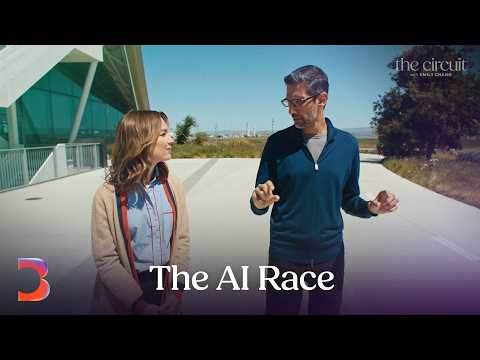
“To me, we are just getting started in the beginning of what I think will be a extraordinary decade of innovation…”Bloomberg The Circuit interview, 2024 · full transcript →
He treats organizational speed as part of competing well
Pichai’s view of competition is not only about technology; it is also about how a company makes decisions. He argues that only a small number of decisions are truly consequential, and that for most choices the bigger risk is moving too slowly.2021
That emphasis on velocity fits his broader leadership approach in fast-moving markets. He believes leaders need to set a clear direction, bring the company along behind important choices, and keep the organization moving so it can learn and adapt faster than the environment changes.2221
This helps explain why he talks about AI as a company-wide shift rather than a side project. If the transition is as profound as he says, then competing well requires aligning products, talent, and execution around it over many years.232425
Pichai on competition, in his own words
“To me, we are just getting started in the beginning of what I think will be a extraordinary decade of innovation…”
Where to watch
 Sundar Pichai on AI Search: Google’s Big Transition2025 · 62 min · full transcriptBest for his direct argument that AI is an opportunity for Search, with detail on usage shifts, cost, infrastructure, and rivals.
 Sundar Pichai on AI and Search: Building Google’s Next Act2024 · 41 min · full transcriptBest for understanding his full-stack theory of competition and why he thinks Search is being transformed rather than displaced.
 Sundar Pichai on Future of AI: Search, Gemini, and Competition2024 · 24 min · full transcriptBest for his framing that AI competition is still early and for how he explains Search’s mix of answers, links, and exploration.
 Sundar Pichai on AI, Search, and Policy: Google’s Expansionary Moment2025 · 30 min · full transcriptBest for his clearest zero-sum rebuttal and his long-run investment mindset.
 Sundar Pichai on Google AI Strategy: Search, Agents, and AGI2026 · 46 min · full transcriptBest for how organizational structure, speed, and product coordination fit into his competitive strategy.
Questions people ask
- How does Sundar Pichai keep Google relevant?
- How does Sundar Pichai make big decisions at Google?
- What did Sundar Pichai say AI will do to engineering jobs at Google?
- What did Sundar Pichai say about AI and Google Search?
- What did Sundar Pichai say about the future of Google Search in the age of AI?
- What does Sundar Pichai say about talent at Google?
Sources
Every quote above, word for word from the transcripts. Numbers match the text.
“I think the dilemma only exists if you treat it as a dilemma.”
“It feels very far from a zero sum game to me…”
“I think choice choice is good for users…”
“I think I think the opportunity space is also increasing. I just view this as making engineers dramatically more productive, getting a lot of the mundane aspects out of what they do, allowing them to spend on higher value added tasks. But that means it's an accelerator. People will be able to do more, which means maybe we will create new products and hence we will need more people, at least in the near term. To me, it looks like, you know, we will expand engineering velocity and that doesn't mean we are constrained in what we will do. We'll end up doing more as a company as well.”
“You know, from our perspective, and I think it's true for technology in particular, the world keeps changing, as I said earlier. So a big part of what I focus on at any given time is making sure we are innovating and building products for the future. You know, it's just got to be a normal course of how you think. And so we constantly think about what to do next. So Android is very popular, people are using smartphones, but I always sit and think about what is the next version of how people use computing, right? And so we are thinking about things like virtual reality or augmented reality. These are all new areas, but we are constantly thinking about it.”
“It's a good frame, a good question to talk about. You know, I've definitely, you know, for almost a decade, you know, one of the first things I did was to think of the company as AI first. It was very clear to us. We had Google Brain underway in 2012. We acquired DeepMind in 2014. 2015, when I became the CEO, I said, look, the technology is really evolving. The reason we were excited to approach our work as AI first is because we really felt that AI is what will drive the biggest progress in search. And so, you know, I think, even the last couple of years, I viewed this as an extraordinary opportunity for search. I think if you look at how much information means to people, I think they're going to, each person is going to have access to information in a way they've never had before.”
“Search itself will continue to change profoundly in '25.”
“I think part of what makes Google Search differentiator is while there are times we give answers, it'll always link to a wide variety of sources. Now we've had answers in Search now for many, many years. We are just now using generative AI to do that. So the links will live on. Yes, and, you know, I think it'll always be an important part of Search. There will be times when they want quick answers. My son is celiac, so we did a quick question to see whether something is gluten-free. We just want to know. But often it leads to more things, and, you know, then you want to explore more.”
“You know, I actually find- - In an agentic search world. - One of the arguments I've made over time, and I actually see it playing around a little bit more, I've started using the web more again. - Okay. - Over the last year, year and a half. I think all these AI experiences have brought the web back more. You know, there was a time when it felt like, you know, but I always felt the web would be vibrant. In fact, I've argued the web is gonna be vibrant every year.”
“We have taken such a deep full-stack approach to AI.”
“I, uh, the last decade, you know, uh, set the company to be deeply AI first, right? This is for us. AI is not the LLM. It's one moment in time, right? We are working on so many things in such a deep fundamental way pretty much. It's, it's the same piece of technology which improves search, which improves YouTube, which improves Cloud. You know, Cloud and YouTube are over $100 billion in revenue, and 10 years ago these were in businesses for us, right? It's what, PureView. Uh, we have many, many other bets too. So I, I still think of us as an AI-first company, and I think if you're at the forefront of making progress with this technology, bringing it in a bold and responsible way, I think we'll do very well as a company.”
“I think everyone will get more compute…”
“I think the progress is going to get harder when I look at 25, the low-hanging fruit is gone…”
“…the cost to serve that query has fallen dramatically in an eighteen month timeframe…”
“Look, it plays out everywhere. To your earlier question on cost per query in search, the reason we feel comfortable we can serve it at that scale is because we are constantly innovating through e generation, including chips which are really, really good at inference. Right? And Ironwood, which is our latest in our TPUCs, a single part of Ironwood is over 40 exaflops, right? And so, the scale of these things are incredible, and we have thought about our info all the way from subsea cables to the scale at which we do infrastructure is unparalleled. And I've always viewed that full stack approach. You know, deep infrastructure, foundational, fundamental R and D on top of it, and then you build and innovate on top of that. And I think that approach will serve us well over time.”
“To me, we are just getting started in the beginning of what I think will be a extraordinary decade of innovation…”
“AI is not the LLM. It's one moment in time…”
“We are definitely investing for the long run…”
“We are committed to making foundational progress towards AGI in a bold and responsible way…”
“The more you're able to make those decisions and keep the company moving forward, you're generally better off.”
“A big part of my framework is over time understanding that there are very, very few decisions which are really consequential, and most decisions aren't. So what matters much more is that you make the decision because that's what determines the velocity of an organization. And so the more you're able to make those decisions and keep the company moving forward, you're generally better off. Of course, there are a few decisions like combining and setting up Google DeepMind, you know, those are more consequential and you want to take your time deliberating and doing it, but a lot of decision making is about just making them. And so the more you're able to do that, you do develop over time some pattern matching and some intuition for you've seen a version of the problem before, and so I think it's good to rely on that and separate the signal from the noise so that the signal is that this is a really important decision and you want to really deliberate around it versus this is just it may look big, but it is more a normal course of action you need to take.”
“I think the larger the company is, you are making fewer consequential decisions, but they need to be clear, and you have to point the whole company to that. Part of that, at times, involves bringing the company along. You build consensus because that's what allows you to have maximum impact behind those decisions. I mean, any leader in a position like yours has to be willing to hear the criticism.”
“I think it's one of the most profound things we're working on as humanity.”
“Around that time, you know, when I became CEO, I kind of pivoted the company to what we call this AI-first approach. I just feel like no difference from when the internet came or desktop to mobile. It's an even bigger transition. When I fast forward to now, AI is kind of built into all our products. You know, even if you take search, the quality improvements we've gotten by now being able to understand voice, video, images, text, both from an input standpoint and also looking at the information standpoint and putting it all together, it's pretty profound. Conversational AI, I don't think is fully transformed yet. By AI, we are still in the handcrafted stage of…”
“Yes, you know, look, I, I, I deeply care about building, seeing the journey through on AI, right? It's what in 2015 I set the company to be AI first. It's why I was excited to be a CEO too, and I think the next decade is going to be the most interesting there. You said you want to see it through? Yeah.”
How this guide was made: drafted with AI from the full transcripts of the recordings cited, then checked: every quotation must match a transcript word for word and be the speaker's own words, and an independent review gates accuracy. Methodology and corrections.

