Sundar Pichai on Google
Sundar Pichai sees Google’s mission as giving more people useful access to information, then using AI to make that help faster, broader, and more practical.
- Google’s core mission stays the same: organize information and make it universally accessible and useful.
- Pichai treats usefulness, not novelty, as the test: technology should help knowledge, success, health, or happiness.
- He sees inclusion as central to the mission, from local merchants to people with limited access or disabilities.
- AI matters because it can advance the mission in new ways, but only with real responsibility.
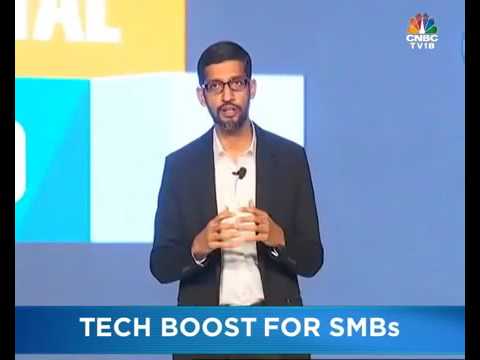
“Our mission for the last 18 years has been to organize the world's information and make it universally accessible.”Digital Unlocked event, 2017 · 10:08
The mission is simple: make information accessible and useful
Pichai returns again and again to one core idea: Google exists to organize information and make it broadly accessible. He describes that as a long-running constant rather than a slogan that changes with each new product wave.12
What matters to him is not just access in the abstract, but usefulness. Search is valuable because it helps people get what they need quickly, which shows how he thinks about the mission in practical terms rather than purely technical ones.3
“Our mission for the last 18 years has been to organize the world's information and make it universally accessible.”Digital Unlocked event, 2017 · full transcript →
He defines the mission by who it serves: everyone, not just the most advantaged
Pichai consistently frames Google’s mission as universal. He emphasizes that the internet and Google’s tools should work for ordinary people and small businesses, not only for elite users or fast-growing startups.4
That helps explain why he talks so often about access. He describes Google’s work as expanding access to both information and computing, and he argues that solving for places with tougher constraints can produce solutions that work for the world at large.56
This same logic appears in how he talks about India, affordability, and accessibility features. The mission is strongest when technology reaches people who have historically had less access, whether because of geography, cost, language, or disability.65

“…enabling radically more access to both information and computing to more people…”Interview with Marques Brownlee, 2021 · full transcript →
Usefulness is the standard: better knowledge, success, health, or happiness
Pichai does not talk about the mission as merely putting more information online. He uses a clearer test: technology should be helpful in people’s lives, and he evaluates that help through knowledge, success, health, and happiness.78
That standard ties Google’s older products and newer AI work together. Search aims to get people answers quickly, while newer tools in translation, transcription, accessibility, and learning extend the same mission into more situations.38
This is why his version of Google’s mission is broader than search rankings or product launches. The point is to improve outcomes for users in concrete ways, not to ship technology for its own sake.78

“I mean, we have, I mean the test I use is, is this, if by creating a feature with this, is it going to be helpful? I think about it four dimensions is going to help people improve their knowledge, success, health, or happiness. Okay, if it fits one of those four attributes, I think it's good to do. So that's, that's kind of how I think about it. And if I feel it's not doing any of that, you know, I would question as to why we are adding that.”Google I/O 2022 interview with iJustine · full transcript →
AI is not a new mission; it is a new way to fulfill the same one
Pichai presents AI as an inflection point, but not as a break from Google’s purpose. In his view, AI strengthens the company’s long-standing mission by making information easier to understand, access, and apply.91011
He treats AI as a way to reinvent products around greater helpfulness. That includes Search, Assistant, accessibility tools, health applications, and other systems that turn raw information into something more directly useful to people.
This continuity matters to how he leads. He wants people to see Google’s future technologies as serving the same basic goal: empowering people through better access to information and computing.1511
Because the mission is so powerful, he thinks responsibility is non-negotiable
Pichai pairs ambition with caution. If AI can greatly expand access and usefulness, then Google has to build and deploy it responsibly.1617
He talks about responsibility in concrete terms: avoiding harmful uses, being transparent, and treating stewardship seriously. He also connects the mission to quality, arguing that helping people find higher-quality information goes to the essence of what Google does.1819
In his framing, responsibility is not separate from the mission. It is part of what it means to make information genuinely useful for everyone at scale.171920
Pichai on google, in his own words
“Our mission for the last 18 years has been to organize the world's information and make it universally accessible.”
“…to make information universally accessible and useful…”
“…enabling radically more access to both information and computing to more people…”
“…we have four attributes we focus on: knowledge, success, health, and happiness…”
Where to watch
 Sundar Pichai on AI Vision: Google, Gemini, and the Future2025 · 45 min · full transcriptBest single overview of how Pichai connects Google’s original mission to AI as its next major expression.
 Sundar Pichai on AI and Accessibility: Google I/O 20222022 · 20 min · full transcriptShows how he translates the mission into a practical test of helpfulness across search, learning, translation, and accessibility.
 Sundar Pichai on Artificial Intelligence: Google I/O demos and the Assistant2018 · 20 min · full transcriptCaptures his view that AI is a computing turning point that can advance Google’s mission in new ways.
 Sundar Pichai on Digital Transformation: Small Business Growth in India2017 · 63 min · full transcriptExplains why universality matters to him, especially for small businesses and users outside the usual tech centers.
 Sundar Pichai on AI and Responsible Tech: Building Helpful Products2021 · 14 min · full transcriptSummarizes the user outcomes he cares about most: knowledge, success, health, and happiness.
 Sundar Pichai on Artificial Intelligence Policy: responsibility, trust, and global rules2017 · 30 min · full transcriptUseful for understanding why he thinks the mission now requires stronger responsibility and governance around AI.
Questions people ask
- How does Sundar Pichai decide which AI projects Google should build?
- What does Sundar Pichai think Google will be in the AI era?
- Why does Sundar Pichai say Google needs to refocus on its mission?
- What did Sundar Pichai say about Google's role in democracy and information quality?
- How does Sundar Pichai keep Google relevant?
Sources
Every quote above, word for word from the transcripts. Numbers match the text.
“Our mission for the last 18 years has been to organize the world's information and make it universally accessible.”
“…to make information universally accessible and useful…”
“…search was always about trying to get you the answer as quickly as possible…”
“The internet is as much for the established local merchant as it is for a high-flying starter.”
“…enabling radically more access to both information and computing to more people…”
“When we solve for a place like India, we solve for everyone around the world.”
“…we have four attributes we focus on: knowledge, success, health, and happiness…”
“I mean, we have, I mean the test I use is, is this, if by creating a feature with this, is it going to be helpful? I think about it four dimensions is going to help people improve their knowledge, success, health, or happiness. Okay, if it fits one of those four attributes, I think it's good to do. So that's, that's kind of how I think about it. And if I feel it's not doing any of that, you know, I would question as to why we are adding that.”
“We're at an important inflection point in computing…”
“AI is enabling this for us to do this in new ways…”
“AI is the ultimate expression of that…”
“But I think overall, look, we have a clear sense of where we are going. I think we want to empower people all in the service of our mission. So if anything, you know, over the past few years, and you are right, there are moments, not just us, but as an industry, I think, I think some of the other things became more of the focus than the mission of the company, and why we are all here, right? We are not all here in the company to resolve our personal differences or something. We are here because you're excited about, you know, innovating in the service of the mission of the company and the impact you can have.”
“…we have to be very responsible…”
“…we feel a deep sense of responsibility to get this right…”
“AI is not ever used in an impersonation way…”
“I mean, first of all, I think it was an important speech. And I think that's something we think about deeply, it's in our stated mission. If you think about search, this is what we are trying to do for every query, right? We are trying to sort what is higher quality information. And so, it cuts to the essence of what we do.”
“I think it's a moral imperative to do that.”
How this guide was made: drafted with AI from the full transcripts of the recordings cited, then checked: every quotation must match a transcript word for word and be the speaker's own words, and an independent review gates accuracy. Methodology and corrections.