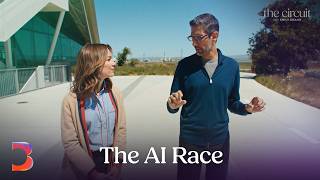
Sundar Pichai on Responsibility
Sundar Pichai treats responsible AI as a practical obligation: build powerful systems that help people, but pair them with safety, privacy, fairness, accountability, and rules that earn trust.
- AI is powerful enough that responsibility cannot be an afterthought; it has to shape development from the start.
- Responsible AI means safety, fairness, privacy, human accountability, and clear user control.
- Pichai argues the danger is not only misuse, but also failing to advance AI in ways that help society.
- He supports regulation and international coordination because AI is too important and too global to govern loosely.
- He wants AI to be useful in real products, while keeping a high bar for quality, sources, and trust.

“AI is one of the most profound things we are working on…”World Economic Forum conversation in Davos, 2020 · 7:15
Responsible AI starts with taking the technology seriously
Pichai consistently frames AI as a technology of unusual scale and consequence. He describes it as one of the most profound areas humanity will work on, and he places the current moment at a major computing inflection point rather than a passing hype cycle123.
That view drives his emphasis on responsibility. If AI is this important, then companies cannot treat safety and ethics as side issues to solve later; they have to be built into how systems are developed and launched45.
He also resists a purely fearful framing. Pichai argues that society should worry not only about overreach, but also about turning away from a technology that could deliver major benefits if advanced responsibly67.
“AI is one of the most profound things we are working on…”World Economic Forum conversation in Davos, 2020 · full transcript →
His core standard is useful AI with safety, privacy, fairness, and accountability
When Pichai talks about responsible AI, he returns to a stable set of principles: systems should be beneficial, safe, fair, private, and accountable. In his broader product philosophy, he also ties technology to concrete human outcomes such as knowledge, success, health, and happiness82.
Privacy is central to that standard, not optional. He argues that people should have transparency, choice, and control over how their data is used, and he has stated that privacy should not become something only a few people can afford910.
Fairness and accountability matter just as much because AI systems shape what people see, know, and trust. Pichai has defended the idea that products should operate without political bias and has linked long-term product success to serving users well over time, not simply maximizing short-term engagement1112.

“We give them transparency, choice, and control.”House Judiciary Committee hearing, 2018 · full transcript →
Responsible AI has to show up in product decisions, not just principles
Pichai does not present responsibility as abstract ethics separate from shipping products. He points to practical safeguards such as watermarking AI-generated content, privacy rules, careful licensing for advanced capabilities, and deliberate rollout choices5.
He also connects responsibility to product quality. In Search, for example, he argues that AI should help users get answers while still linking to sources and supporting deeper exploration, rather than acting like a closed box detached from the web14.
That same logic appears in his comments about quality standards and accountability. He emphasizes a high bar for results and notes that visible products create natural accountability because users can judge whether the system is actually helpful and trustworthy15.

“We are trying to be proactively responsible where we can…”Google I/O interview, 2023 · full transcript →
Trust depends on avoiding misuse and preserving human agency
Pichai’s version of responsible AI includes clear limits on how synthetic systems should behave around people. He has said AI should not be used in an impersonation way, which points to a broader concern with deception, manipulation, and loss of user agency16.
He also stresses that human voices and judgment still matter even as models become more capable. That suggests he sees good AI not as replacing people everywhere, but as assisting with the right tasks under meaningful human oversight5.
This matters because public trust is fragile. Pichai’s comments on democracy and information environments show that he sees large-scale technology as capable of both strengthening and destabilizing society, which raises the bar for how AI systems should be designed and governed17.

“AI is not ever used in an impersonation way…”Interview with Marques Brownlee, 2021 · full transcript →
Regulation and global cooperation are part of responsible AI
Pichai does not argue that companies should govern AI alone. He says regulation has an important role to play, and he has stated plainly that AI is too important not to be regulated1920.
He also treats AI governance as a shared project across companies, governments, academia, nonprofits, and the public. In his view, open discussion and outside scrutiny are signs of progress, especially because the technology is still early and the rules are still taking shape1921.
Because AI is global, he believes governance must be global too. He argues that countries need to work together since no single nation can solve planetary-scale issues alone, making international frameworks part of responsible development rather than an optional add-on22.

“AI is too important an area not to be regulated.”World Economic Forum interview, 2022 · full transcript →
Why he remains optimistic anyway
Despite all the caution, Pichai remains notably optimistic about AI. His optimism is not blind faith in technology itself, but confidence that people can use powerful tools for good when they organize around the right goals and values23.
That optimism is tied to practical benefit. He repeatedly points to AI improving access to information and computing, along with applications in products and domains that can help people directly, from accessibility to health to everyday productivity242526.
So his overall position is not slow down at all costs or move fast without guardrails. It is to push forward boldly, but do so in a way that keeps trust, public benefit, and accountability at the center2754.
“I'm a technology optimist, not because I believe in technology, but I believe in how people come together to use technology for good.”World Economic Forum interview, 2022 · full transcript →
Pichai on responsibility, in his own words
“…we feel a deep sense of responsibility to get this right…”
“AI is one of the most profound things we are working on…”
“…privacy cannot be a luxury good…”
“We are trying to be proactively responsible where we can…”
“AI is too important an area not to be regulated.”
“We need countries to come together because no single country can solve a planetary issue.”
Where to watch
 Sundar Pichai on AI, Privacy, and the Internet2020 · 29 min · full transcriptBest concise statement of why AI is so consequential and why responsible progress matters.
 Sundar Pichai on Responsible AI: Ethics, Regulation, and Education2019 · 53 min · full transcriptStrong overview of his ethics-and-governance view: safety, privacy, fairness, accountability, and smart regulation.
 Sundar Pichai on AI in Products: Search, Gmail, and Safety2023 · 10 min · full transcriptShows how he translates responsible AI into product safeguards and rollout choices.
 Sundar Pichai on AI and Global Governance: Technology, democracy, and safety2022 · 30 min · full transcriptBest for his case that AI needs regulation and international coordination.
 Sundar Pichai on Data Collection: Transparency, Privacy, and Bias2018 · 222 min · full transcriptUseful for understanding how transparency, user control, and neutrality fit into his broader trust model.
Questions people ask
- What did Sundar Pichai say about AI regulation and responsibility?
- What did Sundar Pichai say about the future of Google Search in the age of AI?
- What does Sundar Pichai say about responsibility for AI search results?
- What did Sundar Pichai say about Google's role in democracy and information quality?
- What did Sundar Pichai say about Google’s goal for AGI?
- What did Sundar Pichai say about engagement versus long-term user trust?
Sources
Every quote above, word for word from the transcripts. Numbers match the text.
“AI is one of the most profound things we are working on…”
“AI is one of the most profound things we will ever work on as humanity.”
“We're at an important inflection point in computing…”
“…we feel a deep sense of responsibility to get this right…”
“We are trying to be proactively responsible where we can…”
“I do worry that we turn our backs on technology…”
“I think it's a moral imperative to do that.”
“…we have four attributes we focus on: knowledge, success, health, and happiness…”
“We give them transparency, choice, and control.”
“…privacy cannot be a luxury good…”
“I lead this company without political bias and work to ensure that our products continue to operate that way.”
“It's in our natural incentive to do so.”
“I think part of what makes Google Search differentiator is while there are times we give answers, it'll always link to a wide variety of sources. Now we've had answers in Search now for many, many years. We are just now using generative AI to do that. So the links will live on. Yes, and, you know, I think it'll always be an important part of Search. There will be times when they want quick answers. My son is celiac, so we did a quick question to see whether something is gluten-free. We just want to know. But often it leads to more things, and, you know, then you want to explore more.”
“Look, we are giving context around it, but we are still anchoring it in, you know, the sources we find, you know, but we've always felt a high bar, you know, in Google. I mean, last year when we launched AIO views, I think, you know, people are adversely querying to find errors and the error rate was one in 7 million for adverse real queries. And so, but that was a big, but that's the bar we've always operated as a company. And so I think to me, nothing has changed. Like, you know, Google operates under a very high bar. That's the bar we strive to meet , and you know, our search page results are there for everyone to see. But that comes that natural accountability, and you know, we have to constantly earn people's trust. So that's how I would approach it.”
“AI is not ever used in an impersonation way…”
“…democracies are essentially fragile, and it takes all of us to understand that and reinforce it every way we can.”
“Compared to most technologies we have developed, I think AI is very early on. We have started talking about it. So I think, you know, that that is a lot of progress and credit to many people, uh, who have highlighted the issues there. I think harnessing AI is going to be no different from other things we've had to harness as humanity. And I think early on, talking about it, companies, public, uh, you know, governments, academic institutions, nonprofits—all of us have to play a role, and regulation has to play an important role. Uh, I would say there’s a lot of publishing, uh, there’s open sourcing of, of models, there are independent people working on it,…”
“AI is too important an area not to be regulated.”
“AI is overhyped as well as it’s also underhyped.”
“We need countries to come together because no single country can solve a planetary issue.”
“I'm a technology optimist, not because I believe in technology, but I believe in how people come together to use technology for good.”
“…enabling radically more access to both information and computing to more people…”
“AI is enabling this for us to do this in new ways…”
“It's great to reinvent products with AI…”
“We are committed to making foundational progress towards AGI in a bold and responsible way…”
How this guide was made: drafted with AI from the full transcripts of the recordings cited, then checked: every quotation must match a transcript word for word and be the speaker's own words, and an independent review gates accuracy. Methodology and corrections.