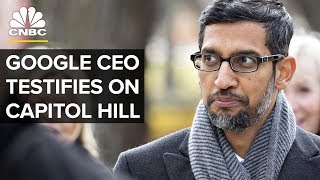
Sundar Pichai on Search
Sundar Pichai sees AI as a long-term platform shift that will make Google Search more conversational, contextual, and useful while keeping links, sources, and the open web at the center.
- Pichai treats AI as an opportunity to improve Search, not replace it.
- He says Search should give faster answers and better context, while still sending people to sources and links.
- He expects search behavior to become more conversational, multimodal, and context-aware.
- He argues this shift is early and will keep unfolding over years, not as a one-time product change.

“Understanding context is very, very hard, right? And I think, as humans, we do a very, very good job of it, and, you know, computers are very, very good at certain things, but what's changing, and this is why a lot of us who work in this field are very excited in the last, uh, two to three years, is we now believe we can start doing the kinds of things which are much more intelligent and, you know, understanding context, understanding the situation, being able to understand who's asking it, what's appropriate, are there others listening to it—these are all important things. And I think computing is just beginning to address those things.”Code Conference interview, 2016 · 8:00
Pichai does not see AI as a threat to Search’s existence
Pichai’s basic stance is that AI strengthens Search rather than making it obsolete. He has described Google as AI-first for years because he believed AI would drive the biggest progress in Search, and he still frames the current moment as an opportunity rather than a dilemma.12
That is why he rejects the idea that Search and generative AI are in a zero-sum fight. He says the market is expanding, user choice matters, and Search can absorb new AI capabilities while continuing to grow.34
He also places this change in a much bigger arc. In his telling, AI is not a one-product phenomenon but a foundational shift across Google, and Search is one of the most important places where that shift shows up.57
Search should answer more directly, but links remain central
Pichai has been consistent that Search cannot remain just a page of blue links. He has said it is not enough to give links alone, because users often want immediate help, direct answers, and support in completing a task.89
At the same time, he does not describe AI answers as a replacement for the web. He says a key differentiator for Google Search is that it provides answers while continuing to link to a wide variety of sources, because users often move from a quick answer into deeper exploration.10
That same idea carries into AI Overviews and newer AI search experiences. Pichai says Google is adding context around information while anchoring responses in sources, and he treats that balance between helpful synthesis and visible sourcing as part of Search quality itself.1112
AI changes the kind of search people can do
For Pichai, the important change is not just better ranking but a different interface to information. He expects Search to handle more natural, conversational, and complex questions, including follow-ups and requests where context matters.1314
He has been pointing in this direction for years through voice and Assistant, where the goal was to understand pronouns, context, and ongoing dialogue instead of treating every query as isolated. That same ambition now extends into modern AI-powered Search.914
He also ties Search’s future to multimodality. Gemini was built to work across text, images, video, code, and more, and that implies a Search experience that can understand richer inputs and help users navigate richer outputs.15
“Understanding context is very, very hard, right? And I think, as humans, we do a very, very good job of it, and, you know, computers are very, very good at certain things, but what's changing, and this is why a lot of us who work in this field are very excited in the last, uh, two to three years, is we now believe we can start doing the kinds of things which are much more intelligent and, you know, understanding context, understanding the situation, being able to understand who's asking it, what's appropriate, are there others listening to it—these are all important things. And I think computing is just beginning to address those things.”Code Conference interview, 2016 · full transcript →
He thinks Search will keep changing profoundly, not settle quickly
Pichai repeatedly frames AI and Search as early-stage transitions. He says Google is still in the early days of the AI platform shift and that Search itself will continue to change profoundly, which suggests he sees today’s AI search products as an opening move rather than an endpoint.7
He also emphasizes that this is a long journey. Progress will continue, but some of the easier gains are behind the industry, so future improvements will require deeper breakthroughs in reasoning, planning, and system design.1819
That is one reason he keeps widening the frame beyond today’s large language models. In his view, AI is bigger than the current model cycle, and Search will keep evolving as the underlying technology improves.2021
His standard for AI Search is usefulness with a high quality bar
Pichai does not present AI Search as a race to ship answers at any cost. He says Google is trying to provide context while maintaining a high bar, and he connects that directly to accountability because Search results are visible to everyone and judged in real time.11
He also ties Search quality to responsible design choices. In practice, that means grounding answers in sources, preserving exploration, and keeping user trust central as Search becomes more generative.1022
Underneath that product view is a full-stack strategy. Pichai argues that Google’s advantage comes from combining research, models, infrastructure, chips, and products, which matters because AI Search has to be good, fast, and scalable all at once.232425

“Look, we are giving context around it, but we are still anchoring it in, you know, the sources we find, you know, but we've always felt a high bar, you know, in Google. I mean, last year when we launched AIO views, I think, you know, people are adversely querying to find errors and the error rate was one in 7 million for adverse real queries. And so, but that was a big, but that's the bar we've always operated as a company. And so I think to me, nothing has changed. Like, you know, Google operates under a very high bar. That's the bar we strive to meet , and you know, our search page results are there for everyone to see. But that comes that natural accountability, and you know, we have to constantly earn people's trust. So that's how I would approach it.”Decoder interview, 2025 · full transcript →
Pichai on search, in his own words
“I think the dilemma only exists if you treat it as a dilemma.”
“It feels very far from a zero sum game to me…”
“It's not just enough to give them links.”
Where to watch
 Sundar Pichai on AI Search: Google’s Big Transition2025 · 62 min · full transcriptBest single interview on why Pichai sees AI as expanding Search through AI Overviews, AI Mode, and new query behavior.
 Sundar Pichai on AI Search and the Web: More Context, More Growth2024 · 39 min · full transcriptStrong on the practical balance between AI answers, source links, publisher traffic, and Search quality.
 Sundar Pichai on Future of AI: Search, Gemini, and Competition2024 · 24 min · full transcriptClear explanation of why Google thinks Search can combine quick AI answers with links and deeper exploration.
 Sundar Pichai on AI and Search: Building Google’s Next Act2024 · 41 min · full transcriptBest for understanding why Pichai thinks Search will keep changing profoundly as AI improves.
 Sundar Pichai on Google Assistant: Google's next big leap2017 · 24 min · full transcriptUseful historical context showing that Pichai’s move from links toward assistive, conversational search started years before the current AI boom.
 Sundar Pichai on Artificial Intelligence: Google’s Next Inflection Point2016 · 32 min · full transcriptShows the early roots of his thinking on context, follow-up questions, and AI as the next inflection point for Search.
Questions people ask
- What did Sundar Pichai say about AI and Google Search?
- What did Sundar Pichai say about the future of Google Search in the age of AI?
- What did Sundar Pichai say about understanding context in AI assistants?
- What does Sundar Pichai say about Google's infrastructure advantage in AI?
- What does Sundar Pichai say about responsibility for AI search results?
- What does Sundar Pichai think Google will be in the AI era?
Sources
Every quote above, word for word from the transcripts. Numbers match the text.
“It's a good frame, a good question to talk about. You know, I've definitely, you know, for almost a decade, you know, one of the first things I did was to think of the company as AI first. It was very clear to us. We had Google Brain underway in 2012. We acquired DeepMind in 2014. 2015, when I became the CEO, I said, look, the technology is really evolving. The reason we were excited to approach our work as AI first is because we really felt that AI is what will drive the biggest progress in search. And so, you know, I think, even the last couple of years, I viewed this as an extraordinary opportunity for search. I think if you look at how much information means to people, I think they're going to, each person is going to have access to information in a way they've never had before.”
“I think the dilemma only exists if you treat it as a dilemma.”
“It feels very far from a zero sum game to me…”
“I think choice choice is good for users…”
“AI is the most profound technology humanity will ever work on.”
“We are in the very early days of the AI platform shift.”
“It's not just enough to give them links.”
“We want to be there for our users, asking them, "Hi, how can I help?”
“I think part of what makes Google Search differentiator is while there are times we give answers, it'll always link to a wide variety of sources. Now we've had answers in Search now for many, many years. We are just now using generative AI to do that. So the links will live on. Yes, and, you know, I think it'll always be an important part of Search. There will be times when they want quick answers. My son is celiac, so we did a quick question to see whether something is gluten-free. We just want to know. But often it leads to more things, and, you know, then you want to explore more.”
“Look, we are giving context around it, but we are still anchoring it in, you know, the sources we find, you know, but we've always felt a high bar, you know, in Google. I mean, last year when we launched AIO views, I think, you know, people are adversely querying to find errors and the error rate was one in 7 million for adverse real queries. And so, but that was a big, but that's the bar we've always operated as a company. And so I think to me, nothing has changed. Like, you know, Google operates under a very high bar. That's the bar we strive to meet , and you know, our search page results are there for everyone to see. But that comes that natural accountability, and you know, we have to constantly earn people's trust. So that's how I would approach it.”
“I view it as the essence of what Search quality is…”
“Understanding context is very, very hard…”
“Understanding context is very, very hard, right? And I think, as humans, we do a very, very good job of it, and, you know, computers are very, very good at certain things, but what's changing, and this is why a lot of us who work in this field are very excited in the last, uh, two to three years, is we now believe we can start doing the kinds of things which are much more intelligent and, you know, understanding context, understanding the situation, being able to understand who's asking it, what's appropriate, are there others listening to it—these are all important things. And I think computing is just beginning to address those things.”
“A frontier model built to be natively multimodal from the very beginning…”
“We believe this is a long journey.”
“I think the progress is going to get harder when I look at 25, the low-hanging fruit is gone…”
“AI is not the LLM. It's one moment in time…”
“To me, we are just getting started in the beginning of what I think will be a extraordinary decade of innovation…”
“That's gonna be a core design principle for us.”
“We have taken such a deep full-stack approach to AI.”
“Look, it plays out everywhere. To your earlier question on cost per query in search, the reason we feel comfortable we can serve it at that scale is because we are constantly innovating through e generation, including chips which are really, really good at inference. Right? And Ironwood, which is our latest in our TPUCs, a single part of Ironwood is over 40 exaflops, right? And so, the scale of these things are incredible, and we have thought about our info all the way from subsea cables to the scale at which we do infrastructure is unparalleled. And I've always viewed that full stack approach. You know, deep infrastructure, foundational, fundamental R and D on top of it, and then you build and innovate on top of that. And I think that approach will serve us well over time.”
“We are definitely investing for the long run…”
How this guide was made: drafted with AI from the full transcripts of the recordings cited, then checked: every quotation must match a transcript word for word and be the speaker's own words, and an independent review gates accuracy. Methodology and corrections.