Sundar Pichai on Data Collection: Transparency, Privacy, and Bias
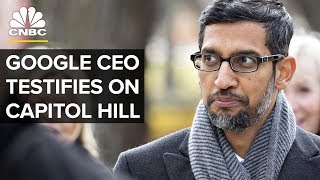

What Pichai talks about
Sundar Pichai gave this testimony before the House Judiciary Committee in 2018 on Google’s data collection, privacy controls, content moderation, and alleged political bias.
Also known as: testifies before the House Judiciary Committee; testifies before Congress; testifies on Data Collection.
Sundar Pichai tells Congress that Google tries to give users transparency, choice, and control over the data it collects, including through privacy checkups and account settings. He frames Google as a company built around the free flow of information and says its products are designed to serve users over the long run.
The hearing probes how Google collects location and device data, how it moderates content, and whether it treats political viewpoints fairly. Pichai says Google does not operate with political bias, does not plan to launch a search product in China, and works to detect spam, bots, and abusive activity across its services.
The exchange matters because it shows the tension between the usefulness of data-driven products and the public’s concern that a company as influential as Google may collect too much, explain too little, or wield too much power over information access.
Committee members question Pichai throughout; Pichai gives sworn testimony and answers questions.
In his words
“I lead this company without political bias and work to ensure that our products continue to operate that way.”
“We give them transparency, choice, and control.”
“It's in our natural incentive to do so.”
“Right now, there are no plans to launch a search product in China.”
“Protecting the privacy and security of our users has long been an essential part of our mission.”
Key points
- Pichai says Google gives users transparency, choice, and control over data collection.
- He argues Android and other services collect data based on user choices and product settings.
- He says Google wants long-term user satisfaction, even if that means changing products or reducing engagement.
- He rejects the idea that he leads Google with political bias.
- He says Google has no plans to launch a search product in China.
- He says Google invests heavily in security and in detecting spam, bots, and manipulation.
- He says Google supports federal privacy legislation and has proposed a privacy framework.
Full transcript: Sundar Pichai, House Judiciary Committee testimony (2018)
So here, from the back, so.
Right. Oh, so oh. Ah.
So, uh.
So, uh.
Ah, oh, good morning.
The Judiciary Committee will come to order. And without objection, the chair is authorized to declare recesses of the committee at any time. We welcome everyone to this morning's hearing on transparency and accountability, examining Google and its data collection, use, and filtering practices. Before I recognize myself and the ranking member for opening statements, I'd like to recognize our first witness, the Majority Leader Kevin McCarthy of California, for his statement. Welcome. Well, thank you, Mr. Goodlatte. Uh, Chairman Goodlatte, for working with me to organize this hearing. I want to thank Sundar Pichai for testifying on Capitol Hill. We appreciate and note your willingness to travel here and answer our questions.
First in a private setting in September and now in a public setting, Google is one of the most valuable companies in America because of what it does. Google Search engine organizes the entire internet, and by extension, almost all the information in the world. This is hardly an exaggeration. Here is a statistic you will hear a lot today, but it bears repeating. According to the Wall Street Journal, 90% of all internet searches go through Google. That is power, and it comes with responsibility. Mr. Pichai, it is— it was necessary to convene this hearing because of the widening gap of distrust between technology companies and the
American people, for our country and economy to grow stronger, the American people must be able to have trust in the great companies of the 21st century. We can alleviate some of their concerns today with transparency and candor. I hope we can begin to restore trust in the technology companies that shape our world. But we need answers. We need to know first that Google is committed to the free market ideals of competition and entrepreneurship that long stitch revolutionary products to begin with. Second, we need to be sure that any political bias within Google's workforce does not creep into its search projects. Third, we need to know that Google is living up to America's belief in free
Expression and human rights when it deals with foreign governments. Now, a word on the last subject. Right now, Google reportedly is developing a censored search engine with the Chinese Communist Party. It is also developing next-generation technology on Chinese soil and in conjunction with Chinese national champions like Tinsan Technology that the administration considers a national priority. Now, this news raises a troubling possibility that Google is being used to strengthen China's system of surveillance, repression, and control. Right this very second, China's authoritarian system detains
More than a million religious minorities in re-education camps. Mr. Pichai, I urge you to reflect on that fact and on the promise your company made when it pulled out of the China market in 2010. And I applauded you for that move. In 2010, back then, Google promised it would not censor its search results in China or compromise its commitment to a free and open internet. Now, in light of these recent events, I think the American people deserve to know if something changed, and if so, what. All these topics: competition, censorship, bias.
And others point to one fundamental question that demands the nation's attention: Are America's technology companies serving as instruments of freedom, are they instruments of control? Are they fulfilling the promise of the digital age? Are they advancing the cause of self-government, or are they serving as instruments of manipulation used by powerful interests and foreign governments to rob the people of their power, agency, and dignity? I believe we need to grapple with these questions together as a nation because the free world depends on a free internet. We need to know that Google is on the side of the free world and that it will provide its services.
Free of anti-competitive behavior, political bias, and censorship. I want to thank you again for being here and answering these questions. I look forward to listening to the answers with a very open mind, and I yield back. I'd now like to invite Mr. Pichai to take his seat at the witness table. Without objection.
The chair now recognizes the ranking member, Mr. Nadler, for a point of personal privilege to recognize a member of his staff, a very distinguished member of his staff. Thank you, Mr. Chairman. Mr. Chairman, I want to take a moment to recognize Danielle Brown, whose last working day for the committee is tomorrow. Danielle has served on the Judiciary Committee Democratic staff for more than a decade in a variety of roles, beginning as a staff assistant and then going to counsel, parliamentarian, chief legislative counsel, and most recently deputy chief counsel. Danielle has been essential to the operations of this committee, and she has been involved in nearly every important piece of committee business over the last decade.
Her interests and expertise range from protecting vulnerable immigrants to ensuring reproductive freedom and preserving vital consumer protections. She is leaving us now, unfortunately, to become General Counsel and Parliamentarian of the Ways and Means Committee. Our loss is surely their gain. I wish you well. I appreciate a wise counsel. I thank her for all of her years of service to this committee, and I hope the committee will join me in thanking her for her years of service to this committee. Wait, the gentleman yields. (applause) I will yield to the chairman. Uh, I thank the gentleman for yielding. I would like to join him in thanking Danielle for her service to this committee. She has worked
With the members on both sides of the aisle, she has worked with the majority staff very productively, very cooperatively on a great many issues that have made this committee not only more productive but also operating in a fashion that has resulted in a number of bills getting from this committee all the way to the president's desk. Whether that president be Barack Obama or Donald Trump, that's an accomplishment that this entire committee should be proud of, and Danielle should be proud that she's played an important part in doing that. I thank you. (applause) I now recognize myself for an opening.
Statement in the United States: Google operates the preeminent internet search engine, the leading email service provider, and the Android operating system, which runs most of the smartphones in the United States. When a consumer performs an internet search, sends an email, or uses his or her smartphone, Google collects information on that person. In fact, almost every minute of every day, the Android operating system sends information about the exact location, temperature, barometric pressure, and speed of movement of every phone that runs on the Android operating system, with Americans carrying their
smartphones all day, every day. Google is able to collect an amount of information about its users that would even make the NSA blush. Of course, when users click through the terms of service for these services, they do consent to such collection. I think it is fair to say that most Americans have no idea the sheer volume of detailed information that is collected today. I hope to get answers on the extent of data collection and use by Google. In addition, decades ago Congress passed the Communications Decency Act, including Section 230 of that act, which allows service providers to remove lewd, lascivious, excessively violent, or
otherwise objectionable content from their platforms. This law allows service providers to remove illegal materials, including child pornography and content that is illegal under our intellectual property laws. While meant to allow them to block illegal, obscene, and harmful materials, there is some discretion that service providers by necessity must use to make decisions about what content is harmful or objectionable. Given Google's ubiquity in the search market, Google is often consumers' first and last stop when searching for information on the internet. As such, this committee is very interested in how Google makes decisions about what constitutes objectionable content that justifies filtering and who
at Google makes these decisions. Given the revelation that top executives at Google have discussed how the results of the 2016 elections do comply with Google's values, these questions have become all the more important. While it is true that Google is not a government entity and so it does not have to comply with the First Amendment, the American people deserve to know what types of information they are not getting when they perform searches on the internet. The market works best when information about products and services is readily available, and so today, on behalf of this committee and the American consumer, I hope to get answers
from Mr. Pichai regarding who at Google makes the judgment calls on whether to filter or block objectionable content and what metrics Google uses to make those decisions. I want to thank Google's CEO for his willingness to testify today and to answer these and other questions. With respect to search results, algorithmic screening is the primary means through which Google sorts data and information. Google Search algorithm, for example, calculates what is presented to a user based on the variables the user inputs into the search bar. At its best, Google's algorithm reaches the best answer in the least amount of time while providing choices to the user.
By ranking pages most relevant to the search inquiry. Of course, by ranking pages, Google Search always favors one page over another. This kind of bias appears harmless. After all, the point of a search is to discriminate among multiple relevant sources to find the best answer. This process, however, turns much more sinister with allegations that Google manipulates its algorithm to favor the political party it likes, the ideas that it likes, or the products that it likes. There are numerous allegations in the news that Google employees have thought about doing this, talked about doing this, and have done it. The dangerous implications to a fair
democratic process cannot be understated. One study performed by psychologist Robert Epstein has revealed that internet search rankings have a significant impact on consumer choices, mainly because users trust and choose higher ranked results more than lower ranked results. After performing five relevant double-blind randomized controlled experiments using a total of 4,556 undecided voters representing diverse demographic characteristics of the voting populations of the United States and India, the study revealed that biased search rankings can shift the voting preferences of undecided voters
by 20 percent or more. The shift can be much higher in some demographic groups, and search ranking bias can be masked so that people show no awareness of the manipulation. The potential for this kind of bias is clearly problematic and is further compounded by the fact that Google every day collects mountains of information about its users while they are actively engaged with a Google product or even when they are not. According to a study conducted by Vanderbilt University, a dormant, stationary Android phone with Chrome active in the background communicated location information to Google 340 times during a 24-hour period, or at
an average of 14 data communications per hour. The location, the collection of location data, may be obvious to most users, but they are often unaware of the many sensors that the Android platform supports, including an accelerometer, a barometer, and a photometer. These photometers, these sensors, in addition to the cameras and microphone on a mobile device, can collate into a very accurate picture of where a user is, what they are doing, and who else is there. The shocking amount of information that Google collects via its phones was recently featured on Good Morning America, in which a reporter using an Android phone with no SIM card that
wasn't connected to the internet discovered that the phone collected the device's movement, even identifying the mode of transportation such as the subway or even a bicycle, and at times taking 10 sensor readings per minute. Moreover, Google's practice of reinforcing its dominance in light of allegations of self-serving bias creates little choice for consumers across the spectrum of internet-based products or services. Given that Google's ads show up on non-Google websites, and Google Search engine is being used as the default search tool on other products such as the Apple phone, it is almost impossible to avoid Google altogether. Google in many things
Google has many things. It's one of the largest data collectors ever seen in human history. It's an advertiser that can get the right product to the right customer at precisely the right time. Google is also an internet giant, directing over 3.5 billion searches per day. With this massive authority, however, comes the potential for far-reaching abuse. The mere suspicion that Google manipulates its products and features for self-serving or even political purposes raises serious concerns about its business practices, its impact on free speech, and our democratic process. And Americans trust that the information gathered about them in their day-to-day
lives is done with their knowledge and is not being used against them. My hope is that through our inquiries today we will ensure more transparency and accountability going forward. Last, despite the nature and scope of today's hearing, Google is still the story of the American dream. The company was started by two individuals in a garage and grew to be one of the most successful companies in the world. Two decades ago, we could not fathom instantaneous access to more information than that which is contained in all the encyclopedias in the world. Now, we take that for granted because of the innovative services Google provides. With that, I want to again thank our witness for his presence here today. I
look forward to your testimony. It's now my pleasure to recognize the ranking member of the committee, the gentleman from New York, Mr. Nadler, for his opening statement. Thank you, Mr. Chairman. Mr. Chairman, our society has become increasingly reliant on social media and other online platforms to obtain, create, share, and sort information. This information helps us make decisions ranging in importance from where to make dinner reservations to which candidate to vote for in a presidential election. The public's increasing use of these platforms has generated many positive benefits for society, but it has also given rise to some troubling trends. Google is among the dominant firms in this field. As such, given the public's widespread use and reliance on its products and services,
there are legitimate questions regarding the company's policies and practices, including with respect to content moderation and the protection of user privacy. But before we delve into these questions, I must first dispense with a completely illegitimate issue, which is the fantasy dreamed up by some conservatives that Google and other online platforms have an anti-conservative bias. As I have said repeatedly, no credible evidence supports this right-wing conspiracy theory. I have little doubt that my Republican colleagues will spend much of their time presenting a laundry list of anecdotes and out-of-context statements made by Google employees as supposed evidence of anti-conservative bias, but none of that will actually make it true. But this fact-free propaganda does help
generate the mistrust that the majority leader referred to a few moments ago. And even if Google were deliberately discriminating against conservative viewpoints, just as Fox News and Sinclair Broadcasting and conservative talk radio hosts like Rush Limbaugh discriminate against liberal points of view, that would be its right as a private company to do so, not to be questioned by government. During the Reagan administration, about 35 years ago, the Federal Communications Commission, then appointed by Ronald Reagan, abolished what we used to have called the Fairness Doctrine, which placed an obligation on broadcasters who used the public airwaves to be fair to different points
of view. That question might be relevant if the Republican members wanted to bring back the Fairness Doctrine and expand its scope to social media companies. I doubt we will see any interest in doing so. But we should not let the delusions of the far right distract us from the real issues that should be the focus of today's hearing. For example, we should examine what Google is doing to stop hostile foreign powers from using its platform to spread false information in order to harm our political discourse. It has been more than two years since the 2016 election, yet this committee has not held a single hearing focused on Russia's campaign to manipulate online platforms to undermine American
democracy, despite the fact that it is the consensus view of our intelligence agencies that Russia engaged in a massive disinformation campaign to influence the 2016 election. I hope that Mr. Pichai can tell us what actions Google has taken to counter this unprecedented attack and what gaps remain in its defenses. Without being so specific as to give guidance to foreign powers, this may help Congress determine what more can be done to further insulate our democratic processes from foreign interference. We should also examine how Google enforces community standards that prohibit racism, bigoted threats, and other inappropriate conduct. While internet platforms have produced many societal benefits, they've also
provided a new tool for those seeking to stoke racial and ethnic hatred. The presence of hateful conduct and content on these platforms has been made all the more alarming by the recent rise in hate-motivated violence. According to statistics recently released by the FBI, reported incidents of hate crimes rose by 17 percent last year compared to 2016, marking the third consecutive year that such reports have increased. The horrible massacre at the Tree of Life synagogue in Pittsburgh, the recent murder of an African-American couple in the Kentucky grocery store, the killing of an Indian engineer last year in Kansas are sadly not isolated outbursts of violence, but the most salient examples of a troubling trend we should
consider. To what extent Google and other online platforms may have been used to foment and to disseminate such hatred and how these platforms can play a constructive role in combating its spread. As the dominant player in this field, Google possesses significant market power. It is also useful to examine its policies and practices to ensure that other companies are able to compete in an open and fair marketplace. There are also concerns about the prevalence of pirated material available on Google and other internet platforms at the expense of legitimate content. Finally, it is important to know what Google is doing to protect its users' data privacy and data security. The Wall Street Journal recently reported that Google
Discovered last March that a bug in its social media platform Google Plus had exposed the private profile data of up to 500,000 users to third-party developers, but adopted not to disclose the issue publicly, not even to those who may have been affected at the time. And just yesterday, the company announced that it had discovered another Google Plus bug that may have exposed the private profile data of millions of users. While Google has so far found no evidence that developers have in fact abused these bugs or that any user profile data has been misused in any way, incidents like this still raise legitimate questions about what types of data exposures a company is obligated to disclose publicly. It also raises questions about how much control users should have over their own data and how
such controls should be regulated. I am also disturbed by recent reports that Google is developing a search engine for the Chinese mainland market. According to these reports, the search engine would not only accommodate Chinese government censors, it might allow the Chinese government to track individuals by linking search terms to the user's mobile phone number. Unfortunately, in this, our fourth hearing devoted to entirely fictitious allegations of conservative anti-conservative bias by internet companies, we will waste more time and more taxpayer money on elevating well-worn right-wing conspiracy theories instead of concentrating on the substantive questions and issues that should be the focus of our hearings. Our committee can and must and will do
better. I yield back the balance of my time. Thank you, Mr. Nadler. We welcome our distinguished witness and if you would please rise, I'll begin by swearing you in. Please raise your right hand. Do you swear that the testimony that you are about to give shall be the truth, the whole truth and nothing but the truth, so help you God? Thank you. Let the record show that the witness answered in the affirmative. Our only witness today is Mr. Sundar Pichai. Pichai is the Chief Executive Officer of Google. Your written statement will be entered into the record in its entirety and we ask that you summarize your testimony in five minutes. To help you stay within that time there's a timing light on your table. When the light switches from green
to yellow, you have one minute to conclude your testimony. When the light turns red, it signals your five minutes have expired. Uh, Mr. Pichai, you are very welcome and you may begin. Chairman, good luck. Ranking Member Nadler, distinguished members of the committee, thank you for the opportunity to be here today. I joined Google 15 years ago and have been privileged to serve as CEO for the past three years, but my love for information and technology began long before that. It's been 25 years since I made the U.S. my home. Growing up in India, I have distinct memories of when my family got its first phone and its first television. Each new technology made a profound
difference in our lives. Getting the phone meant I could call ahead to the hospital to check that the blood results were in, instead of taking a two-hour trip there. And the television, well, it only had one channel, but I couldn't have been more thrilled by its arrival. Those experiences made me a technology optimist, and I remain one today, not only because I believe in technology but because I believe in people and their ability to use technology to improve their lives. I'm incredibly proud of what Google does to empower people around the world, especially here in the U.S. I'd like to take a moment to share a bit of background on that. Twenty years ago, two students, one from
Michigan and one from Maryland, came together at Stanford with a big idea to provide users with access to the world's information. That mission still drives everything we do. Whether it's saving you a few minutes on your morning commute or helping doctors detect disease and save lives, today Google is more than a search engine. We are a global company that's committed to building products for everyone. That means working with many industries, from education and health care to manufacturing and entertainment. Even as we expand into new markets, we never forget our American roots. It's no coincidence that a company dedicated to free flow of information was founded right here in the U.S.
As an American company, we cherish the values and freedoms that have allowed us to grow and serve so many users. And I'm proud to say we do, and we will continue to work with the government to keep our country safe and secure. Over the years, our footprint has expanded far beyond California to states such as Texas, Virginia, Oklahoma, and Alabama. Today, in the U.S., we are growing faster outside of the Bay Area than within it. I've had the great opportunity to travel across the country and see all the places that are powering our digital economy, from Clarksville to Pittsburgh to San Diego, where we recently launched a partnership with the USO to help veterans and military families.
Along the way, I've met many people who depend on Google to learn new skills, find jobs, or new businesses. Over the past year, we have supported more than 1.5 million American businesses and over the past three years, we have made direct contributions of $150 billion to the U.S. economy, added more than 24,000 employees, and paid over $43 billion to our U.S. partners across Search, YouTube, and Android. These investments strengthen our communities and support thousands of American jobs. They also allow us to provide great services to our users to help them through the day. It's an honor to play this role in people's lives and it's one we know comes with great responsibility. Protecting the privacy and security of
our users has long been an essential part of our mission. We've invested an enormous amount of work over the years to bring choice, transparency, and control to our users. These values are built into every product we make. We recognize the important role of governments, including this committee, in setting rules for the development and use of technology. To that end, we support federal privacy legislation and proposed a legislative framework for privacy earlier this year. Users look to us to provide accurate, trusted information and we work hard to ensure the integrity of our products. We have put a number of checks and balances in place to ensure they continue to live up to our standards.
I lead this company without political bias and work to ensure that our products continue to operate that way. To do otherwise would be against our core principles and our business interests. We are a company that provides platforms for diverse perspectives and opinions, and there is no shortage of them amongst our employees. Some Googlers are former servicemen and women who have risked much in defense of their country. Some are civil libertarians who fiercely defend freedom of expression. Some are parents who worry about the role technology plays in our households. Some, like me, are immigrants who are profoundly grateful to the freedoms and opportunities it offers.
And some of us are many of these things. Let me close by saying that leading Google has been the greatest professional honor of my life. It's a challenging moment for our industry, but I'm privileged to be here. I greatly appreciate you letting me share the story of Google and our work to build products worthy of the trust users place in us. Thank you for the opportunity, and I look forward to answering your questions. Thank you. We'll now proceed under the five-minute rule with questions, and I'll begin by recognizing myself. Mr. Pichai, is it true that the Android operating system sends Google information every few minutes detailing the exact location of a smartphone within a few feet, the speed of movement
of the phone, the altitude of the phone sufficient to determine what floor of a building the phone is on, the temperature surrounding the phone, and other readings? And if so, with Americans carrying their phones with them virtually at all times, doesn't the collection of this volume of detailed information really mean that Google is compiling information about virtually every movement an individual with a smartphone is making every hour of every day? Mr. Chairman, uh, thank you for the question. Uh, today for any service we provide our users, we go to great lengths to protect their privacy, and we give them transparency, choice, and control. Android is a powerful platform and
provides smartphones for over 2 billion people. And as part of that, it depends on the applications users choose to use. If you're using a fitness application which is deducting the number of steps you walk, you expect it to send that information, but it's a choice users make. We make it clear, and it depends on the use cases. So the answer to my first question is yes, is that correct, that the information that I cited is gathered by Google? If for Google services, you have a choice of what information is collected, and we make it transparent, transparent. I understand there are uses that consumers make use of. I use it to keep track of the number of
steps I walk. I understand, uh, that service that one of your competitors provides, so I understand that purpose. But do you think the average consumer understands that Google will collect this volume of detailed information when they click through the terms of service agreements in order to use the Android operating system? It's really important for us that, you know, that average users are able to understand it. This is why we do something called Privacy Checkup. Average users read the terms of service and the updates that are very frequently sent to us. Beyond the terms of service, we actually offer, we remind users to do a Privacy Checkup, and we make it very obvious
every month. In fact, in the last 28 days, 160 million users went to their My Account settings, where they can clearly see what information we have. We actually give, you know, show it back to them, and we give clear toggles by category where they can decide whether that information is collected, stored, or, more importantly, if they decide to stop using it. We work hard to make it possible for users to take their data with them if they choose to use another service. Let me switch to, uh, the issue of Section 230 of the Communications Decency Act. You heard me say in my opening statement that this provides broad liability protections for you and other technology companies for
good faith restrictions that, when Google thinks something is obscene, lewd, lascivious, filthy, excessively violent, harassing, or otherwise objectionable. On the other hand, objectionable material, by whatever standard applied, likely elicits the most engagement from users on your site. And for Google, increased engagement potentially means increased revenue. However, it is important for Google to make very clear where it draws the line, and I don't believe Google has done its best to make that clear. So what I would ask is the following: would Google or YouTube be willing to make changes in support of a healthier civic dialogue if doing so meant a drop in user engagement metrics?
Absolutely, Mr. Chairman. We have a long track record of, uh, we've always focused on long-term goals towards user satisfaction. We focus on their knowledge, happiness, success, and that's what we work hard to create. It is important to us that platforms like YouTube are viable over the long run. It's in our natural incentive to do so. YouTube is a place where users, advertisers, and content creators who make their livelihoods use the platform, and so we want to make this work in a sustainable way. When it comes to political advertising, as you know, some of your competitors in other advertising media are required by law to offer the same
rate, the lowest rate as a matter of fact, to all political candidates. So for example, that's true in television, radio. Would Google should competing political candidates be charged the same effective ad rates to reach prospective voters? Our advertising products are built without any bias, and the rates are competitive, set by a live auction process. So depending on the keywords for which you're bidding, depending on the demand that is in the auction, uh, the prices are automatically calculated. So, you know, the system decides that they understand it's automatically calculated, but could two competing political candidates targeting
The same audience see different ad rates, and if yes, could that disparity be substantial? There wouldn't be a difference based on, uh, you know, any political reasons unless there are keywords which are of particular interest and the market determines it. So it's essentially a supply-demand equilibrium. It can lead to differences in rates, but it will vary from time to time. Can those rates be very substantial in difference? Uh, there could be occasions where, uh, yes, uh, there could be differences in rates here. I haven't looked at the specifics of it. Yeah, so the result is different than in other markets like television or radio where every candidate is entitled to the lowest rate that that, uh...
television station or radio station offered to any political candidate for office. We, you know, there could be variations based on the time of the day, uh, the keywords you're, uh, choosing to go for, uh, you know, the geographies you're advertising in, but it's decided by the system and it's a process we have done for over 20 years. And let me assure you, anything to do with our civic process, we make sure we do so in a non-partisan way, and it's really important for us. Thank you. The chair recognizes the gentleman from New York, Mr. Nadler, for five minutes. Thank you, Mr. Pichai. According to media reports, Google found evidence that, uh, well...
Let me go to the other one first. Google found a bug in its Google Plus social media platform that could have potentially exposed the private data of up to half a million users without the consent to third-party developers. Google, however, did not disclose this bug until months later after it was revealed by a report in the Wall Street Journal. Yesterday, as I mentioned before, they found the, you announced another bug. What legal obligations is the company under to disclose data exposures that do not involve sensitive financial information but still involve private personal data like user's name, age, email address, or phone number? Congressman, we take privacy seriously, uh, the bugs you mentioned are bugs we we found...
them by either doing an audit or, you know, using our automated testing systems. Whenever we find any bugs, we follow, uh, you know, it gets escalated to our privacy and data protection office, and we comply with all. Right, I'm not criticizing what you do. I'm asking what legal obligation is the company under to disclose such data exposures that don't involve financial information but still involve other personal information. It depends on the situation. We follow the requirements, uh, and in that case, in the first case, uh, typically, we look at our legal requirements, but we go above and beyond to make sure we do the right thing for our users. In the first case, uh, both there was no evidence data was misused and we couldn't accurately do it. I...
understand all that, but my question is what legal obligations are there, you know, today, right now, if you found a bug, uh, you know, and you've ascertained once you've done the investigation and you've ascertained the users who are eligible for notification. My understanding is you have 72 hours and we both notify users as well as regulators in that time frame. Okay, thank you. Now, according to media reports, Google found evidence that Russian agents spent thousands of dollars to purchase ads on its advertising platforms that span multiple Google products as part of the agents, the Russian agents campaigned to interfere in the election two years ago. Additionally, Juniper Downs, head of global policy for YouTube, testified in July...
that YouTube had identified and shut down multiple, and shut down multiple channels containing thousands of videos associated with the Russian misinformation campaign. Does Google now know the full extent to which its online platforms were exploited by Russian actors in the election two years ago? We have, uh, you know, we undertook a very thorough investigation, and in 2016, uh, we, we now know that, uh, there were two main ad accounts, uh, linked to Russia which, uh, which, you know, advertised on Google for about forty-seven hundred dollars in advertising. We also found other limited total of forty-seven hundred dollars, that's right, uh, which...
was, uh, you know, no amount is, uh, okay here, but, you know, but we found limited activity, improper activity. We have learned a lot from that, and we've, you know, dramatically increased the protections we have around our, uh, election offerings leading up to the current elections. We did, we again found limited activity both from the Internet Research Agency, uh, in Russia as well as accounts linked to Iran. And what, what specific steps have you taken including during the recent 2018 elections to protect against further interference by Russia or other hostile foreign powers? We have undertaken a significant review of how ads are bought. You know, we look...
for the origin of these accounts. We share and collaborate with law enforcement, other technology companies, and we essentially are investing a lot of effort and oversight in this area. Looking ahead to the next Congress, I assume we can have your assurances that Google will work with this committee as we examine the issue of how to better secure our elections from future foreign interference. Congressman, protecting our elections is foundational to our democracy, and you, you have my full commitment that we'll do that. Okay, my last question because we time is running out, uh, what are you doing? What is Google doing to combat the spread of white supremacy...
and right-wing extremism across YouTube, Congressman? YouTube is an important platform. We do want to allow for diverse perspectives and opinions, but we have rules of the road. We have clear content policies, and we have policies against many categories, and we are transparent about these policies. And, you know, when we find violations on our policies, we do remove those videos and handle content. When you find violations, you what of your, of our policy? For example, we have policies against hate speech, and we clearly define them. And if we find any violations there, we do take down the content. When you take down the content, do you note who put it up so you can flag future content from the same sources? We
We, on, you know, we look at it on a video-by-video basis. Uh, to the extent that our repeat offenses from the same account, we do take into account, and we notify the content creator and we follow up accordingly. Thank you very much. I yield back. Chair recognizes the gentleman from Texas, Mr. Smith, for five minutes. Thank you, Mr. Chairman. Mr. Chairman, Google has revolutionized the world, though not entirely in the way I expected. Americans deserve the facts, objectively reported. The muting of conservative voices by internet platforms has intensified, especially during the presidency of Donald Trump. More than 90 percent of all internet searches take place on Google or its
subsidiary YouTube, and they are curating what we see. Google has long faced criticism for manipulating search results to censor conservatives. Conservative individuals and organizations have had their pro-Trump content tagged as hate speech or had their content reduced in search results, and enforcement of immigration laws has been tagged as hate speech as well. Such actions pose a grave threat to our democratic form of government. PGA Media found that 96 percent of search results for Trump were from liberal media outlets. In fact, not a single right-leaning site appeared on the first page of search results.
This doesn't happen by accident, but is baked into the algorithms. Those who write the algorithms get the results they must want, and apparently management allows it. Dr. Robert Epstein, a Harvard-trained psychologist, authored a study recently that showed Google's bias likely swung 2.6 million votes to Hillary Clinton in the 2016 election. Google could well elect the next president, with dire implications for our democracy. This should be a real concern to all but the most politically partisan. Those at the top set the tone. It will require a herculean effort by the chief
executive and senior management to change the political bias now programmed into the company's culture. And Mr. Rajai, let me ask my first question about those examples of political bias that I just mentioned, and you're going to hear others too. In your opening statement, you mentioned your desire to provide information that was without political bias. Clearly, that's not working. So what are you going to improve that situation? Congressman, thanks for the question. If I may, uh, some of the studies you mentioned, we have investigated those. There are other studies which have looked at it. We have found issues with the methodology and the sample size and
so on, but let me step back and say providing users with high-quality, accurate, and trusted information is sacrosanct to us. It's what our principles are. Under business interests, our natural long-term incentives are aligned with that. We want to serve users everywhere, and we need to earn their trust in doing so. Right. So, what actions are you going to take to try to counter the political bias in some of those examples that I just gave? I mean, they're irrefutable, so it occurs, you have to take some responsibility for that bias. What do you intend to do about it, Congressman? Uh, with respect, Dr. Epstein's study, we have investigated; we don't agree with the methodology. Happy to follow up with your office and give our findings on that, on the study when we
look at it. We evaluate our studies to evaluate our search results. Today we use a very robust methodology, and we've been doing this for 20 years. Making sure the results are accurate is what we need to do well, and we work hard to do that. What does methodology have to do with the fact that 96 percent of the references to Trump are from liberal media? There are always studies, you know, which can show one set of data and arrive at conclusions. But we have looked at results on our top news category. We find that we have a wide variety of sources, including sources from the left and sources from the right, and we are committed to making sure there's diverse perspectives. By the way, the study that I referred to was done by a
self-proclaimed Democrat who voted for Hillary Clinton and said he regretted to find what he found, but he felt it was irrefutable and no one has been able to disprove him. Let me go to another question: And that is, clearly, there may be a difference of opinion as to the degree or amount of political bias. Would you agree to allow an independent entity to study your search results for political bias? I know you have individuals studying that now, but you appointed them. Would you allow a third-party independent outside organization to study your search results and cooperate with them to determine the degree or, if any, of political bias?
Congressman, if I may, make two points. One is, today there have been independent third-party studies looking at search results, the economists, but you chose those third parties. I'm talking about someone truly independent. Uh, we didn't choose those third parties. I mean, they completed those studies. The second is, we are transparent as to how we evaluate search. We publish our rater guidelines. We publish it externally, and raters evaluate it. And that's how we, you know, we are trying hard to understand what users want, and this is something important to us to get right. I'm happy to follow up and explain the methodology and the studies which have been done by independent third parties. Okay, to my knowledge, again, you have picked those third parties, and I'd like to have someone truly independent study those results. Number
one. Number two: Also, to my knowledge, you've never sanctioned any employee for any type of, for manipulating the search results, uh, whatsoever. Is that the case? The time of the gentleman has expired, but Mr. Pichai will be allowed to answer the question, and very quickly. It's not possible for an individual employee or groups of employees to manipulate our search results. You know, we have a robust framework, uh, including many steps in the process. And my time is up. Let me just say I disagree. I think humans can manipulate the process. It is a human process, at its face. Thank you, Mr. Chairman. Yield back. Jay recognizes the gentleman from California, Ms. Lofgren, for five minutes. Uh, thank you, Mr. Chairman, and thank you.
For being here, uh, Mr. Pichai. Google is located in Santa Clara County, my home, and I've got to say that, you know, in contrast to the recent Amazon effort for a headquarters they are proposing, Google is proposing to establish a facility in downtown San Jose and they didn't ask for any tax subsidies. In fact, they're purchasing the land and paying the city gobs of money. I'm going to be parochial and ask a question because I think most people in San Jose are excited by the proposal, but there's anxiety about the impact on housing and whether Google intends to be a partner with the City of San Jose to make sure
that we accommodate the housing that will be necessary for the 20,000 additional employees that are proposed in San Jose. Uh, sorry, I missed the last part of your question, whether you would be a partner with the city in helping to provide additional housing to accommodate these employees. Uh, Congresswoman, it's an important question. We deeply care about the community, uh, where we work. As part of this effort, we have done wide outreach and we are, we have committed to making sure there is affordable housing at varying affordability levels as part of, uh, as part of the development. Thank you. We are already in touch with the city leaders there. Thank you so much. You know, there's so many questions and we're
not going to be able to deal with them all today. I'm hoping in the next Congress we will be able to visit with you and other tech companies to go through issues of privacy, data localization and its relationship to human rights, competition policies, the issue of takedown requests by authoritarian regimes, encryption policy and what's going on in Australia, filtering and confirmation bias and its impact on society generally, both culturally and politically. But we can't do that in the five minutes we have here today, so I would just like to revisit some of the questions that have already, uh, been asked. The chairman asked about, uh, location policies in your
Android system, and you pointed to various apps that might, uh, provide information. Let's say I got an Android phone and unlock. Unlike most people, I don't have a single app on that phone. What information would be collected? Congresswoman, there is a, there is a device-specific location setting which, which you can turn on or off. And say, I turn it off, turn it off, there's no location information sent from that device. Okay, but this is a complex area. There are times, for example, your IP address may include some location information. Correct? It's an area we are committed to doing more to make it easier. Now, manipulation of search results, I think
it's important to talk about how search works. Um, right now if you Google the word "idiot" under images, a picture of Donald Trump comes up. I just did that. How would that happen? How does search work so that that would occur? We provide search today, uh, for any time you type in a keyword. Uh, we as Google, we have crawled, we've gone out and crawled and stored billion copies of billions of web pages in our index and we take the keyword
and match it against web pages and rank them based on over 200 signals, things like relevance, freshness, popularity, how other people are using it, and based on that, you know, at any given time we try to rank and find the best results for that query and then we evaluate them at external raters, uh, to make sure that, and they evaluate it to objective guidelines, and that's how we make sure the process is working. It's not some little man sitting behind the curtain figuring out what we're going to show the user. It's basically a compilation of what users are generating and trying to sort through that information. Last year, we served over 3 trillion
searches and just, just as a fact, every single day, 15% of the searches Google sees we've never seen them before. So, uh, so this is working at scale and, you know, we don't, you know, manually intervene on any particular search yourself. I would just like to note from time to time my colleagues on the other side of the aisle complain that they hear an individual engineer appears to be a Democrat, and I just like to put this in context: in Santa Clara County, Donald Trump, in the 2016 election, got 20% of the vote. That's how much of the vote he got. So, it's not a surprise that the engineers who live in Santa
Clara County would reflect that general political outcome. That has nothing to do with the algorithms and the really automated process that is the search engine that serves us. You know, if we didn't have Google, we wouldn't be able to find any information in the efficient way that we do. I look forward next year to working with you on some of the very serious questions that we face. It's pretty obvious that bias against conservative voices is not one of them. Thank you. Uh, very much, my time has expired. Mr. The chair recognizes the gentleman from Ohio, Mr. Shabbat, for five minutes. Thank you, Mr. Chairman and Mr. Pichai. Let me
start out with, uh, uh, something real quickly. We've heard several times this morning, uh, the mention that ninety percent of the time that a person, he or she does an internet search, that it's through Google. Would you basically agree that that's, that that's true? More than ever, there are many ways users access information. Just to give an example, if you're, if you're trying to shop, if you're trying to buy something, more than 50% of product searches originate with Amazon in the US today. Uh, if you're looking for information on, on news today, you can get it from more sources than ever before. Do you dispute then the 90 number? You know, our internal, I mean, it's tough for us to assess the numbers. There are external studies which have shown different numbers, including lower.
Numbers than that. Okay. Um, now you've, you've heard the allegation this morning. I know you dispute it, but you've heard the allegation that there's a bias in favor of liberal or progressive, uh, points of view and against a more conservative, uh, point. You've heard that this morning, uh, already. Is that correct? Uh, yes. Okay. Uh, let, let me tell you now about a first-hand experience that that I've had. I do a weekly blog. I've been doing it for the better part of nine years now. And a while back, Republicans in the House passed legislation to repeal and replace Obamacare. Our bill was called the American Health Care Act or the AHCA. When I was writing
my blog about that, I googled American Healthcare Act and virtually every article was an attack on our bill. Article after article alleging that our bill would result in millions and millions of people losing the great care that they were supposedly getting under Obamacare. I would argue that was completely false. But it wasn't until you got to the third or fourth page of search results before you found anything remotely positive about our bill. Let me give you a second example. The Republican tax cut bill was passed about a year ago, the Tax Cuts and Jobs Act, same story. Article after article attacking the Republican tax cut plan alleging
the tax cuts only went to the rich, when in actuality about 85 percent of taxpayers got their taxes cut, including millions and millions of middle class taxpayers. And once again, uh, to find any article that had anything, uh, remotely good to say about our plan, you had to go deep into the, into the search results. Now I know Google's attitude, um, uh, the algorithm made us do it, but I don't know that I buy that. How do you explain this apparent bias on Google's part against conservative points of view, against conservative, uh, policies? Is it just the algorithm or is there more happening there?
Congressman, I, I understand the frustration at seeing negative news and, you know, I see it on me, on Google. There are times you can search on Google and page after page there's negative news, which we reflect. But what, what is important here is we use a robust methodology to reflect what is being said about any given topic at any particular time and we try to do it objectively using a set of rubrics. It is in our interest to make sure we reflect, uh, uh, what's happening out there in the best objective manner possible. I can commit to you and I can assure you we do it without regards to political ideology. Our algorithms have no notion of political sentiment. I'm going to run out of time here. I
apologize for interrupting but, um, and, and I, I sincerely believe that that you believe what you're saying here but you've got almost 90,000 employees. Somebody out there is doing something, uh, that, that just isn't working if you're looking for unbiased results. And I've seen this firsthand, uh, time after time. I just mentioned two of the most obvious ones that people would remember. Yeah, those bills, heard about those. Um, so I've seen it if what is, what I've described and some others. I'm sure you're going to hear other examples. If it is happening, do you see how conservatives believe, um, that your company is kind of putting their thumb on the scale so to speak, uh, that you're in effect picking
winners and losers in political discourse out there in America today and therefore actually affecting, uh, elections. And, and, uh, do you see why conservatives would be concerned about this and why we're asking these kinds of questions today? There's a lot of people that think what I'm saying here is happening and I think it's happening. So I've only got about 20 seconds to go but I'll yield it to you. Congressman, it's important to me that I, I understand these concerns. This is why I've been trying to reach out and meet people. We've done outreach. We want to explain how these things work. We are happy to look at independent studies, uh, it's important to us to demonstrate that our products work without any bias and and
we build our products in a neutral way and I'm happy to follow up and look forward to, uh, you know, uh, getting a chance to explain it better. Thank you very much, and I appreciate your willingness to follow up because there's, I think a lot of people have a lot of questions and I know I'm already out of time but let me also thank Google for one thing. I happen to be chair of the House Small Business Committee and your company has worked with an awful lot of small businesses all across the country, created a lot of jobs, and I commend you for that. You're back. The chair recognized the gentleman from George—sorry—the gentlewoman from Texas, Ms. Jackson Lee, for five minutes. Good morning, Mr. Pichai. I'm right here. It's a pleasure to have you here this morning. I'm going to try and, uh, answer
very, uh, or offer to you questions initially that require just a yes or no answer if you would. Uh, does Google choose conservative voices over liberal voices? We approach a work without any political, uh, bias. We build it in a neutral way. Answer is no. Yes or no? No. If hate speech provokes violence, is that the, uh, definition beyond other aspects that you consider that you would take it down? I know there are other aspects but particularly, uh, encouraging violence does that get taken down? The primary purpose of inciting violence is what we consider as hate speech. Yes, Congressman, and it will be taken down, uh.
Yes, we would remove. Uh, I want to, uh, just take note of the fact that, uh, I look forward to best practices when, uh, we start the 116th Congress in terms of having more hearings. My view is that this committee has washed its hands clean of engaging in meaningful oversight of technology platform efforts to sift through content being sold by hostile foreign actors, actors claiming, uh, to heighten social division at the peril of democracy. I won't ask a question on that but I will make mention of the Universal Declaration of Human Rights Article 12 which says no one should be subjected to arbitrary interference with his privacy and has been noted that Google does engage in reviewing emails. Would you commit to adhering to
Article 12 of the Declaration of Human Rights relates to protecting the privacy of individual emails. You know, we think privacy is an important individual right. It's an important human right, and we are committed to upholding that and happy to engage in any discussions with respect to that. I'd like to do so. We know that building the U.S. economy through innovation is very important. I would like to know whether or not you would be open to Google involving the AI economy to non-traditional areas of socio-economic groups. Data shows the impact of not having that access. Would you be welcome, or would you welcome invitations to those communities?
To do more than what has been done? Definitely. Absolutely, yes. You received a letter from the Senate a few weeks ago regarding illegal drug sales. It's quite extensive, and my question is, have you made any efforts to deal with the facilitating of sale of counterfeit, substandard, and falsified medicines sold through illegal online pharmacies? Congresswoman, this is a national crisis. We have undertaken a lot of work in this area. We just recently rolled out—we participated in National Take Back Day. In Google Maps, we showed drop-off locations. We work with law enforcement here and just last week we received a Corporate Citizenship Award from Partnership for Drug-Free America, and we are very committed to doing more work in this
area. We applauded you in 2010 when Google took a very powerful stand of principle and democratic values over profits and came out of China. I am concerned that you are now going back into China and upholding the Dragonfly procedures, which would help censor Chinese persons seeking a lifeline of democracy and freedom. How can you do that, and what are you doing to minimize or to indicate that this is not best practices? Congressman, at the outset, right now we have no plans to launch in China. We don't have a search product there.
Our core mission is to provide users access to information, and getting access to information is an important human right. So we are always compelled across the world to try hard to provide that information. But right now, there are no plans to launch search in China. I'm committed to being fully transparent, including with policymakers, to the extent we ever developed plans to do that. I'd like to pursue that with you, and I thank you for that. I think that was an important statement. My community is diverse, as you well may have heard. The Congressional Black Caucus has been working extensively with Google and other search engines to recognize there are not enough individuals of diversity and African Americans. My district has a huge number of musicians, artists, and creators from all
areas of entertainment. I'd be interested in what efforts are being taken by Google's platform YouTube to promote diversity and inclusion with its employees. What are the demographics of YouTube's U.S. employees, and also how is YouTube currently distributing resources for U.S. diversity? But the focus is on diversity. What are you doing? YouTube is a great message, and there is a whole population growing of diverse persons including African Americans. Diversity is an area where we are very committed to. YouTube, as you highlighted, is a platform where as we reach out to content creators, we want to ensure there are diverse perspectives, and we do reach out to minority communities and we engage with them to make sure they have a voice on
the platform. It's something we are committed to doing as a company. We've been undertaking a lot of work. We were one of the first to publish a transparency report. We publish our representation numbers externally. There is a lot more work left to do. We acknowledge that, but it's an area where we have engaged with the Congressional Black Caucus and we're committed to doing more. Let me invite you to Texas and the 18th Congressional District on these very important issues, and I'd like to work with Google as we go forward on some of the many issues that I've raised here today. It would be a pleasure to do that. I thank you very much, Mr. Chairman. I'd like to put into the record a letter from EPIC.org dated December 10,
2018. Ask unanimous consent, Mr. Chairman—without objection. And let me thank the witness for his testimony. Thank you also for your work. Jerry, thanks. Gentlemen, recognize the gentleman from California, Mr. Issa, for five minutes. Thank you, Mr. Chairman. Mr. I would like to follow up on some of the gentlemen that came before me on this side of the dais who talked about the bias, and I know that the gentlelady from Texas and some of the others said there is no bias, but I'd like to pick up where Sheila Jackson Lee just left off because I think it's important. She used numbers and outcome that
she either has or believes exists to say that you have to do better in the minority community. Do you agree with that? As a company, we are committed to making sure—no. No, but statistically the outcome that she measures is how she asks you to do better because your outcome is insufficient relative to the size of her community. Do you agree with that? You know, I interpret it as we today don't have enough representation internally. Very good, you got her point. Now, here's the point that I think we're giving: if you measure the outcome, such as some of those that were just listed by the gentleman from Texas and Ohio, what you find is that there is an
appearance of bias, including quite frankly the outcome of search engines, even the question of whether if I pay for advertising and my Democratic opponent pays for advertising, the characteristic of what we happen to search for somehow is more expensive if you're trying to get conservative than Republican. Those are outcome events. Will you commit to look, in the case of political—potential political bias in all aspects of your very large company—to look at the outcome, measure the outcome, and see if in fact there is evidence of bias using that and then work backwards to see if some of
That can be evened to what would appropriately be the outcome. Do you see my point there, Congressman? I understand we don't want any... While I'm confident we don't approach our work with any political bias, I think it's important to me that we always look at outcomes and we assess to make sure there is no evidence of bias. And the reason I give you this point, for most of my adult life there have been laws on the books to stop the events that Ms. Jackson Lee speaks of. We have had laws to protect minority communities. We have had laws to protect against segregation and bias. And yet, there are measurements that are still being used including
Quite frankly, we create districts that are dedicated to minorities in this country under federal orders because of a history or a measurement of outcome. And I would ask you to seriously come back, commit to measure, and when you find an outcome that is inconsistent with that which would be ordinarily predictable — I mean, we are two parties relatively tied in the outcome of elections on a national basis. If that outcome doesn't come out similar, then in fact you have the evidence to work backwards and see if, in fact, policies can be found which are causing that artificially, and which, by the way, might include an overzealous
Liberal crowd that simply spends more time trashing Republicans than vice versa. That might be what you find. But unless you look at the outcome, you're always going to say, "Well, we seem to be fair," but the outcome measured by my colleagues will in fact not work out. Congressman, I think it's a valid point. I appreciate it and happy to engage more and follow up on it. I want to get through just two more quick things. In your opening statement and in the questions you've asked, you have talked about turning off location and other data collection. And there are two things that I'm concerned about. Can you commit as you go through generation 15, 16, 17 of
Your software to improve the dashboard, the transparency, and the tools available to teach people how to protect their privacy, how to offload data, how to in fact turn off things they may not want to have in order to gain privacy? It's an area we want to do better. You know, I want to acknowledge as the company has grown a lot, there is complexity, and you know, it's something I do think we can do better. You know, more than other we do today, show clear dashboards with the data and give controls. But we want to simplify it, make it easier for average users to navigate these settings, and it's something we are working on. And I will tell you, each time I try to turn it on and off, refreshing my memory is a
Pain because there is no simple place to go to find out how to do it. But the reality is, I agree that you do have a dashboard most don't. I ask unanimous consent now that an article from the Wall Street Journal, October 8 of 2018, be placed on the record without objection. And in that article, it talks about the user data breach, and it also makes us aware that there's a memorandum at Google, and that memorandum has been requested by multiple members of Congress, including Senator Thune. Would you commit to provide that memorandum to Congress so that we can know more about the internal workings related to this breach? You know, I'm happy to have my office follow up on
It. I'm not fully aware of all the specifics there, but definitely I can commit to following up with your office on it. Thank you. Thank you, Mr. Chairman. Yield back. Jerry thanks gentlemen, and recognizes the gentleman from Tennessee, Mr. Cohen for five minutes. Thank you, Mr. Chair. Heidi, first I'd like to follow up what Mr. Isa was talking about. I use your apparatus often, or your search engine, and I don't understand all of the different ways that you can turn off the locations. There's so many different things. Have you considered having an online school that people could go to with a Google rep, and you could kind of log in and kind of ask questions or have Google
And not like Comcast where you can put a whole test where you get put on and find somebody who you can't understand, something easy, to talk to somebody and say, "How do I do this or that?" Congressman, we are constantly looking for better ways to do it. One of the areas is giving online tutorials, and we haven't specifically looked at an option like that, but I'm happy to take that feedback today. We do remind people of privacy checkups, and we walk them through a flow. Around 20 million people come to it every day. And so we do — it's online though. That's online. But you don't have individuals. I find it's a lot easier to talk to somebody and go, "This is what I want," because the other thing is frustrating. But if you could look into that, I think it would help. Privacy is something I think many people, and myself included, are
Interested in, but sometimes it's difficult to use the device to get that. Definitely, you said that you can turn off your location history, but still your IP address will track your information. Is that correct? All I meant — not just common to Google, today many internet companies do collect and sometimes store IP information for security reasons. For example, we need to know the language in which we serve your search results. There may be some location information. You know, location turns out to be in the fabric of how people use the internet today. I do think it's important. There is legislation in this area. As a company, we want to try and simplify things and be state-of-the-art, but it is a complex area. We realize we need to do better, and
We are working on it. Question about Russia in recent months: authoritarian regimes, most prominently Vladimir Putin's regime in Russia, which seems to have first place—they're the Heisman winner of that—have used bots to manipulate YouTube's algorithms into restricting the accessibility of online content from democratic and human rights. Would the gentleman suspend? Sure. The individual who has, uh, stopped provided us with a poster. We'll remove that immediately from the room. Or the—could we have the doors closed? Could we have the doors closed? Objection.
All right, so in recent months, authoritarian regimes, most prominently Vladimir Putin's regime in Russia, have used bots to manipulate YouTube's algorithms into restricting the accessibility of online content from democratic and human rights activists by piling up tens of thousands of artificial dislikes to their videos. I'm aware human rights activists had met with representatives of Google to discuss this problem and find a way of amending the algorithms to prevent this abuse by authoritarian regimes, but so far no systemic solution has been found. YouTube is the main platform for democratic and human rights activists in authoritarian countries where the mainstream media are controlled by the governments. This results in YouTube algorithms, as they currently operate, putting up barriers to the distribution of such content. What is YouTube and Google currently doing to address this?
Problem, Congressman? Both YouTube and Google are really committed to freedom of expression. We do want to be a platform by which people can get their messages out, and we work hard to do that. And, you know, I'm not sure of all the specifics in that particular case, but happy to follow. But in general, we work hard; we operate around the world. Part of the reason we do it is so that we can be a platform by which people can get their messages out, including human rights activists. But there are ways that bots could influence the algorithm by going in and disliking or whatever. Is that not right? You know, throughout our systems, we deal with, uh, you know, spam bots and lots of many, many kinds. It's what we've worked—
Hard over 20 years to make sure we can counter. We have several measures in place. We detect these activities, and we respond strongly to follow up on this. Should I talk? I heard on television this morning, uh, MSNBC said you have almost 200 lobbyists, uh, and it's amazing that they all look like add-ons. But, but should I just talk to one of the add-ons and ask him to get with you on this issue? We'll definitely have our office follow up. Yeah, thank you, sir. Um, and by the way, as far as MSNBC would be a news—I mean, if you're on MSNBC, wouldn't that be in your news? It's MSNBC news provider study question. So if you like, I put my name in here, Rep. Steve Cohen. I punched news this weekend. I—
Was on MSNBC four times, and yet the first thing that comes up is The Daily Caller, not exactly a liberal and, I guess, well-known group, then Roll Call, then Breitbart News, then the Memphis Business Journal, then Breitbart News, then Breitbart. So it looks like you are overly using conservative news organizations on your news, and I'd like you to look into the overuse of conservative news organizations to put on liberal people's news on Google, and if you let me know about that, I appreciate it. You know, we do get concerns across both sides of the aisle. You know, I can, I can assure you we do this in a neutral way, and we do this based on that specific keyword, what we are able to assess as the most relevant information. And I'm sure you try to—it's hard for me to fathom being—
On MSNBC for like eight minutes each show four times, and there's more content on Breitbart News than MSNBC. That might say something about—well, I'm not going to say that. Scary. Thank you, sir. Chair recognizes the gentleman from Ohio, Mr. Jordan, for five minutes. Thank you, Mr. Chairman. Mr. Pichai, in your opening statement, you said, "I lead this company without political bias and work to ensure that our products operate that way." Ileana Murillo is Google's head of multicultural marketing. Does, uh, Ms. Murillo do good work? I'm not directly familiar with her work.
But she's an employee of Google, and, you know, we are proud of her employees. Well, you praised her work the day after the 2016 election. In a four-page email, she wrote about her work with the Latino vote. She said, "Even Sundar gave our effort a shout-out." Is she referring to you there? She was referring to my communication around translation for a different, related effort. Okay. Well, I'm going to look at two other sentences she had in that long email, again recapping her work in the 2016 election with the Latino vote. She said this: "We pushed to get out the Latino vote with our features." A few lines down in her email, she qualified that sentence and she said, "We pushed to get out the Latino vote with our features in key states," and she—
Specifically cites the states Florida and Nevada. Near the end of her email, in a similar sentence, she says, "We supported partners like Voto Latino to pay for rides to the polls in key states." With me, I want to kind of analyze those two sentences: "We pushed to get out the Latino vote with our features in key states," "We supported partners like Voto Latino to pay for rides to the polls in key states." Is it fair to say the "we" in both sentences, Mr. Pichai, refers to Google? Uh, Congressman, uh, we, we are very concerned whenever there are allegations like that. We, we, our team looking forward to asking that question. I'm asking: Is it fair to say the "we" in both sentences refers to the company Google?
As Google, we wouldn't participate in any partisan efforts around any civic process. So, okay, I don't think so. So this is, so we pushed and we supported partners like Voto Latino to pay for rides and pulse in key states, and we pushed to get out the Latino vote during the 2016 election. Um, and how were they getting that done? They were getting that done by, according to Ms. Morello, your head of multicultural marketing, by altering your features or configuring your features in such a way and for paying for rides for people to get to the polls. Is that an accurate reading of those? That's all I'm asking. Is that fair to say what those sentences are talking about? Not aware of all the specifics, but we did look into it. We found no evidence.
That, uh, you know, there were any activity like that from Google, uh, towards that organization. So she's not telling the truth for sure. We didn't find any supporting evidence of any such activity. She said she paid for rides to the polls and they configured their features in such a way as to get out the Latino vote. And look, look, I actually think that's all okay, right? I think that that's just a good corporate citizen encouraging voter participation, encouraging people to participate in our election process. I think so far those sentences are just fine. But then there's three words at the end of each sentence that do cause me real concern, and those three words are "we pushed to get out the Latino vote with our features in key states."
Now suddenly it gets political. We supported partners like Voto Latino to pay for rides to the polls in key states. Now that makes everything different. So I got really just one question for you: why, why, why, why did Google configure its features and pay for rides to the polls to get out the Latino vote only in key states, Congressman? Necessarily, we found no evidence to substantiate those claims. The only effort we do around elections — so your head of multicultural marketing, who you praised her work in this email, gave her a shout-out — was lying when she said you were trying to get out the Latino vote in key states?
We today in the U.S. around elections, we make it — and this is what users look to us for — where to register to vote, where to find your nearest polling place, what are the hours they are open, and we do not want to do those things effectively. I appreciate that, Mr. Pichai. I already said that's just being a good, good corporate citizen. What I'm asking is why did you only do it in key states? We didn't do any such activity as Google on any of these key states. I mean, there are employees, I think they are partisan. Did you push to get out the Latino vote in all states? Ask Google. We don't have goals around pushing out to get any particular segment. Uh, we don't participate in partisan activities. We engage with both campaigns. We support and sponsor debates.
Across both sides of the aisle, and we provide users with information to get to elections. Your head of multicultural marketing said you were pushing to get out the Latino vote, paying for a ride to the poll, to the polls for the Latino vote only in key states, and you're saying that's not accurate. Uh, yes, that's right. Uh, we haven't found any evidence to substantiate. She just made it up out of thin air the day after the election and wrote this email to your top executives and it's not true. Uh, Congressman, I'm happy to follow up, but I think the employees today do their own activities. I want the follow-up. I want the real answers right here in this committee. As I said earlier, we have looked into it. We didn't find it. Did you push to get out the key vote? And I would say the two most populous states for Latinos would be California and Texas. Did you push to get
Out the Latino vote and pay for people to go to the polls in California and Texas? We as a company didn't have any effort to push out votes for any particular demographic. That would be against our principles. We participate in the civic process and in a non-partisan way, and we think it's really important we do it that way. Well, I just think it's interesting, Mr. Chairman. I know I'm over time, but I think it's interesting that their head of multicultural marketing writes an email the day after the election where she talks about 71% of the Latino votes voted for Hillary, but that wasn't enough. And she talks about paying for rides to the polls in key states for Latino votes to get out the Latino vote in key states. And the head of the company says that's not
Accurate. The time of the gentleman has expired. The witness may answer the question. Uh, Chairman, I think it's important for us and we are happy to follow that, Congressman, there, and we haven't found any evidence to substantiate those allegations. But does Ms. Morillo still work for the company? It's my understanding she does. Yes, sir. There you go. Jay recognizes the gentleman from Georgia, Mr. Johnson, for five minutes. Thank you. Mr. Pichai, have you ever heard talk of this email that you know you were just asked about by your head of, uh, multicultural
Not at that time, but later, you know, when there were concerns expressed around it, I was made aware then. Is it true that she sent that email, or could that be fake news? My understanding is that there were emails which were sent, uh, like the Congressman referred to. But it's your testimony today that, um, Google did not configure its features to get out the Latino vote in key states. We don't build partisan features or features with any goals around affecting elections in those ways. We mainly focus our efforts on helping people register to vote and our, you know, we, we reach
Users across the United States, so anytime we do these efforts, informing people where to vote, these are used in a very distributed way, widely across the entire country. All right, thank you, sir. And Google's collection and use of consumers' data and its record of protecting consumers and their data are appropriate areas of congressional oversight. But sadly, this committee has neglected consumer protection as an area of oversight, choosing instead to squander their oversight responsibility and use its power so as to bully Google and other
technology companies into minimizing negative news and comments about Republicans and, most importantly, the Trump administration. Yesterday, Google disclosed that private profile data of over 52 million YouTube users may have been exposed. I understand that you're phasing out the Google Plus platform, but many Americans trust your email platform and countless other products with their personal information, and you admit that you collect private data for use in advertising. How can we be assured, considering this new
breach, that the personally identifiable information of consumers is safe with you? Congressman, it's an important question. This is why we undertake all these efforts. We do operate important products like Gmail. The reasons you know, building software inevitably has bugs associated as part of the process. We actually undertake a lot of efforts to find bugs, and so we find it, we root it out, and we fix it, and that's how we constantly make our systems better. And, you know, the biggest area of risk we normally see for our users around security is that, you know, their account gets hacked or something. That's why we work hard. Gmail is an area where we have
invested a lot. We have an advanced protection program. I would encourage members of the Congress to sign up for it if you're using Gmail. It allows a second layer of protection to your account, which makes it, you know, much, much harder to get your account, you know, misappropriated in any way. All right, thank you. Yesterday, The New York Times published an in-depth investigation of your location tracking applications that still purportedly identified — excuse me — personally data. Google has said that it doesn't sell data, but as a corporation deeply involved in the business of consumer
data use in advertising, your company benefits from applications that track consumer locations. How do you differentiate what Google does with geo-locational data from companies with applications that track and sell the data? As a company, we do not sell user data. That would be against our principles. And how do you differentiate what you do with the geo-location data from companies that do sell that data? How do you, um, how do you differentiate what you do with that data
versus what these applications that do track and sell the data do? An important source of differentiation: we do not and would never sell user data. We do give consumers preferences about how their data is used for advertising. Most of our user experience, we make our advertising relevant based on the keywords you type in. That's where we get most of our information. You can just type in "control your ad settings" into Google, and you can actually change, you know, the use of your personal data for advertising as well. We allow that as an option. For us, as time expires, let me ask you: do you believe Google has done enough to be transparent
in its data-collecting policies? You know, we always think there is more to do. It's an area which is going to be an ongoing area of effort for us. But we have invested a lot over the years, and we do make it very transparent, and we encourage users to go check it out. In fact, every day, 20 million users go and check it, and over the last month, around 170 million users did check it. But we're going to continue and invest more in this area. Thank you. Are you back? The chair recognizes the gentleman from Texas, Mr. Poe, for five minutes.
Thank you, Mr. Chairman. I'm over here on this side. I have an iPhone, and if I move from here and go over there and sit with my Democrat friends, which will make them real nervous, does Google track my movement? Does Google, through this phone, know that I have moved here and moved over to the left? It's either yes or no. Not by default. There may be a Google service which you've opted in to use, and if so, Google knows that I am moving over there. It's not a trick question. You make a hundred million dollars a year; you ought to be able to answer that question. Does Google know, through this phone, that I am moving over there and sit next to Mr. Johnson, which would make him real nervous? It's his question. It's just your note. I wouldn't be able to answer without looking at — can't say yes or no
without knowing more details. If I walk over there and sit next to Mr. Johnson and carry my phone, does Google know that I was sitting here and then I moved over there? You're welcome anytime, Judge. Yes or no? I genuinely don't know without knowing. I'm shocked you don't know. I think Google obviously does. Are you familiar with the General Data Protection Regulation by the European Union? Very familiar. We've worked over 18 months on it. The European Union is protecting the right of privacy of the people in Europe. We don't have such law in the United States, do we, Congressman? We have supported, and we do
not have such a law in the United States, do we? We don't have a comprehensive user data privacy. Are you familiar with House Resolution 1039? It's a resolution that I've introduced that would basically adopt some of the European practices in America and give consumers in the United States the right of privacy. Are you familiar with that legislation? No, but I'll give you a copy before you leave. Lee? It's ironic to me that the United States is supposed to be the country in the world that protects privacy of individuals more than anybody else. We are playing second fiddle to the Europeans. They protect the privacy of their folks more than we do. I think the
United States Congress needs to move in a direction to allow citizens to opt in to the dissemination of their information rather than opt out, which seems to be the current law. As Mr. Cohen has stated, I think most Americans don't know all the things that this phone can do. One thing that it can do is disseminate information that we are really unaware of to all different people out there. The United States should change the rules and make it so that we as consumers opt in. Otherwise, that information is not disseminated. That is just my opinion. Um.
What does Google view as objectionable? I think there are, if you're referring to our content policies, we do publish. There are areas, for example, categories for YouTube like violent extremism, pornography, child safety, fraudulent activities. So we define categories. What are extreme political views? You find those objectionable? Not saying you shouldn't, I'm just saying, what are those extreme political views? We think it's important. Google and YouTube are platforms which support—what are those extreme political views that you find objectionable? We don't define any political views as—
Objectionable, so you let all political views come on, even objectionable political views? We have areas which we have defined as not allowed on our platforms. For example, on YouTube there are clear definitions around hate speech, but it's defined as speech which is the primary goal of inciting hatred or violence to its groups of people. You would agree that hate speech has many different definitions depending on who's doing the defining, wouldn't you agree? We understand it's a subjective area, could be open to interpretation, but we define it and we publish our definition of it, and we do. You believe that Google has been brought out here in some question, is biased?
Congressman, it's really important to me that we approach our work in an unbiased—You believe that Google is biased? It's either yes or no. No, no, not in our approach. It is a private company, is it not? Yes, it is. It's not the government—Google is not the government, is it not? Philosophy, technology, you want the government to regulate Google? Today, we are subject to a lot of regulation across many different agencies, but you're not subject to the definition of what bias is by the government coming in and saying Google cannot be biased and we, the government, are going to decide what's bias and what's not bias. You're not subject to that philosophy, are you not today? I hope we don't get to that.
Point where government tries to come in and regulate what bias is, and because it is this is an independent free company. I think that that is, you know, Google may have to, to me, it's just a part of doing business like any other media outlet; they can say what they want. I've gone over time, Mr. Chairman. I have some other questions I'd like to submit for the record. Well, Mr. Chairman, if I might, the gentleman is certainly welcome to join me on this side of the aisle and switch parties at any time. It's getting a little late in his career today, that's right.
(laughter) I will just respond to the gentleman from Texas and say that we will be submitting questions in writing to you, Mr. Pichai, including the ones from the gentleman from Texas, and we would ask that you answer them promptly. I'd be very happy to. Thank you very much. The chair now recognize the gentleman from Florida, Mr. Deutsch, for five minutes. Thank you, Mr. Chairman. Mr. Pichai, I believe that the platforms can and should do a better job preventing people from using services to engage in illegal activity. Tim Cook recently said platforms and algorithms that promise to improve our lives can actually magnify our worst human tendencies. Some of your peers are publicly reckoning with the ways their companies are not neutral platforms and are accountable for the content on the services. In congressional testimony, Mark Zuckerberg
said his company is responsible for the content on its platform. In a Washington Post interview, Uber CEO Dara Khosrowshahi said, "We have to stand for the content of our platforms. We can't just say we're a platform and our job is done." Mr. Pichai, will you, in front of our committee this morning, join your peers and affirm that Google is accountable for the content on your platforms? We are. We have a commitment to our users to provide accurate and trustworthy information, high-quality information, and we work hard on all those commitments. I'll take that as a yes. I want to return to the privacy discussion that's going on, and I—I went to do a privacy checkup while we're sitting here, and you're right, it's quite good, but I want to talk about what it does
and what it doesn't do, and perhaps you can help me work through this a bit. On my settings now on Google, my location history is paused, my device information is paused, my voice and audio activity are paused, my YouTube watch history is paused—that's probably a good thing—and my YouTube search history is paused. That said, it doesn't mean that you're not collecting data on me, does it? I think if you, for those categories, if you pause it, we stop collecting. I understand, but overall, it doesn't mean that you've stopped collecting data. You're still collecting data on search, you're still collecting data on ways that can help advertising and help provide the services that you provide. I appreciate that.
My question is this: I wanted to focus also on the New York Times article about what they refer to as the mobile location industry, and I understand the way that data is collected. When you talk on your website about searching Google, getting directions for Maps, to watch, even watching videos on YouTube, you collect data to make services work better. I understand that, but data is also collected to use in advertising. According to the New York Times story, it's a hot market—sales of location-targeted advertising reaching an estimated 21 billion dollars this year. It talks about your company and
Facebook is dominating the mobile ad market, that also leads in location-based advertising. And it says that Google also receives precise location information from apps that use its ad services. Can you explain that to me? Is the New York Times saying that if there is any company that uses your ad services, and given the dominant place that you play in advertising, that would be, I would imagine, most, if there is any company that uses your advertising, then that data that they collect would also be available to you? And ultimately, the data they collect on me is the question I'm asking.
So we, as a company, and you know, we have commitments to you. We view our data as belonging to users; we are stewards of it. So we don't transmit personal data to advertisers. If I understand that—I'm asking about the—I'm asking about the data that companies—because the New York Times said that Google receives precise location information from apps that use its ad services. My question is: do you receive information—Is the New York Times right? Do you receive information about the locations that I travel from companies who use your advertising service? Um, you know, I just want to make sure I understand the specifics, but there may be information. So for example, if we are
providing an ad and, let's say it's for a restaurant, we normally would do it in a location near you so that it's relevant for you. You have an option to turn that setting off, but if it is, since we are providing that information, we would be aware of it. It's not coming from that company to us, but no—no, but that's what—I want to understand if, if the ad, if a company uses your advertising, does their location sharing get to you? And here's why. Let me just—'cause I don't have a lot of time—the Times talks about the information isn't tied to someone's name or phone number. Your personal information, as you define it, seems to be name, email address, and billing information. The question a lot of us have, Mr. Pichai, I think you can sense, is that while that may be personal
information, and you treat that the way we would expect, that there is a lot of information about where we go and where we are at any moment that can, as the Times points out, allow someone with access to the raw data, including employees or clients, to identify a person without their consent by following someone they knew, pinpointing a phone that regularly spent time at that person's home address. Can you use the locations that people go to identify, to back into who a person is? You wouldn't do it, but could someone else do the same thing? We wouldn't do that without explicit user consent. To answer your question, you know, I'm happy to follow up. I want to
make sure I address it. It's a specific question. I think at a high level, I would say location is turning out to be an important area as we consider privacy legislation. I, you know, I think it's important we give location protection for our users. As a company, we want to lead the way, and we are—I understand—and I have to—have to go back. I just one last question—Mr. Time of the gentleman has expired. The Chair recognizes the gentleman from Pennsylvania, Mr. Mourinho. Thank you, Chairman, and thank you for being here, all of you. Let me start out by saying that, sir, you and the office of your company, I think particularly you, because you who are at the helm, have a
tremendous responsibility. Responsibility towards your employees, responsibility toward your stockholders, to your company, providing jobs, and we thank you for providing jobs. But I think you also have a much more awesome responsibility to the American people to make sure that you educate accurately, to make sure that you stay in the middle of the road because I've learned this over the years as a prosecutor and more so as a member of Congress—there are a lot of people who believe everything that's put out
by anyone. We're a 10-second society now and we can't hold conversations. We can only read 10 or 12 words, and that's supposedly the gospel. You have a responsibility to see the truth is out there, and I will hold you to doing that. I don't believe in government taking control or defining, as my friend the judge says, what is right and what is wrong. I, for one, the less federal government in my life, the better. So I am depending on you and companies like your company to help us along the lines, because if
the federal government does ever step in to regulate, you're not going to like it. And with that said, I have a concern concerning China. In 2010, Google left the Chinese marketplace due to concerns over hacking attacks, censorship, and how the Chinese government was possibly gaining access to data. I'm interested in what has changed since 2010 and how working with the Chinese government to censor research results are part of Google's core values. Do you understand my question, Congressman? Uh, we right now, there are no plans for us to
launch a search product in China. We are in general always looking to see how best—it's part of our core mission and our principles to try hard to provide users with information. We always have evidence—based on every country we have operated in, us reaching out and giving users more information has a very positive impact—and we feel that calling. But right now there are no plans to launch in China. To the extent that we ever—you know, approach a decision like that—I will be fully transparent, including with policymakers here, and engage and consult widely. Remind then to understand that there's—you have no plans to enter into any.
Agreements with China concerning Google, uh, how it's used, uh, in China. We currently do not have a search product there. And so, you know, are you planning on having a search product there? Right now, there are no plans to launch a search product in China. Okay, let me ask it this way. If in the future you decide to do that, what information would you share with the Chinese concerning other users, other countries? Anytime we look to operate in a country, I mean, we would, uh, you know, we would look at what the conditions are to
Operate. There are times in the past we have, uh, debated the conditions, uh, to operate and we explore a wide range of possibilities. Currently, it is an effort, uh, only internally for us that we are not doing this in China. And so, you know, uh, but I’m happy to consult back and be transparent to the extent we plan something there. I’m sure you are aware that right now there are thousands, maybe hundreds of thousands of people that the Chinese government has on computers trying to hack in the U.S. and any other countries. Same thing taking place, so to a lesser degree, in Russia, simply because of the population what.
What can Google do to help curtail that, if not eliminate countries from hacking into other countries? As a company, we have faced, uh, significant attacks before. So, you know, protecting the security of our users is what really keeps me up at night, and it's something we invest a lot in over the years. We work with law enforcement because we rely on their intelligence to help us assess threats, but it's a comprehensive effort, and it's something we take seriously. Thank you. I yield back. But remember the responsibility that I think you have. Chair recognize the gentlewoman from California, Ms. Bass, for five minutes. Thank you, Mr. Chair, and thank you for
Coming today, I wanted to follow up on some questions that were asked of you earlier, specifically the use of bots by authoritarian regimes and also the use of troll farms by Russia, and wanted to know if you could be more specific in terms of how Google is going to, uh, respond. In other words, will you expand your staff or modify the algorithms in an effort to identify and eradicate the online trolls? And then, in terms of the flooding that takes place with bots, what specifically will you do to address this? This is something we actually face across the set of products we do today, uh, be it our ad systems, uh, be it our search products. People are trying to
Spam and we be it YouTube and so on. So in general, we've built systems over the years to detect anomalous traffic patterns and mitigate that. And we also learn, we collaborate with others. Law enforcement has been very helpful to us in this regard. So, the example of the bots, where you have—I mean, I saw one example where there was one day 125 dislikes, and the next day there were 84,000. How do you respond in a situation like that, where it's obviously done purposely? So when we see view count manipulation, manipulation of likes, dislikes, and either we get reports or we detect it in our systems.
Spikes in those activities, which, uh, you know, which make it clear that it's, it's not humans doing it. Uh, you know, we detect it, we treat it as spam or abuse of our systems. You have staff dedicated to looking at that? Yeah, both. We have our algorithms, AI systems, and manual reviewers, and we are staffing up our manual reviewers significantly over the past couple of years. And so we do it comprehensively across all those things. So anticipating what took place in 2016 happening again. And this is specifically regarding what Russia did to foment racial tensions in the United States and wanting to know how you are responding to that, where they called for, you know, fake protest.
Uh, either to get African Americans to turn out to protest something that was fake, or to have white supremacists be ginned up to attack communities of color. So specifically, what is Google doing to respond to that? We mainly saw, with respect to Russia, limited improper activity on our ad platforms. But in general, you know, we are not a social networking company across the products we do. It's an area we haven't done well as a company. So, we typically are in connecting groups of people, and that's not how Google mainly works today. And so, we haven't seen that kind of activity on our platforms, but we are vigilant and, you know, happy to share any findings.
Which come through as we look into it more. So, I also wanted to ask you a couple of questions about online creators of color. Where mainstream media outlets often fail to cater to communities of color with relatable content or resolve lingering issues of underrepresentation or misrepresentation, communities of color have sought out digital mediums to tell their stories. In some cases, this has been very successful, and it's led to larger networks recognizing the talent. In other cases, it's given a platform to voices that would otherwise be silenced. So, I wanted to know what policies Google might be developing to put in place to ensure that the voice of online creators can expand. YouTube has a lot of community outreach.
Programs we partner with other organizations who do important work in this area. Uh, but today, you know, when we look—look at YouTube, we do see a platform with a very diverse set of perspectives and opinions. It's partly the strength of the platform and the reach it provides to, uh, voices. And could I get, um, the information about your outreach? Specifically, who you do outreach to? Uh, that would be very helpful. I'd be very happy to do that, and I yield back my time to Representative Deutsch. Thanks. I—I thank my friend from California, Mr. Patricia. I just wanted to finish up. Uh, again, appreciate you being here. And I wanted to follow up on something that the chairman started our hearing with, and that was a question about information.
Collected by Google. Uh, I think the report that he referred to talked about information collected specifically on Android phones, even if those phones aren't on Wi-Fi or the cell service isn't on. Is that something that happens, uh, Congressman? It's not clear to me how something when there's no connectivity would happen, but, uh, you know, so we haven't—I'm sorry, so I'm aware of those concerns, but we haven't been able to substantiate those specific findings. You're looking into those findings though? There's an area where we are, you know, our goal is to, you know, we're trying to help users with the...
Information they want. Today, there are many cases users give us feedback. Uh, part of what we're trying to do is they want us to be location aware when they get that. I know, I understand. But you're not aware of data being collected while the phone is not connected to either cell service or Wi-Fi? Yeah, there may be specific instances; for example, GPS may be working and so, you know, depends on the specifics, but in general, no. And so that finally the question is, if that information is—if that's possible, if you learn that it is happening—and I would love you to share that with us if you learn that's happening—and the information then, when the customer turns on his or her cell service, is that information then sent back to your company...
On their data plan. A lot of people obviously have limited data plans. When you look at this, if you could also look at whether, when the information is sent back—to the extent it's happening—that it might cause some people to go over their limits, thereby costing them more on their monthly bill, that would be helpful information as well. That's good feedback. We will. Okay, thank you, Mr. Chad. Thank you, Mr. Chairman. Chairing nice. Gentleman from Georgia, Mr. Collins, for five minutes. Thank you, Mr., and thanks, Michelle, for being here. I look, there is an understanding, I think, has come across from everyone here and is saying that I've sort of lived by most of my adult life, and I think most people get perception is reality. Now, you can disagree with the perception, you can disagree with the reality, but at a certain point in time, as you've even heard from many of the folks discussing on both sides of the aisle today...
There's several perceptions that are going on: what's being stored, what's not being stored, and how that is or how that data and that privacy issue and also the effects or the outcomes of the searches are made. Now, one of the other issues, not just Google itself but also YouTube, there's another issue that I will not touch today but probably will do some questions on, is the issue of content and the issue of how that is stolen in many cases and how that could be worked on. Those are issues we'll deal with in another setting. We've talked about this, but I want to go through several questions because it's been discussed a lot about what you collect and what you don't collect. So the next few questions will be yes/no questions; I'm not trying to trick you here. It's simply what do you collect and how do you collect it? Okay, in dealing with, uh, Google...
Do you or do you not collect identifiers like name, age, and address? Yes or no? If you're creating an account? Yes. And using an account? Yes. Specific search histories when a person types something into a search bar if you have search history turned on? Yes. Device identifiers like IP address or IMEI? Depending on the situation, we could be collecting it. Yes. GPS signals, Wi-Fi signals, Bluetooth beacons? You know, would depend on the specifics, so there may be situations. Yes, GPS? Yes. Yes, if you have some conversations when using Google Voice products, we give an option to turn on or off, and if a person didn't know it... Voicing conversations when using Google Voice...
Products, we only record when they initiated with "OK Google" and then say the terms after. Contents of emails and Google documents? We store the data, but we don't read or look at your Gmail. You have access to them. As a company, we have access to them? Yes. So you could—saying you don't—I'm not asking do you or don't, I'm saying you could? Though there is a possibility. We have clear established policies on how we would do that data and their privacy policy, speaking of that, has changed 28 times, including eight times since January 2016. So I think the policies, you know—and this is why I'm asking these questions—is there any type or origin of data which Google would refuse to collect that is not already...
Prohibited by laws like COPPA or HIPAA? And there are many categories of information today. You know, we are particular about anything to do with health data; those are covered under those. Anything that you would not collect outside of the two that I named, which are generally accepted as things you cannot collect? There are many things which we don't collect. For example, we don't collect—you could have a product like Google Home—we won't collect conversations unless you specifically ask us to. So you ask a question, and so we definitely are very careful and minimize the data we need to provide the service back to our users. I'm glad you mentioned data minimization. We'll get to that in just a second. How long do you keep the data that you have captured? Today, we give you the choice of whether...
You want to store the data or not, but if you store the data from the time you turn it on, we store it for you. Okay, well let me ask a question here. For all this that's been discussed—age, identifiers, search histories, all these things—and for the—how many would you say—let me just, you're interested, made an interesting quest—how many people actually understand that they can actually cut this off? You know, we remind the, remain people, and every day 20 million people come and make changes in these settings, so we see robust. You control 95% of searches. You control this in a very large way. I would say the vast majority—not the most sophisticated, not the ones in a certain age demographic—are not as familiar with this as, say, some who work in the industry or at least around the industry. Would that not be a fair statement if you could repeat that, Congressman?
Sorry, I'll get back to it. Earlier, it was said that identifiers such as age, name, and address are treated differently. If that is true, how are you treating them differently? And is the same data collection process still done? How is it treated differently than maybe some of these others that we have spoken of that came, I think, from Mr. Deutsche's discussions, such as locators and things like that? We offer different controls for that. So, for example, for location, we give specific controls. For your voice and voice activity, we give specific controls. We are trying to meet users' expectations. And so, for example, some people may want their search history to be available, but they don't want YouTube history to be recorded. So, we give those choices to our users. One of the general dynamics of
most of this tech industry and those who collect data is data minimization. You brought it up just a few minutes ago. The issue that I have—and it was in March of this year—a security researcher actually downloaded his quote Google Takeout. This is probably—there, it was 5.5 gigabytes. This is not just a few names and addresses and where you went the why. Number one, does Google need all this information? We can answer that in the fact that 85 or 76 percent of your revenue comes from advertising. So, we know you manipulate the data in some ways. However, can you explain what you do to minimize this data, which is generally an accepted standard practice among those who collect data? You know, our goal is, you know, but we are providing, for example, if we are providing you a service like
Gmail, which we have done for 15 years, that data we need to store it for our users. So, they expect us to. So, we are trying hard to match users' expectations. We don't need, you know, our data for advertising—as I said earlier, most of it comes from just the keywords you type—and so, you know, we need minimal data to do advertising. We give you options to turn ads personalization off. We store most of the data we do today to help give users the experience they want, and that's what we're trying to do. I'm gonna go back to where I started. Perception is reality: the amount of data being collected here, how it is being used, how you monetize the one ad, basically the flow of information that you have and the monetization of that is a concern. I think the perception of how it is used and from what side of the aisle is
something that this committee, I think, will take up and continue to process. But I think when most people deal with this—what I said earlier—I'm not sure that in the broader scope of things, simply clicking yes, especially in a society today in which some of these things, and especially that was talked about mobile, which we've not delved into even further, is going to open up a much larger situation which is not just simply monetizing data, it's actually using information that can be then used by either law enforcement or others in legal proceedings that can then be used against them that they're not going to understand exactly what is going on with that. My time has expired and I'll offer you sure. Thanks, gentlemen. Chair recognized gentleman from Rhode Island, Mr. Cicilline. Thank you, Mr. Chairman. Thank you, Mr. Pichai, for being here. In 2006, internet pioneer Vince Cerf testified on behalf of Google that the
open internet was designed so that no central gatekeeper could exert its control to discriminate against rivals, consumers or other businesses. Since then, it's become increasingly clear that this virtuous cycle of innovation is fundamentally threatened by the dominance of a few powerful companies. Tim Berners-Lee, the inventor of the World Wide Web, made this point clear in an open letter earlier this year where he warned that the open internet has been compressed under the weight of a few dominant platforms that have the ability to harm competition and control which ideas and opinions are seen and shared online. Along with 83 percent of Americans, I strongly support an open, decentralized internet that is free of powerful gatekeepers with the ability to discriminate against rivals, threaten innovation, or harm consumers. With that
in mind, I'm deeply concerned by reports of Google's discriminatory conduct in the market for internet search. According to findings by the European Commission, Google has harmed the competitive process by favoring its own products and services over rivals by de-prioritizing or de-listing competitors' content. So, my first question, which Mr. Pichai is: as a proponent of internet openness, will Google commit to ending the discrimination against rivals and other businesses through Google's products? Uh, Congressman, with respect, you know, I disagree with that characterization. We provide users with the best experience. Uh, they're looking for the most relevant information, and that's our true north, and that's how we approach our products. But does that include the use of
discriminatory practices? Is that part of your business model? Uh, definitely not. And, you know, in the European Commission, we are appealing that decision. Uh, when they looked at shopping as a category, they excluded Amazon as a potential entrant in the space. So, the specifics matter here. We are interested in providing users with the best information they're looking for, be it from another company and be it from a competitor. That's what we are interested in doing. Well, I strongly believe in structural antitrust enforcement. I also plan to work with the Federal Trade Commission to develop legislation to address this type of discriminatory conduct online. Will Google commit to working together with Congress on legislative proposals designed to ensure that online firms
with significant market power are not able to harm the competitive process through discriminatory conduct? You know, we're happy to engage constructively on legislation around any of these areas. Thank you. I'd like now to turn to the question of China. Mr. Pichai, the operating environment in China has deteriorated with respect to surveillance, censorship, and the like. Since Google first made the decision in 2010 to leave, in September I sent you a letter along with 15 other colleagues raising serious concerns about reports that Google is playing to re-enter the Chinese market with an app-based search engine that would likely have to comply with strict censorship and surveillance requirements imposed by the Chinese government. Since
Then a widespread course of opposition to such a move has emerged, including from lawmakers, leading human rights activists, and a group of Google’s own employees. The environment has deteriorated. You're launching an app in that environment would seem to be completely inconsistent with Google’s recently launched AI principles, which say you will not design or deploy technologies whose, and I quote, purpose contravenes widely accepted principles of international law and human rights. It’s hard for me to imagine you could operate in the Chinese market under the current government framework and maintain a commitment to universal values such as freedom of expression and personal privacy. So I want to ask very specifically, are any employees currently
having product meetings on this, on this Chinese project? And when, if not, when did those end? Uh, we have undertaken an internal effort, but right now, there are no plans to launch a search service in China. As I said earlier, are there any current discussions with any member of the Chinese government on launching this app? Currently, we are not in discussions around launching a search product in China. Are there any current discussions with members of the Chinese government about this? Uh, you know, this effort currently is an internal effort, and, uh, you know, I'm happy to, uh, you know, consult, as well as we transparent to the extent we take steps towards launching a product in China. And who at Google is leading the Dragonfly effort?
Uh, it’s, you know, our efforts around, uh, building search, you know, it’s, it’s, it’s undertaken by our search teams, but these are distributed efforts. It’s a limited effort internally currently. Will you, Mr. Pichai, rule out launching a tool for surveillance and censorship in China while you are CEO of Google? Congressman, I, I commit to, uh, engaging. One of the things which is important to us as a company, we have a stated mission of providing users with information, and so we always, we think it’s in our duty to explore possibilities to give users access to information. And, you know, I have that commitment, but, you know, as I said earlier on this, we’ll be very thoughtful and we will engage widely as we make progress. Well, I appreciate that, and let
me be clear. This goes beyond Google, and frankly, beyond China. At a moment of rising authoritarianism around the world, when more leaders are using surveillance, censorship, and repression against their own people, we're in a moment that we must reassert American moral leadership. And I think it’s important that, because other countries will look at that relationship. And, Mr. Chairman, with that, I would ask unanimous consent to submit for the record 15, the letter of 15 colleagues and I sent to Mr. Pichai, his response, and a letter from more than 50 human and civil rights organizations opposing the launch of a censored Google search engine for the Chinese market. And I would just note, Mr. Chairman, that in the, uh, submission of this for unanimous consent, the NGO letter, uh, reports that, and I quote, the Chinese
government is actively promoting its model of pervasive digital censorship and surveillance around the world. Many governments look to China’s example, and a major industry leader’s acquiescence to such demands will likely cause many other regimes to follow China’s lead, provoking a race to the bottom in standards. It would also undermine efforts by Google and other companies to resist government surveillance requests in order to protect users’ privacy and security, emboldening state intelligence and security agencies to demand greater access to user data. So, the implications, Mr. Pichai, you understand. And I (music) chair now recognizes the gentleman Florida, Mr. Guest. Thank you, Mr. Chairman.
Have you ever launched an investigation into whether political bias is impacting the consumer experience? Uh, Congressman, we, we do it direction. There are concerns, we look into them, and, you know, have you expressly launched an investigation into political bias of your employees? Uh, on our employees, you said yes. Uh, you know, to the extent, you know, we always take, we take any allegations around code of conduct across every issue seriously, and we look into them. You said to me yesterday that, and as it relates to political bias, you haven’t launched those investigations because there are so many redundancies and there is so much peer review that that would not be possible. Is that still your testimony today? Uh, Congressman, yes, it’s
it’s the way our processes work. If you need to make a change in our algorithms, uh, there are several steps in the process, including launch committees and and user testing and our rate or guideline evaluation. Your company, your employees can get together and chat in groups, right? Google Groups? Uh, yes, they can. One of those groups is the civil rights group, right? We have many employee resource groups on which they can participate in conversations. Yes. Have you ever looked into the conversation into the Resist group? Uh, Congressman, no. Is it does that strike, is that a surprise to you that there’s a Resist group? I’m not aware whether such a group exists or not. If there was a Resist group, would that be the type of thing that you would want to look into? You know, we have clear policies around
how our products are built, and if there’s a resist, you know, that the Resist movement is a movement built to resist the agenda of President Trump. There’s a Resist group within your company where groups of employees, not one, are getting together within that group to engage in discourse on company time with company infrastructure. Does that strike you as the type of thing you would want to investigate? Congressman, I’m not aware of any such group. None like that has been brought to my attention, and, you know, happy to follow up, you know, and understand the concern better. Yeah, uh, Mr. Chairman, I seek unanimous consent to enter into the record a document from what purports to be Google employee Miles Borins, which is opposed to the Google group Resist. Without objection, um.
I'm also reading, uh, now from, uh, the discussion that occurred over Breitbart and Google ads, and I'm quoting from one of your employees who purportedly posted, "Anyone want to hold their nose and look through Breitbart.com for hate speech?" Why would someone need to hold their nose to do that work? Congressman, today we have 90,000 employees, and they communicate in, uh, forums. As a company, we have allowed freedom of expression, and we don't stand or condone, uh, you know, comments expressed in these things. We're very clear about our policies as to how we build our products, and, and, you know, we serve our publishers that way. Well, if, if you haven't launched an investigation in any of your employees because it would take a group of
employees to engage in improper conduct, and if those groups of employees are engaging in discussion on your platform, and if one of those platform groups is Resist, and if on that Resist movement, uh, site or any other sites in your platform there's discussion of suppressing conservative speech, why would that not be something that you would launch an internal investigation in, publish the reports, uh, sanction those employees that may or may not be engaged in improper conduct, so that we can all have greater comfort in the user experience? Uh, Congressman, first of all, I want to assure you we have checks and balances so that employees, and we, not just on this issue across any issue, we protect the sanctity of our systems, our product development process, and we would do that. How can I have confidence that you're
protecting the sanctity of your system when you don't even know that your employees are getting together on your own company's infrastructure to talk about political activity? In general, we always assume, uh, our systems are designed—we assume there could be bad intent. So we've designed from first principles because, you know, for security reasons, both externally and internally, at any given moment we, we assume that somebody may be acting in bad faith, and, and that's how we have designed our systems—with all the protections in place. We need to do that for our security of our systems, and it's a first principles approach. So if your assumption is that people can act in bad faith, why then have you not launched an investigation into the communications that seem to indicate a desire to suppress conservative
political movements and conservative voices? If there are allegations around, you know, discussions which are specific with the intent of manipulating our products, we would conduct, uh, an investigation. Well, that's good to hear. The Wall Street Journal reported that your workers were discussing tweaking search terms to, uh, frame the discussion over the travel ban. Did you perform an investigation into that allegation? We looked into it. There was no attempted, uh, you know, anything to influence our products. There are, at times during important news events, important, for example during events like hurricanes, etc., we have a set of tools—crisis response tools. During the travel ban, even the Department of Homeland Security was looking to put out information because there was some confusion around the
event, so there was some discussion around things like that too. And so I, I would strongly suggest that one of the crisis response tools that you use is an investigation into the discourse of your employees on resisting the Trump presidency, resisting the Trump agenda, and then smothering some of the conservative outlets that seem to amplify that content. I yield back, Mr. Chairman. General Neil's back. Uh, General, the chair now recognizes the general of California, Swalwell. Thank you, Mr. Chairman. Uh, welcome, Mr. Pichai. I represent a congressional district in the San Francisco Bay Area where a number of my constituents work at Google and was hoping we could dive into some concerns I hear from them but also that I hear from
constituents. I just, just have concerns, uh, about privacy. Does the United States need a national privacy law? Uh, Congressman, I, I'm of the view given how important privacy is that we are better off with the, uh, you know, more of a single overarching—would you mind moving the microphone in front of your mouth so we can hear you better? Thank you. Thank you. I'm of the opinion that we are better off at, uh, with, uh, uh, more of an overarching, uh, you know, data protection, uh, framework, uh, which for users, and I think that would be good to do. And, you know, in Europe just last year they implemented the General Data
Protection Regulation, known as GDPR, and the goals were for consumers to know, to understand, and consent. And would you agree that if there was a framework in the United States to have a national privacy law, that would be the, you know, critical framework to have? No understanding, consent—you know, we've had quite a bit of experience now working with GDPR, and we have done it for many, many months. And, you know, I think there are, uh, you know, I think it's a well-thought-out, uh, crafted piece of legislation. I do think there's some value for companies to have consistent global regulations. I think it's also important for users as they navigate services globally. And so I do see value in aligning where we can.
Mr. Pichai, as part of Russia's attack on our democracy in 2016, it used ads on your platform, on Facebook's platform, on, uh, Twitter's platform, and money was provided in rubles, uh, and from Russia addresses. What has Google done to make sure this doesn't happen again? And just last week, Secretary Mattis, uh, confirmed that Russia continued its attack on our democracy in the most recent midterm elections. Congressman, as I said earlier, it's an area where we invest a lot. I mean, we did see, uh, limited improper activity, uh, and, you know, obviously we learned from that. We've been very transparent with our findings leading up over the past couple of years. Any time we have found, uh, other activity, uh, you know, which is material, we disclose it and we are constantly
Evolving, uh, the practices we do, but, you know, I do say our efforts have been pretty successful, uh, so far, Google as a whole through both our election cycles. But it's an area where it's never enough, and, you know, so you're constantly vigilant and doing more. And, Mr. Pichai, I don't think anyone disagrees that seeing an answer on a results page for certain queries can be useful. For example, if I type in, you know, "What is 25 x 15?" and Google spits out "375," that's useful. But today, you know, if my wife was to search for a pediatrician in Dublin, California, instead of being matched with the most relevant information from across the web according to Google's algorithms, my wife or any mom would see a map that
is powered by Google's ecosystem of local reviews. And in response to claims that Google has put its own results ahead of its competitors, uh, when its PageRank algorithm believes the competitors should be ranked higher, Google has told certain international enforcers that local search results come from a specialized index which is distinct from its organic web index. And I was hoping today you could clarify for me: is it technically possible for Google to compare local business content it collects against that of content collected by third party services using a PageRank-like quality score? You know, we, we employ a wide variety of signals. We are interested in providing users—we respond to user feedback. So as
a user, you could be on a mobile phone with very limited connectivity. You could be a busy parent on your way, and you're checking for some information, maybe trying to find a doctor because your kid is sick. And so we are looking to see how we can get that information to you as quickly as possible. That's the use case which drives our product development. And if that information is best available from another company, we make it available. There are times we are able to provide that information because we have better information, and so we are constantly looking and, and, and we do that to the best of our ability. Thank you. Yield back, gentlemen. Yields back. Uh, at this time, the Chair recognizes the general Louisiana, Miss Johnson. Thank you, Mr. Chairman, Mr. Pichai. Um, we want to thank you for appearing today and for taking the time to answer and
and meet with us individually, answer our questions. I think you and I both agree it's important for your company and for the people, for us to have this public hearing and to get all this information, um, on the record, so to speak. So as we discussed in my office yesterday, my conservative colleagues and I are fierce advocates of limited government, and we're also committed guardians of free speech in the free marketplace of ideas. We do not want to impose burdensome government regulations on your industry. However, we do believe we have an affirmative duty to ensure that the engine that processes—as much as we said today, 90 percent of all internet searches—is never used to unfairly censor conservative viewpoints or suppress political views. Your challenge today and in the days ahead is to convince the members of this
body that Google and your industry peers will implement your own sufficient safeguards and solutions to this problem so that the government doesn't have to intervene. Here's a question: in previous hearings and discussions, Google has described the Trusted Flagger program as a source for recommending content be removed from your platform. Recently, Google released a transparency report on content removal, which revealed that out of the 7.7 million automated flagging removals from your platform, YouTube, around 70 percent of that content was removed before it had received any views from the public. Here's the question: how does Google ensure that content removed in the automated process is not merely because of philosophical or political differences?
Uh, Congressman, it's an important question. As you said, uh, YouTube is committed to being a platform for freedom of expression, and, you know, we, we go to great lengths to do that. We only handle videos in the areas of clearly defined policies we have. We do have automated systems, but, you know, we assess it, we later spot check it to make sure the system is working as intended. We respond to feedback. As content creators, you can appeal if you think something was removed erroneously. But it's really important to us that we, we provide a platform for freedom of expression but enforce the rules of the road on areas where we have said—and—but we are very transparent about the areas and the clear policies with which we do those things. You've spoken a lot today about objectivity. That's the goal. We applaud
and appreciate that. As you know, Alphabet's incubator Jigsaw has introduced Perspective. It's a tool that uses machine learning to filter online discussions for "toxicity," unquote. This, to me, raises issues of how Google's parent company is using machine learning to filter speech that is viewed as unproductive, such as ad hominem attacks or offensive language or the like. When creating a tool like Perspective, what steps is Google taking to protect conservative viewpoints from being considered toxic by subjective reviewers as the program progresses? Congressman Perspective, uh, provided by one of our sister organizations, Jigsaw, it's a platform for publishers to use, so the publishers get to define what they want
uh, acceptable or not, and, and, and then that's what the tool, uh, you know, provides for them. But I think a point is valid. I mean, we, we don't want to be in the, uh, in the position of just editorializing publisher content, and we are just providing a tool for publishers to better drive the content on their platforms. You mentioned the appeals process. If a content provider has their material flagged, how quick does that appeals process work? In other words, what's the review period? Um, I think it varies. We prioritize areas which are sensitive. For example, areas like terrorism is something we prioritize very significantly and higher up in the queue. But we are ramping up our resources, and our goal is to do it as soon as possible, but, you know.
Sometimes it can be a matter of hours if it's areas around copyright. We have implemented Content ID. We have a system by which we can automatically detect and respond right away back to copyright owners. So it's a constant work in progress. And in the committee's last hearing with Google's Miss Juniper Downs, we discussed this. I raised the case of the Alliance Defending Freedom's content being removed after being reported by a trusted flagger on YouTube. The flagging organization was the Southern Poverty Law Center, which has kind of an infamous reputation for being, I would say, a radical left organization that opposes conservative viewpoints. What criteria does Google use when granting trusted flagger status to third parties such as the SPLC?
Uh, you know, today we, uh, I first want to clarify one thing: our trusted flaggers don't remove content. They can flag content for us to review, and we review flagged content. It's mostly used by law enforcement, many, many nonprofit agencies in important areas like child safety, terrorism, and so on. Uh, Southern Poverty Law Center is a trusted flagger. People can't register, uh, last we checked, they've never flagged a single video on our platform. We have reached out to a wide variety of organizations, including conservative organizations. We would be happy to take your suggestions to add, uh, you know, organizations as trusted flaggers. I appreciate that. We need a little objectivity in the reviewers, and not you'll bet Jonathan has inspired the
Chair now recognize the gentleman from California, Mr. Liu. Thank you, Mr. Chair. This is now the fourth hearing in a series of ridiculous hearings on free speech of internet companies. A significant portion of this hearing was a waste of time because the First Amendment protects private individuals and corporations' free speech rights. Now, there are things that Google does unrelated to speech that I disagree with. But when it comes to search algorithms, your prioritization, what videos you want to show, the First Amendment protects you. So I'm going to ask you a series of questions. Some of them are fairly basic, and I apologize, but I feel like I have to educate some of my colleagues on how the
U.S. Constitution works. And feel free to answer yes or no. So, my first question is, we here on the Judiciary Committee, or the government and Google is a corporation, correct? Yes or no? Yes. All right. The First Amendment limits what government can do in regulating the content of speech. It does not limit Google. But Google does have to follow corporate laws and other laws. And under those laws, you and your board of directors have a fiduciary duty to your shareholders, correct? Um, yes. And one of the ways that Google generates a profit is when consumers use your search engine, they watch videos, some of them click on ads, they use your applications.
Isn't that one way you generate profit? That's one of the business models. And if consumers were not getting the search results they wanted or not getting the videos they wanted to see, they might start moving to your competitors. Isn't that right? Um, every Monday when I run my management meetings, yes, we worry about we users have a lot of choices, so we work hard to earn their trust every week. And, uh, so let's say you figure out that the number one thing users want to see are dog and cat videos. Under the U.S. Constitution, you have the absolute right to promote dog and cat videos. I'm not saying you do that, but you do have the right to do that if you want to. Isn't that correct? Um, Congressman, uh, I'm not the expert on First Amendment
But generally, I think that's right. I thank you. So, last week, when I got notice we have another one of these hearings, I did a search on Google. I searched for Congressman Steve Scalise. He is a Republican. And I hit the news tab, and the first four articles that come up are generally pretty positive. The first one is from Townhall, a generally conservative publication about his book "Back in the Game." The second article, it's also about his book "Back in the Game." Third is about him talking about election results. Fourth is from Fox, another positive article about his book "Back in the Game." You don't have a group of people at Google sitting there thinking, "Hey, we like Steve Scalise, so we're going to generate positive articles on these
search results." That's not what's happening, right? You know, I'm very glad to see Congressman Steve Scalise fully recorded and back, but we don't, we don't, you know, deal with individual queries and, uh, you know, with any viewpoint. And so these things are nowhere in your programming code. Does Congressman Steve Scalise even show up? Isn't that right? Yes, that's right. Now, I'm going to do a real-time Google search for a very similar term. I'm going to change one word, so I'm going to search for Congressman Steve King. I'm going to hit the news tab. First article that pops up is from ABC News. It says, "Steve King's racist immigration talk prompts calls for congressional censure." That's a negative article, but you don't
have a group of people at Google sitting there thinking and trying to modify search results. Every time Steve King comes up, a negative article appears. That's not what's happening, right? We always operate for any query with the same set of principles. We are trying to reflect what is currently, you know, if it is newsworthy, what is currently being discussed about that phrase. Thank you. So let me just conclude here by stating the obvious: if you want positive search results, do positive things. If you don't want negative search results, don't do negative things. And to some of my colleagues across the aisle, if you're getting bad press articles and bad search results, don't blame Google or
Facebook or Twitter, consider blaming yourself. I yield back. Jonas' time has expired. The chair now recognizes this gentleman from Arizona, Mr. Big. Thank you, Mr. Chairman. Thanks for being here, Mr. Pichai. I don't disagree with one point made by the last questioner—questionnaire, less calm questioner—that's easier to say. In the sense that I think you have a first minimum right to do what you guys want to do. So, you're a private company. There are very few constraints on the First Amendment, although there are lots of constraints, ultimately, when we start looking at everything from libel to slander to threatening, intimidating, to dealing fire in the crowd of theater. There are—we have constraints on first.
Amendment speech, but you've seemed, as we've gone through here today, to say that Google doesn't have bias. You yourself have said you personally don't have bias or animus, and you've also tried to implement policies to prevent bias and animus as well, isn't that true? Yeah, we work hard to build our products in a neutral way, and I'm committed to doing it that way, right? And in some respects, um, we haven't heard much discussion about the human intersection with the creation or manipulation or editing of algorithms, but there is human interaction with the crea—humans create the algorithms, and you might have some artificial intelligence that that might
Do some additional information as it goes, but originally the creativity comes from the humans, right? Yeah, that's right. Well, how can we be assured that foreign adversaries will not use your platform against Americans or American national interests? You know, we always worry about that, that as a threat factor, and this is why we make sure, you know, the best way we do it when we are building our products, we don't rely on, you know, one person or groups of people to be able to do it. We follow a set of robust processes including tests and validation, both from users—we get feedback from users—and we use raters externally to evaluate, and we do this, for example, our
Search traders in the U.S. are there in all the 50 states of the US. We geographically distribute them so that we really get the perspectives of everyone around the country. Well, that doesn't really get to answering my question of security assurance. And so I guess if manipulation of your information systems was not possible or effective, we would not be seeing so many countries investing in the capability of manipulation, whether it's Russians or Chinese or Iranians or others that are, you know, attempting to manipulate your system. And there may be attempts to use our products and services. So for example, because we provide advertising products.
You know, somebody, and what we saw in the 2016 election was, uh, you know, limited activity, but it's improper, uh, two accounts related to Russia, you know, advertised using our platforms that totaled $4,700 bucks, I think you said. Yeah. So that's an example of, uh, you know, the kind of threat we see, and, you know, it's something we are working hard to mitigate and avoid. Okay. And so, um, I guess I would say that looks like you guys have a policy of do no evil, right? Is that fair to say? You? You… It's not an official policy, but, you know, it's, it's a statement which has been communicated by us internally, and other people have brought up the, the work that you may or may not be doing in China, and I want a clarification of that. Are you looking to?
Expand in China and cooperate with the Chinese government on a platform release in China. Um, to the question, it's about search. Right now, we have no plans to launch search in China. We have always, over the years, explored how best we can continue to serve users in China, but that's what we're doing. Are you doing anything with the data shared with the Chinese government? Uh, today we don't operate our services which involve user data, like Google Search or Gmail, in China. And so now... So, you tell me, nothing at all in China? We do provide, you know, for example, Android, which is an operating system. We work with partners around the world, and there are OEM manufacturers around the world, including in China. So, manufacturers, but beyond manufacturers...
Any other platform use? We don't have any special agreements on user data today with the Chinese government. That's right. Okay, do you share the data that you collect on civilians with the United States federal government? We comply with valid law enforcement requests, and you know, we do process... we comply with valid law enforcement... What's the extent of that? You know, we publish a transparency report in which we give insights into the law enforcement requests we've gotten and our, you know, our compliance there. The last question I have real quickly: In May 2016, Google banned all ads by payday lenders, even though it invested in Lindup, which is effectively a payday...
Lender Um, and it banned ads by competitors. Is that a normal practice? Uh, Congressman, we undertook ad policies in that particular area because we saw evidence of misuse, and we had gotten a lot of feedback. And that's what we reacted to. Did you ban your own, uh, Lindup app? I don't think Google is involved. I think one of our sister companies has an investment in Linda. Yeah, I think that's my understanding. Is it banned, German Sam? Has it? I can follow up. I'm not aware of the specifics. They're happy to follow. Thank you. Thank you. My time has expired. Uh, the general.
For Maryland, Mr. Askins recognized. Thank you, Mr. Chair. Uh, welcome and thank you for your testimony today. Do you know what frazzle drip is? Uh, I'm not aware of the specifics about it. Uh, I heard some references about it from my team over the past 24 hours. Um, I just learned about it in the Washington Post this morning. This article with this headline: “A platform for free speech that extremists routinely exploit,” and in it, the article explains that the recommendation engine for YouTube, which is owned by Google, correct? Yes. The recommendation engine for YouTube recently suggested videos claiming that politicians, celebrities, and other elite
figures were sexually abusing or consuming the remains of children, often in satanic rituals. According to watchdog group Algo Transparency, the claims echo and often cite the discredited Pizzagate conspiracy, which two years ago led to a man firing shots into a northwest Washington DC pizzeria in search of children he believed were being held as sex slaves by Democratic Party leaders. One recent variation on the theory, which began spreading on YouTube this spring, claimed that Democrat Hillary Clinton and her longtime aide Huma Abedin had sexually assaulted a girl and drank her blood, a conspiracy theory its proponents dubbed frazzled drip. Now the article goes on to describe how this frazzled drip conspiracy is all
over YouTube, and some of the frazzle drip clips purport to show grainy images of Clinton and Abedin committing crimes and speak of invoking the death penalty. In one video, which has been viewed 77,000 times and remains online today, has a voiceover that says, “Will these children become the dessert at the conclusion of the meal?” So, um, and this is just one example that they use of extreme right and paranoid conspiracy groups using YouTube as a place to trade their videos and to promote propaganda. Um, what is your company policy on that and are you
trying to deal with it? You know, we are constantly undertaking efforts to deal with, uh, misinformation, but, you know, we have clearly stated policies and we have made lots of progress in many of the areas where, uh, you know, over the past year. So, for example, in areas like terrorism, child safety, and so on, we are looking to do more. Uh, you know, this was a recent thing, but I'm committed to following up on it and making sure we are evaluating these against our policies. But it's an area we acknowledge there's more work to be done and, you know, and we'll definitely continue doing that. One of the videos discussed included images of a body on a table before restrained children and of Hillary
Clinton with a bloodied mouth and fangs, claiming that she and Abedin drank the blood of their victim. That was removed, but then another consisting of an exact copy of the video remained online or apparently remains online. Um, so, uh, I mean, is your basic position that this is something you want to try to do something about but basically there's just an avalanche of such material and there's really nothing that can be done and it should be buyer beware or consumer beware when you go on YouTube? You know, we do grapple with difficult issues. Maybe we have to look at it on a video-by-video basis and we have clearly stated policy, so we would need to evaluate whether the video, the specific
video, yeah, uh, violates any of our policies and we do strive to do it. Uh, for the volume of content we do get, and, you know, around 400 hours of video every minute, but it's our responsibility, I think, uh, to make sure, uh, YouTube is a platform for freedom of expression but is responsible and contributes positively to society. Some of my colleagues are upset about negative references to Donald Trump, not Hillary Clinton or not Barack Obama, and obviously, you know, one potential strategy today is to try to heckle you into somehow playing favorites with Donald Trump and Republicans. Uh, I think that would be a silly and ridiculous takeaway from this. On the other hand, there is material which is a true public danger.
You know, you've got a right to have whatever politics you have. I mean, we could, we could subpoena Fox News and bring them in here and beat them up about how 90% of the references on Fox News to Barack Obama or Hillary Clinton are negative, but they've got that right under the First Amendment. You've got the right under First Amendment to have whatever political views you've got. But I think the point at which it becomes a matter of serious public interest is when your communications vehicle is being used to promote propaganda that leads to violent events like, uh, the guy showing up within the Pizzagate conspiracy case. And so, but I guess my question is, are you taking that threat seriously? I mean, as time has expired, but you can't answer the question. Thank you. We have very clear policies against hate
speech, things which could incite harm or hatred or violence, and, you know, that's an area where we are clearly taking a lot of action. But I want to acknowledge there is more work, more work to be done, and, you know, with our growth comes more responsibility and we are committed to doing better as we invest more in this area. Thank you, Mr. Chair. Thank you, Chair, and I recognize the gentle lady from Georgia, Ms. Handel. Thank you, Mr. Chairman. Thank you very much for being here, Mr. Pichai. For years, a Federal Trade Commission on a bipartisan basis has affirmed that precise geo-location information is considered highly, highly sensitive and that consumers must opt in to that. Do you agree with that? Yes, I agree with that. Do you think
There's other information, privacy information of consumers, that should also be required to have opt-in versus opt-out. In general, I think a framework for privacy in which users have a sense of transparency, control, and choice, and have clear understanding of the trade-offs they need to make, I think it's very good for consumers, and we would support that. Okay, and speaking of privacy and transparency, I'm trying to understand the difference between a paying customer for the Google Suites versus the free Gmail. So when it comes to data collection, are the criteria and the rules the same if you're on Google Suites versus Gmail?
Um, Gmail, Google Suite is a broader suite of products than Gmail alone. Uh, you know, we have very specific policies around Gmail. In general, we don't, as a company, we don't read your Gmail unless we have expressed consent from you. For example, to investigate security or abuse related to an account. On G Suite, we provide G Suite across many instances. We have clear policies against that too. We don't use it. But what I'm asking is, are the policies different? Uh, we don't distinguish between, uh, so for example, today we provide G Suite, uh, for free to many educational institutions. We don't use that data from within G Suite for advertising. You collect it? Well, we store, you know, G Suite involves
user documents, be it documents or Gmail, so we store it for the user so that they can access it, and no one in your company has access to it. People where they do have access, you have policies that they cannot access it unless they have specific consent from the user for a specific situation. What would be one of those reasons, for example? You may want to investigate, uh, fraudulent activity related to your account, and, you know, we may ask for your permission to do that. There may be a valid law enforcement requirement, uh, which we have to comply with. All right, I'm going to go back to a Google Takeout, which my colleague from George asked about earlier. I would say that the average person probably has never heard of Google Takeout until
recently. So when did it become available? You know, we, we, we started this effort, uh, you know, aware of it as early as over 10 years ago. And we started building for many of our products. We started an office in Chicago with the express goal of providing users with this Takeout capability. I think we were quite unique in starting to work on that as a company, but there's more effort we plan to do there. Who has access to it? This is for users, so for example if you decide to, you know, stop your Gmail account and you go with another email provider, being able to take your Gmail data with you, and that's what it's designed for. Takeout is for users here, and but no one from within Google or any other place can come in to Google
Takeout and get your information? No. It's expressly designed for consumers to take their data with them and understand what it's designed for. I'm asking, who practically can get access to it? You know, we have very strict limitations on access to censorship. Oh, so it's more than just if I were going to Google Takeout for care and handle, I'm not the only person who has access to my Google Takeout? You are the only person who can take out your data. But I'm just saying, you asked about internal systems. We have clear policies. Employees can't go looking at user data unless there is a, there are a narrow set of circumstances, uh, which may involve either consent from the user or legal
situations, etc. All right, is it free? Uh, is taking your data? Yes, it is free. So when a person takes their data out, or they want to go through and clean up privacy and they delete, is it really deleted or is it just hidden? You know, depending on the service, if you're terminating your account and you delete the data, uh, it will take some time, and we communicate that, to propagate through our systems and get removed, but we follow through on that. But it's deleted. It's not just hidden from sight. It's deleted. Okay, one last question. You said that your company, um, embarked on an initiative to register people to vote. How did you do that, and who did you target and in what states? All, all. We, you know, so for example during
registration windows, we, you know, we highlight, we give people information about where to register. We do these things representatively across for all our users across the U.S., and all indications are that the participation is, uh, uniformly high across our user base. So, you know, we do this, uh, with the express goal of, uh... But how did you do it? Did you send out links? Did you send out voter registration forms to people? Generally, anytime inspired, but you can answer the question. For example, on the Google home page, we may say, check where your polling places are, and as a user you can click on it, and we give you the location of your closest polling, uh, locations and the opening times available to you. That's nice. I'll be following up on that. Thank you, Mr. Chairman. Of you, chair, and
Eric is a general lady from Washington state, Miss Chaplin. Thank you, Mr. Chairman, and thank you, Mr. Pichai, for coming to testify before us. I, for one, am thrilled that you, as a company, encourage people to vote. I think we should all do that. I'd love to see Election Day as a holiday. I've been deeply concerned for some time about employers mandating forced arbitration rather than allowing for people to pursue justice, and forcing people into arbitration when they've already experienced a violation of their basic rights. I think is a deep injustice, and it subjects people who have already been victimized to further victimization. And we've seen research that shows that it discourages people from coming forward to report abuses to begin with. They're very successful companies in your field, including companies like
Salesforce, that have thrived while foregoing forced arbitration contracts and clauses, and I think that we can all agree that the argument that eliminating forced arbitration threatens innovation should be dismissed out of hand. Eliminating forced arbitration has been a shared priority by my colleagues on this committee, as evidenced by the fact that our ranking member Jerry Nadler, as well as Hank Johnson, David Cicilline, and I have all introduced legislation to end the practice. And I was very heartened to see that Google ended forced arbitration but only in the context of sexual harassment. And so I hope you agree with me that upholding people's fundamental right to safety in the workplace and freedom from discrimination, whether it's based on gender or sexual orientation or
race or religion or any other metric, really benefits all of us. And so I wanted to point out that it's particularly critical for companies like Google to take that moral leadership in this space since there are limitations for affected people to pursue system-wide change through tools like class-action lawsuits. And I recognize that this is not exclusive to Google and that it extends to many, many other employers. But since you're here before the committee today, which has jurisdiction over this issue, I want to ask you if you will voluntarily commit to expanding the policy of ending forced arbitration for any violation of a person's rights, not just around sexual harassment, but really for all of your employees and your contractors.
Congresswoman, uh, thanks for the question. It's an important area. Uh, one thing if I could clarify: today our arbitration agreements don't require any confidentiality provisions. That's how we have done it. Uh, but as you mentioned, for sexual harassment we agreed that it should be up to the employees, and we gave them a choice. We are definitely looking into this further. It's an area where I've gotten feedback personally from our employees, so we are definitely reviewing what we could do and, you know, I'm looking forward to consulting and happy to think about more, more changes here. Well, we'd love to work with you on that. I think that this really, for people who are listening to this hearing that may not understand this basically, when you sign a contract as
we saw with sexual harassment, some employees don't even know what they're signing away. But they're signing away their ability to actually pursue claims in the justice system by going to forced arbitration. And so, um, I think that this is very, very important. I think your point about confidentiality is important, but that's not the issue here. That is about transparency, but it's not about the basic right of somebody to seek access to due process and to justice in the courts. Um, so what stage are you at in advancing the issue of ending forced arbitration both on the sexual harassment side but also in terms of the process for looking at it more broadly? How do we... How do we have a timeline? How do we engage with you to
make sure that you endorse our legislation as we move forward in the next Congress? We've already, you know, we've already enacted the changes for forced arbitration for giving arbitration as an option for employees for sexual harassment. We are definitely reviewing what more we could do in this area. I'm definitely happy to have my office follow up as they're thinking about it to get your thoughts on it, and we are definitely committed to looking into this more and making changes. Thank you. The other issue I wanted to just raise in my last minute is moderating hate speech. And this has come up in a number of different ways, and we appreciate the work that you have done particularly with YouTube. I know we had Alex Jones in the room earlier, um, but I
think you know promoting conspiracy theories that are patently false and result in real harm is a problem. Do you agree with the U.N. High Commissioner for Human Rights' assessment that social media played a role, for example, in perpetuating, perpetuating genocide against the Rohingya? And what is Google's responsibility to moderate hate speech on your platforms? We feel a tremendous sense of responsibility to moderate hate speech, you know. We've defined hate speech clearly as inciting violence or hatred towards groups of people. It's absolutely something which I think we need to take a very strict line on, and we've stated our policies clearly and we are working hard to make our enforcement better, and we've gotten
a lot better. But it's not enough, and so we're committed to doing more here. Well, we really look forward to working with you on that. And, uh, before I yield back, Mr. Chairman, let me just take a point of personal privilege to say I was born in the same state as you, in India, and I'm excited to see you leading a company and continuing to show that immigrants to this country contribute great value in spite of some of the rhetoric we hear. Thank you, Mr. Pichai. Yield back. Gentleman's, lady, gentlelady's time has expired. Now Chair recognizes the general Pennsylvania Mr. Office. Thank you, Mr. Chairman. Mr. Pichai, thank you for being here. I appreciated the reference to Pittsburgh in your opening testimony. Great to have you and a part of our community there. Your company really should be held out as a success story of America as a
success story of America's free, uh, Google has very powerful products and services. There is a saying that goes with, with great power comes great responsibility. I think you realize that. I want to talk a little bit about these allegations of bias that have been out there. I've seen the media reports about a few Google engineers lamenting the 2016 election results. Then they discussed potentially manipulating search results that would favor some political viewpoints in the future on a hypothetical level. Those Google engineers believe that they had the power to influence an election. Do you think Google's products and services are powerful enough that they can sway public opinion to tilt an
Election. If the company wanted to, are your products that powerful? Congressman, today we see users get information from a wide variety of sources. And, uh, while, uh, Google is a big player in search, search is just one of the ways in which people get information. They get it from social networking sites. Do you, do you think that your products are that powerful? That's not the way I think about it. When we are building, building the products, you know, we constantly worry about the areas where we are not doing well, and we're looking to do better. We definitely see a lot of innovation, not just from within the US, but globally around the world. And, and we do realize we are a large company, and with that comes scrutiny. And we, we think it's important to engage on that, you know.
You've testified about Google and its algorithms working in a nonpartisan, a nonpartisan way, and that you're confident that Google does not approach work with any political bias. Um, Zolofkin highlighted the vote in Santa Clara County. Does Google do anything to ensure ideological diversity among its employees and decision makers? Um, Congressman, we've, you know, I've communicated clearly to the company that, you know, we need to welcome viewpoints from across all sides. As a company, we are, you're right, we are definitely based in Northern California, and, uh, clearly, you know, there is a leaning there, but
Last year was the first year we grew faster outside of California than within California. We also have have employees globally, and I do see a wide variety of opinions. When Mr. Johnson asked a question about the Trusted Flagger program, you said for us to review, who's to us? Who's doing the, who's doing that review? Uh, we review things both with the combination of our automated systems as well as manual reviewers. These are people who are part of— and how many people is that? How many is it, a committee? Is it, you know, uh, uh, in 20 we've committed to scale up our manual reviewers to over 10,000 people, and we are well, well underway to do that. And so this is thousands of people
working 24/7 globally across looking at content based on our policies. Um, Google has described its ethic with these pithy great statements: don't be evil, do the right thing. I'd like to discuss these ideals in relation to reports at Google that we've been talking about with China. The strict authoritarianism, the Chinese government rules its people, has caused concern around the globe for generations. I vividly recall the early days of June 1989 in Tiananmen Square. Now, I read reports, recent reports, about crackdowns on Muslims, on Christians, on Falun Gong, mass incarcerations, and human rights abuses against people of faith in China should be a major concern for everyone around the world, including your company.
Um, did Google design a prototype for a search engine that could be used in China to censor, uh, content? Uh, Congressman, we have undertaken an internal effort. Did they, did you create a prototype, though? There was a report in The Intercept that says a prototype for the censored search engine was designed. We've developed and explored what search could look like if it, if it were to be launched in a country like China, and that's what we explored. And how many months was that project ongoing? Uh, we've had the project underway for a while, and there have been other projects which we've undertaken for a while, and we've never launched them too, so it could be a constantly exploring. How many
how many people were working on it? Uh, the estimates, uh, you know, sorry, the number of engineers on the project have varied over time. At 10, at one point we've had over 100 people working on it. It's my understanding. Um, I just want to echo what, uh, my colleague Ms. Jayapal had said. You know, yeah, I'm glad you're here at the committee, but I'm glad you're here in our country. Um, you are the success story, and I can just think of you sitting as a teenager in India thinking that this was probably never even on your, your radar. Um, but you came to this country, uh, because this country had that promise out there, and I want to thank you for being here
today and, uh, encourage you to continue collaborating with this committee. Thank you. Gentleman's time has expired. The chair now recognizes the general letter from Florida, Miss Dimmings. Thank you so much, uh, Mr. Chairman and Mr. Pichai. I'm here. Thank you so much for, uh, being here and enduring, uh, all that we have heard and seen today. As you know, uh, Google certainly has significant influence over the dissemination of information to the American people. Uh, you have the ability to mold and shape, uh, how we think, the decisions we make, what we buy. But let me just remind you and others
that America, with all of his greatness, has enough problems, and we have to make sure that the gift of Google is used. The service that you provide is a responsible one. In your own statement, you said that the American people have the ability to use technology to improve their lives. So that tells me Google helps to solve problems, not create problems. My concern specifically centers around the protection of the consumers because Google certainly would not be anything without
the consumer. So the protection of the data, their information, the level of service that you provide. And I know we've talked a lot today about data collection and how it's used, and if the settings are in place, then it's not collected. So let me just understand really, starting with the chairman's questions, which I thought was a good opening for us: if a consumer tells you not to collect their data, then you do not collect the data. Is that correct? That's, that's right. Okay. And how does, uh, Google, or does Google allow advertisers to target ads?
Based on sensitive factors like race, ethnicity, religious affiliation, currently we don't have those, the ones you mentioned as factors in our advertising product. Okay. And what is your policy regarding predatory advertisements? You know, we have strict policies against, and you know, we respond to concerns there. We have undertaken significant changes to the action we find predatory practices on our platform, so it's an area we are committed to doing better. And since we do represent everybody, poor communities as well as affluent communities, how do you make sure that the information that is received in
at-risk communities protects the consumer, if you will? How are they treated the same in terms of affluent versus poor communities? How do you make sure that they are? We do engage with community organizations. We do, you know, our teams do wide outreach and to the extent that our specific concerns, which, you know, there is an abuse of our product or platform which affects, you know, communities disparately, we do follow up and engage and take action. And how do you do that again, please? So, for example, you know, if there's a specific category of a product where, you know, we get clear feedback the way we have implemented the product has a disparate effect on, uh, some
minority communities, we do engage and we understand and, you know, make changes in our products or policies. So you get feedback. So do you initiate or do any checking or does that information have to come back to you? Or are you proactive in terms of looking for those types of vulnerabilities? We do both and, you know, but I do think there's more we can do in being proactive and, uh, it's something I'm happy to follow up and understand better. But, you know, it's an area we are committed to doing well. You talked quite a bit about working more with law enforcement. I believe you've said that maybe four or five times. I'd like to hear more about some of the things that you do with law enforcement to protect the consumers as well and protect our
electoral process and other things that we should care about. We do this across a wide variety of areas. So, for example, when there were concerns expressed about election interference, it's an area where we look to law enforcement for guidance. Areas like child safety is an area where we actively collaborate with law enforcement agencies. So fraud, malware, and, you know, depending on the area, we engage and we support them through efforts they are trying to do. The opioid crisis is a good example of an area where we are doing a lot of work with law enforcement. What do you think is the main area where Google could improve to better help the consumer? I always try to protect the consumer. I
always think, you know, privacy is an area where we think it's sacrosanct and we have done a lot for users over the years, but it's an area where expectations are constantly evolving, and we are as a company needing to evolve and adapt to it. And so it's an area we're committed to doing better, but it's an area I want to acknowledge that there's more to do and it's never done and something we are committed to doing better. Again, thank you and Mr. Chairman. I yield back. Generally, gentlelady yields back. The chair now recognizes the gentleman from Texas, Mr. Gohmert, for five minutes. Mr. Jackson, appreciate you being here, and I think most all of us agree on both sides we applaud great work.
For example, Steven Spielberg, despite politics, he's provided my family a lot of enjoyment and entertainment. You and your colleagues at Google have created an extraordinary vehicle for searching out things. It's fantastic. And, as Mr. Lou, my friend across the aisle was pointing out, you know, you've got government that's not supposed to interfere in people's civil rights, and then you've got a company, a corporation like Google. My problem is when the government gives its immunity from lawsuits over to a private corporation that's
the head of that corporation doesn't even realize that there is political bias run among in his company. And that's the problem. I don't want to see you overregulated. I don't want to see you regulated. I want to see others come up with brilliant ways, as you, Mr. Brinn, and others did, to create something that makes life easier. But a good example: you have a trusted flagger you'd indicated called the Southern Poverty Law Center. The Southern Poverty Law Center really has stirred up more, stirred up more hate
than about any other group I know. They stirred up one guy to the point that he went to the Family Research Council, and I know those people, and they're Christians and they believe, and I believe that Christianity is really more based on love than about any other religion in history: God so loved the world, he sent his son; his son so loved the world, he gave his life. And yet they stirred up hate against the Family Research Center and a guy goes in shooting. You have, uh, well, let's see, June 18th of this year, Southern Poverty Law Center announced it had reached a
settlement with Nazim Nawaz and his organization, Quilliam, for falsely labeling them as an anti-Muslim hate group. They were wrong. Now, you consider them a trusted flagger, yet they keep creating problems for people that are not haters. And in fact, they had to—excuse me—they had to pay out 3.375 million. My problem is, when you put your moniker on them, a trusted flagger, why aren't you paying 3.375 to Mr.
Nazim Nawaz? That's my problem. You trust people that have stirred up a lot of hate, and another good example, and you don't—you're so surrounded by liberality that hates conservatism, hates people that really love our Constitution and the freedoms it's afforded people like you that you don't even recognize it. It's like a blind man not even knowing what light looks like because you're surrounded by darkness. But if you look, um, let's see, a good example: after President Trump won, your co-founder Mr. Brin said, quote, “Most people here are pretty upset and pretty
Sad. Now a lot of us have seen the video. We saw how upset the top people at Google were, and for you to come in here and say there is no political bias in Google tells us you either are being dishonest—I don't want to think that—or you don't have a clue how politically biased Google is. Now, another example is Wikipedia. We do a search and what comes up is right there: the knowledge panel on the right. And we hopefully will have a screenshot of that. We get Wikipedia. My chief of staff went on; she tells me every night for two weeks and put
proper honest information in with proper annotations, and Wikipedia's liberal editors around the world would knock it out every day and instead put up a bunch of garbage like Mark Levin has now been facing. Yet to you, they get a trusted spot, and when Wikipedia slanders or libels someone and you're the one that has trusted them above any other entity, you ought to be liable. You ought to be liable. When the SPLC is liable, you ought to be liable. When Wikipedia demeans and uses their political bias—and I hope and encourage you
to look around and notice—you run off conservatives, you embrace liberals, and it's time Google was actually not immune so that people can hold you accountable and get a little better objectivity. I see my time's run out. I give back. Thank you, Mr. Chairman. Um, I appreciate your testimony here today, and I've a number of these questions to follow to me even though I may be repeating some of this, but I'm still not clear on
how many staff and who it is that establishes the parameters by which the algorithms are written. Can you tell me about how many staff that is and how that works? Uh, Congressman, today it's our search team, uh, which works on the core—core of our search teams, and it's, uh, you know, uh, well over a thousand people. I can, you know, I'm happy to, uh, elaborate more, but it's thousands of—it's close enough conceptually. And when you hire them, are there people who are coming in from the outside? Are they brought up from internally? What's a typical path to this roughly thousand-person search team? Uh, it's a combination of both, but, uh, senior
most, uh, engineers on our search team typically tend to have been in the company for a very long time, and so most of the time you will know them from having worked with them. Um, do you then—do you go into their social media to try to determine what they might be doing on social media? Uh, normally we don't. You know, as a company, we have allowed people to, uh, express themselves, but we, we make it clear that how we build our products is done with great care and thought, focused on giving users the information they are looking for. But, but these are this team of roughly a thousand—they're the people that write the parameters by which those who write the algorithms write the algorithms.
That's roughly correct, yeah. Uh-huh. And so there isn't really any—in any look at what their private lives are, even though their public social media is not examined by the company, and does anyone outside of Google know who these thousand people are? You know, we don't, uh, we don't examine their personal activities, and, you know, there are some senior people who do participate in conferences and meetings outside, and they're known to the outside community. And we're watching people whose social media has knocked them out of some pretty high positions in life almost every week. There's one or more whose social media this week—a couple of them that I can think of just in the last 24 or 48 hours. Um,
but I'm gonna make this point, and I believe I've made it with a number of the Internet companies that have been sitting here at this table in the past: what we read with situation here is that there's a very strong conviction on this side of the aisle that the algorithms are written with a bias against conservatives. So people on the other side don't agree with that because, of course, it benefits them. And, but what we don't know are who are these thousand people, and we don't know what their social media looks like. But we do know that the people that come from that county are about 80 percent supporters of Hillary Clinton if I listen to the gentlelady from California correctly. And so that would be a built-in bias if I know people from California and know their politics from California, and I
think I do. So we've got at least theoretically a built-in bias that's here. It's not being examined, and not examining the social media, how would you expect that you could get to an objective result, which you said that, um, you know, we build our products in a neutral way, but that doesn't mean that your product comes out neutral. So how would you expect to get to an unbiased result with a built-in formula that I've described that I don't think you object to or disagree with? Congressman, it's an important question, but the way we rank our results is essentially based on user feedback, and that's what drives the iterative loop in our, uh, you know, in what we put in. So I do understand how it's prioritized that way, and I watch what's going on. Um, but I made this point that
if we don't know who the thousand are and we can't look at their social media and we can't see the algorithms to understand the results of the work they're doing behind closed doors and yet the public believes that it's an open forum where there's a balanced exchange of open access for information—of course it's not. And so I have said we either need to know who they are and look at their social media, and if that doesn't solve this problem, next step then is publish the algorithms. If that doesn't happen, then the next step on the line is Section 230, the amendments to Section 230. And the step on the line beyond that is a Teddy Roosevelt step. Now, I'm looking with Mr. Gorman. I don't want to regulate anything, but neither do I want to see a society that's so
Polarized and so divided and so loaded that the will of the American people can't be expressed in the ballot box. That looks like either where we are or the direction we're going. And I would just finish it with this: I have a seven-year-old granddaughter who picked up her phone before the election, and she's playing a little game, kind of game a kid would play, and up on there pops a picture of her grandfather. And I'm not going to say into the record what kind of language was used around that picture of her grandfather, but I'd ask you, how does that show up on a seven-year-old's iPhone who's playing a kid's game? Congressman, uh, iPhone is made by a different company, and so, you know, I mean, it might have been an Android. It's just it was a hand-me-down of some kind.
Uh, you know, I guess I'm happy to follow up and understand the specifics. There may be an application which was being used which, uh, had a notification, but I'm happy to understand it better and clarify it for you. Okay. I thank you for your testimony and yield back the balance of my time. Mr. Sherman, Mr. Chairman, what purpose does the gentleman from Texas seek recognition? To place, uh, three questions on the record, Mr. Chairman. Um, we've already indicated we'll take all questions submitted in writing and ask him to answer them, and I'd appreciate it.
If I can, uh, share these three. Uh, all right. You know, woman, without objection. Thank you for your courtesies. I thank you for the courtesy of the gentlelady from Alabama. I think it's her time next. There have been several points made, and obviously algorithm has been mentioned over and over again. Uh, three questions: one, uh, the explaining how algorithm may play into someone's impression that conservative is over liberal. I think you're very clear on that that it's not the case. In addition, uh, your clarification on China and engaging in any activities to censor those individuals, and number three, the algorithms again about your products may be a proprietary.
Maybe a priority over others, and any explanation as to how that is in fact if you represent it to be not true or how that might be perceived that that happens your products, Google products, over others and how algorithms may play a part into that. And the gentlewoman will submit those in writing to us so we can submit. Thank you. And I thank the gentleman, and I thank you for yielding. Thank you very much. The Chair recognizes the gentleman from Florida, Mr. Rutherford, for five minutes. Thank you, Mr. Chairman. Mr. Bashar, thank you very much for your testimony today. I want to go back to the privacy policy and talk about some of those issues because I think that's very important for the American public. You mentioned the transparency.
In your policy, but when you, know, I know your policy is 20 pages long. It changes multiple times a year. I have to ask a couple questions about the policy because I quite frankly don't understand all of it. And that is the, the, the policy states that Google's data collection applies when, quote, you use Google service. And so most consumers would think that means Google Search or Google Maps. My question is, does the policy apply when a consumer contacts a DoubleClick cookie? Are they then under that.
Policy or not? Today, our product there is called Google Ad Manager, and in general, when users interact with our services, uh, we, you know, we need their consent, and by law, we need to apply our privacy policy so that we can offer them the full protections we can and fulfill our obligations. And so as part of that, I think if you're interacting with our ad services, we do, you know, we do get your consent for your privacy policy. So that's written in the policy. And they have, okay. And then, and then secondly, if a consumer does not have a Google account but they land on a webpage that has Google Adware, again.
Is that consumer using a Google service under the privacy policy? My understanding would be yes, if they are interacting, if they, you know, they may be both, uh, subject to the privacy policy of the publisher, uh, or the application they are using, as well as the ad platforms that work, work on that product. Okay. And then third and finally, your privacy policy says you collect voice and audio information when you use audio features. However, does this mean Google Assistant is recording our voices in conversations? Um, how about when just, just using Google Voice? Are.
Is that actually being recorded today? If you invoke Google Voice by either using the microphone or you say, "Okay Google," and issue a command, we treat it like a search query and record that activity. But we have a separate setting in which, as a user, you can choose whether you want these stored or not, and so we give users the choice and option. So, yeah, I, you know, when it gets to transparency, I think when you realize you have these, um, active, uh, you know, when I'm clicking and giving that information and agreeing to it, I think people understand that information is going out and they're giving that permission. But it's.
These passive collection points, uh, you know, like, um, like Android and Chrome, where they're picking up that information, and the user, I'm not sure the user actually knows that. And so, you know, one of, one of my questions is we're agreeing to a privacy policy, but we don't really know what information we're giving up because there are other groups that you are contracting with, Android and Chrome, who are collecting passive information.
How do you address that? And how do you make that transparent for the consumer? Of course, man, we realize privacy policy alone is, uh, you know, is not enough. This is why we prompt and give privacy checkups, right? So, so, let me stop you there and ask you then, because, you know, is it possible for Google to send me a printout of all the information that they have collected on me within the last month? You know, where I've been, what I've clicked, where is all that information? You have all that information that could be provided to me, right? We do make it available to you very
easily. Uh, you know, we want, we are concerned about the security of the data, so we don't, you know, uh, uh, casually get it out. But, right. So, so, so I would ask if, if, because I'm running out of time, but instead of—instead of me as a consumer or anyone as a consumer giving you the privacy right up front, why don't you, why don't you be more honest with me? Tell me exactly what information has been collected, what information you want to share, and then allow me to decide how much of that information I would like to share as a consumer. Uh, Congressman, I agree with that sentiment. In fact, what we precisely do is, actually, we are very transparent and
like, we make it very easy. You go to your account settings, we clearly tell the categories, and you can click and see the information we have. You can turn it on or off. But we want to do better and, yeah, but there are areas where information is being collected even if I have, I have the particular sites turned off, there's still information being collected through some of these other passive systems that you, that you've contracted with, correct? We, we are pretty explicit about data which we collect and we give protections for you to turn them on or off. And even when you use a product like Chrome or Gmail, you know, or Google Home, we're very clear about the data we collect and we reflect it back to the user, the data we have on
them. And, and we try to be transparent. I can just say my time's out, but I would tell you this: I would much rather be giving permission after I know what information I'm, I'm giving up. So, thank you very much again and I appreciate your time. I yield back. Mr. Chairman. Sure, thanks. Gentlemen recognizes the gentlewoman from Alabama as Roby for five minutes. Thank you, Mr. Chairman. Thank you. I'm just gonna build upon what my colleague was just talking about and use a specific example. In June of 2016, Google changed its privacy policy to allow for combining the DoubleClick cookie information with, quote, personal identifiable information. Before this change, the cookies that track people across the web were not
melded with other consumer information Google got from searches or Android phone use. And it's my understanding that when Google purchased DoubleClick, representations were made that Google would keep the data separate. The point here is you've heard from many people concerns today about the consumer and what the consumer knows. And I understand there's a personal responsibility as a consumer to do my part to try to understand this, but it's also very complicated stuff. And so, um, I want to point to something positive that Google is doing. Uh, in March, um, you had the online safety road show that came through Alabama's second
congressional district to a middle school, uh, Gerard Middle School in Dothan. Um, you're, you're being a corporate citizen by trying to teach our young people how to be smart and safe on the internet. And as a mom of a 13-year-old girl, I appreciate that very much. I think that is truly, truly a good example of what it means to be a corporate citizen, that these young people can have the world in their hands. Um, in recognizing that all the positive things that can come from it, there's some dangers as well. I would just say, I think what we would all benefit from is understanding, as a corporate citizen, what are you doing, uh, to educate the consumer about the privacy policy? You've heard many of my
colleagues point to the fact that you have this 20-page privacy policy but it changes multiple times during the year or there's representations that are made in 2016, um, about, uh, DoubleClick that change. And so most of us don't have a, um, a, a way to, um, understand this in a way to know that the data that's being collected on us, exactly how it's being used. So, um, I applaud you for the work that you're doing to educate our young people, but I would just ask if you could provide us—you said you use the words "evolve" and "adapt" when it comes to the policy, but what are you doing specifically to help educate
your consumers on how they can be aware of when they click accept on the privacy policy that they have a better understanding of how their data is going to be used? Congresswoman, it's a good question. And for example, we are sending email reminders for certain types of data that's being collected and asking you to go review your settings. And that's an example of the kind of evolution we are doing and we are implementing. We are looking at combining settings where we can so that it's easier for users. So, we want to minimize the number of controls, but we want to match it with users have complex expectations too. For example, they want some of the devices to be private, but they are okay with some of their other devices being able to be used where
Location is aware, etc., so we are trying to match users' expectations. Users do tell us when they search for weather or restaurants they want restaurants near their location and not somewhere else. And, as you can imagine, if someone from Alabama is searching, they want information relevant to them. So that's what we are trying to meet. But I agree with you that we need to simplify this even more, and there's more work to do, and it's a constant effort we are undertaking. As I look into 2019, we'll be doing more changes to make things work better, and I'll take this feedback into account. Well, in just one example, my legislative assistant was showing me in the privacy policy where it's redlined to show what the change was.
But it's not pointed out to that, that I'm aware of. It's not pointed out to the consumer when the policy is updated, for whatever reason, what the exact change is. You have to go search for it and find it yourself. And so, if I've got that correct—correct me if I'm wrong—but my understanding is you would have to scroll through the entire privacy policy to see where the changes were made. Is that correct? I'm happy to follow up on that. I, you know, I do think there are times we've pointed out to the updates in a blog post or something, and we make it clear what the changes are, but happy to follow up and get the specifications. I think the more you could streamline to the consumer how their personal information—
—will be used, is being used, without the consumer having—I mean, again, there's personal responsibility there as well, but I just think you're doing some good things in terms of educating folks about, particularly with the online safety roadshow. I think that you could take some of the work you're doing there and hearing our concerns here today, look for ways that you could better educate the consumer moving forward. Thank you. I yield back. Thank you very much, Mr. A. A couple of quick follow-ups here that I don't think anybody asked: Who makes the judgment calls regarding content moderation at Google? Chairman, it depends on the area. So—
—for example, if it's YouTube, we have very clear teams which are responsible for YouTube content policies, and they identify—is it possible for a customer to write to them and say, "Hey, here's a concern I have"? We give clear channels for content creators to raise concerns back, and we have clear avenues. And we also have had people who are responsible for these platforms, including content moderation, appear here, you know, and I think they've consulted widely here too. I have a question about pre-loaded apps. Do you have—
—agreements with the companies? I mean, Amazon might have an app that they put on your platform. Do you have a data sharing agreement with them? Do they get the information, and you get the information that's generated by their app as well? How does that work? We don't have any special agreements with respect to user data as part of pre-loading any application. So if another somebody puts an app on your platform, they do it with your permission—is that correct? Not necessarily. You know, so for example, our device manufacturer can pre-load applications on Android, and, you know, it's up to them and the app developer to do so, right?
If they operate on your operating system, do you get the information as well as the app owner of information about what's happening within that application? Right. Unless there may be specific cases where the user has given us diagnostic information. So the answer would depend on the context, but in general no. I mean, the relationship is between the user and the app developer. If you get an app that gathers information on a specific thing, that's not also coming to Google as well as to the developer of the app. In a general sense, no. All right, then finally—and this you can write to us, a written answer, because it's a very lengthy answer, I believe—but I'm interested in knowing—
I know you've had a lot of difficulties in Europe of late, and I'm interested in knowing how your policy in Europe differs from your policy in the United States. I'm happy to have it for—I think it's a pretty extensive topic—I'm happy to have a follow-up on that area back to your office. Okay. Yes, we would appreciate that. We'll give you some written questions that other members have provided. We'll have some more of our own, and we would ask that you respond to those promptly. We definitely will. Thank you. Well, you've gone for about three and a half hours, and it's about what we predicted, isn't it, yesterday when we talked? So, we thank you very much for your—
—participation today. This concludes today's hearing, and without objection, all members will have five legislative days to submit written questions for the witness or additional materials for the record. And with that, this hearing is adjourned. Thank you for being here. Foreign.
From YouTube captions, lightly punctuated for readability. Timestamps link to the video above. Errors are possible.
Cite this recording
Sundar Pichai, “House Judiciary Committee testimony (2018)”, 2018. Transcript and video: Thinkers Archive, https://thinkersarchive.com/sundar-pichai/data-collection-congress-testimony-2018/
Quoting a passage? Link to its exact moment: every timestamp above has its own anchor (for example https://thinkersarchive.com/sundar-pichai/data-collection-congress-testimony-2018/#t-331).