Sundar Pichai on Decision Making
Sundar Pichai treats decision making as a speed problem with a judgment filter: move fast on most choices, slow down on the few that truly shape the company, and keep trust, users, and long-term impact in view.
- Most decisions are not highly consequential, so speed matters more than perfection
- A leader’s job is to make the important calls clearly and keep the company moving
- On the biggest decisions, Pichai slows down, deliberates, and builds consensus for impact
- He ties decisions to long-term user value, not short-term noise or optics
- Trust, transparency, and user control are decision criteria, especially in AI

“I just think the CEO job is not that complicated.”Decoder interview after Google I/O, 2026 · 0:00
Most decisions should be made quickly
Pichai’s core idea is simple: organizations lose more from hesitation than from making many ordinary decisions imperfectly. He sees most choices as reversible or limited in consequence, so the real advantage comes from deciding and maintaining momentum rather than waiting for ideal certainty12.
That is why he links decision making directly to organizational velocity. In his view, a company is generally better off when leaders keep it moving forward, because delay itself becomes a cost12.
A few decisions matter disproportionately
Pichai does not argue for speed on everything. He draws a sharp distinction between everyday decisions and the small number of choices that are truly consequential, where the stakes are broader, the effects last longer, and careful deliberation is worth the time1.
As companies get larger, he believes leaders actually make fewer of these high-consequence calls, but those calls must be clear and directional. The job is to identify them, handle them with care, and point the whole company behind them3.
Clarity matters as much as correctness
Pichai’s view of leadership is less about projecting complexity and more about creating clarity. He suggests the CEO role is not mainly about mystique or endless analysis; it is about making the important decisions and ensuring the organization understands where it is going43.
That emphasis on clarity explains why he pairs decision making with forward motion. A clear decision aligns teams, while an unclear one can create drag even if the underlying idea is sound23.
“I just think the CEO job is not that complicated.”Decoder interview after Google I/O, 2026 · full transcript →
Good decisions are built around users and the long term
Pichai repeatedly returns to a long-term standard for judging decisions: whether they sustain user satisfaction and create durable value. He frames this not as altruism alone but as a practical business incentive, arguing that serving users over time is in the company’s interest5.
That gives his decision making a stable reference point. When tradeoffs appear, he tends to anchor on what helps users over the long run rather than what merely boosts short-term reactions or attention.
On sensitive decisions, trust and input are part of the process
Pichai’s framework becomes more cautious when decisions affect trust, safety, or public legitimacy. In privacy and AI, he stresses transparency, choice, control, and user agency, suggesting that a decision is not good enough if people do not understand it or feel in control of it79.
He also sees internal criticism as useful rather than threatening. Employee voice, in his approach, helps leaders catch when the company has not gotten something right, and better decisions come from acknowledging that feedback and improving from it.
This same pattern shows up in frontier cases like cybersecurity and advanced AI capabilities, where he favors responsible, case-by-case judgment instead of a reckless race. When a decision could move the frontier significantly, he argues for working carefully and in coordination rather than treating speed as the only value.

“I think once you get the taste of using something like that and the superpower that comes with it, I think they're genuinely adding value, in a way. I think people will use them. I think it's important we build it in a way that users feel a sense of control and agency and transparency when they use agents. I think that's important. That's an important foundation. But I think, yes, I do expect agents to be a core part of how we use the web.”Google I/O dialogue stage discussion, 2026 · full transcript →
Pichai on decision making, in his own words
“I just think the CEO job is not that complicated.”
“I think the larger the company is, you are making fewer consequential decisions, but they need to be clear, and you have to point the whole company to that. Part of that, at times, involves bringing the company along. You build consensus because that's what allows you to have maximum impact behind those decisions. I mean, any leader in a position like yours has to be willing to hear the criticism.”
“I think once you get the taste of using something like that and the superpower that comes with it, I think they're genuinely adding value, in a way. I think people will use them. I think it's important we build it in a way that users feel a sense of control and agency and transparency when they use agents. I think that's important. That's an important foundation. But I think, yes, I do expect agents to be a core part of how we use the web.”
Where to watch
 Sundar Pichai on Google AI Strategy: Search, Agents, and AGI2026 · 46 min · full transcriptBest single source for Pichai’s decision framework: most choices should move fast, while a few need careful deliberation and company-wide clarity.
 Sundar Pichai on AI and Leadership: Building Technology for Everyone2022 · 46 min · full transcriptShows how he connects leadership decisions to culture, employee input, risk-taking, and learning from mistakes.
 Sundar Pichai on Agents and AI Infrastructure: Trust, Cyber, Compute2026 · 32 min · full transcriptUseful for seeing how his decision making changes when trust, transparency, and frontier AI risks are involved.
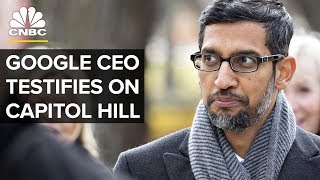 Sundar Pichai on Data Collection: Transparency, Privacy, and Bias2018 · 222 min · full transcriptHighlights the principles he uses on contested decisions: transparency, control, neutrality, and long-term user incentives.
 Sundar Pichai on AI and Search: Building Google’s Next Act2024 · 41 min · full transcriptHelps explain how he makes strategic decisions in fast-moving technology shifts without reducing AI to a single moment or product.
Questions people ask
- How does Sundar Pichai make big decisions at Google?
- How does Sundar Pichai think about employee dissent and walkouts at Google?
- What did Sundar Pichai say about the future of agents on the web?
- How does Sundar Pichai describe his leadership style at Google?
- What did Sundar Pichai say about engagement versus long-term user trust?
- What did Sundar Pichai say about releasing powerful AI models for cybersecurity?
Sources
Every quote above, word for word from the transcripts. Numbers match the text.
“A big part of my framework is over time understanding that there are very, very few decisions which are really consequential, and most decisions aren't. So what matters much more is that you make the decision because that's what determines the velocity of an organization. And so the more you're able to make those decisions and keep the company moving forward, you're generally better off. Of course, there are a few decisions like combining and setting up Google DeepMind, you know, those are more consequential and you want to take your time deliberating and doing it, but a lot of decision making is about just making them. And so the more you're able to do that, you do develop over time some pattern matching and some intuition for you've seen a version of the problem before, and so I think it's good to rely on that and separate the signal from the noise so that the signal is that this is a really important decision and you want to really deliberate around it versus this is just it may look big, but it is more a normal course of action you need to take.”
“The more you're able to make those decisions and keep the company moving forward, you're generally better off.”
“I think the larger the company is, you are making fewer consequential decisions, but they need to be clear, and you have to point the whole company to that. Part of that, at times, involves bringing the company along. You build consensus because that's what allows you to have maximum impact behind those decisions. I mean, any leader in a position like yours has to be willing to hear the criticism.”
“I just think the CEO job is not that complicated.”
“It's in our natural incentive to do so.”
“We give them transparency, choice, and control.”
“I think once you get the taste of using something like that and the superpower that comes with it, I think they're genuinely adding value, in a way. I think people will use them. I think it's important we build it in a way that users feel a sense of control and agency and transparency when they use agents. I think that's important. That's an important foundation. But I think, yes, I do expect agents to be a core part of how we use the web.”
How this guide was made: drafted with AI from the full transcripts of the recordings cited, then checked: every quotation must match a transcript word for word and be the speaker's own words, and an independent review gates accuracy. Methodology and corrections.
