Sundar Pichai on Gemini & AI
Sundar Pichai sees Gemini as Google’s core AI platform: a long-term, multimodal system that upgrades Search, products, and human capability rather than replacing them.
- Pichai treats AI as an early, long platform shift, not a short-term hype cycle.
- Gemini matters because Google built it as a natively multimodal model and is using it across major products.
- He believes AI should expand Search with better answers, context, and exploration, while keeping links and the open web important.
- Google’s edge, in his view, comes from a full-stack approach: research, chips, infrastructure, models, and product distribution.
- He pairs ambition with responsibility, arguing Google should push toward advanced AI boldly but with care.

“A frontier model built to be natively multimodal from the very beginning…”Google I/O 2024 keynote opening remarks · 2:41
AI is a long platform shift, and Gemini is Google’s symbol for that era
Pichai does not talk about AI as a one-off product launch or a sudden break from everything before it. He frames it as the beginning of a long cycle of innovation, with major advances still ahead rather than behind us. That is why he repeatedly emphasizes that this is still early and that Google has been orienting itself around AI for years.12
In that framing, Gemini is not just a chatbot name. It is the organizing idea for Google’s current phase: the company is in a Gemini era, and AI is becoming a new platform layer across consumer products, developer tools, and infrastructure. Pichai ties that directly to Google’s broader mission of making information accessible and useful, arguing that AI is the next and strongest expression of that mission.467
Gemini matters because it was built to understand more than text
A central part of Pichai’s view is that Gemini’s importance comes from being multimodal at its foundation. He presents that as a deliberate design choice, not a feature added later: the model is meant to reason across text, images, video, code, and more. That matters because he sees the future of AI as richer than text generation alone.89
This is also why he resists reducing AI to the current large-language-model moment. In his telling, language models are one phase in a much broader technological arc, and the more durable opportunity is building systems that can work across many kinds of information and many Google surfaces. Gemini is the vehicle for that broader shift.108
He also makes the point that Gemini is already embedded broadly, not held apart as a separate experiment. His claim is that all of Google’s two-billion-user products now use Gemini in some form, which shows how he thinks about AI: not as a side product, but as a common layer beneath the company’s most important experiences.11
“A frontier model built to be natively multimodal from the very beginning…”Google I/O 2024 keynote opening remarks · full transcript →
Search is not being replaced; it is being rebuilt around AI
Pichai’s most consistent argument is that AI is an expansion of Search, not a fatal threat to it. He rejects the idea that Google faces a simple tradeoff between classic search and AI answers, and instead argues that AI lets Search handle more kinds of questions, longer queries, and more exploratory tasks. In his view, the change is profound, but it is still a change to Search rather than an exit from Search.121314
He is equally clear that Search should not become answer-only. A core differentiator for Google, as he describes it, is combining direct answers with links to a wide range of sources, so users can both resolve quick factual needs and continue exploring when they want depth. That balance is not peripheral for him; he treats it as central to search quality.151617
Pichai also argues that these AI experiences can strengthen the web rather than drain it. He says the web can become richer and more multimodal, and he has suggested that newer AI experiences have in some ways pushed people back toward broader web use. So his theory is not chatbot versus web, but AI plus web, if quality and incentives are handled well.9
Google’s advantage, in Pichai’s view, is the full stack
Pichai repeatedly returns to one strategic idea: Google’s AI strength comes from controlling more of the stack than most rivals do. He points to a deep combination of research, custom chips, infrastructure, frontier models, and product distribution. That full-stack structure is how he explains both Google’s staying power and its ability to turn breakthroughs into real products.1920
He also suggests that raw compute alone will not decide the race forever. More players will get access to compute, but he expects differentiation to come from algorithmic advances, reasoning improvements, product integration, and efficiency. That is why he talks not only about bigger systems, but about harder breakthroughs as the field matures.212223
This helps explain why he focuses on latency and product quality as much as cost. He notes that serving AI is getting cheaper over time, but his larger point is that infrastructure exists to make these experiences fast and scalable enough for mainstream products. Gemini, in this logic, is powerful because it sits on top of years of investment below the model layer.242025

“We have taken such a deep full-stack approach to AI.”New York Times DealBook Summit interview, 2024 · full transcript →
He is ambitious about advanced AI, but insists on responsibility
Pichai does not hide the scale of Google’s ambitions. He says the company is trying to make foundational progress toward AGI, and he presents that as a legitimate long-term goal for Google’s AI effort. But he pairs that ambition with a strong insistence that the work must be done responsibly.262728
That combination matters because his broader story about Gemini is not just about capability. It is also about trust, rollout, and the consequences of getting things wrong. Even when he speaks optimistically about what AI can unlock, he frames the work as one that requires care, especially because these systems increasingly sit inside products people use every day.2811
He also seems to believe responsibility is compatible with speed, not opposed to it. Google has reorganized to move faster on shared AI infrastructure and products, but his management view is still that leaders must make decisions, maintain velocity, and keep the company moving toward a clear direction. The underlying message is that boldness and discipline have to coexist in the Gemini era.293031
Pichai on gemini & ai, in his own words
“A frontier model built to be natively multimodal from the very beginning…”
“We have taken such a deep full-stack approach to AI.”
“AI is the ultimate expression of that…”
Where to watch
 Sundar Pichai on Gemini and AI: Google’s Next Platform Shift2024 · 21 min · full transcriptBest short overview of why Pichai calls this the Gemini era and how Gemini is being spread across Google.
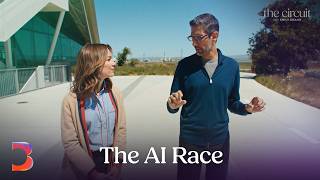 Sundar Pichai on Future of AI: Search, Gemini, and Competition2024 · 24 min · full transcriptStrong explanation of how AI changes Search while preserving links, exploration, and Google’s broader AI ambition.
 Sundar Pichai on AI and Search: Building Google’s Next Act2024 · 41 min · full transcriptBest for understanding Pichai’s full-stack thesis and why he thinks Google stays at the frontier.
 Sundar Pichai on AI Search and the Web: More Context, More Growth2024 · 39 min · full transcriptUseful if you care about multimodality, the open web, publishers, and how AI Overviews fit Search quality.
 Sundar Pichai on AI, Search, and Policy: Google’s Expansionary Moment2025 · 30 min · full transcriptGood for Pichai’s later view that Gemini 2.5 was a breakthrough and that AI is expanding Google’s businesses.
 Sundar Pichai on AI Vision: Google, Gemini, and the Future2025 · 45 min · full transcriptMost personal explanation of why AI matters to him and how it connects to Google’s mission.
Questions people ask
- What did Sundar Pichai say about AI and Google Search?
- What did Sundar Pichai say about the future of Google Search in the age of AI?
- What did Sundar Pichai say about the future of the web in an agentic search world?
- What does Sundar Pichai say about Google's infrastructure advantage in AI?
- What did Sundar Pichai say about Google’s goal for AGI?
- Why did Sundar Pichai say he wants to stay at Google and see AI through?
Sources
Every quote above, word for word from the transcripts. Numbers match the text.
“To me, we are just getting started in the beginning of what I think will be a extraordinary decade of innovation…”
“We are in the very early days of the AI platform shift.”
“At Google, though, we are fully in our Gemini era.”
“…to make information universally accessible and useful…”
“AI is the ultimate expression of that…”
“A frontier model built to be natively multimodal from the very beginning…”
“I hope the web is much richer in terms of modality…”
“AI is not the LLM. It's one moment in time…”
“Today, all of our two billion user products use Gemini.”
“I think the dilemma only exists if you treat it as a dilemma.”
“It feels very far from a zero sum game to me…”
“Search itself will continue to change profoundly in '25.”
“I think part of what makes Google Search differentiator is while there are times we give answers, it'll always link to a wide variety of sources. Now we've had answers in Search now for many, many years. We are just now using generative AI to do that. So the links will live on. Yes, and, you know, I think it'll always be an important part of Search. There will be times when they want quick answers. My son is celiac, so we did a quick question to see whether something is gluten-free. We just want to know. But often it leads to more things, and, you know, then you want to explore more.”
“I view it as the essence of what Search quality is…”
“It's not just enough to give them links.”
“We have taken such a deep full-stack approach to AI.”
“Look, it plays out everywhere. To your earlier question on cost per query in search, the reason we feel comfortable we can serve it at that scale is because we are constantly innovating through e generation, including chips which are really, really good at inference. Right? And Ironwood, which is our latest in our TPUCs, a single part of Ironwood is over 40 exaflops, right? And so, the scale of these things are incredible, and we have thought about our info all the way from subsea cables to the scale at which we do infrastructure is unparalleled. And I've always viewed that full stack approach. You know, deep infrastructure, foundational, fundamental R and D on top of it, and then you build and innovate on top of that. And I think that approach will serve us well over time.”
“I think the progress is going to get harder when I look at 25, the low-hanging fruit is gone…”
“I think everyone will get more compute…”
“I think 2.5 was a real breakthrough in terms of capabilities…”
“…the cost to serve that query has fallen dramatically in an eighteen month timeframe…”
“We are definitely investing for the long run…”
“We are committed to making foundational progress towards AGI in a bold and responsible way…”
“But I think if you define AGI as AI becoming capable across a wide variety of economic activity and being able to do it well, I think that's one way to look at it. So Google's gonna get us to AGI? You know, we are committed to making foundational progress towards AGI in a bold and responsible way. And so, you know, I'll focus on the effort to do that and do that well.”
“…we have to be very responsible…”
“The more you're able to make those decisions and keep the company moving forward, you're generally better off.”
“A big part of my framework is over time understanding that there are very, very few decisions which are really consequential, and most decisions aren't. So what matters much more is that you make the decision because that's what determines the velocity of an organization. And so the more you're able to make those decisions and keep the company moving forward, you're generally better off. Of course, there are a few decisions like combining and setting up Google DeepMind, you know, those are more consequential and you want to take your time deliberating and doing it, but a lot of decision making is about just making them. And so the more you're able to do that, you do develop over time some pattern matching and some intuition for you've seen a version of the problem before, and so I think it's good to rely on that and separate the signal from the noise so that the signal is that this is a really important decision and you want to really deliberate around it versus this is just it may look big, but it is more a normal course of action you need to take.”
“I think the larger the company is, you are making fewer consequential decisions, but they need to be clear, and you have to point the whole company to that. Part of that, at times, involves bringing the company along. You build consensus because that's what allows you to have maximum impact behind those decisions. I mean, any leader in a position like yours has to be willing to hear the criticism.”
How this guide was made: drafted with AI from the full transcripts of the recordings cited, then checked: every quotation must match a transcript word for word and be the speaker's own words, and an independent review gates accuracy. Methodology and corrections.


