The Fed Framework
Central banks shape the playing field, but can also destroy the signals.

“And I think had they had a clean slate, they would have never been buying bonds to that degree with what was going on in the economy. But they were trapped, in my opinion, by forward guidance. It's pretty incredible from from the point we wrote the article when it was so obvious that we even wrote about it. It was 13 months from when inflation went through 2% to when they finally raised rates. They also bought 2 trillion of bonds during that period.”Bloomberg interview, 2024 · 1:39
The lesson
Druckenmiller’s Fed framework starts with a simple hierarchy: for the overall market, central banks and liquidity matter more than reported earnings or neat economic narratives. He says broad market direction is driven first by monetary conditions, so an investor should watch policy, rates, and liquidity before getting lost in bottom-up detail12. That is why he treats Fed decisions as changes to the playing field, not just one variable among many.
His core criticism is that years of zero rates, QE, and balance-sheet expansion pull demand forward instead of creating durable growth. In his view, that is borrowing from the future, which can lift asset prices now but raises the odds of a worse adjustment later345. He does not argue the Fed should never act in a crisis; the issue is staying in emergency mode too long and inflating financial assets beyond what the real economy justifies.
A second part of the framework is his attack on rigid inflation targeting and forward guidance. He argues that an automatic 2% target is too narrow and can trap policymakers into staying too easy even when conditions no longer call for it67. In this view, policy mistakes come not just from bad forecasts, but from overcommitting to a framework that ignores changing conditions and measurement problems around inflation.
Druckenmiller also thinks prolonged easy money weakens capitalism’s feedback mechanisms. If rates are held too low and bonds are bought aggressively, investors lose a real hurdle rate, weak businesses survive longer than they should, and capital gets pushed into speculation and poor allocation choices89. That is why he links Fed policy to the loss of market discipline: prices stop sending clean signals about risk, quality, and scarcity.
The final implication is practical: markets become harder to read when central banks dominate and trading systems amplify noise. Druckenmiller says free money and algorithmic trading have damaged the old rhythm of markets, so macro investors must be more selective, more liquidity-aware, and less eager to force big views when signals are corrupted101112. Even when he favors normalization, he still adjusts to current conditions rather than treating every period as equally tradable13.
5 principles from Stanley Druckenmiller
Start with liquidity, not headlines
For broad market calls, begin with central bank policy and the direction of liquidity. Use earnings and macro data as secondary inputs, because Druckenmiller argues the Fed often dominates the overall market backdrop.
“Earnings don't move the overall market; it's the Federal Reserve Board.”
Treat prolonged easy money as borrowing from the future
When policy stays too loose for too long, it can support markets in the present by pulling demand and risk-taking forward. Apply this by asking whether current gains are being bought at the cost of future instability or weaker returns.
“I have enough. But I just, I've always believed that expansions and usually would type monetary policy or credit problems, and I think what we're doing is definitely borrowing from the future…”
Question rigid inflation targeting
Do not assume a single inflation number should dictate policy in all environments. Druckenmiller’s critique is that overfocus on 2% inflation can justify easing or delay normalization even when asset prices and incentives are already distorted.
“The 2% inflation target needs to go.”
Restore a real hurdle rate for capital
Healthy markets need a meaningful cost of capital so that weak uses of money get rejected and stronger ones get funded. In practice, this means watching for periods when artificially low rates may be keeping bad projects, weak firms, or speculative behavior alive.
“But, uh, it's interesting you asked about normalization because the conversation I hear in the media and the financial press seems to center around tightening, and I think the conversation should be what you dis alluded to: normalization. And the difference being normalization means sort of reestablishing a hurdle rate for investment that's been with us actually for probably 5,000 years. It's just in this eight-year period we've decided to throw it out, throw that out the window, and it's a little bizarre when you…”
Be cautious when signals are distorted
If free money and market structure changes are overwhelming normal price discovery, reduce confidence in old playbooks. That means sizing down, waiting for cleaner setups, and relying more on internals and liquidity than on simple historical analogies.
“These algos have taken all the rhythm out of the market…”
Moments to watch
In his own words
The quotes behind the lesson, word for word from the transcripts. Numbers match the lesson above.
“Earnings don't move the overall market; it's the Federal Reserve Board.”
“Focus on the central banks and focus on the movement of liquidity.”
“I have enough. But I just, I've always believed that expansions and usually would type monetary policy or credit problems, and I think what we're doing is definitely borrowing from the future…”
“…you're borrowing from the future.”
“…we're going to pay the piper at some point.”
“The 2% inflation target needs to go.”
“And I think had they had a clean slate, they would have never been buying bonds to that degree with what was going on in the economy. But they were trapped, in my opinion, by forward guidance. It's pretty incredible from from the point we wrote the article when it was so obvious that we even wrote about it. It was 13 months from when inflation went through 2% to when they finally raised rates. They also bought 2 trillion of bonds during that period.”
“I'm a dyed-in-the-wool capitalist who believes in free markets and believes in creative destruction…”
“But, uh, it's interesting you asked about normalization because the conversation I hear in the media and the financial press seems to center around tightening, and I think the conversation should be what you dis alluded to: normalization. And the difference being normalization means sort of reestablishing a hurdle rate for investment that's been with us actually for probably 5,000 years. It's just in this eight-year period we've decided to throw it out, throw that out the window, and it's a little bizarre when you…”
“These algos have taken all the rhythm out of the market…”
“…when the free money ends, we'll go back to a normal macro trading environment…”
“…the inside of the stock market…”
“For now, the Fed shouldn't hike.”
Reflect
- Where in your own work do you focus too much on headline metrics and not enough on the underlying conditions driving outcomes?
- What would 'borrowing from the future' look like in your decisions—taking easy short-term gains now at the cost of resilience later?
- How do you know when the signals in your environment are trustworthy versus distorted by incentives, intervention, or noise?
Check your understanding
Go deeper
 Stanley Druckenmiller on Monetary Normalization: Fed, Bitcoin, and Taxes2017 · 32 min · full transcript
 Stanley Druckenmiller on Monetary Policy: Free Money Distorts Markets2018 · 85 min · full transcript
 Stanley Druckenmiller on Macro Investing: Liquidity, Rates, and Signals2018 · 31 min · full transcript
 Stanley Druckenmiller on Monetary Policy: Why He Fears the Fed2019 · 50 min · full transcript
 Stanley Druckenmiller on Macro Investing: Fed Policy, China, and Markets2019 · 61 min · full transcript
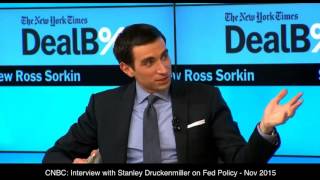 Stanley Druckenmiller on Fed Policy: Why It Ends Badly2015 · 25 min · full transcript