Stanley Druckenmiller on Fed Policy: Why It Ends Badly
What Druckenmiller talks about
Stanley Druckenmiller spoke in a CNBC interview in 2015 about Federal Reserve policy, arguing that zero rates and quantitative easing distort markets, corporate decisions, and long-term growth.
Also known as: CNBC Interview: Stan Druckenmiller on Fed Policy; Stanley Druckenmiller on Fed Policy: Why It Ends Badly.
Stanley Druckenmiller says the Federal Reserve’s prolonged emergency policies pushed investors, companies, and governments into short-term, irrational behavior. He argues that zero rates and quantitative easing pull demand forward and create misallocation rather than lasting growth.
He extends the critique beyond the Fed to buybacks, capital spending, and market structure, saying stock prices and policy distort corporate decisions. He also connects easy money to inequality and to the political delay of addressing entitlements.
The conversation ends with his practical investor stance: stay flexible, hold cash, study more than one asset class, and avoid forcing long-term certainty onto uncertain markets.
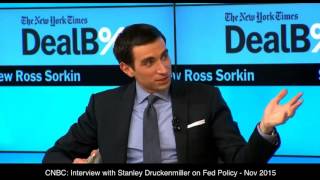
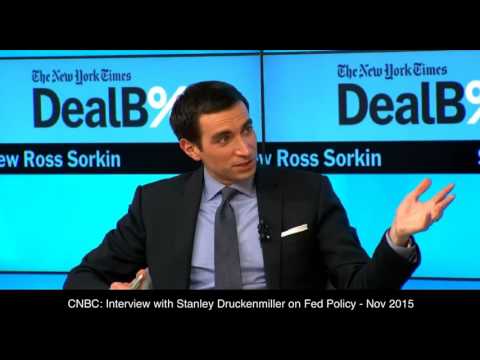
An CNBC interviewer hosts the discussion; Druckenmiller speaks throughout the substantive exchange.
In his words
“The problem with the Fed.”
“You're borrowing from the future.”
“We're going to pay the piper at some point.”
“I manage for the long term.”
“The crowd is usually wrong on the market.”
Key points
- The Fed was right to act forcefully in 2009, but should have normalized policy sooner.
- Prolonged zero rates and QE encourage risky behavior by governments, corporations, and investors.
- Record buybacks and weak capital spending reflect distorted incentives, not textbook rationality.
- He sees a speculative, short-term mindset across markets and society.
- He is open-minded on a U.S. equity bear market and has been positioning defensively.
- He likes companies that invest for the future, including Amazon and Netflix.
- He argues QE has lifted asset prices and worsened inequality, while delaying entitlement reform.
Full transcript: Stanley Druckenmiller, CNBC interview on Fed policy (2015)
We have, uh, two final guests this afternoon, uh, both of whom I imagine may make some news, and I hope will be, and know will be, a tremendous conversation. Let me introduce to you, uh, Stan Druckenmiller. He is a legendary investor. He needs really, uh, no introduction, so I'm just not even going to give him one. Uh, Stan, come on. (music) Out. Thank you. You're the only one. To see you can take your, you can take your lanyard off. You're the only one who—I should have told you that. But he's so, so interesting. I'm known as a slob, so it really doesn't affect anything. Um, Stan really is one of the—the great legendary investors, and there's so much to talk to
him about, especially given the theme and topic of today, which is playing for the long term. And there's a couple of topics that we really haven't touched today that I really want to spend some time, uh, with Stan talking about. One is what I think, you know, and, and, uh, Larry Fink mentioned it briefly, but the issue of entitlements and sort of the long-term, uh, challenges that that poses. And also we have not really had a conversation today, uh, about the Fed and where all of this ends and, and what really happens. And so I want to start—I want to start with the Fed and, and then we can sort of take it from there. Stan, but you know, you have been one of the great investors. You have seen a very, uh, you know, you've seen the macro view for so very long. When you see where we are
today in terms of what the FED is doing, you've been out there saying that there's a real problem here, but one of the things I don't think we all know is how it's going to end. Join the club. I don't know how it's going to end either. But I suspect you—you've said you think it's going to end badly. Yeah, so, but I want understand it's going to end badly because what, what is going to happen that's going to make all of this end badly? Well, first of all, I, I love the title of your conference because whether it's government, the Fed, or money managers, everybody's managing for the short term now. And that, that is the problem with the Fed.
Um, to me, we got in a very, very difficult situation in '08-'09, partly by the way because the Fed was late in recognizing the situation in '06. Uh, and what they did in '09 was unbelievably creative. It was forceful, in my opinion. It was terrific. I'm not a fan of counterfactuals, but who knows what would have happened without them. But sometime between 10.1% unemployment and 5.1% unemployment and retail sales have been going like this and a very healed economy, you would have thought we would
have gotten out of emergency measures. And the reason I think it's going to end badly is at some point over six years, when you have zero rates and quantitative easing, you cause—you move investors out the risk curve. You cause Emerging Market governments, which have always had market discipline imposed on them, to act in ways they never would have been able to act in history because the markets wouldn't have let them, i.e., Brazil and Turkey. You cause corporations to start acting in bizarre ways, buying back twice as much stock with prices at two and a half times where they were four or
five years ago at, you know, record, record prices. Um, and at some point the Fed, all you do when you're doing this, Andrew, is you're pulling demand forward today. This is not some permanent boost you get. You're borrowing from the future. And I think there's been such a misallocation of resources because this has gone on so long and so unnecessarily, the chickens will come home to roost. An example: the last time we did something but not nearly this radical—I remember in November of '03 being down at the New York Fed and there was a somewhat heated
there were four or five of us, but I tend to sometimes lose it a little and I said, "What are we doing? You have 7%, 9% nominal growth rates, rates of 1%, and that's not even enough for you people. You've got this considerable period attached to it." I didn't know how it was going to end if you put a gun to my head. I have said an inflation would have been dead wrong, but I knew it was a mistake, and more importantly, it was unnecessary. Two or three years later I figured it out, and that's kind of how I feel now. This is unnecessary. You're causing irrational behavior by governments, investors, corporations, and we're going to—we're going to pay the piper at some point. Okay, I want—I want to read you something. This is from a friend of yours, Kevin War,
and Michael Spence wrote an op-ed in the Wall Street Journal, and you said they—they said, although I know you're friends with them, the Fed has hurt business investment. QE is partly to blame for record share of buybacks as your issue and meager capital spending. Then in response, Larry Summers said, "This is the single most confused analysis of US monetary policy that I've read this year," and said that raising rates will threaten all of the central bank's major objectives. Why? Why is Larry Summers so wrong? Well, it's interesting what he said elsewhere in that little rebuttal, because one of his points was, "Why in the world would they be buying back stock as
opposed to Q, as opposed to investing? Because, with prices up, rational economic theory, they would be doing investing." So Kevin and Nobel Laureate Mike Spence were all wet. Well, a lot of things work in the classroom that don't work in the real world. And he was calling for empirical studies. Well, he should do an empirical study, because I can show you a chart: when stock prices go up, corporations are just like the rest of us schmucks. The higher they go, the cheaper they look. So they bought back record amounts in '07 when prices went down when economic theory says they would buy more. In '09-'10 they stopped buying, and as I just pointed out, they borrowed all this money.
$2 trillion to do $2.2 trillion in buybacks the last four years at twice the price and at twice the volume they were doing them four years ago. So I can't explain in a classroom and with traditional economic theory. Maybe it's why I dropped out of a PhD program. But what I can tell you, it's a historical fact when prices go up and speculation is rampant, that's when corporations buy back stock. That's when they do it. And so, would you say we're in a bubble now? I mean, do you really think we're in a speculative bubble at this moment? We're in a bubble in terms of what I would call short-term
behavior, if that makes any sense. So, as an investor, what, by the way, at all four levels I talked about: government, business, the Fed, money managers—it's rampant in our whole society. So, what do we do about that? About what? The ladder or the Fed? As, no, let's start as just an investor. Everybody here is trying to figure out what to do. How do you, how do you, how do you deal with this then? Well, I'm a bit of an oxymoron in the sense that I don't make so-called long-term investors the way other, well-known investors do, but I manage for the long term. I have, but it's
a series of short-term investments. I have never exited or went into a trade 'cause I thought it would make my quarter look better or I was afraid my clients would think this or they would think that. I happen to, I happen to have been trained for 35 years. If we get into difficult environment, fortunately or unfortunately, all my biggest absolute returns were in periods of chaos. So, I'm not looking forward to it, but I think I can deal with it if this unfolds. So does—I mean, you're anticipating chaos and you are sitting with all this cash under your—no, I'm sitting with cash. One of the reasons I got rid of my clients so I'd have enough
money so I'd be flexible. No, I'm playing around like everybody else, and I'm watching and ready to move. When you say you're playing around like everybody else, where, where are you playing? What are you doing? Well, I don't know. I guess in terms of equities, I'm working under the assumption that we may have started a primary bear market in July, mainly because about 80 or 90% of the stocks have been going down for a year, and that tends to precede. And we had the Nifty 50 right around when I was starting the business, and now we're down to about the Nifty 10,
everybody in this room knows what they are, and I've been hanging out in the Nifty 10 and short value stock, probably the opposite of what they would teach in Dr. Summers's class. And I'm shorting the euro again, which is another fundamental thing. If you want to get into the reasons for all this, I will, but please do. The euro this again is, first of all, don't go and out and do anything I say. The probably one of my greatest assets the last 30 years: I'm very open-minded and I can change my mind very quickly,
but about, well, I guess it was May of '14, US monetary policy and European monetary policy flipped at the same time. Draghi decided to do quantitative easing, lowered the deposit rate. At the same time, Banki decided to do tapering, so because it had been the opposite for a few years, the euro was overvalued, their balance sheet was shrinking, ours, so that flipped back then. I have never seen a currency move, and I've been doing this a long time, of this intensity, last 11 months. The nice thing about currency moves is they tend to last two or three years,
but they usually take a timeout somewhere in the middle. If you remember, the yen went from 80 to 105 and then took like a timeout for about eight or nine months from 105 to 95. I have thought we're in a timeout like that in the euro, and now look at what's happening. Draghi looks like he's pretty much pre-announced step two. We don't know whether it's going to be a cut in the deposit rate to even more negative, more QE, or both at the same time. There's even more heavy breathing going on at the Fed. Who knows whether they're going to pull the trigger or not, but you have sort of a mini version of what we had in May of '14, which is a movement like this in the two monetary policies. Given the fact that currency moves usually last two or three years,
it's only been a year and a half; the policies are sort of flipping. All my brethren have gotten out of the trade, including me. I'm working on the assumption that leg two has started. When I say working under the assumption, I'm flexible. Andrew, you're flexible, and you can change your mind. Let me ask you: you mentioned you thought there was a bear market or a bear market has begun this summer in the equity market in the U.S. I'm very open-minded to that. Yeah, open-minded to that, positioned that way. I was, I covered very well. Unfortunately, I didn't play the rally other than to get out of the way of it, and where I am now is sort of neutral
and long this high beta, high growth stuff. The companies are investing in their business, it's stuff, things that I think will do very well with low nominal growth, and I'm sure a bunch of value companies that buy back stock and need cyclical growth against it. And my guess is I could get, I could see myself getting very bearish. I can't really see myself getting really bullish, so I'm kind of on the sidelines in equities in terms of exposure and messing around in the euro right now. Help us with this. J. Remedy was here earlier this morning and I quoted you about—oh, that was nice, it was lovely. She must have been really excited about your view in particular.
About IBM and the buybacks. When you look at IBM now, she made an argument, um, may have been persuasive to some, may not have been to others, about the fact that a company like that needs time to shift. She made the argument that this is not a secular shift for her company. And, but by the way, I wouldn't even argue she made it as a cyclical shift. She just sort of suggested that they are in a transformation period. Do you buy that? No. Um, I was looking at Amazon and I was looking at IBM the other day, the last 19
quarters. Amazon has missed their quarterly earnings nine times. They don't give a damn. IBM has missed three quarters since 2006. They really care about their quarterly earnings. It's an interesting transformation because I heard a little bit of your questions, and it's not just the 14 quarters in a row of down sales. Their R&D has shrunk as a percentage of sales. They're under major attack from Amazon, Palantir, all these companies out there eating away, and their R&D has shrunk in absolute terms and as a percentage of their sales,
over the same time. I think it's gone from like 6.2 to 5.9% on a shrinking base. Amazon, on exploding sales, has gone from 5% to 10%. Now, who's investing for the transition? I mean, what kind of transition is that when you're shrinking your R&D? They bought back 43 billion in stock at an average price of 189. They say they're stewards of capital and returning value to shareholders. I don't know how you buy something at 189 and it's 142. That's not my kind of return to shareholders. But so, no, I don't, I don't believe in the transition you mentioned. Amazon, yeah, is that a stock that makes sense to you? Oh yeah, I love
Amazon because, because they're investing in their future. Bezos is a serial monopolist. Um, he's come up with this AWS, okay, which is absolutely exploding. I don't know how many people here are small businessmen, but — and women — if you're starting a business today, you don't need a technical department, you don't need a back office, you can use AWS. Um, by the way, it's just ripping to shreds the 10 or 15 consultants you have from IBM on your firm that you used to need, that you don't need because now you go into cloud. And in retail, they were 22% of U.S. sales growth this year of retail, one company, and he's just sitting there with narrow margins. And when he
has enough share of market, whenever he wants, he can get the margin. Why are you convinced he's going to do that? He may never do that and doesn't matter. What do you mean? Why am I? Because he's a businessman and I, I see his strategy and I think it's genius. But you're convinced that he will at some point? Of course. Of course he will. I'll probably be dead, but of course he will. By the way, in the similar vein, how do you feel about a company like Netflix? That man went to Bowdoin. He walks on water as far as I'm concerned. Okay, uh, same thing. You know, I only heard 30 seconds of him. I was in the gym, but when he said, "If you manage for quarterly earnings, you're dead." And then somebody on CNBC says,
"Well, it's easy for him to say with a stock price like that." Well, why do you think he has a stock price like that? Because he's thought about the long term and not cared about quarterly earnings and all the short termism the whole time. Let me ask you this. Um, we've had conversations, uh, privately before about inequality, and I think you've made the argument to me that you think what the Fed has done has exacerbated inequality in this country, and especially when it comes to sort of the long-term issues in this country when it comes to entitlements. True? Uh, you know, I'm not going to run around and say that Fed's exacerbated inequality. It has been a side effect of what they've done.
Uh, look, QE has elevated asset prices. Um, the middle class hasn't participated, so clearly it's exacerbated inequality. But I'm more worried about the eventual consequences and who's going to pay for them, um, which is not going to be me. Uh, but in terms of entitlements, yes, I do think—and I've made this point very strongly four or five years ago—I haven't talked about it too much since then, that you get congressional action and presidential action in a CR crisis. Um, and by keeping the markets elevated and blocking the market signal—the same way that the market signal was blocked to
the Brazilian government—um, the Congress has been able to not really worry about entitlement. So everybody's happy, everybody's partying, we're keeping this thing going. But just like it is on climate change, the clock is ticking on the entitlements, and it's, uh, it's a nasty story that's developed. Well, you, you went around about five years ago, and you visited all sorts of schools. It was during the sequester, so yeah, probably would have been 2011. And the argument you were making then still matters today, and it is what the argument is. Um, in a nutshell, it's twofold. From the late 60s, we've gone from about 28% of government outlays being payments
to individuals to 68%. Uh, during the same time period, senior poverty rates have gone from 30 to 9. That's a good thing. Child poverty rates have gone from 21 to 23 over 50 years. That's a bad thing. Twenty-three percent of American children are born into poverty. The top 35 industrialized nations, we're number 34. We beat Romania. We do not beat Latvia and the other 32 countries. Now, I'm going to give you a quiz, Andrew, because you're very smart, and you're very educated in this stuff. The federal government sends, spends
$8,000 per capita per child in this country, as defined by 15 and under. $8,000 per capita. What do they spend per capita on the seniors of our country? I'm assuming the answer is even less. The seniors, $44,000. $44,000. $8,000 on our children, $44,000 on our seniors. I'll put it a different way: 8 cents out of the average income of a dollar of every American goes to spending on children. 56.8 cents goes towards spending on seniors. So they've been getting a bigger and bigger and bigger share of the pie over the last 50.
Years, say what you will about that. Unfortunately, that's not the end of the problem. A bunch of us or a bunch of our parents had babies, one of which I was, back in the early 50s. So we have a demographic Baby Boom about to turn into a gray boom. So those of us—I'm only 62—but I'll be there in a little bit, who are getting so much more of the pie, there's about to be a lot more of us. Between now and 2050, the over 65, the non-working population, is going to grow 117%. The working population, 18 to 64, is going to grow 177%. So you've got this huge, huge bulge.
It started in 2011. Every day, 11,000 new seniors are created, but only 2,500 new adult workers are created to support them. Sometime between now and 2030, this is going to be a problem. It's going to be a big problem. Now, this is the part the scaremongers like to talk about. I'm not really into scaremongering, but I will tell you that the federal deficit, or the federal debt—everyone that runs around, certainly Republicans—$19 trillion, we hear it every day. If you believe that, I was going to get my Social Security payments, and everybody else was in their Medicare payments, and the government's not going to renege on.
Us, so you present valued the following: that's a liability, not a revenue. If you're going to pay me something, if the government owes, it's a liability. And you present valued that stream of payments that's been promised to me and looked at the revenues are coming in, the federal debt would not be $19 trillion; it would be $205 trillion. That's the bulge we're looking at, and that's assuming interest rates are going to be 4%. Anybody who's been to Greece knows that they won't be 4%, somewhere along that chain. So that's the problem. You asked me to articulate a very pessimistic take on the world. We don't have that much time, but I want to open it up to questions because I know there are probably a handful of folks.
Who want to ask. Way, I'm not pessimistic. You just asked me to describe some facts. Sounds pretty pessimistic. We got a question right over here. So Stan, given that pessimistic demographic and financial picture, what asset classes does a smart investor expose themselves to to benefit from all that travesty? It's very hard to short stocks. It sounds great in theory. It's very difficult.
Because you run, you're basically playing against the house, the government, the security industry, everyone. Probably the asset class I get into if this was unfolding would be cash. If I was a normal investor in my world, because I do this for a living and because I've been doing it a long time, I probably more interested in bonds and currencies than I would in stocks because they tend, once you get in a chaotic period, they tend to make their biggest moves in. So if I was 18 and trying to prepare myself financially for this, I would study and try and learn how to play a bunch of asset classes, not just equities. Is it a bad idea? Real quick. I mean, we Larry Thinkink here. Art was here from Oppenheimer this morning.
The Buy and Hold strategy—you, you've been a long-term investor, but you've been in and out the whole time. What do you think of just the rest of us who buy mutual funds? It beats trying to time the market because 85% of the people are worse than random. So yeah, I think if you believe you have great companies and you believe you really know something about them and you believe they're going to grow, I'm okay with that strategy as opposed to the alternative, which is market timing, because again, if people were just random and right 50% of the time, I don't know what I'd say about it, but they're not. I mean, the crowd is usually wrong on the market. We're going to leave it there. You.
Want to give us a glimmer of hope on something? Well, I—I'm very optimistic about what my future on that note. Stan Druckenmiller, the great Stan Druckenmiller. Thank you, Stan. Appreciate it.
From YouTube captions, lightly punctuated for readability. Timestamps link to the video above. Errors are possible.
Cite this recording
Stanley Druckenmiller, “CNBC interview on Fed policy (2015)”, 2015. Transcript and video: Thinkers Archive, https://thinkersarchive.com/stanley-druckenmiller/fed-policy-cnbc-2015/
Quoting a passage? Link to its exact moment: every timestamp above has its own anchor (for example https://thinkersarchive.com/stanley-druckenmiller/fed-policy-cnbc-2015/#t-131).