Stanley Druckenmiller on Risk
For Druckenmiller, risk is not about being right all the time; it is about cutting what is not working, sizing hard when the odds are exceptional, and staying flexible enough to change fast.
- Risk is asymmetric: what matters is how much you make when right versus lose when wrong.
- Sizing is central; when the opportunity is unusually good, he presses hard.
- He cuts positions when the thesis changes and does not get anchored to price or ego.
- He manages risk by reading markets and financial conditions, not by trusting forecasts alone.
- Caution is a position too: when the environment is poor, he reduces exposure and waits.

“It's not whether you're right or wrong, it's how much you make when you're right and how much you lose when you're wrong.”Morgan Stanley Hard Lessons interview, 2024 · 7:33
Risk starts with payoff, not with prediction
Druckenmiller treats investing as a payoff game, not an accuracy contest. His basic frame is that being right a little and wrong a little is not enough; the real question is whether gains are larger than losses over time.1
That perspective shifts attention away from proving a forecast and toward structuring bets well. It also helps explain why he can be aggressive without needing certainty: a trade only has to offer favorable upside relative to downside.1
This is also why he describes himself more as a market operator than a pure economist. He is trying to read opportunity and danger in real time, not win debates about theory.3
“It's not whether you're right or wrong, it's how much you make when you're right and how much you lose when you're wrong.”Morgan Stanley Hard Lessons interview, 2024 · full transcript →
Sizing is the heart of his risk management
Druckenmiller repeatedly comes back to sizing as the biggest determinant of results. In his view, portfolio management is not mainly about collecting many small opinions; it is about deciding when a view deserves real capital and when it does not.4
When he sees a rare setup with unusually attractive odds, he wants to increase exposure dramatically rather than nibble. That is why he talks about waiting for exceptional opportunities and then betting big.567
This also explains his skepticism toward blanket diversification. He does not reject prudence, but he believes spreading too widely can dilute the value of genuine conviction when the risk is actually understood.8

“…sizing is probably 70 to 80% of the equation.”Sohn 2022 conversation with John Collison · full transcript →
He reduces risk by changing his mind quickly
A defining part of Druckenmiller's approach is that he does not stay attached to a position once the reason for owning it changes. He is explicit that if the market or new facts invalidate the thesis, he exits without caring about the original entry price.9
That requires emotional control. He stresses discipline and being unemotional, and he advises moving on after mistakes instead of brooding over them.1011
This is why flexibility matters so much in his framework. Risk is often less about avoiding every mistake than about refusing to let a mistake become a large, identity-driven loss.910

“If the reason I bought a stock is no longer the case, I don't care what I paid for it. And if I bought it at 60 and it's 50, because the markets discovered the problem before me, I have no emotion whatsoever. Soros was the same way. I didn't really learn it from him, but it was certainly reinforced.”In Good Company podcast, Norges Bank Investment Management, 2023 · full transcript →
Markets themselves are his main risk indicators
Druckenmiller looks to markets for warnings before the economic data fully show trouble. He has said the inside of the stock market is often the best economist he knows, which means risk rises when internals, cyclicals, credit, curves, and liquidity start deteriorating.123
That is why he often frames his macro views as conditional and adaptive rather than fixed forecasts. In difficult periods, he emphasizes open-mindedness and acknowledges that the environment can be unusually hard to read.1314
He also believes policy distortions and algorithms can damage traditional signals, so risk management requires constant adaptation instead of blind reliance on old models.151617

“The best economists I know is the inside of the stock market…”Interview, 2018 · full transcript →
Sometimes the best risk decision is to do less
Druckenmiller does not think risk management always means finding the perfect hedge or making a bold call. Sometimes it means recognizing that the environment is poor and stepping back.1920
He has described moving from very high exposure to flat because he did not want to operate in an unattractive setup. That reflects a key principle: preserving capital and mental flexibility matters more than forcing action in noisy conditions.20
This patience is the other side of his aggressiveness. He wants caution when signals are muddy and size only when the pitch is fat, which keeps him from confusing activity with edge.195

“When the Trump tweet went out, I went from 93 percent invested to net flat and bought a bunch of Treasuries. Not because I'm trying to make money, I just—I don't want to play in this environment. They're gonna be better environments to take a shot. So I think if you're confident in your long-term view and your ability to make money, this is not a great environment to be going to vet in the or Antion one way or the other. Not short, not long. It's in terms of the economy though, if you believe that…”Economic Club of New York interview, 2019 · full transcript →
Druckenmiller on risk, in his own words
“It's not whether you're right or wrong, it's how much you make when you're right and how much you lose when you're wrong.”
“I wait for fat pitches and then I play really big.”
“…sizing is probably 70 to 80% of the equation.”
“…when I'm hot, I'm supposed to turn the dial way up.”
“You have to be disciplined, you have to be unemotional…”
“It's just a time for caution…”
Where to watch
 Stanley Druckenmiller on Risk and Trading: Charts, Conviction, Discipline2009 · 83 min · full transcriptBest single conversation on his trading discipline, concentration, liquidity, and how he actually manages risk in positions.
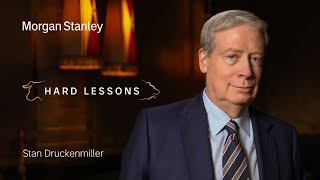 Stanley Druckenmiller on Investing Lessons: Invest, Then Investigate2024 · 28 min · full transcriptClear explanation of payoff asymmetry, conviction, and why sizing drives investing results.
 Stanley Druckenmiller on Macro Investing: Inflation, Recession, and Signals2022 · 68 min · full transcriptStrong on sizing, adaptation, and how he reads changing conditions when old signals stop working.
 Stanley Druckenmiller on Fed Policy and Market Signals: Why He Wants a Pause2018 · 60 min · full transcriptShows how he thinks about caution, market internals, and risk management when conditions tighten.
 Stanley Druckenmiller on Macro Investing: Size, Flexibility, and Trump2016 · 39 min · full transcriptUseful for understanding his preference for size, flexibility, and exiting fast when the thesis changes.
Questions people ask
- What did Stanley Druckenmiller learn from George Soros about investing and position sizing?
- What did Stanley Druckenmiller say about handling mistakes and drawdowns?
- What did Stanley Druckenmiller say about the right investment posture when markets are volatile?
- What did Stanley Druckenmiller say is the biggest mistake investors make?
- How does Stanley Druckenmiller decide when to sell a loser?
- What did Stanley Druckenmiller say he lost as he became a more experienced investor?
Sources
Every quote above, word for word from the transcripts. Numbers match the text.
“It's not whether you're right or wrong, it's how much you make when you're right and how much you lose when you're wrong.”
“I'm more of a market animal than an economist…”
“…sizing is probably 70 to 80% of the equation.”
“I wait for fat pitches and then I play really big.”
“…when I'm hot, I'm supposed to turn the dial way up.”
“I was over 90 percent invested…”
“I think diversification is really overrated…”
“If the reason I bought a stock is no longer the case, I don't care what I paid for it. And if I bought it at 60 and it's 50, because the markets discovered the problem before me, I have no emotion whatsoever. Soros was the same way. I didn't really learn it from him, but it was certainly reinforced.”
“You have to be disciplined, you have to be unemotional…”
“Just get over it and move on.”
“The best economists I know is the inside of the stock market…”
“…this is easily the most challenging period I've had a confident forecast in my career…”
“I would say the most important answer I give that is keep an open mind…”
“These algos have taken all the rhythm out of the market…”
“…when the free money ends, we'll go back to a normal macro trading environment…”
“You have to constantly innovate and not just be a slave to past models.”
“It's just a time for caution…”
“When the Trump tweet went out, I went from 93 percent invested to net flat and bought a bunch of Treasuries. Not because I'm trying to make money, I just—I don't want to play in this environment. They're gonna be better environments to take a shot. So I think if you're confident in your long-term view and your ability to make money, this is not a great environment to be going to vet in the or Antion one way or the other. Not short, not long. It's in terms of the economy though, if you believe that…”
How this guide was made: drafted with AI from the full transcripts of the recordings cited, then checked: every quotation must match a transcript word for word and be the speaker's own words, and an independent review gates accuracy. Methodology and corrections.