Stanley Druckenmiller on Decision Making
Stanley Druckenmiller treats decision making as a forward-looking exercise in reading real-world signals, acting with conviction when the odds are favorable, and changing course instantly when the thesis breaks.
- Decide by looking forward, not by reacting to the present.
- Use markets and liquidity as live information, not abstract models.
- The payoff comes from sizing and asymmetry, not from being right all the time.
- When the reason for a position changes, drop ego and move on fast.
- Discipline matters more than intellect; execution is a real edge.
He makes decisions by imagining the future before others do
Druckenmiller’s starting point is that good decisions are not about explaining today; they are about seeing what the world is likely to look like well ahead of consensus. He prefers to think in an 18-to-24-month frame and asks whether future conditions will look different enough that current prices are wrong. That is why he emphasizes envisioning the future in a way others have not, instead of investing in the present.12
This also explains why he is skeptical of rigid economic models. He does not think the world can be reduced neatly to equations, and he prefers judgment about how events will flow through markets and businesses. His approach is less about formal prediction and more about building a differentiated view of what comes next.34

“I have found it's very important never to invest in the present. Always try and envision the situation as you see it in 18 to 24 months, and then see if you feel things would be different than they are now. Would security prices reflect that? I think that's probably the biggest mistake investors make is they invest in the present rather than forward looking and looking where the puck's going instead of where the puck is.”In Good Company podcast, Norges Bank Investment Management, 2023 · full transcript →
He trusts live signals more than elegant theories
Druckenmiller repeatedly says he is more of a market observer than a traditional economist. In practice, that means he watches the inside of markets, company commentary, financial conditions, liquidity, and leadership within stocks to understand what is changing beneath the surface. He believes those signals often tell the truth sooner than official forecasts or headline narratives.567
That same instinct shows up in how he thinks about policy. He criticizes decision makers who overcommit through forward guidance because it reduces their ability to adapt when the environment changes. For him, good decision making requires optionality, constant updating, and respect for what markets are saying now.
At the broad market level, he puts unusual weight on liquidity and central banks. He argues that overall market direction is driven less by simple earnings stories and more by monetary conditions, which means a strong decision process has to include how policy is shaping incentives and price action.87
He believes the biggest edge is acting decisively
Druckenmiller is explicit that his edge is not raw intelligence but execution. He sees many people who can analyze well, but far fewer who can actually act when the moment arrives. That is why he highlights trigger pulling as an advantage: once the odds line up, hesitation becomes a cost.9
This decisiveness is tied to conviction, not mere boldness. He is not impressed by contrarianism for its own sake; the crowd is often right. But when his work, pattern recognition, and the signals align, he wants to act forcefully rather than nibble.10
He also connects good execution to temperament. Decisions improve when you are disciplined and unemotional, because emotion can delay action, distort interpretation, or tempt you to defend a bad call. For him, courage without discipline is dangerous, but discipline without courage leaves too much on the table.1112
He judges decisions by payoff asymmetry, not batting average
One of Druckenmiller’s core ideas is that decision quality is not mainly about the percentage of times you are correct. What matters is the relationship between upside when you are right and downside when you are wrong. That framing pushes him toward opportunities where the payoff is highly skewed and away from situations where being right is not enough to make meaningful money.13
That is why sizing sits near the center of his decision process. Once he has conviction, he wants the position size to match the opportunity, and he has said sizing is the majority of the equation. He argues that if you are in sync and the setup is exceptional, you should turn the dial up rather than hide behind excessive diversification.141015
His version of risk management is therefore not passive spreading of bets. It is concentrated exposure when the thesis is strong and caution when signals are mixed. He is willing to say it is simply a time for caution when conditions deteriorate or become unclear.16
He changes his mind fast and refuses to marry a thesis
A defining feature of Druckenmiller’s decision making is his willingness to abandon a position as soon as the original reason for owning it no longer holds. He does not anchor on the purchase price, and he does not treat exiting as an admission of weakness. If the market has identified a problem before he did, he wants out.17
That mental habit depends on ego control. He has talked about the need to get over mistakes and move on, and he emphasizes admitting failures and then analyzing them. The point is not self-punishment; it is faster learning and cleaner future decisions.1819
This flexibility is especially important because markets evolve. He notes that old rhythms and old signals have been disrupted by central bank intervention and algorithmic trading, so good decision makers cannot become prisoners of the models that once worked. They have to keep innovating as the environment changes.2021
Druckenmiller on decision making, in his own words
“I have found it's very important never to invest in the present. Always try and envision the situation as you see it in 18 to 24 months, and then see if you feel things would be different than they are now. Would security prices reflect that? I think that's probably the biggest mistake investors make is they invest in the present rather than forward looking and looking where the puck's going instead of where the puck is.”
Where to watch
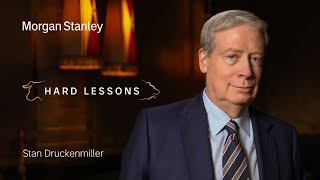 Stanley Druckenmiller on Investing Lessons: Invest, Then Investigate2024 · 28 min · full transcriptBest short overview of how he connects conviction, execution, sizing, and getting past mistakes.
 Stanley Druckenmiller on Future Vision: Seeing Ahead First2024 · 71 min · full transcriptBest window into his forward-looking mindset, self-awareness, and how he forms differentiated views.
 Stanley Druckenmiller on Risk and Trading: Charts, Conviction, Discipline2009 · 83 min · full transcriptBest for discipline, charts versus fundamentals, liquidity, and how he behaves around turning points.
 Stanley Druckenmiller on Macro Investing: Inflation, Recession, and Signals2022 · 68 min · full transcriptBest for how he updates signals, avoids stale models, and thinks about turning conviction into size.
 Stanley Druckenmiller on Fed Policy and Market Signals: Why He Wants a Pause2018 · 60 min · full transcriptBest for seeing how he uses market internals and caution in real time rather than relying on headline macro.
Questions people ask
- What did Stanley Druckenmiller learn from George Soros about investing and position sizing?
- What did Stanley Druckenmiller say about handling mistakes and drawdowns?
- What did Stanley Druckenmiller say is the biggest mistake investors make?
- Did Stanley Druckenmiller say you need to code to be a successful investor?
- How does Stanley Druckenmiller decide when to sell a loser?
- What did Stanley Druckenmiller say he lost as he became a more experienced investor?
Sources
Every quote above, word for word from the transcripts. Numbers match the text.
“I have found it's very important never to invest in the present. Always try and envision the situation as you see it in 18 to 24 months, and then see if you feel things would be different than they are now. Would security prices reflect that? I think that's probably the biggest mistake investors make is they invest in the present rather than forward looking and looking where the puck's going instead of where the puck is.”
“…you envision the future, particularly in a way that others have not…”
“Graduate economics. They were trying to jam the world into a mathematical equation, and I just didn't think it fit. I think I've been proved right on that. When you look at the 800 PhDs at the Fed and their predictive record, it's not so good. But I didn't want to go into math; I wanted to go into sort of figuring out the world, and I just didn't think the world could be stuffed into a mathematical formula. And the problem is these people believed their models, and there was just no way. So it wasn't for me.”
“…every event in the world affects some security somewhere…”
“I'm more of a market animal than an economist…”
“The best economists I know is the inside of the stock market…”
“Focus on the central banks and focus on the movement of liquidity.”
“Earnings don't move the overall market; it's the Federal Reserve Board.”
“My advantage is not IQ. It's trigger pulling.”
“…when I'm hot, I'm supposed to turn the dial way up.”
“You have to be disciplined, you have to be unemotional…”
“Not really. There's no silver bullet. And I'm the great beneficiary of 40 years of scars and successes that I can go back on, and a lot of pattern recognition, because there's not much I haven't seen in this business. I'd say the biggest disappointment in my career has been I think I have more wisdom, and I have more tools of the trade than I had in my 30s and 40s, and I was a much better portfolio manager then because back then I had courage. I would take bigger convicted positions. I'm trying to regain some of my nerve just because it's more fun. Bouzali: So you're chickening out? Druckenmiller: Oh for sure. I've been chickening out for a long time. I'm Mr. Taco, except it's not T, it's DACO. Druck Always Chickens Out.”
“It's not whether you're right or wrong, it's how much you make when you're right and how much you lose when you're wrong.”
“…sizing is probably 70 to 80% of the equation.”
“I think diversification is really overrated…”
“It's just a time for caution…”
“If the reason I bought a stock is no longer the case, I don't care what I paid for it. And if I bought it at 60 and it's 50, because the markets discovered the problem before me, I have no emotion whatsoever. Soros was the same way. I didn't really learn it from him, but it was certainly reinforced.”
“Just get over it and move on.”
“…admit that you've had failures, and then go back and analyze those failures…”
“These algos have taken all the rhythm out of the market…”
“You have to constantly innovate and not just be a slave to past models.”
How this guide was made: drafted with AI from the full transcripts of the recordings cited, then checked: every quotation must match a transcript word for word and be the speaker's own words, and an independent review gates accuracy. Methodology and corrections.


