Stanley Druckenmiller on Position Sizing
Druckenmiller treats position sizing as the heart of investing: wait for rare moments when the future looks clear, bet big in liquid markets, and cut back fast when the thesis weakens.
- Returns come more from sizing than from batting average
- He waits for "fat pitches" and then puts on big positions
- Conviction matters more than broad diversification when risk is understood
- Sizing must fit liquidity and a forward-looking thesis, not a formula
- Discipline means staying unemotional and moving on quickly when wrong

Position sizing is where the money is made
For Druckenmiller, investing is not mainly a contest of being right more often than everyone else. The central question is the payoff profile: how much you make when your thesis works versus how much you lose when it fails. That is the lesson he highlights repeatedly, including as the most important thing he learned from Soros.123
This view changes what matters day to day. Instead of trying to optimize for constant activity or a high hit rate, he focuses on identifying the few situations where the odds and the upside are strongly in his favor, then making sure the position size matches that opportunity.143
Wait for fat pitches, then bet with conviction
His style is patient and selective. He does not describe success as coming from endless small trades; he describes it as waiting for unusually attractive setups and then playing them aggressively. That is the essence of his approach to size.4
Conviction is what turns an idea into a meaningful position. He says his edge is not raw intelligence but the willingness to act decisively, and he also admits that one disappointment later in his career is taking fewer big convicted positions than he once did.56
This also explains why he is not impressed by contrarianism for its own sake. What matters is seeing the future differently in a way that is both well founded and actionable, then having the nerve to express that view in size.7
Big size requires concentration, not automatic diversification
Druckenmiller is unusually explicit that diversification can dilute the best opportunities. He says diversification is overrated, which fits a philosophy built around concentrated bets when the thesis is strong and the risk is understood.8
That does not mean recklessness. His concentration is tied to markets where he can get in and out, and to situations where the opportunity is exceptional enough to justify a larger exposure. In his framework, spreading risk too widely can become a way of avoiding conviction rather than managing risk.4
The practical implication is simple: do not size every idea the same. If one view has much stronger evidence, better liquidity, and a clearer catalyst path than the rest, it should not sit beside weaker ideas with equal weight.1
“I think diversification is really overrated…”Standalone interview, 2009 · full transcript →
Risk control is judgment, liquidity, and emotional discipline
Druckenmiller does not present position sizing as a fixed formula. He says he does not use a numerical system, which suggests that size comes from judgment rather than a preset model.9
That judgment depends on discipline. He says you have to be disciplined and unemotional, and when a mistake happens, his attitude is to get over it and move on. Position sizing only works if you can reduce, exit, or rethink without ego when the facts change.101112
He is also comfortable operating without mechanical stop losses, which makes emotional control and market liquidity even more important in his style. If you are not relying on automatic exits, then your sizing has to be appropriate for what the market can absorb and for what you can handle psychologically.1310
Size follows a forward-looking thesis, not the present moment
He ties sizing to anticipation. His rule is to think ahead rather than invest in the present, because the best opportunities come from seeing how conditions may look well before the market fully reflects them.14157
That is why he is especially drawn to periods of disorder and transition. In chaos, macro relationships can change quickly, creating the kind of large gap between current pricing and future reality that justifies bigger bets.1617
In practice, this means size should increase when you can articulate a clear future state, explain why the market is mispricing it today, and identify a liquid way to express the view. If you cannot do that, the position should probably be smaller no matter how interesting the story sounds.714
Druckenmiller on position sizing, in his own words
“It's funny, when I went there, I thought I would learn what makes the yen in the market go up and move.Immodestly, I learned I knew much more about that than he did. What I learned from him was sizing. It's not whether you're right or wrong, it's how much you make when you're right and how much you lose when you're wrong. And that was a, that was an invaluable lesson. So, you can have something innate. But if you don't have mentors and people to teach you, you're not going to maximize it as much as you do when you do have them.”
“It's not how much, it's not whether you're right or you're wrong, it's how much money you make when you're right and how much money you lose when you're wrong.”
“I think diversification is really overrated…”
Where to watch
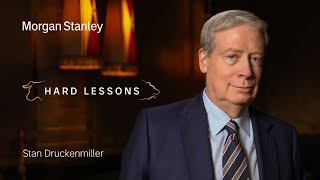 Stanley Druckenmiller on Investing Lessons: Invest, Then Investigate2024 · 28 min · full transcriptBest short explanation of his core belief that performance comes from sizing winners and controlling losers.
 Stanley Druckenmiller on Risk and Trading: Charts, Conviction, Discipline2009 · 83 min · full transcriptBest for how concentration, liquidity, charts, and discipline shape actual position size.
 Stanley Druckenmiller on Macro Investing: Size, Flexibility, and Trump2016 · 39 min · full transcriptBest for his macro style of betting big when the world changes and exiting when the thesis changes.
 Stanley Druckenmiller on Macro Outlook: Inflation, the Dollar, and Bubbles2021 · 61 min · full transcriptBest for the forward-looking mindset behind taking size before the market fully catches up.
 Stanley Druckenmiller on Fiscal Crisis: Entitlements, Fed, and Bubbles2023 · 67 min · full transcriptBest for his most memorable line on waiting for fat pitches and then playing really big.
 Stanley Druckenmiller on Future Vision: Seeing Ahead First2024 · 71 min · full transcriptBest for understanding how seeing the future differently creates the conviction needed to size up.
Questions people ask
- What did Stanley Druckenmiller learn from George Soros about investing and position sizing?
- What did Stanley Druckenmiller say about handling mistakes and drawdowns?
- What did Stanley Druckenmiller say about making money in chaos?
- What did Stanley Druckenmiller say is the biggest mistake investors make?
- What did Stanley Druckenmiller say he lost as he became a more experienced investor?
- Why does Stanley Druckenmiller keep his fund around $10 billion?
Sources
Every quote above, word for word from the transcripts. Numbers match the text.
“It's not whether you're right or wrong, it's how much you make when you're right and how much you lose when you're wrong.”
“It's not how much, it's not whether you're right or you're wrong, it's how much money you make when you're right and how much money you lose when you're wrong.”
“It's funny, when I went there, I thought I would learn what makes the yen in the market go up and move.Immodestly, I learned I knew much more about that than he did. What I learned from him was sizing. It's not whether you're right or wrong, it's how much you make when you're right and how much you lose when you're wrong. And that was a, that was an invaluable lesson. So, you can have something innate. But if you don't have mentors and people to teach you, you're not going to maximize it as much as you do when you do have them.”
“I wait for fat pitches and then I play really big.”
“My advantage is not IQ. It's trigger pulling.”
“Not really. There's no silver bullet. And I'm the great beneficiary of 40 years of scars and successes that I can go back on, and a lot of pattern recognition, because there's not much I haven't seen in this business. I'd say the biggest disappointment in my career has been I think I have more wisdom, and I have more tools of the trade than I had in my 30s and 40s, and I was a much better portfolio manager then because back then I had courage. I would take bigger convicted positions. I'm trying to regain some of my nerve just because it's more fun. Bouzali: So you're chickening out? Druckenmiller: Oh for sure. I've been chickening out for a long time. I'm Mr. Taco, except it's not T, it's DACO. Druck Always Chickens Out.”
“…you envision the future, particularly in a way that others have not…”
“I think diversification is really overrated…”
“I don't use a, like, a number. I know that's a discipline system…”
“You have to be disciplined, you have to be unemotional…”
“Just get over it and move on.”
“I said nothing, I learned not to do that 20 years before, but I got emotional, which I fight every day. I would literally like throw up like once or twice a week, just from anxiety when I'd have a drawdown and so forth. And at some point in my career, I learned that you're going to continue to make mistakes, you're going to continue to get emotional. You're going to continue to have that happen from now and then. But you've got a gift. And just stop torturing yourself for like 48 hours or maybe longer over this because you've been doing this long enough and the record is there long enough that it's no longer like random accident, which I did not believe for like 15 years. So the hard lessons have been like hundreds of mistakes, but that they're just a moment in time. And when you have these drawdowns and if there's money managers listening to this and you're good, it's easier said than done. Just get over it and move on.”
“I've never used a stop loss in 40 years…”
“…never ever think in the present…”
“I have found it's very important never to invest in the present. Always try and envision the situation as you see it in 18 to 24 months, and then see if you feel things would be different than they are now. Would security prices reflect that? I think that's probably the biggest mistake investors make is they invest in the present rather than forward looking and looking where the puck's going instead of where the puck is.”
“I make—I make—I make my money in chaos.”
“You know, I'm sorry, this is on tape, I make—I make—I make my money in chaos. I've always made more money in equity bear markets than I have in bull markets because that's when macro goes crazy. If I wasn't so worried about the country, I'd be salivating over the opportunities that's going to set up. I've been talking about 2025 to 2035 for better than 15 years. And last time I checked, this is 2023, so we're getting into the time period.”
How this guide was made: drafted with AI from the full transcripts of the recordings cited, then checked: every quotation must match a transcript word for word and be the speaker's own words, and an independent review gates accuracy. Methodology and corrections.
