Stanley Druckenmiller on Interest Rates
Stanley Druckenmiller sees interest rates as the economy’s hurdle rate: when central banks hold them too low or force them with guidance, they distort prices, encourage bad risk-taking, and store up trouble later.
- Rates are not just a policy setting; they are the hurdle rate for investment and risk-taking.
- Keeping rates too low for too long pulls demand forward, inflates assets, and misallocates capital.
- He trusts market signals like bonds, credit, and cyclicals more than rigid policy models or forward guidance.
- He does not think policy should revolve around a fixed 2% inflation target if that means suppressing normal market discipline.
- The practical implication is to watch liquidity, nominal growth, and market internals, and stay flexible when the facts change.
Interest rates are the economy’s hurdle rate
Druckenmiller’s basic view is that rates matter because they set the return threshold for almost every economic decision. When that hurdle rate is artificially depressed, investors and companies stop getting clean signals about what is truly worth funding and what is not. He frames the issue as monetary normalization: restoring a normal bar for investment rather than arguing endlessly about whether policy is merely tightening or easing.
That is why he objects to policy frameworks that reduce rates to a narrow inflation exercise. He argues that a fixed 2% inflation target can become harmful if it justifies holding rates below levels that would otherwise impose discipline on capital allocation and pricing across markets.2
Holding rates too low for too long distorts behavior
His deepest criticism is not that the Fed is always too tight or always too easy, but that prolonged emergency policy creates bad incentives. In his view, very low rates and heavy intervention borrow demand from the future rather than building durable growth, so the economy looks better in the present at the cost of more fragility later.45
He connects suppressed rates to inflated asset prices and poorer capital allocation. The result is more speculation, more leverage, and more money flowing into assets because financing is cheap and discipline is weak, not because the underlying economics are sound.265
This view also comes from his broader commitment to market discipline. He believes a capitalist system needs creative destruction, and rates that are pushed too low for too long interfere with that process by keeping weak decisions and weak businesses alive longer than they should.78
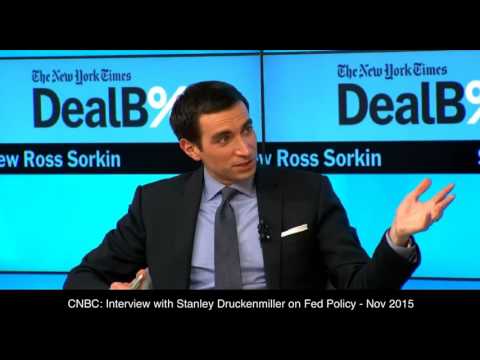
“…you're borrowing from the future.”CNBC interview, 2015 · full transcript →
He trusts market signals more than policy theory
Druckenmiller repeatedly makes the point that he is guided more by markets than by abstract theory. He looks to the bond market, yield curves, credit spreads, liquidity, and cyclical stocks to judge whether policy is actually restrictive or easy.91011
That is why he can oppose further hikes in one period and oppose easing in another without changing his framework. In late 2018, he argued for caution because market internals were deteriorating fast and financial conditions were tightening beyond what official data showed, so the right move was to pause and reassess.1012
By 2024, his concern had flipped: he worried that easing too quickly could repeat the error of relying on a theory of restriction that markets were not confirming. His own rule of thumb is that long rates should sit roughly near nominal growth, which is one way he checks whether bond yields and policy settings make sense relative to the economy.1314
Forward guidance can trap the Fed at the wrong rate
A major part of his thinking on rates is that policymakers get into trouble when they pre-commit too rigidly. He argues that forward guidance can leave the Fed stuck even after the facts change, delaying necessary moves and making later adjustments larger and more disruptive.15
He points to the post-pandemic period as a clear case of policy remaining far too easy for too long after the economy had already recovered enough that emergency settings no longer fit. His complaint is not just that rates were wrong, but that the institutional framework encouraged officials to ignore changing conditions.17
That skepticism is why flexibility matters so much in his approach. He thinks policy should respond to incoming facts and market signals, not to promises made earlier under different circumstances.19
How he applies rate views in markets
For Druckenmiller, interest-rate views are not academic; they drive positioning across bonds, equities, currencies, and commodities. When he sees rates as too low relative to growth and inflation risk, he is willing to be negative on bonds and positive on assets that benefit from stronger nominal growth.14
At the same time, he treats rates as part of a broader liquidity regime rather than a standalone forecast. His process starts with central banks and liquidity because he believes those forces dominate the overall market more than earnings do.2011
The practical lesson is not to memorize one permanent stance on rates. It is to ask whether rates are creating a real hurdle rate, whether markets are confirming the policy story, and whether the facts have changed enough to require a different view.1019
Druckenmiller on interest rates, in his own words
“…you're borrowing from the future.”
Where to watch
 Stanley Druckenmiller on Monetary Normalization: Fed, Bitcoin, and Taxes2017 · 32 min · full transcriptBest single explanation of why he thinks rates should restore a real hurdle rate and why ultra-low rates distort capital allocation.
 Stanley Druckenmiller on Fed Policy and Market Signals: Why He Wants a Pause2018 · 60 min · full transcriptShows how he reads market internals to judge whether rates are too tight or too loose in real time.
 Stanley Druckenmiller on Fed Policy: Don’t Get Trapped Again2024 · 21 min · full transcriptBest recent statement of his view that markets, not models, should guide rate policy and that forward guidance can trap the Fed.
 Stanley Druckenmiller on Fed Policy: Why It Ends Badly2015 · 25 min · full transcriptStrongest case for his belief that prolonged zero-rate policy borrows from the future and ends badly.
 Stanley Druckenmiller on Macro Investing: Liquidity, Rates, and Signals2018 · 31 min · full transcriptGood overview of his macro process: central banks, liquidity, and why rates matter more than headline earnings.
 Stanley Druckenmiller on Fed Policy and the Dollar: Why It Matters2021 · 11 min · full transcriptExplains why he thought post-pandemic emergency policy had become radically inappropriate once conditions improved.
Questions people ask
Sources
Every quote above, word for word from the transcripts. Numbers match the text.
“The 2% inflation target needs to go.”
“…you're borrowing from the future.”
“…we're going to pay the piper at some point.”
“If I were trying to create a deflationary bust, I would do exactly what the world central bankers have been doing the last six years.”
“I'm a dyed-in-the-wool capitalist who believes in free markets and believes in creative destruction…”
“I deeply, deeply believe in a capitalist system.”
“I don't really go by theory. I'm a market animal.”
“The best economists I know is the inside of the stock market…”
“Focus on the central banks and focus on the movement of liquidity.”
“It's just a time for caution…”
“…the golden rule I've always had is is the ten year should trade around where nominal GDP is…”
“…we shorted bonds the day the Fed cut 50 because we thought it was a mistake…”
“…they were trapped, in my opinion, by forward guidance…”
“Certainly the most radical policy by a long shot that I've ever seen relative to economic circumstances.”
“…when the facts change, you have to change…”
“Earnings don't move the overall market; it's the Federal Reserve Board.”
How this guide was made: drafted with AI from the full transcripts of the recordings cited, then checked: every quotation must match a transcript word for word and be the speaker's own words, and an independent review gates accuracy. Methodology and corrections.


