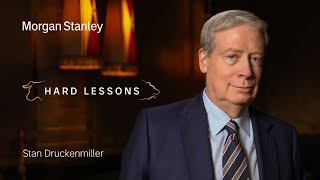
The 2000 Mistake
Even a great investor can abandon discipline at the top of a bubble.

“It's not whether you're right or wrong, it's how much you make when you're right and how much you lose when you're wrong.”Morgan Stanley Hard Lessons interview, 2024 · 7:33
The lesson
Druckenmiller’s lesson from the 2000 bubble starts with a hard distinction: having the right big-picture view is not enough. His edge is seeing ahead, imagining a future others do not yet see, and then acting on that view with conviction. But that only works if the actual position still matches the original thesis and timing, rather than a late emotional reaction to price action or crowd behavior.123
He is explicit that investing success is not mainly about being right in an abstract sense. What matters is the payoff profile: how much you make when the thesis is working and how much you lose when it is not. That means a great macro call can still turn into a bad trade if you enter too late, size it poorly, or let the market pull you into a different bet than the one you originally understood.45
The enemy at a bubble peak is emotion. Druckenmiller says you have to be disciplined and unemotional, yet he also admits that emotion is a recurring fight, not something you eliminate once and for all. His broader lesson is that even elite investors can get caught when anxiety, envy, or the feeling of missing a party overrides process.678
That is why he treats failure as something to analyze, not hide from. When a trade goes wrong, the task is to admit it, study it, and move on, instead of defending ego or torturing yourself. The practical discipline is simple: if the reason for the position is gone, the position should be gone too, regardless of the purchase price or how strongly you once felt about the story.91011
The durable takeaway is not "never be aggressive." Druckenmiller still believes in conviction and meaningful sizing when the odds are exceptional. The real lesson is to be aggressive only when your thesis, timing, and emotional state are aligned; if you are chasing what already ran, or reacting to the fear of being left out, you are no longer investing forward but surrendering discipline at exactly the worst moment.1226
5 principles from Stanley Druckenmiller
Separate being right from making money
A correct macro thesis does not guarantee a profitable trade. Focus on entry, sizing, and downside as much as the idea itself, because the result depends on the full structure of the bet.
“It's not whether you're right or wrong, it's how much you make when you're right and how much you lose when you're wrong.”
Do not let emotion rewrite your process
Bubble markets pressure you to act from envy, anxiety, or fear of missing out. The answer is discipline: notice when your motivation has shifted from analysis to emotion, and stop before that emotional impulse becomes a position.
“The Fed was throwing a party, and I was missing it.”
Invest forward, not in the present
Druckenmiller’s approach is to picture the world 18 to 24 months ahead and ask what is not yet reflected in prices. If you are buying mainly because something has already gone up a lot, you are probably reacting to the present rather than anticipating the future.
“I have found it's very important never to invest in the present. Always try and envision the situation as you see it in 18 to 24 months, and then see if you feel things would be different than they are now. Would security prices reflect that? I think that's probably the biggest mistake investors make is they invest in the present rather than forward looking and looking where the puck's going instead of where the puck is.”
Cut the trade when the reason disappears
The key decision is whether the original thesis still holds, not whether exiting feels painful. If the reason for the position is broken, the disciplined move is to exit without anchoring to your cost basis.
“If the reason I bought a stock is no longer the case, I don't care what I paid for it. And if I bought it at 60 and it's 50, because the markets discovered the problem before me, I have no emotion whatsoever. Soros was the same way. I didn't really learn it from him, but it was certainly reinforced.”
Study mistakes without self-deception
Failure becomes useful only if you admit it clearly and review it honestly. That practice helps you recognize recurring emotional errors before they become expensive again.
“…admit that you've had failures, and then go back and analyze those failures…”
In his own words
The quotes behind the lesson, word for word from the transcripts. Numbers match the lesson above.
“…you envision the future, particularly in a way that others have not…”
“I have found it's very important never to invest in the present. Always try and envision the situation as you see it in 18 to 24 months, and then see if you feel things would be different than they are now. Would security prices reflect that? I think that's probably the biggest mistake investors make is they invest in the present rather than forward looking and looking where the puck's going instead of where the puck is.”
“My advantage is not IQ. It's trigger pulling.”
“It's not whether you're right or wrong, it's how much you make when you're right and how much you lose when you're wrong.”
“It's funny, when I went there, I thought I would learn what makes the yen in the market go up and move.Immodestly, I learned I knew much more about that than he did. What I learned from him was sizing. It's not whether you're right or wrong, it's how much you make when you're right and how much you lose when you're wrong. And that was a, that was an invaluable lesson. So, you can have something innate. But if you don't have mentors and people to teach you, you're not going to maximize it as much as you do when you do have them.”
“You have to be disciplined, you have to be unemotional…”
“I said nothing, I learned not to do that 20 years before, but I got emotional, which I fight every day. I would literally like throw up like once or twice a week, just from anxiety when I'd have a drawdown and so forth. And at some point in my career, I learned that you're going to continue to make mistakes, you're going to continue to get emotional. You're going to continue to have that happen from now and then. But you've got a gift. And just stop torturing yourself for like 48 hours or maybe longer over this because you've been doing this long enough and the record is there long enough that it's no longer like random accident, which I did not believe for like 15 years. So the hard lessons have been like hundreds of mistakes, but that they're just a moment in time. And when you have these drawdowns and if there's money managers listening to this and you're good, it's easier said than done. Just get over it and move on.”
“The Fed was throwing a party, and I was missing it.”
“…admit that you've had failures, and then go back and analyze those failures…”
“Just get over it and move on.”
“If the reason I bought a stock is no longer the case, I don't care what I paid for it. And if I bought it at 60 and it's 50, because the markets discovered the problem before me, I have no emotion whatsoever. Soros was the same way. I didn't really learn it from him, but it was certainly reinforced.”
“I think diversification is really overrated…”
Reflect
- Think of a time when you were broadly right about a trend but still got a poor result. Was the problem timing, sizing, or emotion?
- What are your personal versions of 'missing the party'? Name the situations where envy or fear of being left out most often distorts your decisions.
- Write down one current position or commitment you hold. What is the exact reason you entered it, and what evidence would tell you that reason is no longer true?