Protect Capital First
Aggressive sizing only works if losses are cut before they threaten survival.

“It's not whether you're right or wrong, it's how much you make when you're right and how much you lose when you're wrong.”Morgan Stanley Hard Lessons interview, 2024 · 7:33
The lesson
Druckenmiller’s risk framework starts with a simple asymmetry: the game is not about being right a lot, but about making much more when right than losing when wrong12. That is what makes aggressive sizing possible. If you want to bet big, you cannot let losses grow into something that damages staying power1.
This is why he pairs conviction with fast, decisive action. He sees a key edge not as superior IQ but as the willingness to act, and that applies both when entering and when exiting3. When the reason for a position changes, he does not anchor on the purchase price or wait to feel better; he moves on quickly and without sentiment45.
Capital protection for him is also practical, not theoretical. He focuses on liquid markets and adjusts exposure when the environment is poor, even if that means stepping back rather than forcing a trade6. He does not rely on a fixed mechanical stop-loss number, but that does not mean loose risk control; it means he manages risk through judgment, discipline, and constant reassessment of the thesis and market conditions78.
That approach demands emotional control. Druckenmiller is explicit that you have to stay disciplined and unemotional, because mistakes are inevitable and self-punishment does not improve decision quality910. The useful response is to recognize failures, study them, and then reset fast enough to preserve both capital and clarity for the next opportunity115.
Only after that foundation does concentration make sense. He believes diversification is overrated when you truly understand the opportunity, but that view only works alongside ruthless honesty about being wrong and a readiness to cut risk124. In his framework, protecting capital is not cautious in the timid sense; it is what gives you the freedom to swing hard when the odds and liquidity line up17.
5 principles from Stanley Druckenmiller
Judge every bet by payoff asymmetry
Do not evaluate yourself by hit rate alone. Focus on whether your upside when right meaningfully exceeds your downside when wrong, because that is the basis for both survival and compounding.
“It's not whether you're right or wrong, it's how much you make when you're right and how much you lose when you're wrong.”
Exit when the thesis breaks
Treat the original reason for the position as the anchor, not your entry price. If the market or facts show that reason is gone, reduce or exit without negotiating with yourself.
“If the reason I bought a stock is no longer the case, I don't care what I paid for it. And if I bought it at 60 and it's 50, because the markets discovered the problem before me, I have no emotion whatsoever. Soros was the same way. I didn't really learn it from him, but it was certainly reinforced.”
Use judgment, not autopilot, to control risk
Risk control does not have to mean a rigid preset number on every position. It can mean active reassessment of liquidity, thesis, and environment, with quick de-risking when conditions are poor.
“I don't use a, like, a number. I know that's a discipline system…”
Protect emotional capital too
A bad trade can damage future decisions if you turn it into a long period of regret or self-attack. Review the mistake, learn from it, and regain objectivity so you are ready for the next opportunity.
“I said nothing, I learned not to do that 20 years before, but I got emotional, which I fight every day. I would literally like throw up like once or twice a week, just from anxiety when I'd have a drawdown and so forth. And at some point in my career, I learned that you're going to continue to make mistakes, you're going to continue to get emotional. You're going to continue to have that happen from now and then. But you've got a gift. And just stop torturing yourself for like 48 hours or maybe longer over this because you've been doing this long enough and the record is there long enough that it's no longer like random accident, which I did not believe for like 15 years. So the hard lessons have been like hundreds of mistakes, but that they're just a moment in time. And when you have these drawdowns and if there's money managers listening to this and you're good, it's easier said than done. Just get over it and move on.”
Concentrate only when discipline is stronger than ego
Large positions can work if they are backed by conviction, liquidity awareness, and a willingness to reverse yourself. Concentration without that discipline becomes attachment, not edge.
“I think diversification is really overrated…”
In his own words
The quotes behind the lesson, word for word from the transcripts. Numbers match the lesson above.
“It's not whether you're right or wrong, it's how much you make when you're right and how much you lose when you're wrong.”
“It's funny, when I went there, I thought I would learn what makes the yen in the market go up and move.Immodestly, I learned I knew much more about that than he did. What I learned from him was sizing. It's not whether you're right or wrong, it's how much you make when you're right and how much you lose when you're wrong. And that was a, that was an invaluable lesson. So, you can have something innate. But if you don't have mentors and people to teach you, you're not going to maximize it as much as you do when you do have them.”
“My advantage is not IQ. It's trigger pulling.”
“If the reason I bought a stock is no longer the case, I don't care what I paid for it. And if I bought it at 60 and it's 50, because the markets discovered the problem before me, I have no emotion whatsoever. Soros was the same way. I didn't really learn it from him, but it was certainly reinforced.”
“Just get over it and move on.”
“When the Trump tweet went out, I went from 93 percent invested to net flat and bought a bunch of Treasuries. Not because I'm trying to make money, I just—I don't want to play in this environment. They're gonna be better environments to take a shot. So I think if you're confident in your long-term view and your ability to make money, this is not a great environment to be going to vet in the or Antion one way or the other. Not short, not long. It's in terms of the economy though, if you believe that…”
“I've never used a stop loss in 40 years…”
“I don't use a, like, a number. I know that's a discipline system…”
“You have to be disciplined, you have to be unemotional…”
“I said nothing, I learned not to do that 20 years before, but I got emotional, which I fight every day. I would literally like throw up like once or twice a week, just from anxiety when I'd have a drawdown and so forth. And at some point in my career, I learned that you're going to continue to make mistakes, you're going to continue to get emotional. You're going to continue to have that happen from now and then. But you've got a gift. And just stop torturing yourself for like 48 hours or maybe longer over this because you've been doing this long enough and the record is there long enough that it's no longer like random accident, which I did not believe for like 15 years. So the hard lessons have been like hundreds of mistakes, but that they're just a moment in time. And when you have these drawdowns and if there's money managers listening to this and you're good, it's easier said than done. Just get over it and move on.”
“…admit that you've had failures, and then go back and analyze those failures…”
“I think diversification is really overrated…”
Reflect
- Think of a recent mistake you held too long. What original thesis would have told you to exit earlier if you had followed it honestly?
- Where in your work are you judging success by how often you are right instead of by the size of gains versus losses?
- What conditions tell you an environment is not worth playing in right now, and do you have the discipline to step aside when they appear?
Check your understanding
Go deeper
 Stanley Druckenmiller on Risk and Trading: Charts, Conviction, Discipline2009 · 83 min · full transcript
 Stanley Druckenmiller on Macro Investing: Size, Flexibility, and Trump2016 · 39 min · full transcript
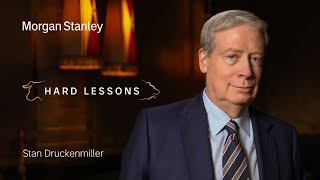 Stanley Druckenmiller on Investing Lessons: Invest, Then Investigate2024 · 28 min · full transcript
 Stanley Druckenmiller on Future Vision: Seeing Ahead First2024 · 71 min · full transcript